 French
  English
  German
  Spanish
  Polish
  Chinese
  Japanese
  Korean
  Russian
 Contenu
Introduction
A silicone baby bib may look simple, but its performance depends on several structures working together.
The bib must sit comfortably around the neck, follow the baby’s upper body, remain stable during movement, and keep the food-catching pocket open during feeding.
Many products look acceptable when they are laid flat on a table. However, after the bib is fastened around the neck, the pocket may:
- Collapse against the bib body
- Curl inward
- Twist to one side
- Sit too close to the baby
- Point downward
- Close when the baby leans forward
- Miss falling food
- Become deformed after packaging
- Lose its original shape after storage
These problems are not caused by silicone hardness alone.
Pocket performance depends on the relationship between:
- Silicone material
- Shore A hardness
- Pocket depth
- Opening width
- Wall thickness
- Upper-edge stiffness
- Sidewall structure
- Pocket-to-body transition
- Bib-body flexibility
- Neck fit
- Product weight
- Mold design
- Demolding
- Emballage
- Real-use conditions
For baby brands, importers, distributors, private-label sellers, and product developers, the correct question is not only:
“Does the bib have a large pocket?”
The more important question is:
“Will the pocket remain open and correctly positioned when the bib is worn, moved, cleaned, folded, packed, and repeatedly used?”
This guide explains how to evaluate silicone baby bib pocket design before tooling, sample approval, and mass production.
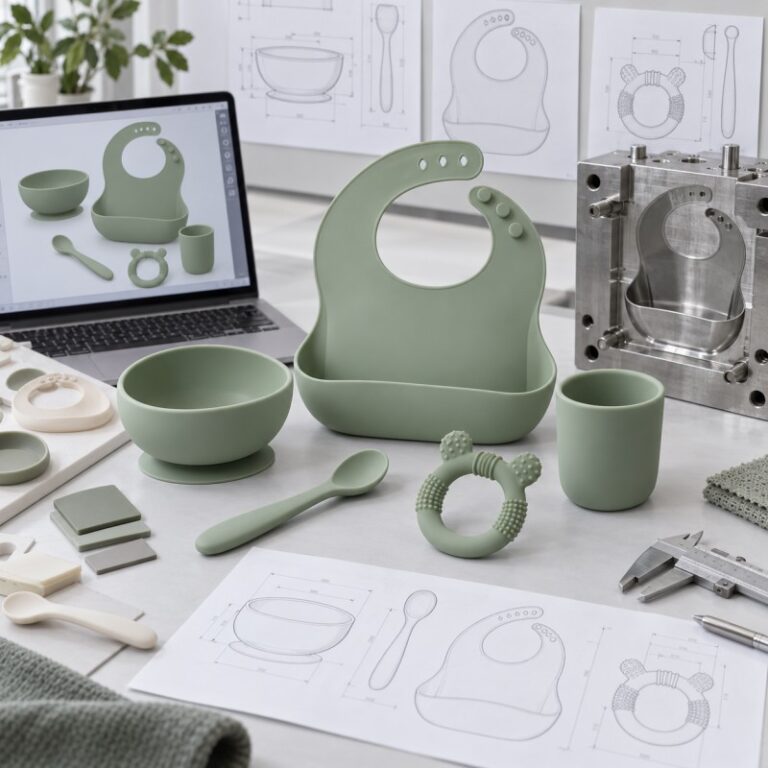
Buyers can also review LYA Silicone’s custom silicone baby bib collection for existing product structures and OEM options.
Answer Excerpt
Silicone baby bib pockets can collapse, curl inward, or fail to catch food when the material is too soft, the pocket wall is too thin, the opening angle is too narrow, the upper lip lacks support, or the transition between the pocket and bib body is unstable.
Neck fit, bib-body flexibility, product weight, baby movement, folding direction, mold shrinkage, demolding, and packaging compression can also change the final pocket position.
Increasing silicone hardness does not automatically solve the problem. A firmer bib may keep the pocket open but become uncomfortable around the neck, difficult to fold, or too heavy.
Reliable performance requires the neck area, straps, bib body, food-catching pocket, wall thickness, hardness, mold structure, packaging, and real-use testing to be evaluated as one complete product.
1. The Food-Catching Pocket Is a Functional Structure
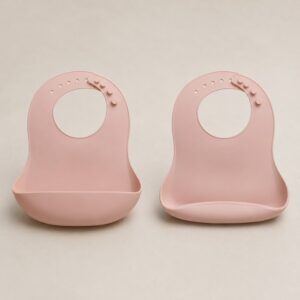
In a custom silicone baby bib, the front pocket is not only a decorative feature.
Its purpose is to receive food, liquid drops, crumbs, fruit pieces, snacks, and feeding utensils that fall during mealtime.
To perform correctly, the pocket must:
- Maintain a visible opening
- Remain positioned below the mouth
- Avoid pressing completely against the body
- Resist curling inward
- Hold a small amount of food without collapsing
- Remain easy to rinse
- Recover after folding
- Stay stable when the baby moves
The pocket must therefore be evaluated as a three-dimensional functional structure.
A wide pocket shown in a 2D front-view rendering may still perform poorly if its opening angle, sidewall support, upper edge, or connection to the bib body is incorrect.
The manufacturer should review the complete pocket volume and wearing position rather than judging only its front appearance.
2. Why Does a Silicone Bib Pocket Collapse?
Pocket collapse usually occurs when the structure cannot resist the forces acting on it.
These forces may come from:
- The weight of the pocket itself
- The flexibility of the silicone
- The bib body pulling upward
- Neck-strap tension
- The baby leaning forward
- Hand or arm movement
- Contact with the table
- Folding during storage
- Compression inside packaging
- Heat during transportation
A very flexible pocket may remain open when the bib is placed flat but close after the product hangs vertically.
A bib may also change shape after the neck straps are fastened because the body bends around the chest.
The pocket can then move inward and lose its designed opening.
This means a useful pocket test must evaluate the bib in its actual wearing orientation rather than only on a flat inspection table.
3. Silicone Hardness Is Only One Part of Pocket Stability
Silicone hardness influences how easily the pocket bends, but it does not independently determine whether the pocket will remain open.
The same Shore A hardness may behave differently depending on:
- Pocket wall thickness
- Pocket height
- Pocket depth
- Upper-lip thickness
- Bib-body thickness
- Product width
- Sidewall shape
- Pocket angle
- Transition radius
- Overall product weight
A soft silicone material can still form a stable pocket when the structure provides sufficient support.
A firmer material can still curl when the pocket geometry is poorly balanced.
When the Silicone Is Too Soft
Possible problems include:
- Pocket mouth closing
- Sidewalls folding inward
- Excessive product drape
- Weak button engagement
- Bib body twisting
- Poor recovery after packaging
- Pocket deformation under food weight
When the Silicone Is Too Firm
Possible problems include:
- Reduced neck comfort
- High fastening force
- Difficult folding
- Pocket edge feeling too rigid
- Increased product weight
- Poor fit against the baby’s body
- Greater stress around button holes
Hardness should therefore be selected together with product geometry and confirmed using actual molded samples.
4. Pocket Depth Must Match the Product Positioning
A deeper pocket can hold more food, but increasing depth also changes the product’s weight, center of gravity, packaging volume, and cleaning requirements.
A pocket that is too shallow may:
- Miss falling food
- Hold very little material
- Look decorative rather than functional
- Become ineffective when the baby moves
A pocket that is too deep may:
- Feel bulky
- Press against the table
- Pull the bib forward
- Become difficult to rinse
- Increase packaging size
- Fold or deform during storage
- Require greater structural support
Buyers should define the pocket according to the intended product positioning.
For example, a lightweight travel bib may use a different pocket structure from a premium baby-led-weaning bib designed for daily self-feeding.
Pocket depth should be evaluated together with:
- Bib length
- Baby age range
- Seating position
- Highchair tray height
- Product weight
- Storage method
- Emballage
- Intended food types
There is no universal pocket depth suitable for every silicone bib.
5. Pocket Opening Width and Angle Determine Catching Performance
A food-catching pocket needs sufficient opening width to receive falling food.
However, width alone is not enough.
The opening angle determines whether the pocket faces upward, forward, downward, or inward.
If the angle is too narrow, the pocket may:
- Sit flat against the body
- Close after fastening
- Miss food falling from above
- Become difficult to inspect
- Trap rinse water
If the angle is too wide, the pocket may:
- Project too far forward
- Contact the table
- Increase packaging volume
- Become easy to pull
- Feel unstable
- Create excessive stress at the pocket root
The pocket angle should be evaluated while the bib is worn on a suitable test form.
Important variables include:
- Neck fastening position
- Chest curvature
- Bib-body bending
- Pocket root angle
- Sidewall stiffness
- Upper-lip geometry
- Pocket weight
A CAD model should simulate the intended wearing shape, not only the product in a completely flat condition.
6. The Pocket-to-Body Transition Is a Critical Area
The connection between the flat bib body and the three-dimensional pocket controls how the pocket opens.
If this transition is too thin, it may behave like an uncontrolled folding line.
If it is too thick, the pocket may become difficult to fold or may pull the entire bib away from the body.
Common transition problems include:
- Sudden wall-thickness changes
- Sharp internal corners
- Weak pocket roots
- Uneven left and right sides
- Stress concentration
- Difficult demolding
- Local deformation
- Excessive flash
- Permanent creasing
A smoother transition can distribute bending across a wider area.
The manufacturer should review:
- Transition radius
- Pocket-root thickness
- Left and right symmetry
- Mold parting line
- Demolding direction
- Product shrinkage
- Expected folding direction
- Packaging pressure
Small changes in the pocket root may improve performance more effectively than changing the hardness of the complete bib.
These structural details should be reviewed during custom silicone mold development before mold machining begins.
7. The Upper Pocket Lip Needs Controlled Support
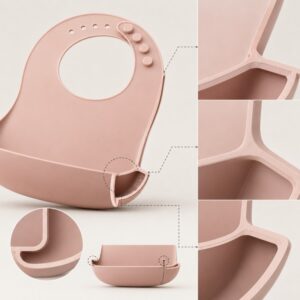
The upper edge of the pocket helps maintain the opening.
If the lip is too thin or too flexible, it may:
- Curl inward
- Form a wave shape
- Collapse under its own weight
- Become deformed during packaging
- Lose symmetry
If the lip is too thick or rigid, it may:
- Feel bulky
- Increase product weight
- Become uncomfortable against the body
- Make the pocket difficult to fold
- Create a visible thick section
- Extend curing time
Possible structural approaches include:
- Slightly increased lip thickness
- Rolled-edge geometry
- Curved upper edge
- Wider side support
- Gradual thickness transition
- Reinforcing ribs away from food-trap areas
Any reinforcing feature should remain easy to clean and should not create unnecessary narrow grooves.
The objective is controlled support, not simply maximum thickness.
8. Pocket Sidewalls Control Shape and Symmetry
The left and right sides of the pocket help maintain depth and opening angle.
If the sidewalls are too weak, the pocket may:
- Fold toward the center
- Twist to one side
- Lose depth
- Become asymmetric
- Collapse when food is added
If the sidewalls are too rigid, they may:
- Make the bib difficult to store
- Increase product weight
- Create hard transitions
- Cause packaging deformation elsewhere
- Make the product feel bulky
Sidewall performance depends on:
- Wall thickness
- Sidewall height
- Curvature
- Pocket width
- Transition radius
- Silicone hardness
- Surface texture
- Mold symmetry
During mold trials, the manufacturer should compare the left and right pocket walls under the same conditions.
An apparently small dimensional difference can cause the pocket to lean or twist after the bib is worn.
9. The Bib Body Affects the Final Pocket Position
The pocket cannot be evaluated separately from the bib body.
The main bib panel controls how the product hangs from the neck and follows the chest.
If the bib body is too soft, it may:
- Fold vertically
- Twist during movement
- Pull the pocket inward
- Allow one side to hang lower
- Create unstable positioning
If the body is too firm, it may:
- Sit away from the chest
- Feel uncomfortable
- Restrict movement
- Increase product weight
- Cause the pocket to contact the table
Important bib-body variables include:
- Overall length
- Shoulder width
- Neck opening
- Body thickness
- Side profile
- Product curvature
- Pocket position
- Strap tension
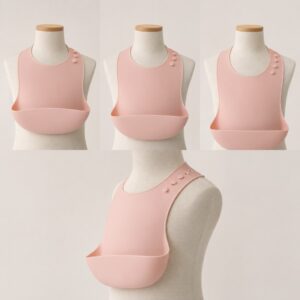
The complete bib should be tested in several fastening positions because changing the neck size can also change the body curvature and pocket angle.
10. Neck Fit Can Change Pocket Performance
A bib that is too loose may hang too low or move during feeding.
A bib that is too tight may pull the body upward and push the pocket inward.
Neck design may include:
- Multiple button holes
- Mushroom-style fasteners
- Slot fasteners
- Adjustable straps
- Fixed neck opening
- One-piece pull-over structure
The fastening system affects:
- Wearing height
- Product tension
- Bib-body curvature
- Pocket position
- Comfort
- Button durability
- Ease of use
The pocket should remain functional at all intended neck settings.
A product should not perform well only at the loosest or tightest fastening position.
Buyers should define the intended age or size range and test each practical adjustment point before approval.
11. Button Holes and Straps Need Their Own Structural Review
Silicone bib straps must remain flexible while resisting repeated pulling.
Common risks include:
- Button holes stretching
- Fastener heads pulling through
- Straps tearing near the base
- Fastening force being too high
- Straps curling
- Uneven left and right tension
These issues can indirectly affect the pocket because damaged or stretched straps change how the bib hangs.
The manufacturer should review:
- Strap thickness
- Button-head size
- Hole diameter
- Hole spacing
- Edge radius
- Connection to the bib body
- Repeated fastening
- Pull direction
- Demolding
The fastening structure should be tested together with the pocket rather than approved as an isolated detail.
12. Product Weight and Balance Affect Wearing Position
A heavier pocket may pull the bib forward or downward.
A very light bib may move too easily when the baby turns or touches the product.
Product weight depends on:
- Overall bib dimensions
- Pocket depth
- Wall thickness
- Silicone density
- Lip reinforcement
- Strap design
- Decorative features
- Logo thickness
Adding more silicone to improve pocket support can increase weight and affect comfort.
Reducing material to lower cost can make the product unstable.
The final design should balance:
- Wearing comfort
- Pocket opening
- Product stability
- Material cost
- Packaging size
- Shipping weight
- Perceived product quality
Sample approval should record actual product weight so that mass-production parts can be compared consistently.
13. Pocket Shape Should Match the Intended Food Types
Different food types fall and collect differently.
A pocket may need to receive:
- Dry snacks
- Fruit pieces
- Puree
- Rice
- Pasta
- Crumbs
- Liquid drops
- Feeding spoons
A narrow pocket may catch small dry pieces but miss larger food.
A deep pocket may catch more material but become harder to rinse after puree or sauce.
Design variables include:
- Pocket width
- Pocket depth
- Bottom curvature
- Internal corners
- Drainage behavior
- Surface finish
- Opening angle
Rounded internal corners are generally easier to inspect and clean than very sharp corners.
Decorative grooves inside the food-catching area should be limited unless they provide a clear functional benefit.
14. Surface Texture Affects Cleaning and Appearance
Silicone bibs may use:
- Smooth glossy surfaces
- Fine matte surfaces
- Coarse matte textures
- Decorative patterns
- Embossed logos
- Debossed logos
Surface finish can affect:
- Food release
- Stain visibility
- Dust visibility
- Cleaning
- Product photography
- Grip
- Mold release
A deep matte texture may create a premium visual appearance but can make food residue or fibers more noticeable.
Brands should also consider why silicone products attract dust when selecting matte surfaces and retail packaging.
A glossy inner pocket may be easier to rinse, while a fine matte outer surface may provide a softer brand appearance.
Brands can consider using different finishes in different functional zones, provided the mold and manufacturing process support the design.
The internal food-contact pocket should prioritize cleaning accessibility over unnecessary decoration.
15. Logos Should Not Weaken the Pocket
A logo is often placed on the pocket because it is highly visible in product photography.
However, an oversized or deeply recessed logo can affect:
- Pocket-wall thickness
- Local stiffness
- Food cleaning
- Demolding
- Surface appearance
- Stress distribution
High-risk logo locations include:
- Pocket root
- Upper pocket lip
- Sidewall transition
- Folding area
- Thin bib body
- Near the mold parting line
Before tooling, buyers should confirm:
- Logo size
- Relief depth
- Position
- Orientation
- Surface finish
- Cleaning accessibility
- Whether the logo creates a thin section
The brand mark should remain clear without reducing functional performance.
16. Mold Parting Lines and Flash Affect Comfort and Cleaning
The mold parting line should be positioned carefully around:
- Neck opening
- Strap edges
- Button holes
- Pocket lip
- Pocket sidewalls
- Food-contact areas
Excessive flash may create:
- Rough edges
- Cleaning difficulty
- Poor appearance
- Weak tear points
- Uncomfortable contact areas
- Inconsistent button engagement
The buyer and manufacturer should define an acceptable edge and flash standard before mass production.
General statements such as “no flash” are difficult to inspect without identifying critical and non-critical areas.
The pocket lip, neck edge, and fastening structures normally require closer inspection because they directly affect function and user experience.
17. Demolding Can Distort the Pocket
The pocket creates a deep three-dimensional structure that must be removed from the mold.
During demolding, the silicone may need to flex or turn temporarily.
If the structure is difficult to release, the pocket may become:
- Stretched
- Twisted
- Inverted
- Permanently creased
- Asymmetric
- White around high-strain areas
- Damaged at thin edges
Demolding risk depends on:
- Pocket depth
- Undercut
- Draft
- Silicone hardness
- Wall thickness
- Mold surface
- Parting-line design
- Manual or automated removal
A pocket that can be molded successfully but requires aggressive manual pulling may not be stable for mass production.
The sample should be inspected after a defined recovery time rather than corrected manually before the buyer sees it.
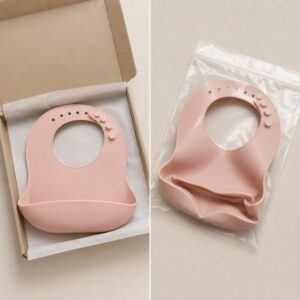
18. Packaging Can Collapse a Correctly Molded Pocket
A bib may leave the molding process with a correct open pocket but become deformed inside the retail package.
Common packaging causes include:
- Folding the pocket inward
- Placing heavy accessories on the pocket
- Using a box that is too small
- Compressing several bibs together
- Tight plastic bags
- Shipping-carton pressure
- Long storage under heat
- Uneven paper inserts
Possible results include:
- Pocket mouth closing
- Upper lip curling
- Permanent fold marks
- Left-right asymmetry
- Body deformation
- Product failing to recover after unpacking
Packaging development should use actual molded samples.
The bib should be inspected:
- Before packaging
- Immediately after packaging
- After a defined storage period
- After transport simulation
- After unpacking and recovery
A package that looks compact may not be suitable when it damages the functional pocket.
19. Sample Testing Should Reproduce Real Feeding Conditions
A bib should not be approved only because the pocket looks open when placed on a table.
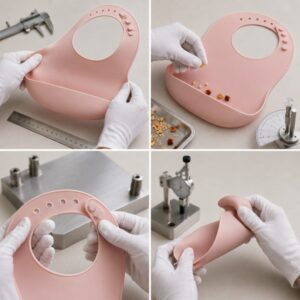
A practical sample evaluation may include:
- Hanging test
- Wearing-form test
- All neck-adjustment positions
- Pocket-opening measurement
- Dry food drop test
- Soft food drop test
- Spoon drop test
- Baby-movement simulation
- Forward-leaning simulation
- Pocket load test
- Rinse and cleaning test
- Repeated folding
- Packaging recovery
- Button fastening cycles
- Strap pull review
The test method should define:
- Product orientation
- Fastening position
- Drop height
- Food or test-item size
- Number of repetitions
- Pocket load
- Recovery time
- Acceptance criteria
Statements such as “the pocket should catch most food” are too subjective unless the test conditions are defined.
When the bib is sold with bowls, spoons, cups or plates, buyers should evaluate it as part of the complete set d'alimentation pour bébé en silicone.
20. Why Can Samples Pass While Mass Production Fails?
Engineering samples are often produced under close supervision.
During sampling:
- Material is prepared carefully
- Mold parameters are adjusted slowly
- Every product is inspected
- Deformed pockets may be manually corrected
- Packaging quantity is limited
- Only one material batch may be used
Mass production introduces additional variables:
- Multiple mold cavities
- Longer production runs
- Material-batch variation
- Hardness variation
- Color-batch variation
- Mold-temperature change
- Operator handling
- Demolding speed
- Tool wear
- Packaging pressure
- Storage time
A pocket structure with little design margin may pass a few samples but become inconsistent during continuous production.
Pilot production should compare:
- Pocket opening
- Pocket depth
- Upper-lip shape
- Left-right symmetry
- Bib-body flatness
- Neck-button engagement
- Product weight
- Hardness
- Packaging recovery
- Cavity-to-cavity differences
21. A Practical Pocket-Failure Analysis
When a silicone bib pocket collapses, curls, or misses food, investigate the issue systematically.
Recommended sequence:
- Confirm the exact failure condition.
- Check whether the bib was laid flat or worn.
- Record the neck fastening position.
- Measure the pocket width, depth, and opening.
- Measure upper-lip and sidewall thickness.
- Confirm silicone material and hardness.
- Compare passing and failing samples.
- Compare mold cavities.
- Check the pocket-to-body transition.
- Inspect left-right symmetry.
- Review demolding operations.
- Check for permanent folding or packaging compression.
- Test the product after a defined recovery period.
- Review product weight.
- Evaluate the bib on a wearing form.
- Change only one controlled variable before retesting.
Do not change hardness, wall thickness, pocket angle, mold, and packaging simultaneously.
Changing one variable at a time makes the root cause easier to confirm.
22. What Should Be Validated Before Mass Production?
Before approving a custom silicone baby bib, buyers and manufacturers should confirm:
- Intended age or size range
- Bib dimensions
- Product weight
- Silicone material
- Shore A hardness
- Neck-opening range
- Button-hole structure
- Strap thickness
- Bib-body thickness
- Pocket width
- Pocket depth
- Pocket opening
- Pocket angle
- Upper-lip thickness
- Sidewall thickness
- Pocket-root transition
- Surface finish
- Logo position
- Parting-line location
- Edge and flash standard
- Demolding method
- Pocket recovery
- Cleaning method
- Packaging structure
- Storage condition
- Sample test method
- Pilot-production consistency
- Reference sample
- Inspection records
The approved reference should show the bib both in a flat condition and in its intended wearing position.
How LYA Silicone Supports Custom Baby Bib Projects
LYA Silicone supports OEM and ODM development for custom silicone baby feeding, teething, bathing, care, pet, outdoor, educational, household, and lifestyle products.
Our custom silicone baby bib support can include:
- Product-requirement review
- Drawing or sample evaluation
- Pocket-structure review
- Material and hardness selection
- Bib-body and neck-strap evaluation
- Wall-thickness review
- Développement de moules sur mesure
- Pocket-angle development
- Button and adjustment design
- Pantone color matching
- Logo and surface-texture development
- Molded sample production
- Functional testing support
- Packaging coordination
- Pilot production
- Appearance and dimensional inspection
- OEM/ODM mass production
With 25+ years of silicone manufacturing experience, we help buyers evaluate the complete bib instead of focusing only on material or appearance.
The goal is to develop a bib that remains comfortable around the neck, keeps the pocket open, catches food effectively, recovers after packaging, and remains consistent during repeat production.
What Information Should Buyers Provide?
To evaluate a custom silicone baby bib project, buyers should provide:
- Product reference photo
- 2D drawing
- 3D file, when available
- Physical sample, when available
- Target age or size range
- Bib dimensions
- Pocket dimensions
- Silicone material requirement
- Hardness preference
- Neck-adjustment structure
- Button design
- Product color
- Logo file
- Surface finish
- Packaging concept
- Target sales market
- Required product claims
- Testing requirements
- Estimated quantity
- Expected launch schedule
When an existing bib has a pocket problem, buyers should also provide:
- Photos of the bib laid flat
- Photos of the bib when worn
- Pocket measurements
- Material and hardness information
- Packaging method
- Storage time
- Videos showing how the pocket collapses
Frequently Asked Questions
Why does the silicone bib pocket stay open on a table but close when worn?
Fastening the bib changes the body curvature and tension. The bib body may pull the pocket inward when the product hangs vertically or follows the chest.
Does harder silicone always keep the pocket open?
No. Harder silicone may improve structural support but can reduce neck comfort, increase weight, make folding difficult, or create excessive fastening force.
Can wall thickness be increased only around the pocket?
It may be possible, but the transition between thick and thin sections must be reviewed for molding, demolding, weight, flexibility, and appearance.
Why does one side of the pocket curl more than the other?
Possible causes include uneven wall thickness, asymmetric mold conditions, demolding deformation, packaging pressure, material flow, or cavity variation.
Can the food-catching pocket be made deeper?
Yes, but deeper pockets affect product weight, cleaning, wearing position, packaging size, and structural support. The complete product should be resampled.
Can a finished mold be modified to improve the pocket?
Some dimensions may be adjusted through mold modification, but major changes to pocket angle, depth, transition, or wall thickness may require significant tooling work.
Should the bib be packed flat or folded?
The correct method depends on the structure and packaging. The final package should be tested to confirm that the pocket, neck straps, and bib body recover after storage and transport.
What should buyers approve before bulk production?
Buyers should approve material, hardness, dimensions, neck fit, button engagement, pocket opening, pocket depth, wearing position, cleaning, color, logo, packaging, inspection standards, and the final reference sample.
Conclusion
A useful silicone baby bib pocket must do more than look large in a product photograph.
It must remain open when the bib is worn, maintain the correct angle below the mouth, resist inward curling, catch food, remain easy to rinse, and recover after folding and packaging.
Pocket collapse is rarely caused by one material specification.
Silicone hardness, wall thickness, pocket depth, opening angle, upper lip, sidewalls, bib-body flexibility, neck fit, product weight, mold design, demolding, testing, and packaging all influence the final result.
The most reliable approach is to review the complete bib before tooling, produce molded samples, test the pocket in realistic wearing and feeding conditions, and validate packaging and pilot-production consistency before bulk manufacturing.
If you are developing a custom silicone baby bib or investigating a collapsing food-catching pocket, contact LYA Silicone and send us your drawing, sample, target dimensions, pocket structure, material, hardness, color, logo, packaging, target market, and estimated quantity. Our team will review the project and provide an appropriate OEM or ODM manufacturing proposal.