 Chinese
  English
  French
  German
  Spanish
  Polish
  Japanese
  Korean
  Russian
 目录
导言
Silicone hardness is one of the first specifications discussed in many custom silicone projects.
Buyers often ask for a product to be softer, harder, more flexible, more stable, more bite-resistant, easier to fold, or more comfortable to touch. However, selecting silicone hardness is not as simple as choosing one Shore A number from a material chart.
The same hardness can feel very different when the product has a different wall thickness, shape, rib structure, texture, cavity, edge design, or overall size.
A thin silicone bib and a thick silicone feeding bowl may use similar material hardness but behave completely differently. A soft pet lick mat may remain flat because of its overall structure, while a small chew toy made with the same hardness may feel too flexible.
For baby, pet, outdoor, educational, and household product brands, silicone hardness should therefore be selected together with product function, structure, dimensions, mold design, cleaning requirements, packaging, and expected use.
This guide explains how B2B buyers should evaluate silicone hardness before mold development, sampling, and mass production.
Answer Excerpt
Silicone hardness is commonly expressed using a Shore A value, but the number alone does not determine whether a custom product will be soft, stable, durable, flexible, or comfortable.
Buyers should select silicone hardness together with wall thickness, product dimensions, structural support, texture, folding requirements, suction performance, intended user, and working environment.
A softer material may improve flexibility and comfort but may also deform, fold, tear, or lose structural support. A harder material may improve shape stability but may require more force to bend, squeeze, collapse, or assemble.
The final specification should be validated using molded samples in the actual product structure rather than relying only on a raw-material hardness sample.
1. What Does Shore A Hardness Mean?
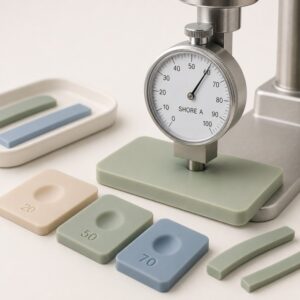
Shore A is commonly used to describe the hardness of flexible rubber and silicone materials.
A lower Shore A value generally indicates a softer and more flexible material. A higher Shore A value generally indicates a firmer material with greater resistance to indentation.
However, Shore A hardness is not a complete product-performance specification.
It does not independently describe:
- Tear resistance
- 拉伸强度
- Compression recovery
- Surface friction
- 耐热性
- Chemical resistance
- Product rigidity
- Suction performance
- Bite resistance
- Folding life
- Wall stability
Two silicone formulations with the same Shore A value may still have different tear strength, rebound, surface feel, transparency, processing behavior, and long-term performance.
For this reason, buyers should avoid choosing material only by saying:
We need 50 Shore A silicone.
A better project requirement would explain:
- What the product does
- How it should feel
- Where it needs to bend
- Where it must remain stable
- Whether it needs suction
- Whether it will be chewed or squeezed
- Whether it needs repeated folding
- What temperature and cleaning conditions it may experience
2. The Same Hardness Can Feel Different in Different Products
Product structure has a major influence on how silicone feels.
For example, a thin flat sheet made from relatively firm silicone may still bend easily. A thick solid part made from softer silicone may feel firm because of its large cross-section.
Important structural factors include:
- Wall thickness
- Product diameter
- Rib design
- Hollow or solid construction
- Surface texture
- Edge thickness
- Internal cavities
- Product height
- Unsupported areas
- Folding lines
- Connection points
This means buyers should not copy a hardness specification from an unrelated product.
A silicone spoon handle, baby teether, pet bowl, dog chew toy, bath brush, and collapsible cup all have different structural requirements.
The correct hardness must be evaluated within the final molded shape.
3. Start With Product Function, Not a Hardness Number
Before selecting hardness, define what the product needs to do.
A useful project brief should describe whether the product needs to:
- Bend easily
- Recover after folding
- Maintain a stable shape
- Create suction
- Resist repeated chewing
- Provide a soft-touch surface
- Hold liquid or food
- Support product weight
- Protect sensitive skin or gums
- Maintain bristle shape
- Seal against another component
- Collapse for storage
- Return to its original shape
Each function may lead to a different material and structural solution.
For example, increasing hardness may help a bowl maintain its shape, but it may reduce collapsibility. Reducing hardness may make a teether feel softer, but an overly thin section may become weak or unstable.
Hardness should therefore be treated as one part of a complete product design.
4. Silicone Hardness for Baby Teethers
A baby teether needs to balance softness, shape stability, easy gripping, smooth edges, texture definition, and repeated use.
If the material is too soft:
- Thin sections may fold too easily.
- Raised textures may feel weak.
- The product may lose its intended shape.
- Narrow connection areas may stretch excessively.
- The toy may become difficult to hold.
If the material is too firm:
- The chewing surface may feel less comfortable.
- Thick areas may become difficult for small hands to grip.
- Flexible features may not move as intended.
- The product may feel heavier and less responsive.
The final hardness should be evaluated together with:
- Teether size
- Target age group
- Ring or handle thickness
- Chewing-zone thickness
- Raised texture
- Hollow or solid structure
- Overall product weight
- Cleaning method
- Packaging compression
For custom baby teethers, molded samples should be tested for grip feel, flexibility, edge comfort, texture clarity, deformation, and recovery before production approval.
5. Silicone Hardness for Baby Pacifiers
A 硅胶奶嘴 contains several functional areas that may not behave the same way.
These may include:
- Nipple
- Neck
- Shield
- 手柄
- Ventilation area
- Connection structure
The nipple may need controlled flexibility, while the shield and handle may require better shape stability.
A one-piece silicone pacifier also needs a suitable balance between softness and structural support. If every section uses the same thickness, the complete product may not perform as intended.
Buyers should review:
- Nipple shape
- Nipple wall thickness
- Shield thickness
- Ventilation-hole structure
- Handle movement
- Product weight
- Target age group
- Cleaning and sterilization conditions
- Mold parting lines
Material hardness alone cannot correct a poorly designed nipple or shield.
The product should be evaluated as a complete molded structure and according to the requirements of the intended sales market.
6. Silicone Hardness for Feeding Bowls, Plates and Bibs
Silicone feeding products often need to combine flexibility with shape stability.
A feeding bowl should remain stable when filled with food. A suction plate should stay flat enough to contact the table. A bib should be flexible enough to wear comfortably while keeping the food pocket open.
Feeding Bowls and Plates
For bowls and plates, hardness affects:
- Rim stability
- Bowl-wall deformation
- Suction-base response
- Product weight
- Stackability
- Demolding
- 包装
- User handling
An overly soft bowl may collapse when lifted. An overly firm suction base may not deform sufficiently to create suction on the target surface.
Wall thickness and base geometry are therefore just as important as Shore A hardness.
硅胶围兜
For silicone bibs, hardness affects:
- Neck comfort
- Strap flexibility
- Button engagement
- Pocket opening
- Product drape
- Folding and storage
- Overall weight
A very soft bib may feel comfortable but allow the food pocket to collapse. A firmer bib may hold the pocket open but feel less flexible around the neck.
The neck area, strap, body, and pocket should be designed as one complete structure.
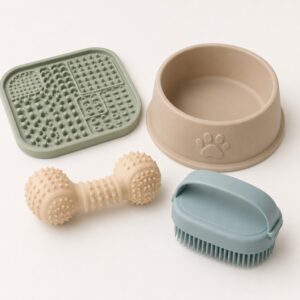
7. Silicone Hardness for Pet Lick Mats
Pet lick mats need enough flexibility to lie flat, sufficient structure to support raised patterns, and suitable deformation for suction cups.
If the material is too soft:
- The mat may curl.
- Raised textures may collapse.
- The product may stretch during cleaning.
- Suction cups may deform excessively.
- Thin edges may tear more easily.
If the material is too firm:
- The mat may not conform well to the surface.
- Suction cups may be harder to activate.
- Folding or rolling may become difficult.
- The product may feel less flexible during use.
Hardness should be reviewed with:
- Mat thickness
- Overall size
- Texture depth
- Texture spacing
- Suction-cup diameter
- Suction-cup depth
- Edge structure
- Storage method
- Intended food type
A successful lick mat requires a balance between feeding function, easy cleaning, flatness, suction, and durability.
8. Silicone Hardness for Pet Feeding Bowls
Pet feeding bowls may be designed as permanent indoor bowls, slow feeders, travel bowls, collapsible bowls, or combined food-and-water products.
Each type has different hardness requirements.
An indoor bowl usually needs:
- Stable walls
- Anti-slip performance
- Suitable rim support
- Easy cleaning
- Shape consistency
A collapsible travel bowl needs:
- Controlled folding
- Good recovery
- Stable fold lines
- Suitable rim support
- Low packing volume
- Repeated folding durability
A slow-feeder bowl also needs enough texture definition to maintain the intended feeding path.
Hardness should be selected together with bowl diameter, wall height, base thickness, fold design, pet size, product weight, and packaging method.
9. Silicone Hardness for Dog Chew Toys
Dog chew toys are among the most difficult consumer silicone products to specify using hardness alone.
A harder product is not automatically more durable. Product durability also depends on:
- Silicone formulation
- Tear resistance
- Wall thickness
- Toy diameter
- Hollow or solid design
- Sharp transitions
- Treat holes
- Connection points
- Surface texture
- Target dog size
- Expected chewing behavior
If the product is too soft, it may deform excessively or allow a dog to concentrate force on thin areas.
If it is too firm, it may provide a less suitable chewing feel or create excessive stress around rigid geometry.
The project should define:
- Puppy, small dog, medium dog, or large dog
- Light, moderate, or stronger chewing use
- Chewing, licking, fetching, or treat-dispensing function
- Solid or hollow construction
- Wall thickness
- Hole dimensions
- Texture depth
- Supervision and use instructions
No hardness specification can make every product suitable for every dog or every chewing condition.
Brands should validate the final product structure for its intended pet category and positioning.
10. Silicone Hardness for Pet Bath Brushes
Pet bath brushes require another balance: the body and handle should remain stable, while the bristles need suitable flexibility.
If the bristles are too soft:
- They may not provide enough cleaning action.
- They may collapse during use.
- Shampoo distribution may become uneven.
- The massage effect may feel weak.
If the bristles are too firm:
- The brush may feel uncomfortable.
- Thin bristle tips may not flex smoothly.
- The product may not suit sensitive skin.
- The user may apply too much pressure.
The apparent softness of a bristle also depends on:
- Bristle length
- Root diameter
- Tip diameter
- Bristle spacing
- Taper design
- Number of bristles
- Body thickness
A longer thin bristle made from a firmer material may feel softer than a short thick bristle made from a lower-hardness material.
This is another example of why hardness and geometry must be evaluated together.
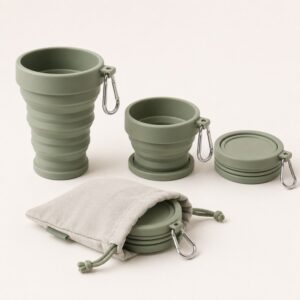
11. Silicone Hardness for Collapsible Outdoor Products
Collapsible cups, bowls, food containers, and travel products need to fold repeatedly while recovering to a usable shape.
The product must be soft enough to collapse but firm enough to remain stable when opened.
Important factors include:
- Fold-line thickness
- Number of folding sections
- Cup diameter
- Product height
- Rim support
- Base stability
- Lid fit
- Liquid weight
- Temperature exposure
- Repeated folding cycles
- Packaging compression
If the silicone is too soft, the product may collapse while being held.
If it is too firm, folding may require excessive force and the fold lines may not move smoothly.
Hardness selection should be validated with actual liquid weight, lid assembly, drinking use, folding, storage, and recovery tests.
12. Wall Thickness May Matter More Than a Small Hardness Change
Buyers sometimes try to solve every product problem by changing material hardness.
However, a structural change may be more effective.
For example:
- Increasing a supporting rib may improve bowl stability.
- Adjusting a fold line may improve collapsibility.
- Thickening a weak connection may reduce tearing.
- Reducing a bristle root diameter may improve flexibility.
- Changing a suction-cup edge may improve activation.
- Adding a mechanical support area may reduce deformation.
A small Shore A change may not solve a problem created by poor geometry.
Before changing material, the manufacturer should evaluate whether the issue comes from:
- Hardness
- Wall thickness
- Product geometry
- Mold shrinkage
- Surface texture
- Parting-line position
- Processing conditions
- Packaging deformation
- Assembly method
13. Softer Does Not Always Mean Better Quality
Soft-touch silicone may feel premium in some applications, but softer material is not automatically higher quality.
An overly soft product may experience:
- Excessive deformation
- Weak shape support
- Difficult demolding
- Stretching during use
- Poor dimensional stability
- Collapsed textures
- Packaging deformation
- Greater sensitivity around thin areas
Similarly, harder silicone is not automatically more durable or more professional.
An overly firm product may experience:
- High bending force
- Reduced comfort
- Poor suction response
- Difficult folding
- Increased assembly force
- Stress concentration
- Reduced conformity to mating surfaces
The correct hardness is the one that allows the product to perform its intended function consistently.
14. How Surface Texture Changes the Perceived Hardness
Two products using the same silicone hardness may feel different because of their surface finish.
A smooth glossy surface may feel different from:
- Fine matte texture
- Coarse matte texture
- Raised dots
- Soft ribs
- Deep grooves
- Fabric-style texture
- Polished surface
- Micro-textured surface
Texture can affect:
- Grip
- Friction
- Dust attraction
- Cleaning
- Visual appearance
- Skin feel
- Product release from the mold
Buyers should review actual molded texture samples rather than relying only on renderings or material color cards.
15. Color and Additives May Affect the Final Evaluation
Custom silicone products often use Pantone-matched colors.
Color masterbatch, transparency, fillers, and other formulation changes can influence processing and final product appearance. Even when the target hardness remains the same, buyers should approve the final molded sample in the required color.
For multi-product sets, one hardness and one color formula may not produce the same visual and tactile result across:
- Thin products
- Thick products
- Matte molds
- Polished molds
- Hollow parts
- Solid parts
- Different curing conditions
The bowl, spoon, bib, toy, and accessory should therefore be reviewed as a complete collection.
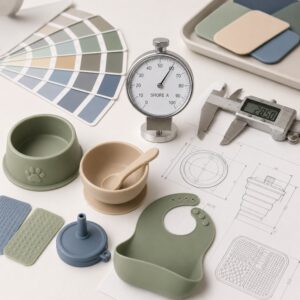
16. Samples Should Be Tested in Real Use Conditions
A small material sheet or hardness block cannot fully represent the final product.
Buyers should test molded samples according to the product’s actual use.
Possible sample checks include:
- Hand feel
- Bending force
- Folding recovery
- Suction performance
- Shape stability
- Grip comfort
- Bristle flexibility
- Texture response
- Bite-area deformation
- Lid fit
- Product weight
- Cleaning
- Packaging recovery
- Heat or cold exposure
- Repeated-use simulation
The buyer and manufacturer should also agree on the sample test method.
For example, statements such as “too soft” or “not flexible enough” are subjective unless the test condition and expected result are clearly defined.
17. Control Hardness During Mass Production
An approved sample should become the production reference, but batch control is still required.
The manufacturer should manage:
- Silicone material grade
- Material batch
- Mixing ratio
- Color batch
- Curing conditions
- Mold temperature
- Product dimensions
- Product weight
- Surface finish
- Hardness inspection
- Sample retention
- Batch traceability
Hardness testing should be performed on a suitable test area or defined test specimen. Very thin, curved, textured, or small product areas may not provide a reliable direct reading.
For this reason, buyers and manufacturers should agree on how hardness will be measured and recorded before mass production.
18. What Information Should Buyers Provide?
To recommend a suitable silicone hardness, the manufacturer needs more than a product name.
Buyers should provide:
- Product drawing or reference sample
- Overall dimensions
- Wall thickness
- Product function
- Target user
- Target age group or pet size
- Flexible and rigid areas
- Folding requirements
- Suction requirements
- Chewing or biting conditions
- Surface texture
- Color requirements
- Temperature exposure
- Cleaning method
- Packaging method
- Target market
- Testing requirements
- Estimated quantity
When an existing sample is available, buyers should also explain what they like or dislike about its softness, stability, grip, folding, or recovery.
How LYA Silicone Supports Hardness Selection
LYA Silicone supports OEM and ODM development for custom silicone baby, pet, outdoor, educational, and daily-use products.
Our project support can include:
- Product requirement review
- Drawing or sample evaluation
- Silicone material selection
- Hardness recommendations
- Wall-thickness review
- Structural optimization
- 定制模具开发
- Pantone color matching
- Surface texture selection
- Sample production
- Functional review
- Quality inspection
- Bulk manufacturing
With more than 25 years of silicone manufacturing experience, we help buyers evaluate hardness together with product function, geometry, molding feasibility, user experience, packaging, and mass-production consistency.
The final recommendation is based on the actual product rather than selecting one universal hardness for every silicone item.
Frequently Asked Questions
What is the best Shore A hardness for a silicone product?
There is no universal best hardness. The suitable specification depends on product function, wall thickness, structure, dimensions, user requirements, and working conditions.
Can two products with the same Shore A hardness feel different?
Yes. Wall thickness, geometry, cavities, ribs, surface texture, product size, and material formulation can make two products with the same nominal hardness feel very different.
Should baby products always use very soft silicone?
Not necessarily. Baby products need suitable softness, but they also require structural stability, smooth edges, functional performance, and product-specific validation.
Should dog chew toys use the hardest available silicone?
No. Hardness alone does not determine chew durability. Material formulation, tear resistance, wall thickness, geometry, holes, texture, dog size, and intended use must all be evaluated.
Can the hardness be changed after the mold is completed?
Material hardness may be adjusted within an appropriate range, but changing hardness can affect shrinkage, demolding, product dimensions, flexibility, suction, and function. New samples should be evaluated before production.
How should hardness be confirmed before mass production?
Buyers should confirm the material grade, target Shore A range, molded sample, actual product function, test method, acceptable variation, and production reference sample.
结论
Choosing silicone hardness is not simply selecting a number from a material chart.
The correct specification depends on product function, wall thickness, geometry, texture, target user, folding, suction, chewing, cleaning, packaging, and long-term use.
Baby teethers, pacifiers, pet lick mats, feeding bowls, dog chew toys, bath brushes, and collapsible outdoor products all require different engineering priorities.
The most reliable approach is to review the structure first, produce molded samples, test the product under real use conditions, and then confirm the material and hardness specification for mass production.
If you are developing a custom silicone product, contact LYA Silicone and send us your drawing, reference sample, product dimensions, intended function, hardness preference, color, packaging requirements, target market, and estimated quantity. Our team will review your project and provide an appropriate OEM or ODM manufacturing proposal.