 Korean
  English
  French
  German
  Spanish
  Polish
  Chinese
  Japanese
  Russian
 콘텐츠
Answer Excerpt
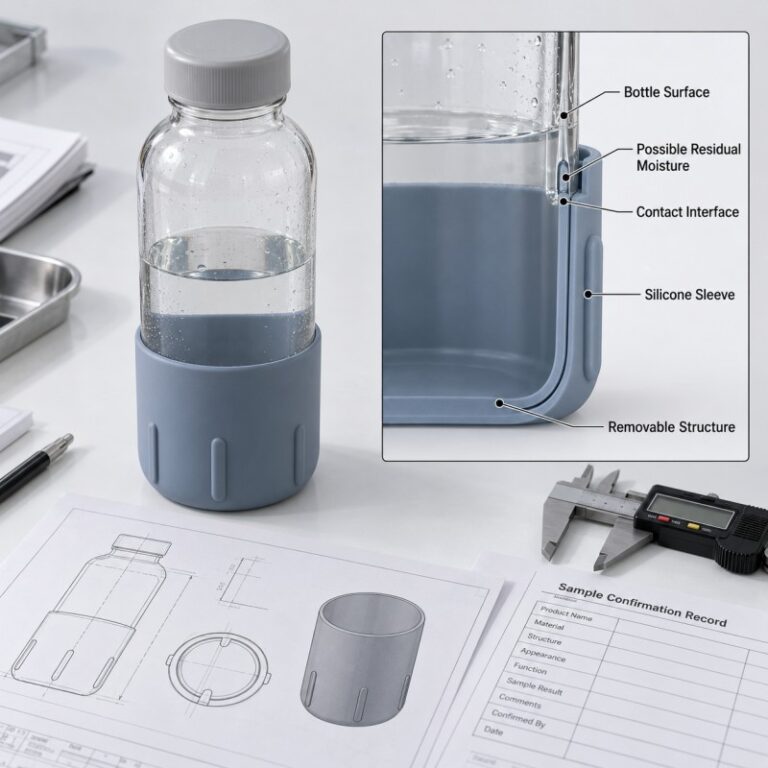
Moisture can become trapped under a silicone water bottle sleeve when condensation, washing water or spilled liquid enters the space between the sleeve and bottle but cannot dry readily. A close-fitting silicone cover may have limited airflow at its contact surface, especially when it wraps around a large portion of the bottle or includes a closed bottom.
For OEM drinkware brands, moisture management should be considered alongside grip and protection. Important factors include bottle material, sleeve coverage, interface geometry, cleaning access, removal force, drying instructions and testing with actual bottle samples.
The design objective is not to guarantee that moisture can never enter. It is to make the bottle-and-sleeve assembly practical to use, inspect, separate, clean and dry.
Why Can Water Collect Between a Silicone Sleeve and a Bottle?
Silicone bottle sleeves are commonly used on reusable drinkware to provide a softer grip and a protective contact layer.
However, the bottle and sleeve are two separate surfaces.
Water can enter between them in several ways:
-
Condensation on the outside of a cold bottle
-
Residual water after washing
-
Liquid spilled near the sleeve opening
-
Water entering during outdoor use
-
Reinstalling a sleeve before both components are dry
When a sleeve fits closely against the bottle, moisture may remain in the interface longer than it would on a fully exposed surface.
This does not mean silicone itself is necessarily damaged.
The concern is that water and residue may remain difficult to see or remove during normal use.
A reliable product should therefore be evaluated as a bottle-and-sleeve assembly rather than as an isolated molded silicone part.
Why Does Condensation Matter for Reusable Drinkware?
Condensation forms when moisture in the surrounding air encounters a surface sufficiently cold for water vapor to condense.
A chilled glass or non-insulated metal bottle may develop moisture on its exterior under suitable environmental conditions.
The amount of condensation depends on factors such as:
-
Bottle surface temperature
-
Room temperature
-
Relative humidity
-
Exposure time
-
Bottle construction
-
Surface coverage
An insulated bottle that keeps its exterior relatively close to room temperature may experience very different condensation behavior.
Brands should not assume that all bottle materials or constructions produce the same amount of moisture.
During development, testing should reflect the actual drinkware product and expected use conditions.
Does a Tight Silicone Sleeve Prevent Moisture Entry?
Not necessarily.
A close-fitting sleeve may reduce the size of the gap between the silicone and bottle, but it should not automatically be considered a watertight barrier.
Water can enter at the upper edge or through other exposed interfaces.
If the sleeve has a closed bottom, residual water may also remain in the lower area until the product is removed and dried.
The designer should consider two different requirements:
Fit retention — the sleeve stays in its intended position during normal handling.
Moisture management — water that enters the interface can be identified and removed through normal care.
Improving retention should not make cleaning or sleeve removal impractical.
How Does Sleeve Coverage Affect Drying?
The covered area affects how much of the bottle surface is concealed.
Short Grip Band
A narrow band covers a limited section of the bottle.
It may be easier to remove and inspect, but it provides less coverage and may not suit applications requiring bottom protection.
Lower-Body Sleeve
A sleeve covering the lower portion of a bottle can combine a grip area with some protection against daily contact.
However, its lower geometry should be reviewed for moisture retention and cleaning access.
Full-Height Protective Sleeve
A taller sleeve covers more bottle surface.
This can provide more room for branding and grip texture, but it also creates a larger enclosed interface requiring maintenance consideration.
The right configuration depends on the brand’s intended use, not simply the maximum available coverage.
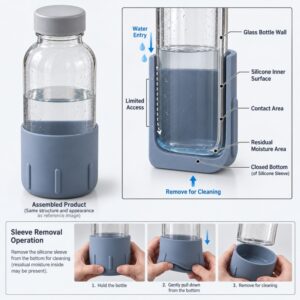
Open-Bottom or Closed-Bottom: Which Is Easier to Maintain?
The bottom structure changes how consumers handle the product.
| Structure | Potential Advantage | Maintenance Consideration |
|---|---|---|
| Open-bottom sleeve | Accessible opening and potentially easier cleaning | Provides less direct bottom coverage |
| Closed-bottom sleeve | Covers the lower bottle surface and base | Water may remain at the bottom interface |
| Partial grip band | Smaller area to inspect | Does not provide comprehensive coverage |
| Custom protective boot | Geometry can be adapted to the bottle | Requires product-specific cleaning and fit review |
An open-bottom design does not automatically drain perfectly, especially where surfaces remain tightly pressed together.
Similarly, a closed-bottom design does not automatically become unhygienic.
The relevant questions are whether the sleeve is removable, the contacting surfaces are accessible and the product can be dried according to practical user instructions.
Should Designers Add Drainage Grooves Inside the Sleeve?
Shallow internal channels can be evaluated as one possible design option.
Such channels may create locally open paths between the bottle and silicone surface.
However, adding grooves is not automatically beneficial.
The engineering team must consider:
-
Channel direction
-
Channel depth
-
Connection to an accessible opening
-
Structural support around the channel
-
Contact pressure against the bottle
-
Moldability
-
Cleaning access
A groove that ends in a closed pocket may simply create another place where water can remain.
Channels can also reduce the available contact area and change how the sleeve grips the bottle.
Therefore, a proposed drainage and easy-clean design should be evaluated against both drying behavior and fit retention.
Drainage features should only be promoted as performance improvements when the actual finished configuration has been tested.
How Can Internal Surface Texture Affect Moisture Retention?
A smooth internal surface may make cleaning relatively straightforward.
However, depending on fit and surface conditions, a smooth sleeve can also contact large areas of the bottle directly.
A fine molded texture may alter the contact pattern, but this does not establish that it will dry faster.
The designer should distinguish between:
-
Decorative exterior texture
-
Grip-enhancing exterior texture
-
Functional internal contact geometry
Very deep internal textures can create narrow spaces that are difficult to inspect.
Tiny raised features may also change the force required to install and remove the sleeve.
For OEM development, internal geometry should be kept as simple as possible while meeting the necessary fit and maintenance requirements.
Why Is Easy Removal Part of Good Sleeve Design?
If a bottle sleeve is intended to be removed for cleaning, the removal process must be realistic for the user.
A sleeve that requires excessive force may discourage regular maintenance.
A sleeve that is too loose, however, may move unexpectedly during handling.
This creates a design trade-off between:
-
Stretch during installation
-
Retention during use
-
Removal force
-
Material recovery
-
Surface accessibility
For custom silicone bottle sleeves, it is important to validate both dry and wet handling conditions where relevant.
Consumers should not need to damage the sleeve or use sharp tools to remove it under normal intended use.
How Do Silicone Hardness and Wall Thickness Affect Maintenance?
The same sleeve design may behave differently when material hardness or wall thickness changes.
A softer sleeve may stretch more easily during removal, but this does not automatically mean it will provide sufficient retention.
A firmer sleeve may remain more stable in some configurations, although removal can become less convenient.
Local thickness also influences deformation.
Brands should review silicone hardness together with:
-
Bottle diameter and shape
-
Sleeve height
-
Wall thickness
-
Internal contact texture
-
Bottom structure
-
Installation and removal force
-
Recovery after repeated stretching
The final design should be evaluated with actual molded samples.
Changing the hardness value alone is unlikely to solve a moisture-management problem caused by inaccessible internal pockets.
Can Moisture Affect the Grip Between the Bottle and Sleeve?
Moisture may change friction conditions at the interface between the silicone and the bottle.
The actual effect depends on surface materials, texture, contact pressure and water distribution.
For example, a close-fitting sleeve that remains stable when dry may behave differently after water enters the interface.
A useful sample evaluation should therefore compare:
-
Dry bottle and dry sleeve
-
Moist bottle and dry sleeve
-
Cleaned and fully dried assembly
-
Repeated installation and removal
The acceptance criteria should match the intended use.
The design team should check whether the sleeve rotates, slides or changes position during normal handling.
It should not assume that a dry-fit evaluation represents every practical condition.
Why Can Closed-Bottom Sleeves Be Harder to Inspect?
A closed-bottom sleeve may be useful when the brand wants protection around the lower portion of a glass or metal bottle.
However, it also creates a lower contact area that is not visible while the sleeve remains installed.
If water enters this space, the user may not notice it immediately.
The designer should therefore assess:
-
Whether the sleeve can be removed easily
-
Whether the inside bottom is smooth and accessible
-
Whether the bottle base can be cleaned
-
Whether both components can dry separately
-
Whether the sleeve returns to its intended fit after reinstallation
An enclosed bottom should not contain unnecessary narrow pockets or inaccessible decorative features.
It is often more useful to provide practical care instructions than to claim that the enclosure will prevent all moisture entry.
How Should Brands Write Cleaning Instructions?
For a removable silicone sleeve, user instructions should clearly explain how the product is maintained.
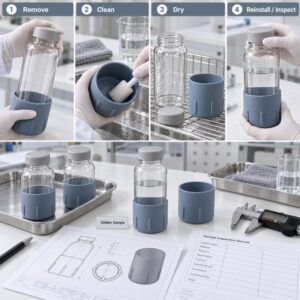
A practical care sequence may include:
-
Remove the sleeve according to the intended design.
-
Clean the bottle and sleeve using the approved method.
-
Rinse away visible residues.
-
Dry both components thoroughly.
-
Reinstall the sleeve only after the contacting surfaces are sufficiently dry.
-
Inspect the sleeve periodically for damage or abnormal deformation.
The actual instructions must be validated against the final silicone formulation, bottle material, surface finish and product construction.
Not every combination of silicone sleeve and bottle is suitable for the same washing temperature, dishwasher cycle or cleaning chemical.
Brands should not copy cleaning claims from unrelated drinkware products without confirming compatibility.
Should a Silicone Bottle Sleeve Be Permanently Attached?
This decision depends on the product concept.
A removable sleeve offers the possibility of accessing the surfaces between the sleeve and bottle.
A permanently attached cover may provide a different assembly concept, but it also requires a different assessment of moisture ingress, bonding, cleaning and long-term performance.
A removable accessory should not be described as permanently attached simply because the fit is tight.
Likewise, a permanently bonded design should not be assumed to be fully sealed unless that characteristic has been validated.
For most removable sleeve projects, practical installation, removal and maintenance are important functional requirements.
How Should Moisture Behavior Be Tested During OEM Sampling?
A useful evaluation should compare how the assembly behaves under several controlled conditions.
Dry Assembly Check
Fit the clean, dry silicone sleeve onto the reference bottle.
Record the installation process, fit position and removal characteristics.
Condensation Exposure
Where relevant, expose the intended bottle assembly to representative chilled-use conditions.
Observe whether moisture develops at exposed surfaces and reaches the interface.
Record the test environment rather than assuming the same behavior occurs in every climate.
Controlled Water Entry
Where appropriate, introduce a small, defined amount of clean water at an exposed sleeve edge.
Observe where the water travels and whether it collects in inaccessible areas.
This is an engineering assessment, not an instruction to treat the finished product as waterproof.
Removal and Cleaning
Remove the sleeve using the intended handling method.
Check whether residue and moisture can be accessed without damaging the bottle or sleeve.
Drying and Reassembly
Dry both components according to the proposed care instructions.
Record any areas that are difficult to inspect or dry.
Reassemble the product and check fit again.
Grip Evaluation
Compare dry and relevant wet-interface conditions using an agreed functional method.
The test should detect meaningful movement without relying on unsupported friction or retention values.
Practical Example: A Silicone Sleeve for a Glass Water Bottle
Consider a private-label reusable glass bottle with a removable silicone protective sleeve.
The sleeve covers the lower portion of the bottle and includes a smooth exterior with a shallow grip texture.
The brand wants protection against everyday contact and a practical product for repeated washing.
Version A — Tight Closed-Bottom Sleeve
The sleeve fits securely but is difficult to remove.
Residual water collects near the bottle base after washing.
Version B — Deep Internal Decorative Texture
The internal surface contains complicated decorative grooves.
These features create additional spaces that are inconvenient to inspect and rinse.
Version C — Overly Loose Fit
The sleeve is easy to remove, but it moves excessively during normal handling.
Improved Design
The revised concept evaluates:
-
Appropriate removable fit
-
Simple internal geometry
-
Accessible bottom surface
-
Controlled wall flexibility
-
Practical cleaning instructions
-
Dry and wet grip behavior
The improved design is not automatically moisture-proof.
It is designed to make maintenance more practical while retaining the sleeve’s intended function.
What Should Buyers Confirm Before Mold Development?
Before custom silicone mold development, buyers should define the complete assembly requirements.
The development specification should include:
-
Reference bottle or accurate drawing
-
Bottle material
-
Bottle diameter and bottom geometry
-
Intended sleeve coverage
-
Open-bottom or closed-bottom design
-
Internal contact geometry
-
Exterior grip texture
-
Silicone hardness and wall thickness
-
Removal requirements
-
Moisture-management objectives
-
Cleaning and drying instructions
-
Color and logo requirements
-
Packaging conditions
-
Functional inspection criteria
The manufacturer should review molded geometry, parting-line position, demolding and expected dimensional variation.
The objective is to avoid creating an attractive silicone component that does not work properly with the actual bottle.
How Should Production Quality Be Controlled?
A moisture-management feature is useful only if its dimensions and overall design remain consistent during production.
The buyer and manufacturer should agree on:
-
Critical internal dimensions
-
Sleeve height and opening geometry
-
Bottom structure
-
Molded surface condition
-
Wall thickness where relevant
-
Silicone material and color
-
Deformation and recovery
-
Fit against approved reference bottles
-
Appearance and packaging
A production AQL inspection plan can help establish sampling and defect classification, but it should not replace functional checks that are important to the product.
For example, an otherwise attractive sleeve that repeatedly slips from its approved bottle may represent a functional failure.
The quality plan should separate cosmetic variation from performance-related defects.
Silicone Bottle Sleeve Moisture-Management Checklist
| Evaluation Item | What the Buyer Should Confirm |
|---|---|
| Bottle construction | Glass, metal, plastic or insulated drinkware |
| Condensation scenario | Relevant to intended temperature and humidity |
| Sleeve coverage | Defined functional contact area |
| Bottom type | Open or closed according to product requirements |
| Internal geometry | Accessible and practical to clean |
| Optional channels | Connected to useful openings if adopted |
| Sleeve removal | Possible under intended user conditions |
| Material hardness | Validated with molded geometry |
| Fit retention | Checked under relevant conditions |
| Cleaning method | Compatible with final materials |
| Drying method | Practical for both bottle and sleeve |
| Mold geometry | Consistent and manufacturable |
| Sample testing | Dry, moist and cleaned assemblies evaluated |
| 패키징 | Avoids unacceptable deformation |
| Production inspection | Functional and appearance criteria agreed |
How LYA Silicone Supports Bottle Sleeve OEM Development
LYA Silicone supports OEM and ODM development for custom consumer silicone products, including reusable drinkware accessories and other silicone outdoor products.
Depending on the project, development support can include:
-
Bottle sample and drawing review
-
Sleeve coverage planning
-
Internal structure evaluation
-
Material and hardness selection
-
Mold development
-
팬톤 색상 사용자 지정
-
Molded logo planning
-
Sample production
-
Dimensional and functional inspection
-
Packaging coordination
-
Bulk manufacturing
Brands can also review our existing water bottle sleeve development guide for the broader topics of grip, protection, appearance and private-label customization.
For moisture-management projects, the key is to confirm how the actual bottle and removable sleeve behave together, rather than assigning performance claims to the silicone material alone.
Frequently Asked Questions
Why Is There Water Under My Silicone Bottle Sleeve?
Possible causes include condensation, residual washing water or spilled liquid entering the space between the sleeve and bottle. The source depends on the specific assembly and usage conditions.
Does Silicone Absorb Condensation?
Water collecting between a bottle and sleeve should not be confused with the silicone material absorbing the liquid. Moisture can remain at the interface even when the silicone itself is not acting as an absorbent material.
Can a Closed-Bottom Sleeve Trap Water?
Yes. Depending on its fit and geometry, water may remain near the bottle base until the sleeve is removed and both surfaces are dried.
Should Every Silicone Sleeve Have Drainage Holes?
No. Openings or channels may be useful in some designs, but they also affect appearance, retention, protection and manufacturing. Their suitability requires product-specific evaluation.
Can Internal Grooves Improve Drying?
Possibly, under certain conditions, but their effectiveness depends on geometry and airflow access. Grooves should not be presented as a guaranteed solution without testing.
Should the Sleeve Be Removed Before Cleaning?
For a removable product, separate cleaning and drying may provide better access to the contacting surfaces. Follow the care instructions validated for the actual bottle-and-sleeve assembly.
Can the Same Design Fit Glass and Stainless Steel Bottles?
Only if the relevant bottle dimensions, geometry and intended use requirements are compatible. Similar-looking bottles should not be assumed interchangeable without sample testing.
Design the Sleeve for Its Full Use Cycle
A functional silicone bottle sleeve should be evaluated across its complete use cycle:
Install → Grip → Use With Cold Drinks → Remove → Clean → Dry → Reinstall
A good design should provide the intended protection and grip while remaining practical to maintain.
For OEM drinkware brands, this means treating moisture management, accessibility and repeatable fit as part of the product specification—not as an afterthought.
If you are developing a custom silicone bottle sleeve or another reusable drinkware accessory, contact us with your bottle sample, drawing, sleeve coverage requirements, material preferences, target market, cleaning method, color, logo, packaging and estimated order quantity.