 Korean
  English
  French
  German
  Spanish
  Polish
  Chinese
  Japanese
  Russian
 콘텐츠
Answer Excerpt
Drainage and easy-clean features in 맞춤형 실리콘 제품 should be designed before tooling, especially for bath toys, feeding products, pet accessories and other products exposed to water or food. Buyers should review drainage-hole position, groove depth, internal cavities, removable structures, corner radius and drying orientation so that water and residue can be removed without creating unnecessary molding or durability problems.
A silicone product can look simple from the outside while containing structures that are difficult to rinse, drain or dry.
Typical problem areas include:
- Deep narrow grooves
- Closed internal cavities
- Small water outlets
- Blind holes
- Deep embossed logos
- Complex suction structures
- Narrow channels
- Hollow handles
- Dense surface textures
- Areas where two components overlap
These details affect more than cleaning convenience.
They may also influence mold design, demolding, product durability, drying time, inspection and customer experience.
For OEM buyers, easy cleaning should therefore be treated as a product-design requirement rather than something considered only after the first sample is finished.
Which Silicone Products Need Drainage and Cleanability Review?
Drainage is especially important for products that regularly contact:
- Water
- Food
- Milk
- Pet food
- Soap
- Saliva
- Cleaning liquids
Typical examples include:
- silicone baby bath toys
- Baby feeding bowls and plates
- Silicone bibs
- Straw cups
- Bottle accessories
- Pet lick mats
- Pet feeding bowls
- Grooming brushes
- Collapsible travel products
- Silicone cleaning accessories
The cleaning challenge is different for every product.
A feeding bowl mainly needs accessible food-contact surfaces.
A bath toy needs to avoid hidden water-retention areas.
A pet lick mat may require textured feeding patterns without creating grooves that are too narrow to rinse.
A brush may need drainage between bristles so that water does not remain trapped around the base.
Why Can Silicone Products Retain Water?
1. Closed Cavities Can Trap Water
Hollow products may contain internal spaces for:
- Squeezing
- Weight reduction
- Product shape
- Water-play function
- Assembly
- Decorative design
If water enters a cavity but cannot leave easily, the product may remain wet internally.
A single very small hole does not always provide effective drainage.
The design should consider:
- Where water enters
- Where air enters
- Where water exits
- How the product is positioned during drying
In some applications, an openable structure may provide better cleaning access than relying only on a small drainage hole.
2. Drainage Holes May Be in the Wrong Position
The lowest point of the product in actual use may not be the lowest point when the product is standing, hanging or drying.
For example, a drainage hole located correctly in a CAD drawing may still leave water inside when the customer places the product upside down.
The engineering team should review several orientations:
- Normal use
- Washing
- Rinsing
- Hanging
- Air drying
- 패키징
Drainage should be evaluated based on how customers will actually handle the finished product.
3. The Drainage Hole May Be Too Small
A very small opening may restrict water flow.
It may also become more difficult to clean if residue reaches the opening.
However, simply making every hole larger is not the solution.
Hole size can affect:
- Product appearance
- Structural strength
- Finger accessibility
- Squeezing performance
- Water-play function
- Mold structure
- Demolding
The correct opening should balance drainage with the product’s intended function.
Why Do Deep Grooves Make Silicone Products Harder to Clean?
Texture is often used to create:
- Slow-feeding patterns
- Sensory surfaces
- Grip
- Decoration
- Brand identity
- Massage effects
But texture also changes cleaning accessibility.
A deep narrow groove may collect:
- Food residue
- Pet food
- Soap
- Fibers
- Hair
- Water
The problem is not simply whether the silicone material itself is washable.
The question is whether water, fingers, brushes or cleaning tools can physically reach the entire surface.
When designing textures, buyers should review:
- Groove width
- Groove depth
- Corner radius
- Texture spacing
- Drainage direction
- Brush accessibility
A visually complex pattern may look attractive in a rendering but become inconvenient during everyday cleaning.
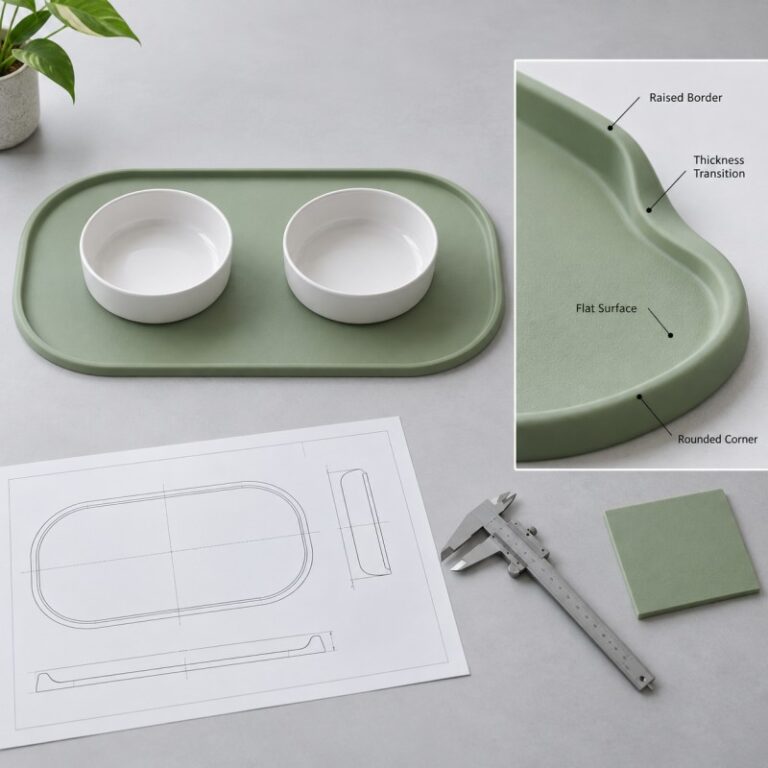
Why Are Rounded Transitions Better for Easy Cleaning?
Sharp internal corners create narrow areas that are more difficult to wipe or rinse.
Rounded transitions can provide:
- Better cleaning access
- Smoother water flow
- Fewer narrow residue areas
- More practical demolding
- Lower stress concentration
Rounded geometry is particularly useful around:
- Bowl bottoms
- Feeding channels
- Internal toy cavities
- Handle connections
- Brush bases
- Drinking openings
- Lid interfaces
The required radius depends on the product size and structure.
The goal is not to make every design completely round, but to avoid unnecessary sharp internal geometry in areas that require frequent cleaning.
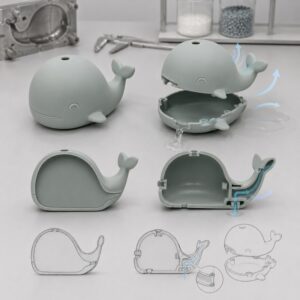
Should a Bath Toy Be Fully Sealed or Openable?
Both approaches can work, but they solve different design problems.
Fully Sealed Structure
A sealed silicone bath toy prevents water from entering the internal cavity.
Advantages may include:
- No internal water storage
- Simple exterior cleaning
- Fewer removable parts
However, the sealing structure must remain reliable during molding and use.
Openable Structure
An openable bath toy allows the customer to separate the product for rinsing and drying.
Advantages may include:
- Direct access to internal surfaces
- Easier visual inspection
- Faster manual drying
- Easier removal of water
However, the connection must be designed carefully.
Buyers should evaluate:
- Assembly force
- Child access
- Component fit
- Wall thickness
- Repeated opening
- Cleaning
- Product-market requirements
The choice should be made during custom silicone mold development, because changing between sealed and openable structures after tooling may require significant mold modifications.
How Should Pet Lick Mats and Feeding Products Be Designed?
Food-contact textures should balance feeding function with cleaning access.
For a silicone pet lick mat, buyers should consider:
- Texture height
- Groove width
- Pattern density
- Corner radius
- Overall mat flexibility
- Suction-cup layout
- Dishwasher or hand-cleaning method
- Drying orientation
Very dense patterns may hold food effectively but require more cleaning.
A practical design should allow the customer to reach the important surfaces with normal washing methods.
For feeding bowls and plates, internal corners should also be evaluated.
A visually sharp bowl transition may create a narrow area where food repeatedly remains.
How Do Suction Cups Affect Cleaning?
Suction cups add useful function but also create additional geometry on the underside of a product.
Multiple deep suction cups may create:
- Additional water-retention areas
- More surfaces that require rinsing
- Narrow gaps between cups
- Slower drying if products are stacked immediately
The design should consider both suction function and cleaning.
For example, the distance between suction cups should allow water to escape instead of creating isolated pockets.
The product should also be evaluated in the position customers are likely to use for drying.
Why Should Cleaning Be Reviewed During DFM?
A DFM review should include more than checking whether a silicone product can be molded.
For products exposed to food or water, the engineering review should also ask:
- Can every important surface be reached?
- Can water leave the product naturally?
- Are there hidden cavities?
- Are grooves unnecessarily deep?
- Can the product dry in a practical position?
- Does the product need to be disassembled?
- Can the customer reassemble it correctly?
- Will packaging keep the product wet or compressed?
- Does the structure create difficult mold features?
These questions are easier to address before mold machining.
After the mold is completed, changing a drainage channel, opening, wall or connection structure can require tooling modification.
What Should Be Tested During Sample Approval?
Water-Fill and Drain Test
Fill or rinse the product as it would be used.
Then check:
- How quickly water leaves
- Whether water remains in cavities
- Whether shaking is required
- Whether the product can air dry naturally
Cleaning Accessibility Test
Use the intended cleaning method.
Check whether:
- Fingers can reach important areas
- A cleaning brush can enter grooves
- Food residue can be rinsed away
- Components can be separated easily
Repeated Assembly Test
For removable products, repeatedly open and reassemble the product.
Check:
- Connection fit
- Deformation
- Tear risk
- Ease of use
- Alignment
Drying Test
After washing, place the product in its intended drying position.
Inspect whether water remains in:
- Internal cavities
- Grooves
- Suction cups
- Handles
- Connections
Packaging Check
The product should be completely dry before packaging.
Packaging design should also avoid creating unnecessary compression that closes drainage openings or deforms removable structures.

Easy-Clean DFM Checklist
| 항목 | What Buyers Should Confirm |
| Internal cavities | Can they be completely accessed or drained? |
| Drainage holes | Correct size and location |
| Drying position | Water can leave in normal orientation |
| Grooves | Not unnecessarily deep or narrow |
| Corners | Suitable rounded transitions |
| Textures | Cleaning tools can reach important areas |
| Suction cups | Water does not remain trapped between structures |
| Removable parts | Easy to open, clean and reassemble |
| Wall thickness | Supports repeated cleaning and assembly |
| Mold design | Drainage features can be produced consistently |
| 샘플 | Tested using actual water, food or cleaning conditions |
| 패키징 | Product is dry and structure remains open as intended |
How LYA Silicone Supports Easy-Clean Product Development
LYA Silicone supports OEM and ODM development for silicone baby, pet, outdoor and educational products.
Project support may include:
- Product drawing review
- Cleaning-accessibility review
- Drainage-structure evaluation
- Wall-thickness review
- Texture optimization
- Removable-structure design
- Mold-development review
- Sample production
- Water-drainage testing
- Functional validation
- Packaging evaluation
- Pilot production
- Mass-production quality control
Cleaning and drainage requirements should be discussed together with product function, appearance and mold feasibility.
This helps avoid solving a cleaning problem only after the product has already entered production.
Frequently Asked Questions
Does Silicone Itself Prevent Water from Becoming Trapped?
No.
Silicone can be water-resistant, but product geometry determines whether water remains inside a cavity or groove.
Is One Drainage Hole Enough for a Hollow Product?
Not always.
The result depends on cavity shape, hole position, air flow and drying orientation.
The final molded sample should be tested with actual water.
Are Deep Textures Bad for Silicone Products?
Not automatically.
Deep texture can provide useful feeding, sensory or grip functions, but cleaning access should be considered during design.
Is an Openable Bath Toy Better Than a Sealed Bath Toy?
Neither is universally better.
A sealed structure keeps water out, while an openable structure provides direct internal cleaning access.
The correct design depends on product function and applicable requirements.
Can Drainage Holes Be Added After the Mold Is Finished?
Some tooling modifications may be possible, but changing drainage geometry can affect the cavity, wall thickness and product function.
It is better to review drainage before tooling.
Should Cleaning Be Tested Before Mass Production?
Yes.
The final molded product should be tested using realistic washing, rinsing, draining, drying and repeated-use conditions.
Design Cleaning Into the Product Before Tooling
Easy cleaning is not created only by choosing silicone material.
The finished product also needs suitable:
- Drainage
- Access
- Groove geometry
- Rounded transitions
- Drying orientation
- Removable structures
- Mold design
Before opening a mold for a water-contact or food-contact silicone product, buyers should review how the product will be washed, drained and dried in real use.
To review an easy-clean custom silicone product design, send LYA 실리콘 your drawing, application, cleaning method, drainage requirements, target market, packaging concept and estimated order quantity.