 Korean
  English
  French
  German
  Spanish
  Polish
  Chinese
  Japanese
  Russian
 콘텐츠
Answer Excerpt
실리콘 제품 may remain deformed after compression when the material, product geometry, wall thickness, temperature, compression level and holding time do not provide sufficient elastic recovery. This behavior is often related to compression set. Buyers should evaluate shape recovery on the finished product—not only Shore A hardness—and validate folding, suction, sealing and packaging conditions before mass production.
Silicone is known for flexibility and elastic recovery.
However, this does not mean every silicone product will immediately return to its original shape after being compressed, folded or stored for a long period.
Common examples include:
- A collapsible silicone cup that does not fully reopen
- A suction bowl base that remains partially flattened
- A silicone lid that no longer fits evenly
- A folded bib pocket that stays compressed
- A pet mat that remains curled after unpacking
- A flexible pouch that does not recover its opening
- A soft silicone component that develops a permanent flattened area
For B2B buyers, the important question is not simply:
Is the silicone soft?
A better question is:
Can the finished silicone product recover its intended geometry after the actual compression, temperature and storage conditions it will experience?
What Is Compression Set in Silicone?
Compression set describes how much permanent deformation remains after an elastomer has been compressed for a defined time and then released.
ISO 815-1:2019 defines methods for evaluating the ability of vulcanized and thermoplastic rubber to retain elastic properties after prolonged compression at specified strain and temperature. The result depends not only on compression, but also on time, temperature and recovery conditions.
In simple terms:
If a silicone part is compressed and returns close to its original shape, its recovery is good.
If it remains noticeably flattened or distorted after the load is removed, it has experienced greater permanent set.
For consumer silicone products, buyers usually care less about the laboratory term itself and more about what the user actually sees:
- Does the cup reopen?
- Does the suction base regain its shape?
- Does the lid still fit?
- Does the pocket remain open?
- Does the mat lie flat again?
Why Does Shape Recovery Matter for Custom Silicone Products?
Shape recovery can directly affect product function.
Collapsible Silicone Cups
A collapsible cup depends on controlled folding rings.
After being stored in the collapsed position, the wall should reopen into a stable usable shape.
Poor recovery may cause:
- Uneven wall shape
- A tilted rim
- Partial collapse
- Difficulty attaching a lid
- Unstable standing
Your current product range includes silicone collapsible cups within the Outdoor category, making recovery particularly relevant to product development and packaging.
Silicone Suction Bowls and Plates
The suction structure must deform when pressed against the table and then continue behaving predictably during use.
If the base remains distorted after storage or compression, the sealing edge may no longer contact the surface evenly.
실리콘 턱받이
A food-catching pocket may be folded tightly for packaging.
If the pocket does not reopen correctly after unpacking, its actual food-catching function can be reduced.
실리콘 반려동물 제품
Pet treat pouches, lick mats, travel bowls and other flexible products may spend long periods folded or compressed during storage and transportation.
Shape recovery therefore affects both appearance and function.
Why Do Some Silicone Products Recover Better Than Others?
1. Material Formulation Matters
Two silicone materials with the same nominal Shore A hardness can still behave differently.
Hardness alone does not define:
- Compression recovery
- Tear resistance
- Elongation
- Rebound
- Tensile properties
- Long-term deformation behavior
Your existing hardness guide already makes this distinction and correctly treats hardness as only one part of final product performance.
For a product that must repeatedly compress and recover, the material should be evaluated according to the actual function rather than selected only by Shore A value.
2. Wall Thickness Changes Recovery
A thin silicone wall and a thick silicone wall made from the same material can recover differently.
A very thin section may:
- Fold easily
- Stay compressed more easily
- Lack enough structural force to reopen quickly
An excessively thick section may:
- Become difficult to compress
- Require more force to fold
- Change the intended user experience
For collapsible products, wall thickness should therefore be matched to the folding geometry.
The entire product does not need one identical thickness.
Different zones can be designed for:
- Flexibility
- 지원
- Folding
- Sealing
- Reinforcement
3. Compression Level Matters
A product that is lightly compressed is not experiencing the same condition as one that is forced into a package much smaller than its natural size.
Excessive compression can occur when:
- A cup is folded beyond its designed position
- A bib is rolled too tightly
- A suction base is pressed under other products
- A pouch is flattened under carton weight
- A lid is stored with heavy items on top
Product developers should define the intended compressed condition.
“Flexible” should not be interpreted as “can be compressed in any direction without consequence.”
4. Compression Time Matters
A product compressed for five minutes during handling is different from a product stored in the same compressed position for several weeks.
Compression-set behavior is time-dependent, and standard elastomer testing also treats time as one of the relevant test conditions.
This is why packaging evaluation should consider realistic storage duration instead of testing only immediately after packing.
5. Temperature Can Increase Recovery Risk
Temperature changes the conditions under which a compressed elastomer is held.
ISO’s compression-set method specifically evaluates rubber at defined ambient or elevated temperatures because temperature affects the resulting permanent set.
For finished consumer products, relevant conditions may include:
- Warm warehouses
- Shipping containers
- Delivery vehicles
- Dishwasher exposure
- Boiling or hot-water cleaning
- Product cooling while still compressed
The correct validation condition depends on the actual product and target market.
Why Can Product Geometry Cause Permanent Deformation?
The material may be acceptable while the geometry is not.
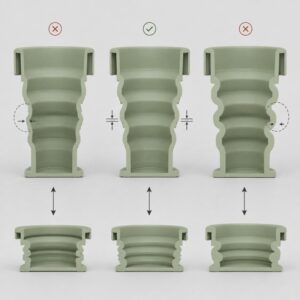
Common structural risks include:
- Very thin folding zones
- Abrupt thick-to-thin transitions
- Asymmetrical wall thickness
- Unsupported large surfaces
- Deep folds
- Sharp bending lines
- Heavy structures attached to thin walls
- Unbalanced ribs
Consider a collapsible silicone cup.
If one folding ring is significantly thinner than the others, most deformation may concentrate in that location.
After repeated folding, that area may behave differently from the rest of the cup.
그리고 DFM review should therefore examine the complete cross-section, not only the external product appearance.
Can Packaging Cause Permanent Shape Problems?
Yes.
패키징 can become part of the engineering problem.
Typical risks include:
- Packing the product in an unnatural folded position
- Using a retail box that is too small
- Stacking heavy products on flexible structures
- Compressing suction bases
- Folding across functional ribs
- Leaving the product compressed for long transportation periods
A product can pass inspection before packaging and still arrive at the customer visibly deformed.
This is why the final packaged sample should be validated before mass production.
Packaging should protect the product’s functional geometry rather than simply minimize carton volume.
How Should Shape Recovery Be Tested?
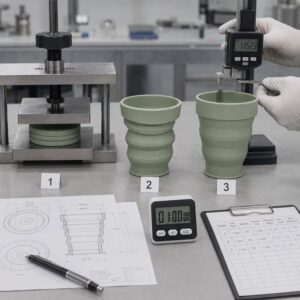
1. Define the Original Shape
Before compression, record:
- Product height
- Opening size
- Flatness
- Folding-ring position
- Suction-base geometry
- Other critical dimensions
2. Compress the Product as It Will Be Used or Packed
Do not invent an unrealistic compression method.
Use the actual:
- Folded condition
- Retail packaging
- Stacking pressure
- Assembly condition
3. Define the Holding Time
The test should represent real storage or use conditions.
4. Release the Product
Allow it to recover naturally without manually reshaping it unless manual recovery is part of the intended customer instruction.
5. Check Recovery at Defined Times
For example, evaluate:
- Immediately after release
- After an agreed short recovery period
- After a longer agreed period
6. Repeat the Functional Test
For example:
- Does the cup remain stable?
- Does the lid fit?
- Does the suction base work?
- Does the bib pocket stay open?
- Does the pouch opening recover?
Function is ultimately more important than simply saying that the product “looks almost normal.”
What Should Buyers Review During DFM?
Before opening the mold, confirm:
- Silicone material
- Target hardness
- Main wall thickness
- Folding-zone thickness
- Compression direction
- Expected compression amount
- Recovery requirement
- Product operating temperature
- Packaging position
- Long-term storage condition
- Functional acceptance criteria
A product that will remain permanently open does not require the same recovery design as one that will be folded thousands of times.
The engineering requirement should match real product use.
Shape Recovery Checklist
| 항목 | What Should Be Confirmed |
|---|---|
| 재료 | Suitable elastic recovery for the application |
| Hardness | Evaluated together with product geometry |
| Wall thickness | Supports both flexibility and recovery |
| Folding zones | Bend in the intended direction |
| Compression level | Matches actual use or packaging |
| Compression time | Represents realistic storage |
| Temperature | Relevant use and shipping conditions considered |
| Recovery time | Clearly defined |
| 기능 | Product still performs after recovery |
| 패키징 | Does not create unnecessary permanent deformation |
| Mold cavities | Recovery remains consistent across cavities |
| Pilot production | Batch samples behave consistently |
How LYA Silicone Supports Shape-Recovery Validation
LYA Silicone provides OEM/ODM development support across silicone baby, pet, outdoor and educational products, with product development involving drawings or samples, tooling, sample confirmation and mass production.
For products where repeated folding or compression matters, project review may include:
- Product-structure review
- Material and hardness discussion
- Wall-thickness evaluation
- Folding-zone analysis
- Mold-development review
- Sample production
- Shape-recovery testing
- Functional validation
- Packaging evaluation
- Pilot production
- Mass-production inspection
The objective is to confirm the product’s behavior in its finished molded geometry, not rely only on a raw-material hardness number.
Frequently Asked Questions
Is Compression Set the Same as Silicone Hardness?
No.
Hardness describes resistance to indentation. Compression set relates to the remaining deformation after a material has been held under compression and released.
Does Softer Silicone Always Recover Better?
No.
Recovery depends on material formulation, geometry, wall thickness, compression level, temperature and time.
Will Making the Product Harder Prevent Deformation?
Not necessarily.
Higher hardness can change folding force, suction behavior, comfort and overall function.
Can a Silicone Product Recover After Being Deformed in Packaging?
Some deformation may recover after release, while other deformation can remain longer or affect function.
The actual final package should therefore be tested.
Why Does One Folding Ring Recover Differently from Another?
Possible causes include wall thickness, geometry, material distribution, mold variation or how the product is compressed.
Should Shape Recovery Be Tested Before Mass Production?
Yes, especially for products that are folded, compressed, stacked or repeatedly deformed during normal use.
Design Recovery Into the Product Before Tooling
Shape recovery is not controlled by silicone material alone.
The final behavior depends on the interaction of:
- 재료
- Hardness
- Wall thickness
- Product geometry
- Compression
- Time
- Temperature
- 패키징
Before approving a collapsible, suction or flexible silicone product, define how the product should recover after realistic compression.
To review shape-recovery requirements for a custom silicone product, send LYA 실리콘 your drawing, application, hardness requirement, folding or compression condition, packaging method and estimated quantity.