 French
 English
 German
 Spanish
 Polish
 Chinese
 Japanese
 Korean
 Russian
Contenu
Answer Excerpt
A silicone pet food spatula may leave wet food inside can corners when its scraper head is too wide, the edge cannot follow the container’s curved surfaces, or the handle angle prevents the user from reaching the bottom-to-wall transition.
For pet food brands developing a custom silicone scraper, the most important design variables include scraper head width, front-edge profile, corner radius, silicone hardness, blade flexibility, handle geometry and compatibility with the intended food containers.
The objective is not to create the softest possible spatula. It is to balance surface contact, controlled scraping pressure, practical handling and easy cleaning.
OEM buyers should evaluate molded samples using representative cans, food pouches and agreed test media before approving the design for mass production.
Why Do Silicone Pet Food Spatulas Leave Food Behind?
Wet cat food and dog food are commonly packaged in metal cans, trays and flexible pouches.
These containers can have different internal shapes even when their external dimensions appear similar.
A silicone scraper may work well against a flat surface but leave residue around:
-
Curved can bottoms
-
Bottom-to-sidewall transitions
-
Narrow internal corners
-
Recessed base profiles
-
Deep container walls
-
Areas beneath the can opening
The problem is not always insufficient material flexibility.
A very soft scraper may bend away from the food instead of maintaining useful contact with the container surface.
A very stiff scraper may fail to conform to curved areas.
For OEM development, the scraper and its intended container should be evaluated as one functional combination.
Why Is Container Geometry Important?
The internal geometry of a pet food container determines which areas the scraper needs to reach.
For a metal can, the important characteristics may include:
-
Internal opening diameter
-
Container depth
-
Sidewall profile
-
Bottom curvature
-
Bottom corner radius
-
Internal ribs or steps
-
Clearance around the opening
The outer diameter of a can does not necessarily describe its usable internal space.
Two containers with similar capacity may require different scraping movements.
For this reason, brands should provide actual reference containers rather than relying only on photographs or nominal food weights.
A useful OEM project begins by defining the intended packaging types.
How Does Scraper Head Width Affect Cleaning Performance?
The width of the scraper head controls how much surface it can contact during one movement.
A broad head may transfer food efficiently from a shallow, wide container.
However, excessive width can make it difficult to reach narrow corners or maneuver inside a small can.
A narrower head may enter smaller openings more easily but require additional movements to collect food from a larger surface.
The correct design should balance:
Scraper Width → Container Access → Surface Contact → Food Transfer
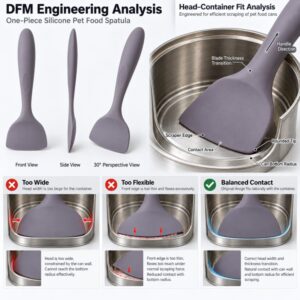
When the Scraper Head Is Too Wide
Possible problems include:
-
Contacting both sides of a curved wall before reaching the bottom
-
Difficulty moving around internal corners
-
Reduced maneuverability
-
Excessive bending at one side
-
Difficulty removing food near the container perimeter
When the Scraper Head Is Too Narrow
Possible problems include:
-
More scraping movements
-
Reduced contact area
-
Less efficient transfer of larger food portions
-
Greater dependence on user technique
The target head width should be established using actual containers and functional samples.
Why Does the Scraper Edge Need Controlled Flexibility?
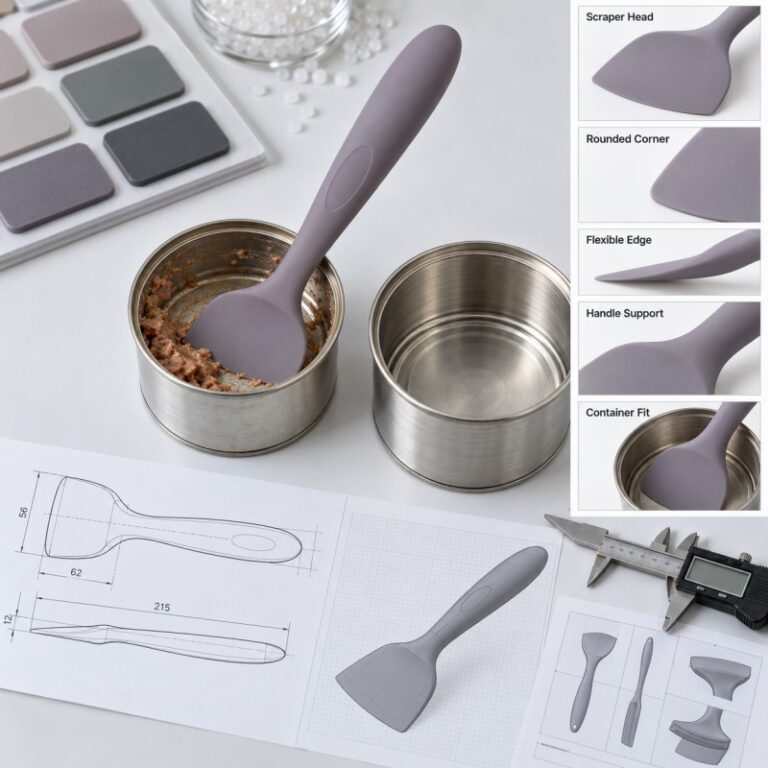
The scraper’s front edge is the main contact feature.
It should deform sufficiently to follow appropriate container surfaces while maintaining useful resistance against the food.
If the edge is excessively flexible, it may fold backward rather than moving food.
If the edge is too rigid, contact may occur only at a small area.
This can leave residue on a curved surface.
A suitable scraper design therefore needs two different characteristics:
-
A flexible contact edge
-
A sufficiently supportive head and handle
Both characteristics can be created through the relationship between material selection and molded geometry.
A one-piece silicone spatula may use the same compound throughout, but its thicker and thinner regions can respond differently to applied force.
How Does Scraper Edge Thickness Affect Performance?
The scraper edge needs to be thin enough for the intended flexibility but sufficiently supported for repeated use.
A very thin edge may deform excessively or become vulnerable to damage.
An unnecessarily thick edge may have difficulty conforming to container corners.
Important design factors include:
-
Tip thickness
-
Thickness transition
-
Edge length
-
Rounded contact profile
-
Local bending behavior
-
Root support
The edge should not be designed as a knife-like cutting feature.
A rounded and properly supported silicone edge is more appropriate for a scraping utensil intended to contact food containers.
The buyer should confirm the final geometry through molded samples rather than approving only a rendered cross-section.
[Insert Image 2 here: Scraper head, edge flexibility and can-corner contact geometry.]
Why Are Rounded Scraper Corners Important?
A scraper head with sharp rectangular corners may appear efficient in a drawing.
However, many pet food containers have rounded transitions between the bottom and sidewalls.
If the scraper corners do not match these areas, the tool may contact the container unevenly.
Rounded scraper corners can help create smoother contact and reduce unwanted catching.
The designer should evaluate:
-
Scraper corner radius
-
Target container corner radius
-
Head width
-
Contact angle
-
Edge flexibility
-
Available movement inside the container
A larger scraper radius is not always better.
If the radius becomes excessive, the contact area may be reduced along other surfaces.
The optimal profile depends on the range of containers the product is intended to serve.
Can One Silicone Scraper Work With Different Pet Food Cans?
A scraper may be designed to work with several container types, but universal compatibility should not be assumed.
For example, consider three hypothetical packaging formats:
| Reference Container | Main Design Challenge | Validation Required |
|---|---|---|
| Small wet-food can | Narrow access and limited movement | Head clearance and corner contact |
| Medium metal can | Curved bottom-to-wall transition | Edge conformity and food removal |
| Flexible food pouch | Narrow opening and deformable walls | Controlled scraping without damaging the pouch |
These are illustrative design scenarios, not verified compatibility results for an existing product.
A brand selling one scraper for multiple packaging types should develop a compatibility matrix.
This matrix can identify which containers were tested and which remain outside the approved range.
A claim such as “works with all pet food cans” should not be made without appropriate supporting evidence.
Why Does the Scraping Angle Matter?
Scraping performance also depends on the angle between the utensil and the container surface.
The user needs to position the head so the edge contacts the intended area without excessive force.
The required movement may change when scraping:
-
The flat bottom
-
The curved bottom corner
-
The vertical sidewall
-
The area close to the opening
A straight handle may provide effective control in some containers.
A slightly angled handle may suit other applications.
However, additional curvature is not automatically an improvement.
The designer must evaluate whether the handle angle provides better access without reducing the user’s ability to control the scraper.
A functional test should therefore use realistic movements rather than a single static contact demonstration.
How Does Silicone Hardness Influence Scraping?
The selected silicone hardness affects how the head, edge and handle deform.
A softer material may improve conformity at the contact edge but reduce support elsewhere.
A firmer material may provide greater structural resistance but change the edge’s ability to follow curved surfaces.
The final behavior also depends on:
-
Blade width
-
Tip thickness
-
Head length
-
Handle cross-section
-
Material formulation
-
Applied force
-
Container geometry
Silicone hardness alone does not establish scraping efficiency, tear resistance or long-term durability.
The material and the final molded structure should be approved together.
Why Is Handle Stiffness Important?
A flexible scraper edge needs enough support from the handle.
If the entire utensil bends excessively, the user may be unable to maintain consistent contact.
A handle that is too thin may create:
-
Excessive bending
-
Reduced scraping control
-
Poor force transfer
-
An unstable grip
-
Difficult operation in deeper cans
A thicker handle may improve support, but unnecessary bulk can make the product uncomfortable or difficult to maneuver.
Important design variables include:
-
Handle length
-
Handle width
-
Cross-sectional shape
-
Grip area
-
Head-to-handle transition
-
Overall product balance
For a one-piece silicone spatula, the head-to-handle junction should use a smooth transition rather than a narrow, abrupt neck.
Should the Scraper Be Designed for Both Cans and Pouches?
A dual-purpose scraper may be commercially attractive to pet food brands.
However, metal cans and flexible pouches create different contact conditions.
A metal can provides a relatively stable internal surface.
A flexible pouch may deform during scraping, changing the available contact area.
The designer should assess whether the scraper:
-
Fits through the intended opening
-
Can reach the necessary internal surfaces
-
Maintains controlled contact
-
Avoids unnecessarily aggressive edges
-
Can transfer food without excessive bending
-
Remains practical to clean afterward
A design intended mainly for rigid cans should not automatically be promoted as suitable for every pouch format.
The final claim should reflect the containers actually evaluated.
What About Sharp Metal Can Edges?
Opened metal cans may contain edges that can damage a soft scraping tool or injure a user.
A silicone pet food scraper is not a can opener and should not be used to pry metal lids or apply leverage against sharp metal edges.
Brands should evaluate:
-
The intended opening geometry
-
The available clearance
-
The scraper’s movement path
-
Foreseeable contact with sharp edges
-
Appropriate user instructions
If a reference can has a sharp exposed rim, the product should not be designed around forcing a thin silicone edge against that hazard.
The suitability of the scraper must be assessed under realistic, appropriate usage conditions.
Why Does Scraper Surface Finish Matter?
A smooth food-contact surface can help make the scraper easier to rinse and inspect.
However, logos, decorative grooves or complex textures may create unnecessary residue-retention areas.
For a wet-food scraping utensil, designers should consider:
-
Smooth blade surfaces
-
Accessible rounded transitions
-
Minimal deep grooves
-
Suitable logo placement
-
Controlled molded edges
-
Practical cleaning methods
The main scraper head should prioritize its function rather than decorative complexity.
Branding can be positioned on the handle or retail packaging where it does not interfere with the scraping surface.
How Should Cleaning Be Designed Into the Product?
Wet pet food can leave residue on the blade, handle junction and grip areas.
A suitable drainage and easy-clean design should avoid unnecessary pockets where food can remain.
For a one-piece scraper, useful considerations include:
-
Smooth continuous surfaces
-
Accessible blade corners
-
Rounded head-to-handle transitions
-
No unnecessary enclosed cavities
-
A practical rinsing method
-
Appropriate drying instructions
Cleaning requirements should be validated for the actual material and finished design.
Do not automatically claim that the product can withstand every dishwasher program, sterilization process or cleaning chemical.
The approved care instructions should be based on the intended use and material compatibility.
What Should Be Confirmed Before Tooling?
Before custom silicone mold development, the brand should agree on the product’s functional specification.
Important inputs include:
-
Target can and pouch types
-
Reference container samples
-
Scraper head width
-
Blade length
-
Edge thickness
-
Corner radius
-
Handle dimensions
-
Head-to-handle transition
-
Material requirements
-
Silicone hardness
-
Surface finish
-
Logo position
-
Testing method
-
Packaging concept
The mold design should also consider parting-line position, material filling, demolding and edge consistency.
The scraper’s contact edge is a functional feature.
Its dimensions and surface quality should therefore be included in the product’s inspection requirements.
How Should Food-Removal Performance Be Tested?
A useful OEM evaluation should reflect the intended serving process.
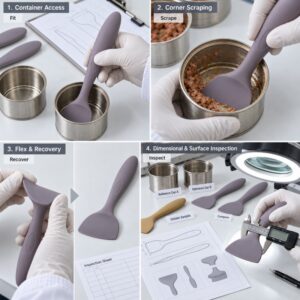
Container Access Test
Insert the scraper into each approved reference container.
Confirm that the head can reach the required surfaces without inappropriate interference.
Bottom Contact Test
Move the scraper across the container bottom using an agreed method.
Observe contact and remaining residue.
Corner Contact Test
Check the bottom-to-wall transitions.
Record areas that the scraper cannot access.
Controlled Food-Removal Test
Use representative wet pet food or an agreed test medium.
Define the initial quantity, scraping method and evaluation criteria.
Handle Deflection Test
Apply a representative use load and observe the handle’s deformation.
Shape-Recovery Test
Check whether the blade and handle return toward the approved geometry after controlled bending.
Cleaning Evaluation
Clean the utensil using the intended procedure.
Inspect the blade corners, edge and junction.
Multi-Sample Comparison
Compare several molded specimens for dimensions, appearance and functional behavior.
The buyer and manufacturer should agree on the test method before using the results to make product-performance claims.
[Insert Image 3 here: Silicone pet food spatula container-fit and functional sample inspection.]
Should Brands Measure How Much Food Remains?
Residual food is a useful performance indicator, but the test needs controlled conditions.
The result may change depending on:
-
Food consistency
-
Container geometry
-
Scraping direction
-
Applied pressure
-
Number of scraping passes
-
Operator technique
-
Test temperature
If a brand wishes to make a quantitative food-removal claim, the testing method should define these conditions.
For example, residual mass may be measured before and after a specified scraping procedure.
However, no removal percentage should be advertised without actual test evidence.
A comparative test can be more useful than an unsupported claim that the scraper removes every trace of food.
Practical Example: A Scraper for Wet Cat Food Cans
Consider a pet brand developing a one-piece silicone scraper for serving wet cat food.
The concept includes:
-
A short rounded scraper head
-
A moderately flexible contact edge
-
A thicker ergonomic handle
-
Smooth blade-to-handle transitions
-
A uniform matte finish
Version A — Scraper Head Too Wide
The head contacts the container sidewalls before reaching certain bottom areas.
Food remains near the curved corners.
Version B — Scraper Edge Too Flexible
The thin edge folds backward when moderate scraping pressure is applied.
The tool does not maintain the desired contact.
Version C — Handle Too Flexible
The head reaches the bottom, but the handle bends excessively during the scraping movement.
Improved Design
The revised concept balances:
-
Head width
-
Rounded corner geometry
-
Controlled tip flexibility
-
Handle support
-
Container clearance
-
Easy-clean surfaces
The design should then be tested with the brand’s actual reference cans.
This example illustrates engineering decisions rather than verified performance for an existing LYA product.
Silicone Pet Food Spatula OEM Checklist
| Design Item | What the Buyer Should Confirm |
|---|---|
| Target application | Wet cat food, dog food or other defined use |
| Reference packaging | Actual cans and pouches available |
| Scraper head width | Suitable for target container access |
| Front edge | Controlled flexibility and smooth geometry |
| Corner radius | Compatible with intended internal contours |
| Blade thickness | Balances contact and support |
| Handle stiffness | Practical force transfer |
| Head-to-handle transition | Continuous, rounded construction |
| Silicone material | Appropriate for intended contact conditions |
| Surface finish | Practical for food removal and cleaning |
| Mold quality | Critical edge geometry reproducible |
| Sample testing | Representative containers and media used |
| Residual-food assessment | Test method agreed where required |
| Cleaning | Finished structure accessible |
| Emballage | Does not create unwanted deformation |
| Product claims | Supported by actual testing |
| Inspection | Functional and visual criteria defined |
How LYA Silicone Supports Pet Food Scraper Development
LYA Silicone supports OEM and ODM development for custom consumer silicone products, including pet feeding accessories and reusable serving utensils.
Its wider range of silicone pet products includes feeding bowls, lick mats, treat pouches and other customized accessories.
For a silicone pet food scraper project, development discussions can cover:
-
Reference container evaluation
-
Scraper head and edge geometry
-
Material and hardness selection
-
One-piece molded structure
-
Color and logo customization
-
Mold development
-
Sample production
-
Dimensional and functional inspection
-
Packaging coordination
-
Bulk manufacturing
Brands developing matching feeding accessories can also explore silicone pet feeding bowls as part of a coordinated product collection.
For a private-label project, the final specification should be confirmed using the actual target containers and approved sample requirements.
Frequently Asked Questions
Why Does a Silicone Pet Food Spatula Leave Food in Can Corners?
Possible causes include excessive scraper width, unsuitable corner radius, insufficient edge conformity, excessive blade bending or an inconvenient handle angle.
Is a Softer Silicone Scraper Always Better?
No. A very soft blade may bend away from the food rather than maintaining useful contact.
Can One Silicone Scraper Fit Different Can Sizes?
It may work with several selected containers, but compatibility should be verified using representative cans and pouches.
Is a Flat Silicone Scraper Better Than a Spoon?
They perform different tasks. A flat scraper focuses on contact with container surfaces, while a spoon primarily holds and transfers a portion of food.
Can the Scraper Head Be Customized?
Yes. Head width, corner profile, local thickness and other features can be developed for a buyer’s intended application, subject to tooling and functional validation.
Can a Silicone Pet Food Scraper Be Molded in One Piece?
Yes. A one-piece silicone structure can be developed, provided the flexible head and supportive handle are appropriately balanced.
Does the Scraper Need Food-Contact Testing?
The material and finished-product requirements depend on the intended contact conditions and sales market. The buyer should confirm an applicable testing plan rather than relying only on general material claims.
What Should Buyers Provide for a Custom Quotation?
Provide the target containers, drawing or reference sample, scraper dimensions, intended food type, material requirements, preferred color, logo, packaging and estimated quantity.
Design Around the Food Container, Not Just the Scraper
An effective silicone pet food spatula depends on the relationship between:
Container Geometry → Scraper Width → Edge Contact → Blade Flexibility → Handle Control → Sample Validation
A scraper should not be designed only to look soft or attractive.
For OEM pet product brands, real container-fit testing provides a stronger basis for design approval than appearance alone.
If you are developing a custom silicone pet food spatula or a coordinated pet feeding accessory collection, contact us with your reference cans or pouches, drawings, material requirements, expected use conditions, branding specifications, packaging and estimated order quantity.