 French
  English
  German
  Spanish
  Polish
  Chinese
  Japanese
  Korean
  Russian
 Contenu
Answer Excerpt
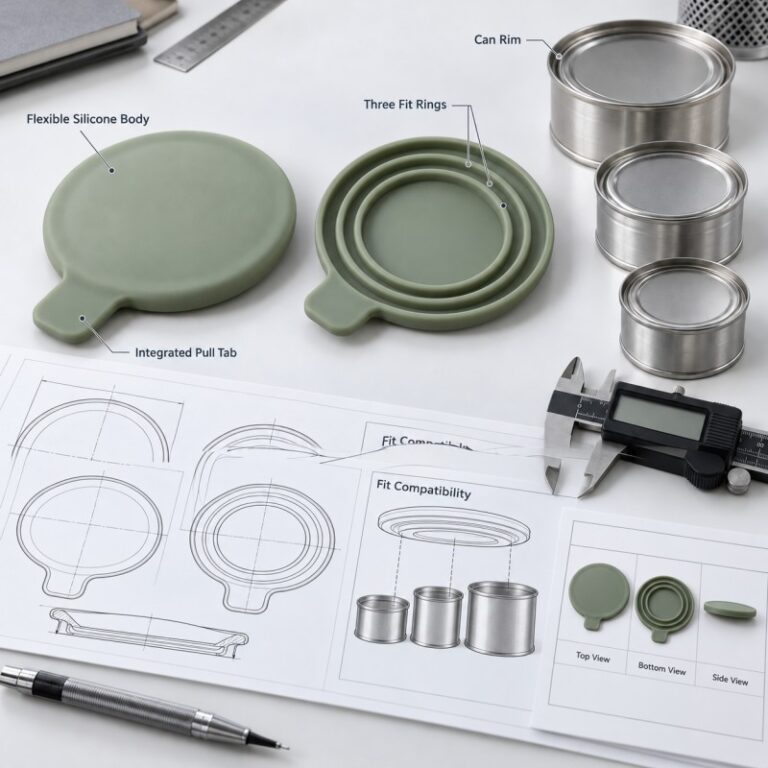
A silicone pet food can lid can be designed to fit several selected can sizes, but a multi-size lid is not automatically compatible with every wet pet food can. Reliable fit depends on the can rim diameter, rolled-edge profile, engagement-ring geometry, silicone flexibility, installation force and resistance to accidental removal.
For OEM pet brands, a multi-size silicone can cover should be validated using the actual target cans. The manufacturer should establish a compatibility matrix and test installation, retention, removal, repeat use and dimensional consistency before mass production.
Why Is Multi-Size Compatibility Important for Pet Food Can Lids?
Wet pet food is commonly sold in metal cans with different capacities and opening dimensions.
For pet brands, retailers and private-label companies, a reusable silicone lid can be a useful accessory for opened canned food.
However, different cans may have different rim structures even when they appear similar in product photographs.
A lid developed around one reference can may fit that container correctly but become difficult to install on another can.
Possible complaints include:
-
The lid feels too loose.
-
One side lifts after installation.
-
The lid is difficult to press onto the can.
-
The cover becomes distorted.
-
The pull tab requires excessive force.
-
The lid works on one brand of can but not another.
These issues are particularly important when a product is marketed as fitting several can sizes.
The objective should be verified compatibility rather than a broad, unsupported universal-fit claim.
Does Can Capacity Tell You the Correct Lid Size?
Not necessarily.
Buyers often identify canned pet food by the amount of food inside.
However, the labeled weight or volume does not always establish the exact external rim dimensions.
Two cans with similar capacities may have different:
-
Outer rim diameters
-
Rolled-edge profiles
-
Rim thicknesses
-
Opening geometries
-
Body diameters
-
Manufacturing tolerances
A brand should therefore avoid developing a silicone lid based only on a list of can capacities.
Actual can samples or controlled technical drawings provide a more useful basis for product development.
For an OEM project, each target container should be identified by manufacturer, specific can type and measured rim geometry.
What Can Dimensions Should Be Measured Before Tooling?
The most important measurements are those that determine how the silicone lid engages the metal can.
Outer Rim Diameter
This dimension helps establish the position of the lid’s engagement features.
It should be measured on representative cans rather than estimated from nominal package information.
Rim Profile
A rolled metal edge may contain a curved or stepped profile.
The silicone engagement ring must interact with that shape.
A lid designed for one rim profile may not retain the same way on another.
Rim Height and Thickness
These dimensions affect how far the silicone feature can engage with the can.
An inappropriate engagement depth may create insufficient retention or excessive installation force.
Roundness and Dimensional Variation
Real containers may have permitted manufacturing variation.
Buyers should review whether the can is sufficiently round and whether its rim dimensions remain consistent across samples.
Clearance Around the Opening
The lid should not interfere unnecessarily with the opening or with the intended removal method.
For reusable covers, relevant dimensional tolerances must be coordinated with the target can dimensions.
The correct fit cannot be determined from silicone lid dimensions alone.
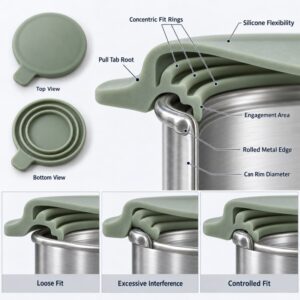
How Do Three Concentric Fit Rings Work?
One approach is to design several integrated circular engagement features into the underside of a single silicone cover.
LYA Silicone’s existing product concept uses three concentric fit rings intended for selected can rim sizes.
These rings are molded as part of the same silicone body rather than assembled as separate components.
The engineering objective is to provide different engagement positions for different reference cans.
For example:
-
One ring may correspond to a smaller target rim.
-
Another may correspond to an intermediate target rim.
-
A third may correspond to a larger target rim.
The actual arrangement depends on the measured can geometry.
It is important that unused rings do not interfere with the ring intended to engage a particular can.
The manufacturer should also consider how the flexible lid body behaves when one of the engagement rings is stretched or compressed during installation.
A design that fits one size correctly may still need modifications to accommodate the complete range.
Why Does More Interference Not Always Mean Better Retention?
Silicone is elastic, so a lid can deform when it is installed onto a metal rim.
Controlled interference may help create contact between the lid and the can.
However, increasing interference is not always beneficial.
If the fit is too tight, the user may experience:
-
Excessive installation force
-
Difficulty positioning the cover
-
Distortion around the outer edge
-
Uncomfortable removal
-
Increased stress near the pull tab
If the fit is too loose, the lid may:
-
Lift at one side
-
Detach during normal handling
-
Fail to remain evenly seated
-
Offer inconsistent coverage
For OEM brands, installation and removal should both be part of the functional specification.
A lid that is extremely difficult to remove should not automatically be considered a successful design.
How Does Silicone Hardness Affect Can Lid Fit?
The selected silicone hardness influences the flexibility of the engagement rings and lid body.
Softer silicone may allow easier deformation around certain rim structures.
However, excessive flexibility can change the way the lid retains its shape.
Firmer silicone may provide greater structural support, but it may require more installation force.
The final behavior depends on several variables:
-
Material formulation
-
Ring geometry
-
Ring cross-section
-
Lid thickness
-
Can rim diameter
-
Engagement depth
-
Elastic recovery
Hardness should not be selected independently of the molded geometry.
The buyer and manufacturer should evaluate actual samples using the required cans before approving the final material specification.
Why Is the Lid’s Main Body Important?
The engagement rings are only part of the design.
The main circular body must also maintain suitable geometry during installation and removal.
If the body is excessively thin, it may deform unevenly when the user presses it onto the can.
If it is unnecessarily thick, installation and removal may become less convenient.
The designer should review:
-
Overall lid diameter
-
Main body thickness
-
Outer-edge geometry
-
Transition into the fit rings
-
Local bending behavior
-
Shape recovery
The ideal structure should allow the intended engagement ring to function without excessive distortion elsewhere.
This requires the complete lid to be evaluated as one flexible component.
How Should the Pull Tab Be Designed?
A pull tab makes the cover easier to remove without requiring the user to grip the entire outer edge.
For a one-piece silicone design, the tab is integrated directly into the molded lid.
Important considerations include:
Tab Width
A narrow tab may be uncomfortable to grip and can concentrate force at its root.
Tab Length
The tab needs enough exposed area for normal handling without creating an unnecessarily large projection.
Root Transition
The connection between the pull tab and the circular lid should use smooth, rounded transitions.
Removal Direction
The expected pulling direction affects how force travels through the tab and into the engaged ring.
Repeated Use
The tab should be evaluated after multiple installation and removal cycles.
The goal is a pull tab that provides practical access while maintaining adequate structural integrity.
Should a Silicone Pet Food Can Lid Be Called Airtight?
Not without relevant validation.
A silicone cover may remain attached to a can without providing a verified airtight or liquid-tight seal.
These characteristics should be distinguished:
| Performance Description | Ce que cela signifie |
|---|---|
| Covering function | Covers the opening of a compatible can |
| Retention | Remains engaged under defined handling conditions |
| Splash resistance | Resists limited liquid movement under defined tests |
| Liquid-tight | Meets a specified liquid-leakage test |
| Airtight | Meets an applicable defined air-leakage requirement |
Passing a retention test does not automatically establish airtightness.
Similarly, placing a reusable lid onto an opened wet-food can does not make the food shelf-stable or extend its permitted storage period.
Opened pet food should be refrigerated and handled according to the food manufacturer’s instructions.
Brands should make performance claims only when supported by suitable finished-product testing.
Why Is a Compatibility Matrix Better Than a Universal-Fit Claim?
A compatibility matrix records which can types have actually been evaluated.
Instead of stating that a single lid fits every can, brands can define the approved range.
For example:
| Can Reference | Rim Profile | Intended Engagement Ring | Validation Result |
|---|---|---|---|
| Can A | Rounded rolled rim | Inner ring | To be tested |
| Can B | Rounded rolled rim | Middle ring | To be tested |
| Can C | Different rim profile | Outer ring | To be tested |
| Can D | Unverified geometry | Not assigned | Not approved |
Illustrative engineering matrix only. These are not real measured can dimensions or approved compatibility results.
The matrix should record actual measured dimensions and test results during development.
This approach helps buyers manage:
-
Product specifications
-
Retail packaging statements
-
Customer expectations
-
Quality inspection
-
Future design changes
When a new can format is introduced, it can be evaluated against the existing compatibility standard rather than automatically added to the marketing claim.
How Should Brands Test Installation and Removal?
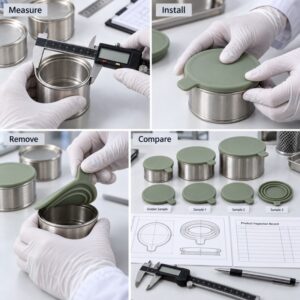
The sample approval process should simulate the way consumers handle the cover.
Installation Test
Position the lid on each target can.
Check whether the intended engagement ring seats evenly around the rim.
Observe whether the lid twists, folds or becomes difficult to position.
Retention Test
Evaluate whether the lid remains attached under the agreed handling conditions.
The acceptance method should reflect the intended product use, not an arbitrary force value.
Removal Test
Use the integrated tab to remove the lid.
Check whether the action is reasonably controlled and whether the tab or ring undergoes unacceptable deformation.
Repeated-Use Test
Install and remove the lid repeatedly according to the agreed evaluation method.
Inspect changes in fit, appearance and recovery.
Fit Variation Test
Use multiple cans of each target type.
A lid fitting one ideal can is not enough to establish compatibility across the permitted production variation.
Why Should Testing Include More Than One Molded Lid?
A single prototype may perform well but may not represent production variation.
Different molded samples should be compared for:
-
Ring diameters
-
Ring shape
-
Overall lid geometry
-
Main body thickness
-
Edge flatness
-
Pull-tab condition
-
Installation behavior
-
Removal behavior
If production involves several mold cavities, cavity-to-cavity consistency may also need to be reviewed.
The objective is to ensure that normal production variation does not produce incompatible combinations of lid and can.
A useful production acceptance standard should include both dimensional and functional checks.
How Should Cleaning and Food Contact Be Evaluated?
A pet food can cover may contact wet food residue and the can opening.
For that reason, the material specification should reflect the intended contact conditions and applicable target-market requirements.
The underside engagement rings should be accessible for normal cleaning.
Avoid unnecessary narrow grooves or enclosed pockets that retain residue.
The brand should define:
-
Intended cleaning method
-
Material compatibility
-
Surface finish
-
Food-contact requirements where applicable
-
Cleaning instructions
-
Repeated-use conditions
A finished lid should not be described as universally dishwasher-safe or suitable for every cleaning method without appropriate verification.
What Should OEM Buyers Approve Before Mold Development?
Before custom silicone mold development, brands should prepare a controlled product specification.
The specification should include:
-
Target can types
-
Reference can samples
-
Measured rim dimensions
-
Approved compatibility range
-
Engagement-ring structure
-
Silicone material requirements
-
Hardness selection
-
Lid-body geometry
-
Pull-tab design
-
Couleur
-
Logo position
-
Surface finish
-
Emballage
-
Inspection requirements
-
Testing conditions
-
Acceptance criteria
The tooling team should review mold filling, demolding, parting-line position and critical ring geometry.
A visually acceptable mold sample does not automatically prove that the finished product will fit every intended reference can.
How Should Bulk Production Be Inspected?
For mass production, inspection should use the approved drawing, reference samples and compatibility matrix.
The manufacturer and buyer should define both dimensional checks and functional fitting checks.
Useful AQL inspection planning may include:
-
Correct silicone material and color
-
Critical ring dimensions
-
Lid diameter and flatness
-
Pull-tab integrity
-
Flash and edge condition
-
Appearance
-
Functional fit with designated reference cans
-
Packaging completeness
-
Lot identification
Functional failures that make a lid incompatible with its approved can should receive appropriate attention in the defect classification.
The inspection plan should distinguish functional failures from minor cosmetic variation.
Silicone Pet Food Can Lid OEM Compatibility Checklist
| Evaluation Item | What the Buyer Should Confirm |
|---|---|
| Target cans | Actual reference containers available |
| Rim dimensions | Diameter and profile measured |
| Ring layout | Matches selected can types |
| Silicone hardness | Evaluated using molded samples |
| Main body | Provides controlled flexibility |
| Installation | Practical under defined conditions |
| Retention | Meets agreed functional requirements |
| Pull tab | Easy to access and structurally supported |
| Removal | Does not require excessive force |
| Repeated use | Fit remains within approved limits |
| Cleaning | Engagement areas remain accessible |
| Food contact | Material requirements defined |
| Compatibility claim | Limited to verified can types |
| Mold development | Critical features reviewed before tooling |
| Inspection | Dimension and functional tests defined |
| Emballage | Correct usage and fit information supplied |
How LYA Silicone Supports Pet Food Can Lid OEM Projects
LYA Silicone provides OEM and ODM development support for reusable silicone accessories, including pet feeding products and customized consumer silicone components.
Its existing produits en silicone pour animaux de compagnie range includes feeding, grooming, enrichment and travel-related items.
For a customized pet food can lid project, development support may include:
-
Can sample and drawing review
-
Rim measurement discussion
-
Engagement-ring design
-
Silicone material selection
-
Hardness evaluation
-
Mold development
-
Color and logo customization
-
Sample production
-
Compatibility validation
-
Quality inspection
-
Packaging coordination
-
Bulk production
Brands can begin with an existing compatible design concept or discuss custom tooling for their target cans.
The final product specification should be confirmed through measured samples and agreed testing rather than universal-fit assumptions.
Frequently Asked Questions
Can One Silicone Pet Food Can Lid Fit Multiple Can Sizes?
Yes, a multi-size design can accommodate several selected rim dimensions, but every target can type should be measured and tested. Compatibility is not universal.
Can a Lid Fit Two Cans With Similar Capacities?
Possibly, but can capacity alone does not establish rim compatibility. External rim dimensions and rolled-edge profiles matter.
Do Three Fit Rings Guarantee Compatibility With Three Can Sizes?
No. Three rings provide three intended engagement features. Their actual compatibility depends on the target can geometries and finished molded performance.
Is a Tighter Silicone Lid Always Better?
No. Excessive interference can make installation and removal difficult or deform the lid.
Can a Silicone Pet Food Can Lid Be Used Without Refrigeration?
A reusable lid does not make opened wet pet food shelf-stable. Follow the pet food manufacturer’s storage and handling instructions.
Can the Pull Tab Be Customized?
Yes. Its geometry, position and surface can be reviewed during OEM product development, subject to functional requirements and tooling feasibility.
What Should Buyers Send for a Custom Quotation?
Provide target can samples or drawings, rim measurements, required can types, product concept, color, logo, packaging, target market and estimated quantity.
Verify Can Compatibility Before Making Product Claims
A reliable multi-size silicone pet food can lid depends on:
Can Rim → Fit Ring → Silicone Flexibility → Installation → Retention → Removal → Inspection
The product should not be developed around an unsupported assumption that all cans with similar capacities have identical openings.
For pet food brands, importers, distributors and private-label buyers, a compatibility matrix and controlled sample evaluation provide a more useful basis for development and marketing claims.
If you are developing custom silicone pet food can lids for your brand, contact us with your reference can types, rim dimensions, required fit range, material specification, color, logo, packaging and estimated order quantity.