 French
  English
  German
  Spanish
  Polish
  Chinese
  Japanese
  Korean
  Russian
 Contenu
Introduction
Baby feeding sets are products that come into direct contact with food, liquids, hands, and often a baby’s mouth. For baby brands, importers, wholesalers, and private-label sellers, choosing silicone is only the beginning of product development.
A buyer may ask:
Is a silicone baby feeding set safe?
A properly designed and manufactured silicone feeding set can be suitable for baby feeding applications. However, the word “silicone” alone does not prove that a finished product is appropriate for a specific market or intended use.
Material formulation, product structure, molding quality, color system, surface finish, cleaning design, testing plan, packaging, traceability, and production consistency must all be evaluated before launch.
Buyers can also review our produits en silicone pour bébés for different OEM and private-label product categories.
This guide explains what B2B buyers should check when developing custom silicone baby feeding sets through OEM or ODM manufacturing.
Answer Excerpt
A silicone baby feeding set can be suitable for baby feeding applications when the material, finished-product design, molding process, testing plan, packaging, and intended use are properly controlled.
Baby brands should not evaluate safety based only on a supplier saying that the product is made from “food-grade silicone.” Buyers should also confirm the target market, age group, food-contact conditions, product structure, suction performance, surface finish, cleaning convenience, color requirements, packaging information, inspection standards, and applicable testing requirements before mass production.
What Products Are Included in a Silicone Baby Feeding Set?
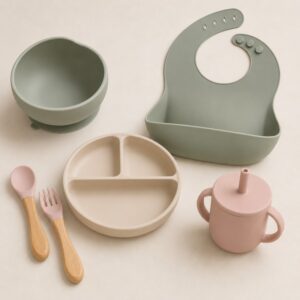
A silicone baby feeding set may contain different product combinations depending on the brand, target age group, selling channel, and price positioning.
Common components include:
- Silicone suction bowl
- Divided silicone plate
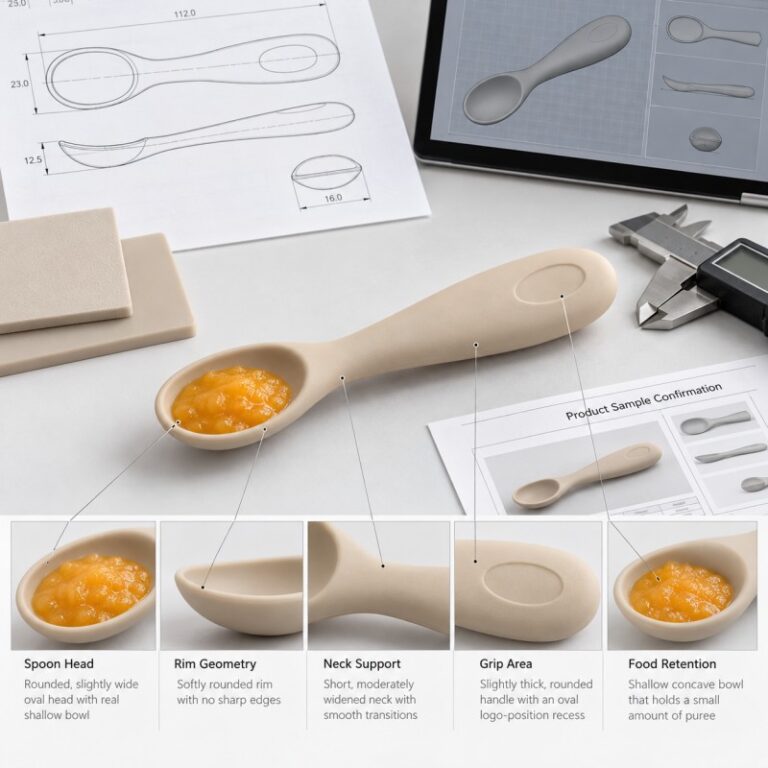
- Silicone spoon and fork
- Bavette en silicone
- Silicone straw cup
- Snack cup
- Placemat
- Training cup
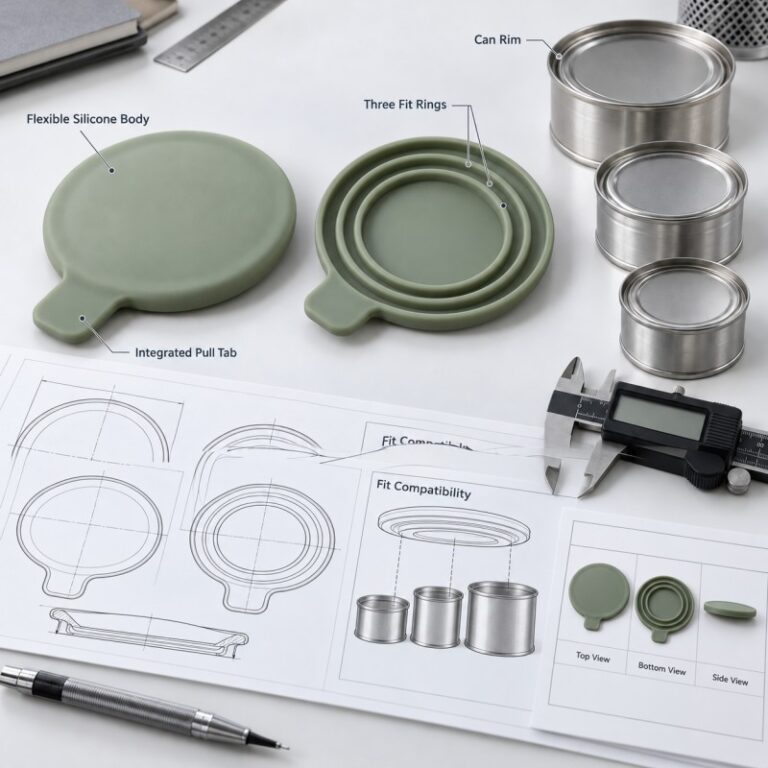
- Bowl lid
- Travel storage case
Some brands launch a simple bowl-and-spoon combination, while others develop a complete feeding collection with coordinated colors, logos, packaging, and accessories.
Before asking a manufacturer for pricing, buyers should define which components belong in the set. A quotation for one bowl and one spoon is very different from a quotation for a complete private-label feeding collection.
1. Start With the Intended Use and Target Age Group
The first step is not selecting a color or shape. It is defining how the product will be used.
Buyers should confirm:
- Target age group
- Product function
- Food-contact conditions
- Hot or cold food use
- Expected cleaning method
- Intended sales country
- Retail or promotional use
- Whether the product will be used at home, outdoors, or during travel
For example, a suction bowl for early self-feeding requires different structural considerations from a snack cup or straw cup.
The spoon size, handle thickness, bowl depth, suction base, rim shape, and product weight should be developed around the intended user rather than copied from an unrelated product.
A clear intended-use definition also helps the manufacturer recommend suitable material, hardness, structure, mold design, and testing arrangements.
2. “Food-Grade Silicone” Is Not the Entire Evaluation
Food-contact suitability is important, but material wording should not be treated as the only purchasing criterion.
Buyers should ask the supplier to clarify:
- Silicone material type
- Material supplier or grade
- Color masterbatch requirements
- Target food-contact conditions
- Applicable testing requirements
- Whether testing applies to raw material or the finished product
- Whether different colors require separate evaluation
- How material batches are controlled
A raw-material document does not automatically cover every finished product, color, accessory, printing process, or packaging combination.
The complete product should be evaluated based on its intended market and use conditions.
Buyers should also avoid assuming that food-grade silicone and medical-grade silicone are interchangeable terms. Material selection should be based on the actual application rather than choosing the most impressive-sounding description.
3. Evaluate Every Component in the Feeding Set
A baby feeding set may include more than molded silicone.
Depending on the design, it may also contain:
- Plastic lids
- Stainless-steel spoon cores
- Printed logos
- Adhesive labels
- Packaging films
- Paper inserts
- Decorative components
- Zippers or travel-case accessories
Buyers should evaluate the complete bill of materials, not only the main silicone body.
For example, a silicone spoon may use an internal metal or plastic insert. A straw cup may combine silicone, plastic, and other components. The safety and durability of the final product depend on the complete structure.
The supplier should clearly identify which materials and processes are included in the quotation.
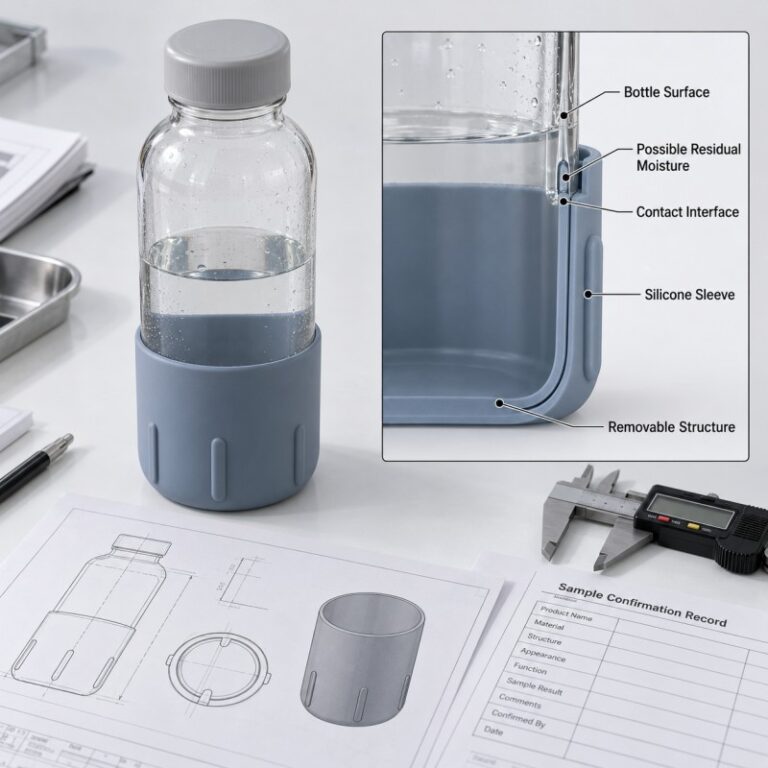
4. Product Design Directly Affects Cleaning

A feeding set may use suitable material but still provide a poor user experience if its structure is difficult to clean.
Common problem areas include:
- Deep and narrow grooves
- Sharp internal corners
- Hollow areas that trap water
- Hard-to-remove lids
- Complex suction structures
- Deep embossed logos
- Narrow straw passages
- Uneven surfaces
- Food-trapping seams
For baby products, cleaning convenience should be reviewed during the design stage rather than after the mold is completed.
The same principle applies when developing a custom silicone baby feeding bowl and spoon set for private-label production.
Rounded transitions, accessible surfaces, suitable texture depth, removable components, and practical drainage can make everyday cleaning easier.
Brands should balance visual differentiation with usability. A highly decorative product may look attractive in a rendering but become frustrating for parents if food repeatedly remains in the detailed texture.
5. Check the Suction Base Structure
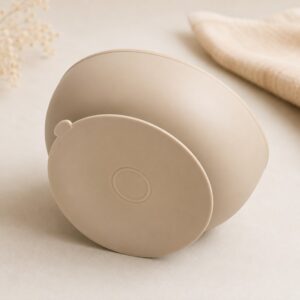
Suction performance is one of the most important functions of many silicone baby bowls and plates.
However, suction performance is not determined only by making the base larger.
It can be affected by:
- Base diameter
- Suction-cavity depth
- Edge thickness
- Silicone hardness
- Product weight
- Surface flatness
- Table material
- Mold accuracy
- Deformation after molding
- Packaging and storage conditions
A suction base that works on one smooth laboratory surface may perform differently on wood grain, textured tables, or uneven surfaces.
Before approving mass production, buyers should define a practical test method and understand the limitations of the product’s suction function.
The supplier should also control base flatness and deformation consistently across production batches.
6. Wall Thickness and Hardness Must Match the Function
Silicone hardness affects flexibility, grip, deformation, suction, user comfort, and product stability.
A very soft bowl may feel comfortable but collapse too easily when filled. A very hard spoon may not provide the desired soft-touch experience. An overly thin suction plate may deform, while an overly thick product can feel heavy and increase material usage.
Hardness cannot be selected separately from the product structure.
The manufacturer should review:
- Product dimensions
- Wall thickness
- Rib structure
- Bowl depth
- Spoon handle design
- Suction base
- Demolding direction
- Packaging method
- Expected temperature exposure
For custom projects, prototype and sample evaluation are important before finalizing the production specification.
7. Inspect Surface Finish, Parting Lines, and Flash
Finished-product quality affects more than appearance.
Baby feeding products are handled, washed, bent, and used repeatedly. Rough edges, excessive flash, uneven textures, poorly placed parting lines, and unstable logo details can reduce user confidence and make cleaning more difficult.
Buyers should define acceptable standards for:
- Edge flash
- Parting-line position
- Surface texture
- Gloss level
- Logo definition
- Color consistency
- Flow marks
- Air marks
- Stains
- Deformation
- Product dimensions
A sample that looks acceptable from a distance may still have problems around the spoon edge, bowl rim, suction base, or logo recess.
These areas should be inspected closely before sample approval.
8. Do Not Make Heat or Cleaning Claims Without Validation
Silicone is often selected for products that may be washed, heated, chilled, or used with different foods.
However, brands should not automatically publish claims such as:
- Passe au four à micro-ondes
- Lavable au lave-vaisselle
- Boil safe
- Freezer safe
- Peut être mis au four
- Sterilizer safe
The appropriate claim depends on the material, product structure, accessories, test conditions, target market, and intended use.
A silicone bowl with no additional components may behave differently from a straw cup containing plastic parts or a spoon with an internal insert.
Before printing care instructions on the packaging, buyers should confirm the validation method and product-specific limitations.
9. Plan Compliance and Testing Before Tooling
Testing should not be discussed only after mass production.
Before mold development, the buyer should tell the manufacturer:
- Target country or region
- Catégorie de produit
- Intended age group
- Food-contact conditions
- Temperature claims
- Labeling plan
- Packaging claims
- Required test items
- Whether testing applies to each color
- Whether the customer has a nominated laboratory
Requirements vary according to product classification and sales market.
The buyer, brand owner, importer, testing laboratory, and manufacturer should align on the testing plan early. This helps reduce the risk of completing tooling and samples before discovering that the structure, color, material, or labeling plan must be changed.
The manufacturer can support material selection and sample preparation, but the brand should confirm the final regulatory pathway for its target market.
10. Packaging Is Part of Product Safety and Quality
Packaging is not only a marketing decision.
Incorrect packaging can deform suction bases, bend spoons, compress product edges, create dust exposure, or cause products to lose their intended presentation during transport.
Buyers should evaluate:
- Individual bag or box
- Set arrangement
- Product support insert
- Suction-base protection
- Dust prevention
- Ventilation requirements
- Label position
- Barcode position
- Care instructions
- Batch identification
- Shipping-carton strength
For retail baby products, packaging should communicate product use and care clearly without making unsupported claims.
Packaging trials should be completed using actual molded samples rather than relying only on digital layouts.
11. Ask How the Manufacturer Controls Batch Consistency
One approved sample does not guarantee consistent mass production.
Buyers should ask how the supplier controls:
- Incoming silicone material
- Color matching
- Material mixing
- Mold condition
- Curing parameters
- Product dimensions
- Product weight
- Surface quality
- Suction performance
- Packaging inspection
- Batch traceability
- Final shipment inspection
Color consistency is especially important when a feeding set contains several independently molded products.
A bowl, spoon, bib, cup, and plate may be produced with different molds and production cycles. The manufacturer must control the color and surface finish so that the complete set looks coordinated.
12. Review the Supplier’s OEM Development Process
A suitable baby feeding product manufacturer should do more than receive a reference photo and provide a price.
Brands planning multiple products should also evaluate whether the supplier can support long-term OEM/ODM cooperation.
A structured OEM/ODM process may include:
- Project requirement review
- Product and market clarification
- Drawing or sample evaluation
- Material and hardness selection
- DFM and structure review
- Mold quotation
- Mold development
- First sample production
- Sample inspection
- Customer approval
- Packaging confirmation
- Pilot production
- Production de masse
- Final inspection and delivery
Buyers should clarify which services are included, which require additional cost, and which documents will be provided at each stage.
What Information Should Buyers Provide for Quotation?
A complete inquiry allows the manufacturer to evaluate the project more accurately.
Buyers should provide:
- Product reference photo
- 2D or 3D drawing, when available
- Components required in the feeding set
- Target dimensions
- Target age group
- Silicone material requirement
- Hardness preference
- Pantone colors
- Logo file
- Surface texture
- Packaging reference
- Target market
- Testing requirements
- Estimated order quantity
- Expected launch schedule
If the product is based on an existing design, buyers should also explain which parts need to be changed.
Simply asking for “the price of a silicone baby feeding set” is usually not enough for an accurate OEM quotation.
How LYA Silicone Supports Custom Baby Feeding Set Projects
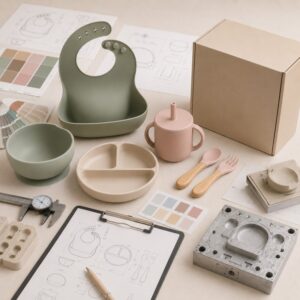
LYA Silicone supports OEM and ODM manufacturing for silicone baby products, including feeding bowls, spoons, plates, bibs, straw cups, teethers, pacifiers, bottle brushes, and related baby accessories.
Our project support can include:
- Product requirement review
- Custom shape and structure
- Material and hardness selection
- Pantone color matching
- Embossage ou débossage du logo
- Mold development
- Sample production
- Surface texture selection
- Packaging coordination
- Quality inspection
- B2B bulk production
For a complete feeding collection, we can help buyers evaluate product combinations, visual consistency, mold requirements, packaging arrangement, and production feasibility.
Early communication about the target market, product claims, testing plan, and estimated quantity can make project evaluation more accurate.
Frequently Asked Questions
Is every silicone baby feeding set automatically food safe?
No. The material name alone is not enough to evaluate a finished product. The material grade, color system, complete product structure, intended use, production process, target market, and applicable testing requirements should all be reviewed.
What should a baby brand confirm before opening a mold?
The brand should confirm product dimensions, components, age group, intended use, material, hardness, structure, color, logo, packaging, target market, testing requirements, and estimated quantity.
Can the bowl, spoon, bib, and cup use the same silicone hardness?
Not necessarily. Different products have different functional requirements. The suitable hardness should be evaluated together with wall thickness, structure, flexibility, suction performance, and intended use.
Why does a silicone suction bowl sometimes fail to stick?
Suction performance can be affected by the base design, hardness, flatness, deformation, table surface, cleanliness, and test method. Buyers should define realistic suction-testing conditions before sample approval.
Can custom colors and logos be added?
Yes. Silicone baby feeding products can generally be developed with Pantone colors and custom logo processes such as embossing or debossing. The final method depends on the product structure and brand design.
What is needed for an OEM quotation?
Buyers should provide product images or drawings, target dimensions, set components, material requirements, colors, logo, packaging, target market, estimated quantity, and testing requirements.
Conclusion
A silicone baby feeding set can be suitable for baby feeding applications, but buyers should not base the entire evaluation on the word “silicone” or a single raw-material statement.
Material selection, complete product structure, cleaning design, suction performance, hardness, molding quality, testing, packaging, traceability, and mass-production consistency all affect the finished product.
For baby brands, importers, wholesalers, and private-label sellers, the best time to review these requirements is before mold development.
If you are planning a custom silicone baby feeding set, contact LYA Silicone and send us your product reference, drawing, target dimensions, set components, colors, logo, packaging requirements, target market, and estimated quantity.. Our team will review the project and provide an appropriate OEM/ODM manufacturing proposal.