 French
  English
  German
  Spanish
  Polish
  Chinese
  Japanese
  Korean
  Russian
 Contenu
Introduction
Developing a successful pet product line requires more than selecting several existing products and adding a logo.
Pet brands, wholesalers, distributors, Amazon sellers, Shopify brands, and private-label buyers need to consider product positioning, target pet type, functional design, material requirements, mold development, color coordination, packaging, inspection, and repeat-order consistency.
Silicone is commonly selected for pet feeding, enrichment, grooming, travel, and interactive products because it can be developed into flexible, washable, colorful, and highly customized structures.
However, every silicone pet product has different functional requirements. A collapsible travel bowl, a suction lick mat, a dog chew toy, and a pet bath brush cannot be developed using exactly the same design logic.
This guide explains how buyers can build a coordinated custom silicone pet product line through OEM or ODM manufacturing.
Answer Excerpt
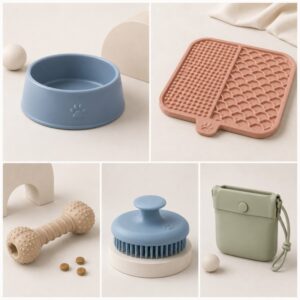
A custom silicone pet product line should be planned around a clear target market, pet type, use scenario, product combination, material requirement, brand style, packaging system, and estimated order quantity.
Before opening molds, buyers should evaluate the function of every product separately. Feeding bowls need stability and suitable capacity. Lick mats need practical texture and suction design. Chew toys need suitable toughness and geometry. Grooming products need comfortable grip and functional bristle structures.
A capable silicone pet products manufacturer should support product review, material and hardness selection, mold development, sample production, custom colors, logo processes, packaging coordination, inspection, and consistent bulk production.
1. Define the Target Customer Before Selecting Products
The first step is deciding who will buy and use the product line.
Different customer groups may require very different product combinations.
For example:
- Urban dog owners may prefer compact feeding and enrichment products.
- Outdoor pet owners may need collapsible bowls and portable treat bags.
- Puppy owners may focus on chewing, teething, and training products.
- Cat owners may prefer smaller bowls, licking mats, and interactive toys.
- Premium pet brands may prioritize coordinated colors, packaging, and gift sets.
- Promotional buyers may focus more on cost, logo visibility, and simple packaging.
Buyers should define:
- Target pet type
- Pet size
- Primary use scenario
- Retail price range
- Sales channel
- Target country
- Brand positioning
- Expected order quantity
A clear product position helps the manufacturer recommend more suitable dimensions, hardness, structures, packaging, and mold solutions.
2. Build the Product Line Around Use Scenarios
A coordinated product collection is easier to market when each item supports a clear use scenario.
Feeding and Drinking
This category may include:
- Bols d'alimentation en silicone
- Slow-feeder bowls
- Collapsible travel bowls
- Double feeding bowls
- Non-slip feeding mats
- Food storage lids
- Portable water containers
Feeding products should be evaluated for bowl stability, capacity, wall thickness, base structure, cleaning convenience, and packaging deformation.
Licking and Enrichment
This category may include:
- Suction lick mats
- Slow-feeding mats
- Treat-spreading mats
- Wall-mounted bath lick mats
- Puzzle-texture feeding products
The pattern should support the intended feeding function without becoming unnecessarily difficult to clean.

Chewing and Interactive Play
This category may include:
- Dog chew toys
- Treat-dispensing toys
- Jouets de dentition
- Interactive balls
- Dental-texture toys
- Tugging products
These products require careful review of shape, wall thickness, softness, toughness, openings, surface texture, and expected chewing behavior.
No pet toy should be promoted as indestructible. The product design, intended pet size, supervision instructions, and usage limitations should be considered together.
Grooming and Bathing
This category may include:
- Silicone pet bath brushes
- Shampoo-dispensing brushes
- Massage brushes
- Deshedding tools
- Paw-cleaning products
- Finger toothbrushes
Grooming products should combine a comfortable grip with suitable bristle softness, cleaning performance, drainage, and easy maintenance.
3. Do Not Select Material Based Only on the Words “Food Grade”
Material selection is important, but the description “silicone de qualité alimentaire” should not be treated as the entire product specification.
Buyers should also define:
- Product application
- Target market
- Silicone hardness
- Color requirement
- Contact conditions
- Temperature exposure
- Cleaning method
- Odor requirement
- Tear resistance
- Testing requirements
- Required documents
A feeding bowl and a chew toy may use silicone materials with different performance priorities.
For a feeding product, the buyer may focus on food-contact conditions, cleaning, surface quality, and shape stability.
For a chew toy, the buyer may pay more attention to toughness, wall thickness, deformation, texture, and resistance to repeated biting.
Material, hardness, and structure should therefore be evaluated together.
4. Develop Product Function Before Decorative Styling
Many buyers begin with color, shape, or packaging, but product function should be reviewed first.
A visually attractive product may still fail in the market when:
- A feeding bowl tips too easily.
- A suction mat does not remain flat.
- A texture traps too much food.
- A collapsible bowl cannot recover its shape.
- A chew toy has weak thin sections.
- A bath brush is uncomfortable to hold.
- A treat bag is difficult to open with one hand.
- The logo position interferes with cleaning.
Before adding decorative details, buyers should confirm:
- Product dimensions
- Functional area
- Wall thickness
- Base design
- Grip structure
- Texture depth
- Opening size
- Drainage structure
- Demolding direction
- Logo location
Functional review before tooling can reduce mold modifications and sample delays.
5. Evaluate Each Product Category Separately
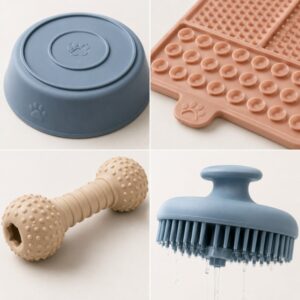
A single product line may use one color system and packaging style, but every product requires an independent engineering review.
Silicone Pet Feeding Bowls
For feeding bowls, evaluate:
- Bowl diameter and capacity
- Pet size
- Base stability
- Anti-slip structure
- Wall thickness
- Rim shape
- Collapsible structure
- Lid fit
- Easy-clean surface
- Packaging method
A travel bowl needs different priorities from a permanent indoor feeding bowl.
Silicone Pet Lick Mats
For lick mats, evaluate:
- Mat thickness
- Overall flatness
- Texture depth
- Food-release performance
- Suction-cup arrangement
- Edge design
- Cleaning accessibility
- Storage and hanging structure
- Wall or floor application
More suction cups do not automatically guarantee better performance. Cup diameter, depth, edge geometry, silicone hardness, surface condition, and mat flatness all affect suction.
Silicone Dog Chew Toys
For chew toys, evaluate:
- Target dog size
- Expected use
- Toy dimensions
- Wall thickness
- Hollow or solid structure
- Treat opening
- Dental texture
- Tear-prone sections
- Mold parting line
- Cleaning accessibility
Products should be positioned according to their intended use and pet category rather than making unlimited durability claims.
Silicone Pet Bath Brushes
For bath brushes, evaluate:
- Handle shape
- Grip comfort
- Bristle softness
- Bristle density
- Shampoo-dispensing structure
- Filling opening
- Drainage
- Cleaning method
- Hanging or storage design
A brush that looks attractive but is difficult to fill, rinse, or hold may create poor customer reviews.
6. Create a Consistent Brand System
A private-label product line should look like one coordinated collection rather than several unrelated products.
Buyers should establish:
- Primary brand colors
- Secondary colors
- Logo size
- Logo position
- Embossed or debossed logo style
- Surface texture
- Packaging layout
- Product naming system
- Photography style
- Care-instruction format
Color consistency can be challenging because different products may use different molds, dimensions, thicknesses, and production batches.
A very thin silicone product may visually appear different from a thick product even when similar color material is used.
Before mass production, buyers should review actual molded color samples instead of relying only on screen colors.
7. Decide Whether to Use Existing Molds or Develop Custom Tooling
Existing molds may help buyers test a market faster and reduce initial development cost.
They are suitable when:
- The brand accepts an existing structure.
- Only color, logo, and packaging need customization.
- The first order is intended for market validation.
- Product differentiation is not the main priority.
Custom mold development is more suitable when:
- The product requires a unique shape.
- The function differs from existing products.
- The brand needs exclusive dimensions or textures.
- A coordinated product collection is being developed.
- The logo must be integrated into the mold.
- Existing products cannot meet performance requirements.
Before selecting either approach, buyers should clarify mold ownership, mold cost, sample quantity, development lead time, modification scope, and maintenance responsibility.
8. Use Sampling to Validate Function, Not Only Appearance
A sample review should include more than checking color and logo.
Buyers should test the product under realistic conditions.
Depending on the product, sample evaluation may include:
- Product dimensions
- Poids
- Hardness
- Couleur
- Odeur
- Surface quality
- Edge flash
- Logo definition
- Bowl stability
- Suction performance
- Folding recovery
- Lid fit
- Texture cleaning
- Bristle comfort
- Treat opening
- Packaging fit
The test method should be defined clearly.
For example, a lick mat suction test should specify the test surface, cleaning condition, applied pressure, food load, and test duration.
Without a consistent method, two people may reach different conclusions about the same product.
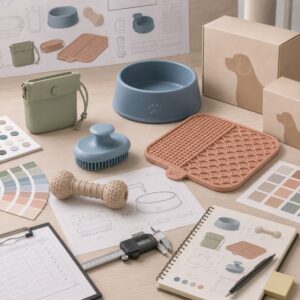
9. Define Mass-Production Quality Standards
An approved sample should become the reference for production, but the buyer should also establish measurable acceptance criteria.
The quality standard may include:
- Product dimensions
- Silicone hardness
- Product weight
- Color tolerance
- Flash limit
- Surface defects
- Logo appearance
- Deformation
- Functional performance
- Packaging condition
- Quantity tolerance
- Inspection sampling
For a multi-product set, consistency should be reviewed across all items.
A feeding bowl, lick mat, chew toy, and bath brush may be manufactured using different molds and production cycles. Color, logo presentation, packaging, and overall brand appearance should still remain coordinated.
10. Plan Packaging Before Mass Production
Packaging can affect product shape, cleanliness, presentation, and shipping efficiency.
Buyers should consider:
- Individual packaging
- Multi-product gift boxes
- Product support inserts
- Hanging display cards
- Barcode position
- Care instructions
- Warning information
- Color labels
- Shipping-carton arrangement
- Compression during transportation
Silicone products are flexible, but poor packaging can still bend suction bases, deform rims, press bristles, or create an unattractive presentation.
Packaging should be tested with actual molded samples before final printing.
11. Build a Product Line That Can Grow
A long-term product collection should allow future expansion.
For example, a brand may begin with:
- A silicone pet bowl
- A matching lick mat
- A coordinated chew toy
- A bath brush
- A portable treat bag
- A travel feeding set
Using a consistent color and packaging system makes it easier to introduce new products without rebuilding the complete brand identity.
Buyers planning long-term OEM cooperation should discuss future product plans with the manufacturer early. This helps coordinate colors, logo size, packaging dimensions, and mold-development priorities.
What Information Should Buyers Provide for an OEM Quotation?
A complete inquiry should include:
- Catégorie de produit
- Reference images
- 2D or 3D drawings, when available
- Target dimensions
- Pet type and size
- Intended function
- Material requirement
- Silicone hardness
- Pantone colors
- Logo file
- Surface texture
- Packaging concept
- Target market
- Testing requirements
- Estimated quantity
- Expected launch schedule
For a product collection, buyers should also identify which product should be developed first and which items can be added in later phases.
How LYA Silicone Supports Custom Pet Product Projects
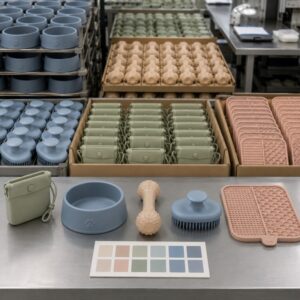
LYA Silicone provides OEM and ODM manufacturing support for custom silicone pet feeding, enrichment, chewing, grooming, travel, and daily-care products.
Our project support can include:
- Requirement review
- Drawing or sample evaluation
- Product-structure suggestions
- Material and hardness selection
- Développement de moules sur mesure
- Pantone color matching
- Embossage ou débossage du logo
- Surface-texture development
- Sample production
- Packaging coordination
- Quality inspection
- Bulk manufacturing
We support silicone pet bowls, lick mats, slow feeders, dog chew toys, treat products, bath brushes, grooming accessories, and coordinated private-label collections.
When developing several products, our team can help buyers review product combinations, mold requirements, color consistency, packaging arrangements, and mass-production feasibility.
Frequently Asked Questions
Can a pet brand start with an existing mold?
Yes. Existing products can be suitable for market testing when the buyer accepts the current structure and mainly needs custom color, logo, and packaging.
When is a custom mold necessary?
A custom mold is usually required when the product needs a unique shape, dimensions, function, texture, structure, or integrated brand design.
Can different pet products use the same silicone hardness?
Not always. Feeding bowls, lick mats, chew toys, and grooming brushes have different functional requirements. Hardness should be evaluated together with thickness, structure, flexibility, and product use.
Can several products use the same Pantone color?
They can be developed around the same color target, but visual differences may still occur because of product thickness, texture, mold surface, and production conditions. Molded samples should be reviewed.
What should be approved before bulk production?
Buyers should approve material, hardness, dimensions, color, logo, surface finish, function, packaging, inspection standards, and the final reference sample.
What information is needed for quotation?
Provide product photos or drawings, dimensions, intended use, material, hardness, colors, logo, packaging, target market, testing requirements, estimated quantity, and launch schedule.
Conclusion
Building a custom silicone pet product line requires coordinated decisions across product positioning, function, material, structure, tooling, branding, sampling, inspection, packaging, and mass production.
A successful collection should not only look consistent. Every product should also perform correctly for its intended feeding, enrichment, chewing, grooming, or travel application.
The best time to identify functional and manufacturing risks is before mold development.
If you are planning custom silicone pet products, contact LYA Silicone and send us your reference photos, drawings, target dimensions, product combination, colors, logo, packaging requirements, target market, and estimated quantity. Our team will review your project and provide an appropriate OEM or ODM manufacturing proposal.