 Korean
 English
 French
 German
 Spanish
 Polish
 Chinese
 Japanese
 Russian
콘텐츠
Answer Excerpt
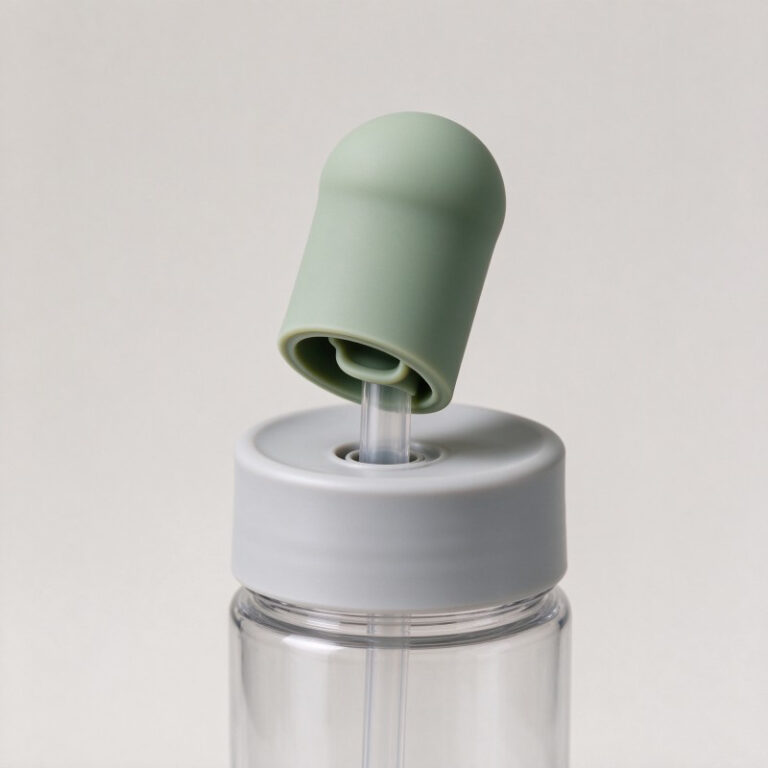
Silicone straw caps may slip off reusable bottles when the cap opening is too large for the straw, the engagement length is insufficient, the retention feature is poorly designed, or the silicone does not recover its intended shape after repeated use. A cap that is too tight can create the opposite problem: difficult removal, excessive stretching, or tearing around the opening.
For OEM buyers, reliable retention depends on the complete interface between the cap and the actual straw, not simply on the nominal diameter. The design should balance secure attachment, intentional removal, material flexibility, dimensional variation, and repeated-use performance. These requirements should be confirmed with molded samples before mass production.
Start with the Actual Cap and Straw Interface
Before changing a mold, define what the cap is expected to do.
Some caps cover the exposed end of a reusable straw to help protect it from dust and incidental contact. Others may have a different interface or closure function. These designs should not automatically be treated as interchangeable.
Start by reviewing the silicone straw cap collection and identifying the actual cap structure relevant to your project.
The buyer and manufacturer should confirm:
-
The outside diameter of the straw where the cap engages.
-
Whether the straw is round, oval, tapered, or locally reinforced.
-
The cap’s internal opening and engagement length.
-
Whether the cap is intended to cover a straw tip or engage another component.
-
How the cap should be installed and removed.
-
Whether the product is a dust cover, splash guard, or a separately validated closure.
This distinction matters because a cap that stays attached is not necessarily liquid-tight. If liquid containment is a product requirement, it needs its own design definition and validation.
Why Do Silicone Straw Caps Slip Off?
1. The opening is too large for the actual straw
A cap may appear to fit correctly on one reference sample but become loose when paired with a straw at the other end of the permitted dimensional range.
Silicone can stretch and conform around a mating component, but that flexibility does not eliminate dimensional variation. If the opening provides insufficient interference, the cap may detach when the bottle is carried, handled, or placed inside a bag.
Measure actual samples rather than relying only on a nominal diameter listed on a drawing. Check the straw at the precise engagement location, particularly if the straw has a tapered end or a nonuniform cross-section.
2. The engagement length is too short
A short cap can have limited contact with the straw. Even when its opening initially feels tight, a small sideways force may tilt the cap and help release it.
Increasing engagement length may improve retention, but the cap also needs to remain easy to remove. A longer cap can change the overall appearance, material consumption, cleaning access, and ease of installation.
The correct length should therefore be selected according to the actual product envelope and handling requirements, then confirmed through samples.
3. The retention feature is poorly proportioned
A smooth cylindrical opening is simple to manufacture, but it may not provide enough resistance to accidental removal for some applications.
A rounded internal retention bead or a gently varying bore may provide additional engagement. However, a sharp internal ridge can concentrate strain, increase insertion force, or make demolding more difficult.
Retention features should be designed as part of the complete interface. Adding a larger ridge without checking the mating straw diameter and local wall thickness can make the product less practical rather than more reliable.
4. Wall thickness and material flexibility are unbalanced
A cap with an excessively flexible opening may not maintain the required contact with the straw. Conversely, an overly stiff opening may require too much force during installation and removal.
The material, hardness, wall thickness, opening geometry, and cap size work together. A change to any one of these variables may affect the finished product’s behavior.
For OEM projects, avoid choosing material hardness independently of the geometry. Evaluate the complete molded part and verify whether it returns to its intended shape after repeated use.
How Should the Fit and Retention Geometry Be Designed?
The objective is not to maximize gripping force. It is to create a fit that remains secure during the intended use while allowing deliberate removal without damaging the cap.
Define a measurable fit window
Use the actual straw dimensions to establish the required fit range. The drawing should identify critical interface dimensions and explain how they will be measured.
A useful dimensional tolerance guide can help the buyer and manufacturer distinguish functional dimensions from cosmetic dimensions.
For flexible silicone components, measurement conditions matter. The cap should be measured in a defined, unstretched condition, with consistent positioning and measuring pressure.
Do not assign an arbitrary universal interference percentage to every cap. The correct fit depends on the specific straw geometry, compound, wall structure, and intended handling.
Use rounded transitions around the opening
The cap entrance should guide the straw into position without forcing the silicone over an unnecessarily sharp edge.
A smooth lead-in can make installation easier. If an internal retention feature is required, its height and profile should be reviewed alongside the opening diameter and the local material thickness.
Avoid thin, sharp-edged sections that may be vulnerable to tearing. At the same time, excessive thickness can make the cap difficult to stretch and remove.

Review wall thickness before changing hardness
그리고 wall thickness design guide provides a useful reference for evaluating flexibility, structural stability, and transitions between thick and thin areas.
For the cap, review at least three zones:
-
The closed top, which determines the cap’s external profile.
-
The sidewall, which controls much of the stretching behavior.
-
The opening and retention area, where local strain and contact occur.
These zones do not necessarily require identical thickness. However, transitions should be considered during design review, and the final geometry must be compatible with the selected molding process.
What Should Be Checked Before Opening the Mold?
A cap can look correct in a CAD model while performing poorly when molded. Before tooling, confirm the straw interface, installation method, expected removal force, target use conditions, and inspection requirements.
그리고 custom silicone mold development checklist is a useful starting point for reviewing critical dimensions, demolding direction, wall thickness, and sample approval.
For this product, the design review should specifically address:
-
Whether the internal retention feature can be molded and demolded consistently.
-
Whether the opening can stretch sufficiently without excessive local strain.
-
Whether the cap can be removed without requiring an impractical pulling motion.
-
Whether the design creates difficult-to-clean internal corners.
-
Whether dimensional variation could cause loose or excessively tight fits.
-
Whether the approved sample can be inspected consistently during production.
These checks should be completed before the tooling design is finalized, rather than waiting until production samples reveal a retention problem.
How Should OEM Samples Be Tested?
A repeatable test is more useful than judging retention by hand feel alone.
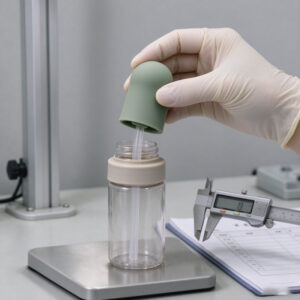
Step 1: Test across the intended dimensional range
Use representative straws covering the minimum, nominal, and maximum permitted interface dimensions. If the straw has several design variants, include the variants intended to work with the same cap.
Record whether each sample installs correctly, remains attached, and can be removed without visible damage.
Step 2: Measure insertion and removal behavior
The buyer and manufacturer should agree on a suitable test method. Where measurable force is important, use a consistent fixture, pulling direction, and test procedure.
Define the acceptable installation and removal behavior for the specific product. There is no universal pull-off force that applies to every silicone straw cap.
Step 3: Repeat the attachment cycle
Install and remove the cap repeatedly according to a project-defined cycle count. Inspect the opening, retention feature, and sidewall for tearing, permanent deformation, or loss of fit.
The number of cycles and acceptance criteria should be agreed before testing. Do not claim a service life that has not been validated.
Step 4: Evaluate relevant use conditions
If the cap will be washed frequently, exposed to temperature changes, or stored under compression, include those conditions when they are relevant to the product specification.
Check whether the cap still fits the intended straw after conditioning. Do not assume that a sample tested only in a clean, dry, new condition represents every use scenario.
Step 5: Record the results for production approval
The test record should identify the sample, straw dimensions, cap dimensions, test method, cycle count, observed defects, and acceptance result.
The same functional requirements should be used when reviewing production samples. The AQL inspection guide can help buyers establish an inspection plan, but functional retention testing should remain separately defined rather than relying on visual inspection alone.
Common Mistakes That Cause Fit Problems
Several avoidable mistakes can create unnecessary tooling changes and production delays.
Using only nominal dimensions. A single reference straw may not represent the full dimensional range of the intended product family.
Increasing retention without checking removal. A cap that is difficult to install or remove may be rejected by users even if it stays attached.
Adding a sharp internal ridge. A more aggressive retention feature may concentrate strain and increase the risk of damage.
Changing material hardness before reviewing geometry. A material change cannot automatically compensate for a poorly proportioned opening or insufficient engagement length.
Treating retention as proof of leak resistance. A cap that remains on the straw has not necessarily been tested for liquid containment.
Approving samples by appearance alone. Visual inspection cannot establish whether the cap will retain its fit after repeated attachment cycles.
Frequently Asked Questions
Why does a silicone straw cap keep slipping off?
Common causes include an oversized opening, insufficient engagement length, unsuitable retention geometry, or dimensional variation between the cap and straw. Actual samples should be measured and tested before changing the design.
Should the cap opening be smaller than the straw diameter?
The required fit depends on the complete interface and the elasticity of the selected silicone. The opening may need to provide controlled interference, but there is no single diameter difference suitable for every cap design.
Can a thicker silicone cap solve the problem?
Not necessarily. Increasing thickness can change flexibility and installation force, but it may also make the cap difficult to remove. Review wall thickness, material hardness, and retention geometry together.
How can an OEM buyer verify retention?
Use a documented fit and removal test with representative straw dimensions, consistent test conditions, and agreed acceptance criteria. Repeat the test after relevant conditioning if the product’s intended use requires it.
Does a silicone straw cap make a bottle leak-proof?
Not automatically. Dust protection, splash resistance, and liquid sealing are different functions. If the cap must prevent leakage, that requirement needs a specific design and validation plan.
Develop the Interface Before Approving the Mold
A reliable silicone straw cap requires more than a close-looking fit. Its opening dimensions, engagement length, retention geometry, wall thickness, and removal behavior must work together.
LYA Silicone provides an OEM silicone manufacturing service for custom silicone product projects. Buyers should prepare the straw drawing or sample, relevant interface dimensions, preferred cap geometry, use conditions, and testing requirements before requesting a design review.
To discuss a custom straw cap project, contact LYA Silicone with your reference product, target fit, estimated quantity, and any existing drawings or samples. The final design and acceptance criteria can then be evaluated for the intended application.