 Korean
  English
  French
  German
  Spanish
  Polish
  Chinese
  Japanese
  Russian
 콘텐츠
Answer Excerpt
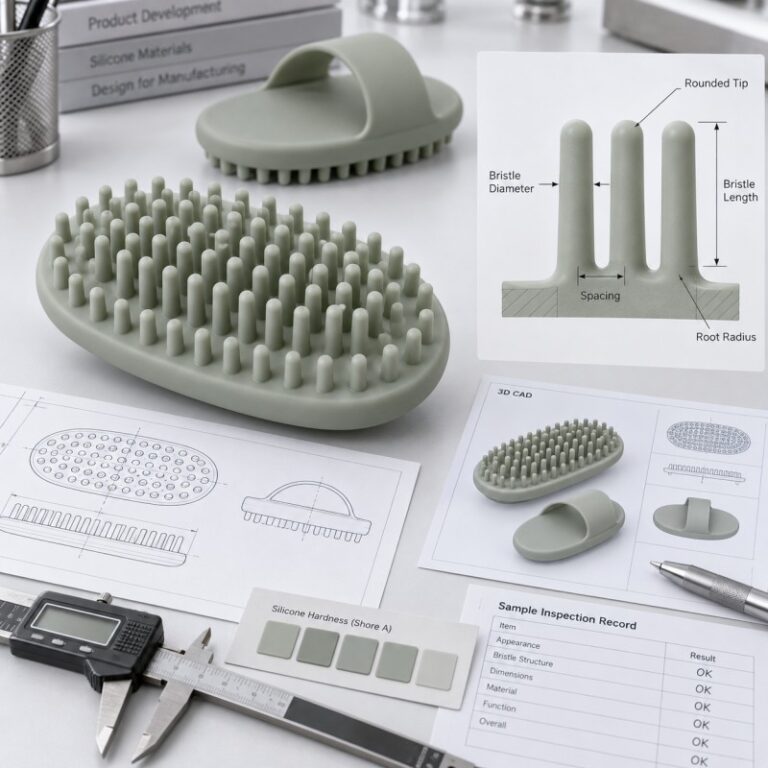
Good silicone brush bristle design depends on more than making the bristles soft. Bristle length, diameter, spacing, root radius, silicone hardness, brush-head geometry and intended cleaning pressure all affect flexibility, recovery, cleaning performance and durability.
For custom silicone bottle brushes, pet bath brushes and other cleaning products, the bristle system should be tested as a complete functional structure before tooling and mass production.
Why Do Silicone Brush Bristles Need Separate Engineering Review?
A silicone brush may look like a simple product.
In practice, the bristles are the part that repeatedly:
- Bend
- Contact surfaces
- Move through hair or fur
- Reach corners
- Carry cleaning force
- Recover after deformation
- Trap and release water or residue
This means the brush body and bristles do not have exactly the same functional requirements.
The body may need structural stability.
The bristles may need controlled flexibility.
A successful design therefore needs to balance:
Bristle Length → Diameter → Spacing → Root Structure → Hardness → Cleaning Force → Recovery
If one variable changes, the whole brushing feel can change.
Which Silicone Products Commonly Use Molded Bristles?
LYA Silicone’s current product range includes both Silicone Bottle Brush under baby products and Silicone Pet Bath Brush under pet products. The pet bath brush product page also supports customization of brush shape and bristle design, including soft, dense, long, short and dual-texture arrangements.
Silicone bristles can therefore appear in products such as:
- Baby bottle brushes
- Straw-cleaning accessories
- Pet bath brushes
- Pet grooming brushes
- Scalp or massage-style cleaning products
- Household cleaning tools
The correct bristle structure depends on what the brush is expected to contact.
A bottle-cleaning brush and a pet-grooming brush should not automatically use the same bristle geometry.
How Does Bristle Length Affect Flexibility?
Bristle length is one of the most visible design variables.
Longer Bristles
Longer bristles generally bend more easily under the same load.
They may be useful when the brush needs to:
- Reach curved surfaces
- Enter deeper areas
- Move through fur
- Provide a softer tactile feel
However, excessively long bristles can:
- Fold over instead of cleaning
- Recover more slowly
- Tangle with neighboring bristles
- Feel unstable under pressure
Shorter Bristles
Shorter bristles usually feel more supportive.
They may provide:
- More direct surface contact
- Better shape stability
- Stronger local scrubbing feel
But if they are too short and thick, the brush may feel unnecessarily rigid.
The correct length therefore depends on both cleaning function and bristle diameter.
How Does Bristle Diameter Change the Cleaning Feel?
Two bristles with the same length can behave very differently if their diameters are different.
A thinner bristle generally bends more easily.
A thicker bristle generally resists bending more strongly.
However, simply increasing diameter to improve durability can create a brush that feels too stiff.
Likewise, making every bristle very thin may reduce support and create poor recovery.
The design team should therefore evaluate:
- Bristle diameter
- Bristle length
- Silicone hardness
- Number of bristles
- Cleaning pressure
together.
The desired result is controlled movement rather than maximum softness.
Why Is Bristle Spacing Important?
Spacing affects how individual bristles move.
If bristles are packed too closely:
- Neighboring bristles may press against each other
- Water and residue can be harder to rinse away
- The bristle field can behave like one stiff block
- Visual inspection becomes more difficult
If spacing is too wide:
- Cleaning contact may become inconsistent
- Large gaps can reduce coverage
- The brush may feel sparse
A good layout provides enough independent bristle movement while still maintaining useful contact density.
For cleaning products exposed to water, spacing should also support easy-clean design rather than creating unnecessarily tight pockets.
Why Is the Bristle Root Critical?
The root is where each bristle connects to the brush head.
This is often the highest-stress region.
Every time the bristle bends, the root transfers that movement into the main product body.
A poor root structure may create:
- Local stress concentration
- Permanent bending
- Surface whitening
- Crack initiation
- Bristle tearing
Instead of using a sharp 90-degree transition, the bristle root should usually be reviewed with a smooth transition and appropriate radius.
This does not mean making the entire root excessively thick.
The objective is to distribute bending more gradually.
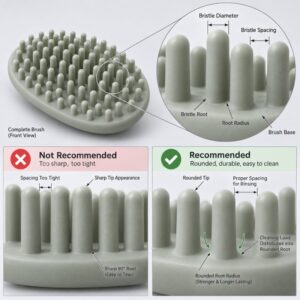
How Should Root Radius and Bristle Diameter Work Together?
A very large root radius on a tiny bristle may make the base unnecessarily bulky.
A very small root radius on a thick bristle may create a concentrated stress area.
The transition should therefore match the bristle section.
During design review, engineers should inspect:
- Root radius
- Bristle diameter
- Local brush-head thickness
- Bristle spacing
- Demolding direction
The root also needs enough room so adjacent bristles do not merge into a difficult-to-clean base.
How Does Silicone Hardness Affect Bristle Performance?
The same bristle geometry can behave very differently with a different silicone hardness.
A softer silicone may provide:
- Gentler surface contact
- Easier bristle bending
- Lower local pressure
But it can also create:
- Excessive collapse
- Slower recovery
- Less effective scrubbing in some applications
A firmer silicone may provide:
- Better bristle definition
- Faster structural recovery
- Stronger contact
but can feel too aggressive if the geometry is already short and thick.
Hardness should therefore be selected together with molded geometry, not as an isolated specification.
Should Every Bristle on the Brush Be the Same?
Not necessarily.
Some brush products can benefit from multiple bristle zones.
For example, a pet bath brush might use:
- Longer flexible bristles in the center
- Shorter supporting bristles around the perimeter
- Massage nubs in a separate zone
A bottle brush might use:
- Longer side bristles
- Shorter tip bristles
- A different geometry near the end of the head
However, adding more bristle types also increases design and tooling complexity.
Each additional zone should have a clear functional purpose.
A complicated brush is not automatically a better brush.
How Should Bristle Tips Be Designed?
The tip is the direct contact point.
For soft silicone cleaning products, the tip should generally avoid sharp geometry.
Possible tip shapes include:
- Rounded
- Dome-shaped
- Soft tapered profile
- Slightly flattened rounded tip
Very sharp tips may:
- Feel uncomfortable
- Be visually inconsistent
- Become more difficult to mold consistently
The final tip design should match the intended contact surface.
For pet care products, the goal may be gentle skin and fur interaction.
For bottle brushes, the goal may be effective contact without unnecessary scratching risk.
How Do Bristles Interact With Curved Brush Heads?
A flat bristle layout may work differently from a curved head.
On an oval or domed pet bath brush, bristles can point in slightly different directions.
This may help the brush follow curved body surfaces.
However, it also changes:
- Bristle spacing
- Contact angle
- Effective length
- Demolding direction
The bristle array should therefore be created together with the brush-head geometry rather than added after the body is finalized.
How Should Bristles Be Designed for a Pet Bath Brush?
A silicone pet bath brush may need to perform several functions:
- Distribute shampoo
- Massage the surface
- Move through fur
- Loosen dirt
- Help collect loose hair
LYA Silicone’s current pet bath brush product line already includes customizable short, long, dense and dual-texture bristle options, making this a relevant OEM structure for pet-care brands.
For this type of product, the design team should evaluate:
Fur Length
Longer fur may require enough bristle length to reach through the coat.
Contact Pressure
The bristle should flex under realistic hand pressure rather than remain completely rigid.
Bristle Density
Dense layouts may increase contact but should still allow rinsing.
Grip and Brush Body
The user needs enough control to apply pressure without crushing the bristle field unevenly.
Shampoo and Water
The brush should remain practical to rinse after use.
How Is a Silicone Bottle Brush Different?
A bottle brush operates in a different environment.
It may need to contact:
- Bottle walls
- Curved bottom corners
- Narrow necks
- Cup interiors
LYA Silicone currently also lists Silicone Bottle Brush within the Baby Products category.
For bottle brushes, bristle design may prioritize:
- Reach
- Flexible head movement
- Contact with curved surfaces
- Rinsability
- Access to narrow areas
This is why copying a pet-brush bristle system onto a bottle brush would not automatically create good cleaning performance.
Why Is Bristle Density Not the Same as Cleaning Performance?
More bristles do not always mean better cleaning.
Very high density can cause neighboring bristles to support each other so strongly that the entire surface becomes less flexible.
It can also reduce the open space available for:
- Water
- Foam
- Dirt release
- Rinsing
A lower-density design may sometimes allow each bristle to move more independently.
The correct density should be determined by testing rather than appearance alone.
How Do Bristles Affect Mold Filling?
A brush head may contain dozens or hundreds of small bristle cavities.
This makes mold filling more demanding than molding a simple flat silicone part.
The tooling and molding team should consider:
- Bristle diameter
- Bristle length
- Cavity depth
- Venting
- Flow path
- Local temperature conditions
Very fine bristles may be more difficult to fill consistently.
If the tip or root does not form correctly, the product can show:
- Short bristles
- Missing tips
- Incomplete filling
- Local shape variation
Bristle geometry should therefore be reviewed during custom silicone mold development before tooling is finalized.
How Do Bristles Affect Demolding?
After molding, the brush must be removed from the tool.
A large number of long, thin silicone bristles may stretch during demolding.
If the geometry is not suitable, this can contribute to:
- Bristle distortion
- Uneven direction
- Local tearing
- Slow recovery
The design team should review:
- Bristle length
- Draft and cavity geometry
- Bristle direction
- Product flexibility
- Mold release path
The finished sample should be inspected after full recovery rather than immediately assuming every bent bristle is a permanent defect.
What Should Brands Test During Sample Approval?
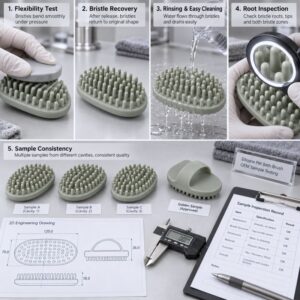
Bristle Flexibility
Apply realistic cleaning pressure.
Check whether the bristles bend without collapsing completely.
Recovery
Release the load and observe whether the bristles return toward their original direction.
Root Condition
Inspect the base of the bristles after repeated flexing.
Look for:
- Whitening
- Cracks
- Permanent bending
- Tears
Cleaning Performance
Test the brush using a representative surface or use scenario.
Rinsing
Wash the product and confirm whether residue can leave the spaces between bristles.
Tip Quality
Check for:
- Missing material
- Sharp or irregular tips
- Short-filled bristles
- Visible deformation
Multi-Cavity Consistency
If the tool has multiple cavities, compare bristle:
- Length
- Density
- Direction
- Recovery
- Appearance
between cavities.
Practical Example: Custom Silicone Pet Bath Brush
Consider an oval palm-style custom pet bath brush.
The product uses:
- Soft matte silicone body
- Integrated hand-grip strap
- Dense oval cleaning surface
- Two bristle zones
The center contains longer rounded bristles.
The outer area contains slightly shorter supporting bristles.
If All Bristles Are Too Long
The brush may feel very soft but provide weak contact.
If All Bristles Are Too Short and Thick
The brush may feel overly firm.
If Spacing Is Too Tight
Shampoo and loose hair may be more difficult to rinse away.
Optimized Structure
The final sample balances:
- Bristle length
- Diameter
- Density
- Root radius
- Silicone hardness
- Brush-head curvature
The correct design is therefore a system, not one isolated dimension.
Silicone Brush Bristle Design Checklist
| 항목 | What the Brand Should Confirm |
|---|---|
| 애플리케이션 | Bottle, pet care or other cleaning use |
| Bristle length | Appropriate reach and flexibility |
| Diameter | Balanced support and bending |
| Density | Enough contact without excessive crowding |
| Spacing | Allows independent movement and rinsing |
| Root radius | Smooth repeated-flex transition |
| Tip shape | Rounded and appropriate for contact surface |
| Hardness | Validated with the actual bristle geometry |
| Brush-head shape | Compatible with bristle direction |
| Mold filling | Fine bristles form completely |
| Demolding | Bristles recover after release |
| Recovery | Returns toward intended orientation |
| Cleaning | Residue can rinse from the bristle field |
| Cavities | Bristle consistency verified |
| 패키징 | Bristles are not stored under harmful compression |
How LYA Silicone Supports Custom Brush Development
For OEM and ODM development, silicone brush structures can be reviewed from product function through tooling and sample validation.
Project review may include:
- Brush application
- Brush-head dimensions
- Bristle length
- Bristle diameter
- Bristle density
- Bristle spacing
- Root radius
- Tip shape
- Silicone hardness
- Handle or grip design
- Mold development
- Sample testing
- Recovery evaluation
- Cleaning review
- Color customization
- 패키징
- Mass-production inspection
The objective is not to create the largest number of bristles.
The objective is to create a controlled bristle system that performs the intended cleaning function and can be produced consistently.
Frequently Asked Questions
Are longer silicone bristles always softer?
Generally, increasing unsupported bristle length can increase flexibility, but diameter, hardness and root structure also affect the final behavior.
Are thicker bristles more durable?
They may resist bending more strongly, but durability depends on the complete geometry. An excessively thick bristle can make the brush too stiff.
Why do silicone bristles stay bent?
Possible causes include excessive length, very soft material, unsuitable root geometry, demolding deformation or prolonged compression during packaging.
Should silicone brush bristles all have the same length?
Not necessarily. Some products benefit from multiple functional zones, but every variation should have a clear purpose.
Why do silicone bristles tear near the base?
The root experiences repeated bending stress. Sharp transitions, insufficient support or excessive deformation can increase local tear risk.
Are dense silicone bristles better for cleaning?
Not automatically. Very dense bristles can reduce independent movement and make rinsing more difficult.
Should the bristle layout be finalized before mold development?
Yes. Bristle geometry directly affects mold cavities, filling, venting and demolding.
Design the Bristle System Around the Cleaning Function
Good silicone brush performance depends on:
Length → Diameter → Spacing → Density → Root Radius → Tip Shape → Hardness → Mold Filling → Recovery → Cleaning
These variables need to work together.
A brush should not use more bristles simply to look premium, and it should not use longer bristles simply to feel soft.
If you are developing a custom silicone bottle brush, pet bath brush or other molded cleaning product, contact us with your reference design, target application, brush dimensions, preferred bristle concept, material requirements, color, packaging concept and estimated order quantity.