 Korean
 English
 French
 German
 Spanish
 Polish
 Chinese
 Japanese
 Russian
콘텐츠
Answer Excerpt
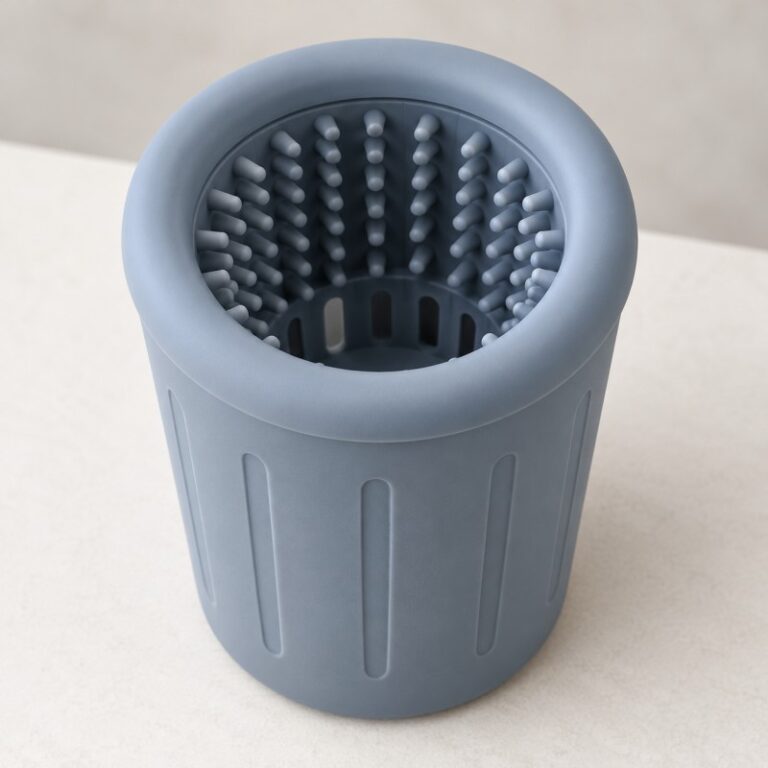
Silicone dog paw cleaner cups can splash dirty water when the fill level is too high, a paw displaces too much liquid, the cup mouth is overly open, or vigorous twisting drives water up the inner wall. Bristle layout, cup depth, grip stability and the way the paw is removed also affect splashing.
For an OEM pet brand, the solution is not necessarily a tighter opening or a deeper cup. A better design balances water containment, comfortable paw entry, accessible brushing, straightforward cleaning and repeatable sample tests.
Splash resistance should be defined under stated use conditions rather than advertised as a guaranteed spill-free feature.
Why Splashing Is Different From Leakage
A customer may report that a paw washer “leaks,” but two different failures are possible.
Leakage means liquid escapes through a damaged cup wall, poorly fitted component or unintended opening.
Splashing happens when water travels over the open rim while a paw moves inside the cup.
A perfectly molded, seamless cup can still splash.
This distinction matters to product developers. Changing the silicone formulation will not fix water that is being pushed above the rim by a dog’s paw.
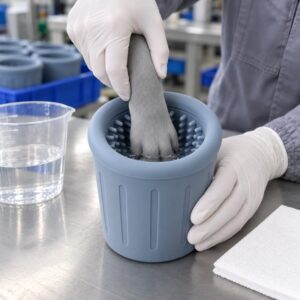
Start by reviewing the actual use sequence: filling, paw insertion, gentle cup movement, paw removal and emptying.
A custom silicone pet paw cleaner cup should be evaluated as a complete cleaning system, not just as a container.
What Actually Sends Water Over the Rim?
The paw raises the water level
The water level rises when a paw enters the cup because the paw occupies space that was previously available to water.
The removable brush insert also takes up internal volume.
If a customer fills an empty cup almost to the top, even slow insertion can cause overflow.
Packaging instructions should therefore specify a tested fill reference, not simply say “add water.”
Twisting produces a moving wave
Users often rotate or gently move the cup to bring soft bristles into contact with muddy fur.
Quick rotation, abrupt stopping or tilting can throw water against the inner wall.
The resulting wave may cross the rim even when the cup was not initially overfilled.
Cup geometry and handling instructions must be considered together.
Paw removal carries water upward
Droplets can remain on the fur, around the toes and between the bristles.
Pulling the paw out rapidly may carry liquid toward the opening.
A splash-control feature must leave enough clearance for comfortable removal; an excessively narrow mouth could trap the paw or wipe dirty water onto the leg.
How Should the Cup Mouth Control Splashing?
A gently inward-turned, flexible silicone rim is one possible design concept.
The inner lip may interrupt a wave moving up the wall and redirect some water back into the cup.
It cannot create a watertight seal around a moving animal’s leg, and it should never constrict the paw.
The design needs to balance three requirements:
-
A generous entry opening.
-
A smooth contact edge.
-
Sufficient internal clearance for water movement.
Its geometry should have rounded transitions without sharp edges or inaccessible crevices.
An extremely deep collar could make rinsing difficult, hide debris or interfere with demolding.
The existing pet paw cleaner product development guide covers general structure and customization.
For splash control, buyers should go further and test how different rim profiles behave during actual paw insertion and removal.
A wider open mouth may be easier to use; a modest inward lip may contain certain splashes better.
The correct trade-off depends on the intended paw-size range.
Why the Brush Insert Changes Water Movement
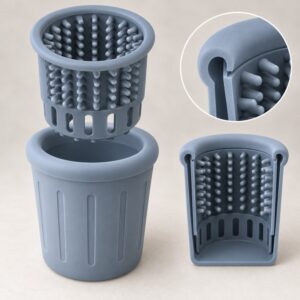
A removable silicone brush sleeve may contain multiple rows of rounded, flexible bristles.
These features occupy space and influence how water travels around the paw.
Densely packed bristles may restrict circulation, while overly sparse bristles may make contact inconsistent.
Longer bristles can bend and release trapped droplets as the cup is moved.
A practical concept uses an open sleeve with drainage gaps near its lower edge, seated securely inside a molded outer cup.
The sleeve should not rotate independently or lift out unexpectedly during use, but it must remain removable for washing and inspection.
Brands considering a different cleaning action can also compare the site’s 2-in-1 silicone dog paw cleaner product direction.
Do not solve splashing by simply adding more bristles.
Review sleeve height, paw clearance, the direction in which water can circulate and whether the insert can be removed without pulling water out of the cup.
How Much Water Should the User Add?
A useful fill mark should be established with the brush insert installed and with a representative test paw inserted.
A mark based on the empty outer cup could be misleading.
Buyers can ask for an unobtrusive molded reference line on the inside wall or include a clearly illustrated fill instruction in the retail insert.
Test at more than one water level and with representative paw sizes.
The product may perform acceptably with a small paw but splash when a larger paw displaces more water.
Also evaluate whether users can see the fill line in normal bathroom or entryway lighting.
A hidden mark has limited practical value.
A Repeatable Sample Test for Splash Control
An attractive prototype photograph cannot demonstrate splash resistance.
Before approving tooling or a production sample, the brand and manufacturer should agree on a simple, repeatable procedure:
-
Place the assembled cup on a level, washable test surface with an absorbent sheet around it.
-
Fill the cup to the proposed reference line using the specified amount of water.
-
Insert a representative soft paw-shaped test fixture to a defined depth. For later user validation, use calm, voluntary handling under appropriate animal supervision rather than forcing a pet’s paw into the cup.
-
Perform the agreed gentle movement pattern and number of repetitions, then remove the test fixture in a defined way.
-
Record escaped water, rim wetting, insert movement and any difficulty withdrawing the fixture.
-
Repeat after removing, cleaning and reinstalling the brush sleeve, and after the agreed packaging-storage simulation.
A comparison should change one design variable at a time, such as rim profile or fill level.
Otherwise, buyers will not know what improved the result.
Use both a dry external cup inspection and a measured collection method where practical.
The buyer should set an acceptable result for the intended use; there is no universal spill threshold that can be assumed for every paw washer.
Compare Design Options Before Freezing the Mold
| Design choice | Potential benefit | Trade-off to check |
|---|---|---|
| Open rounded rim | Easy entry and rinsing | Less interruption of upward-moving water |
| Modest inward lip | May redirect some splashes | Must preserve paw clearance and easy cleaning |
| Taller outer cup | More freeboard at the same fill level | Larger product and less convenient storage |
| Lower fill reference | More space for displaced water | May reduce brushing contact if too low |
| Removable brush sleeve | Easier access for thorough rinsing | Must remain seated during gentle movement |
None of these alternatives is automatically superior.
A brand selling for indoor daily use may prioritize convenient rinsing.
A travel-oriented product may prioritize compact storage and limiting mess near a vehicle.
Evaluate the actual use case rather than copying a competitor’s appearance.
What Should Be Checked in Pilot Production?
Functional approval should not stop with one hand-made or first-mold sample.
Ask for samples representing the planned production tooling and inspect the cup and sleeve as a matched pair.
Check rim shape, inner opening, sleeve seating, bristle definition, surface finish and ease of disassembly.
Where several cavities are used, confirm that the accepted splash test is not passed only by one cavity’s output.
Inspect the rim after demolding and after packaging recovery.
An unintentionally curled lip may behave differently from the approved master sample.
Cleaning is also part of function: residual food, mud or detergent around the sleeve should be removable through the stated care method.
Avoid claims about antibacterial properties, guaranteed hygiene or universal dishwasher compatibility without product-specific validation.
What Should Pet Brands Include in Their OEM Brief?
Brands exploring silicone pet products should define the paw washer’s intended use before requesting a mold quotation.
A useful brief includes:
-
Target dog-size range.
-
Sample paw widths and insertion depths.
-
Cup and sleeve drawings.
-
Proposed fill level.
-
Rim profile and cleaning movement.
-
Required grip texture.
-
Color and packaging concept.
-
Target markets and test requirements.
Clarify whether the brief is for a completely new design or an adjustment to an existing product.
During the OEM silicone manufacturing service, request a drawing review, molded samples and mutually agreed acceptance criteria before production release.
Material or compliance documentation should be scoped to the finished design and destination market rather than inferred from the word “silicone.”
Frequently Asked Questions
Does a taller paw cleaner cup always splash less?
No. Extra height can provide more space above the water, but it may make handling awkward. Paw size, fill level and movement still affect the result.
Will an inward silicone lip make the cup spill-proof?
No. An open cup with a moving paw cannot be assumed spill-proof. The lip is a design option that must be tested for splash control, comfort and cleaning access.
Should the brush sleeve be permanently attached?
Not necessarily. A removable insert can simplify thorough rinsing, but its fit must prevent unintended lifting or rotation during cleaning. The approved assembly and care instructions should be validated.
Can the same design work for every dog?
A single opening may not fit the full range of paw sizes comfortably. Define a realistic size range and verify it with representative paw dimensions and observed use.
Is this a confirmed performance specification for an existing LYA product?
No. The rim and test procedure discussed here are OEM engineering recommendations. Final dimensions, material, cleaning claims and splash performance require project-specific sample approval.
Develop a Paw Washer That Works Beyond the Product Photo
A better paw washer starts with the moment a wet, muddy paw enters and leaves the cup.
Water displacement, movement, rim geometry and brush-sleeve placement should be assessed together.
Define the real use conditions, approve functional samples and keep the acceptance procedure consistent through production.
If you are planning a private-label paw cleaner or need to revise an existing design, contact our team with your product drawing, target paw sizes, cup concept, packaging plan and intended sales market.
LYA Silicone can review the manufacturing options and discuss the next steps for OEM development.