 German
  English
  French
  Spanish
  Polish
  Chinese
  Japanese
  Korean
  Russian
 Inhalt
Introduction
A silicone collapsible cup may look simple, but it must perform two opposite functions.
When expanded, the cup should remain stable enough to hold a drink, support the rim, resist tipping, and provide a comfortable drinking experience.
When collapsed, it should fold smoothly into a compact shape without requiring excessive force, damaging the folding rings, or becoming permanently deformed.
Many collapsible cups perform well in product photos but create problems during real use. Common complaints include:
- The cup collapses when users hold it
- The side wall bends under the weight of the drink
- The rim feels unstable while drinking
- The lid does not fit correctly
- Liquid leaks around the lid or vent
- The base rocks on the table
- Folding rings become distorted
- The cup does not recover after storage
- Thin sections begin to tear
- The product develops permanent fold marks
- Packaging compresses the product out of shape
These problems are not caused by silicone hardness alone.
Reliable performance depends on the relationship between material, hardness, wall thickness, folding geometry, rim support, base design, lid structure, mold accuracy, production consistency, packaging, and intended use.
This guide explains what outdoor, travel, drinkware, household, and private-label brands should review before developing a custom silicone collapsible cup.
Answer Excerpt
A silicone collapsible cup may collapse, leak, or lose shape when its wall is too soft, the folding rings are not structurally balanced, the rim lacks support, the base is unstable, the lid tolerance is incorrect, or the product remains compressed during packaging and storage.
Increasing silicone hardness does not automatically solve these problems. A harder cup may become difficult to fold, while a softer cup may lack sufficient support when filled.
The material, Shore A hardness, wall thickness, folding-line geometry, expanded capacity, rim, base, lid, vent, molding process, testing method, and packaging should be evaluated as one complete product system.
Buyers should approve molded samples under realistic drinking, folding, carrying, cleaning, temperature, and storage conditions before mass production.
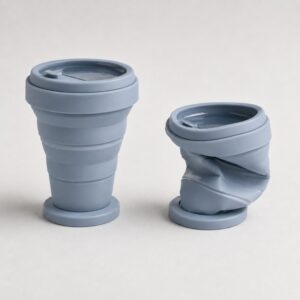
1. A Collapsible Cup Must Balance Stability and Foldability
A rigid drinking cup mainly needs to remain stable.
A collapsible cup needs to remain stable when expanded and flexible when folded.
These two requirements can conflict.
If the product is designed mainly for easy folding, it may become:
- Too soft when filled
- Unstable during drinking
- Difficult to hold with one hand
- Easy to collapse accidentally
- Sensitive to side pressure
If the product is designed mainly for stability, it may become:
- Difficult to collapse
- Bulky after folding
- Heavy
- Uncomfortable to compress
- Prone to stress around the folding lines
The correct design should define where the cup must remain firm and where it should flex.
Typical functional zones include:
- Rim
- Upper cup wall
- Folding rings
- Lower support wall
- Base
- Lid groove
- Vent or straw opening
- Grip area
These zones do not necessarily need the same thickness or structural behavior.
2. The Cup Wall May Be Too Soft to Support the Drink
A cup that stands correctly when empty may become unstable after it is filled.
The cup wall must support:
- The weight of the liquid
- Hand pressure
- Grip force
- Lid pressure
- Movement during carrying
- Tilting during drinking
- Temperature-related material changes
If the wall is too thin or too flexible, users may accidentally squeeze the cup and spill the drink.
A tall, narrow cup may also be more sensitive to side deformation than a shorter, wider structure.
Buyers should evaluate:
- Expanded cup height
- Cup diameter
- Liquid capacity
- Wall thickness
- Folding-ring spacing
- Silicone hardness
- Grip location
- Rim stiffness
- Base diameter
Testing should use the intended fill volume rather than evaluating only an empty sample.
3. Hardness, Wall Thickness, and Geometry Must Be Evaluated Together
Silicone hardness is important, but the same Shore A value can behave differently in different product structures.
A thin wall made from relatively firm silicone may still bend easily.
A thick wall made from softer silicone may feel stable because the cross-section provides additional support.
A softer material may provide:
- Easier folding
- Lower collapsing force
- More comfortable grip
- Better flexibility
However, it may also create:
- Side-wall instability
- Rim deformation
- Excessive stretching
- Poor shape retention
- Difficult lid fitting
A harder material may improve:
- Expanded stability
- Rim support
- Product handling
- Dimensional control
However, it may also cause:
- Difficult folding
- Higher user force
- Stress at the folding lines
- Poor recovery around thin sections
- Reduced comfort
The final hardness should be confirmed using the actual molded cup, not only a material test block.
Buyers can also review how to choose silicone hardness according to product function, wall thickness and structure.
4. Folding Rings Need Controlled Buckling
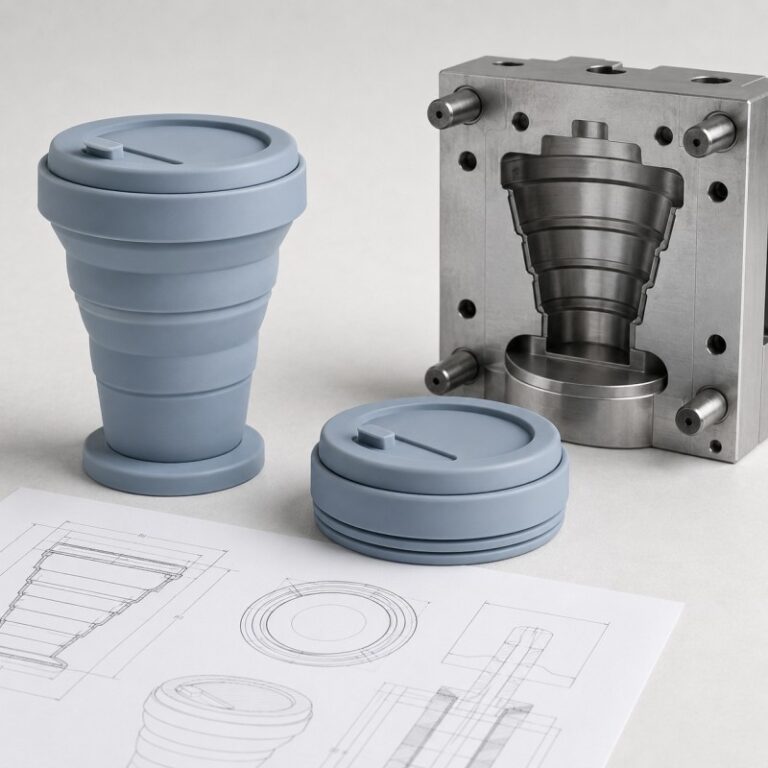
The folding rings determine how the cup collapses.
Each ring should move in a predictable direction and sequence.
If the ring design is not balanced, the cup may:
- Fold sideways
- Twist during compression
- Collapse unevenly
- Trap one ring inside another
- Require excessive force
- Reopen by itself
- Become permanently creased
Important folding-ring variables include:
- Ring height
- Ring angle
- Ring diameter
- Wall thickness
- Transition radius
- Distance between rings
- Number of rings
- Folding direction
- Upper and lower support
A folding line that is too thin may become weak or tear after repeated use.
A folding line that is too thick may resist movement and make the product difficult to collapse.
The mold should reproduce every ring consistently, because small dimensional variation can change the folding sequence.
These structural details should be confirmed during custom silicone mold development before mold machining begins.
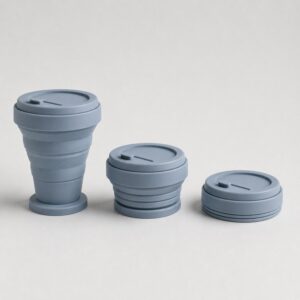
5. The Rim Must Stay Stable During Drinking
The rim is one of the most important structural areas.
It affects:
- Drinking comfort
- Cup opening shape
- Lid fit
- Hand grip
- Product stability
- Stacking
- Verpackung
If the rim is too soft, it may become oval when users lift the cup.
This can cause:
- Liquid spilling
- Uncomfortable drinking
- Poor lid sealing
- Lid detachment
- Difficulty opening or closing the cup
Possible rim-support solutions include:
- A thicker silicone rim
- A reinforced ring structure
- A rigid plastic ring
- A wider upper wall
- A rolled-edge geometry
- A suitable lid-retention groove
However, a rigid insert introduces additional assembly, material, tolerance, and recycling considerations.
The rim structure should be selected according to the target market, cup size, drink type, lid design, and desired retail position.
6. The Base Must Resist Tipping and Rocking
A collapsible cup needs a stable base when expanded.
Common base problems include:
- Small contact diameter
- Uneven bottom thickness
- Warpage
- Raised center
- Deformed folding ring
- Packaging compression
- Unstable transition between the base and cup wall
A cup can have an attractive shape but still feel unsafe when placed on a table.
Base stability should be evaluated with:
- The cup empty
- The cup partially filled
- The cup fully filled
- The lid installed
- The product placed on different surfaces
- The cup after repeated folding
- The cup after packaging storage
A wider base generally provides greater resistance to tipping, but it can increase the folded size and packaging volume.
The base design therefore needs to balance stability and portability.
7. Lid Design Is a Common Source of Leakage
The silicone cup body may perform correctly while the lid creates customer complaints.
Common lid structures include:
- Silicone lid
- Plastic snap-on lid
- Screw-style lid
- Locking lid
- Lid with straw opening
- Lid with drinking opening
- Lid with vent plug
- Lid with sealing ring
Leakage can occur because of:
- Incorrect rim dimensions
- Insufficient lid engagement
- Excessive lid looseness
- Lid warpage
- Cup rim deformation
- Poor sealing-groove geometry
- Vent-plug mismatch
- Straw-opening mismatch
- Assembly contamination
- User installation error
A lid should not be described as leakproof unless the complete cup and lid assembly has been validated under defined conditions.
Some products may be suitable only for splash resistance or upright carrying.
The product claim should match the actual structure and testing.
8. Lid Tolerance and Cup-Rim Tolerance Must Match
The lid and cup are often produced from different molds and sometimes different materials.
Their dimensions can be affected by:
- Material shrinkage
- Hardness
- Mold temperature
- Wall thickness
- Production batch
- Storage
- Verpackung
- Lid-material variation
A lid that fits one sample may feel too tight or too loose on another batch if tolerances are not coordinated.
A tight lid may:
- Deform the rim
- Require excessive opening force
- Pull the cup wall upward
- Make the cup collapse
- Damage the lid groove
A loose lid may:
- Detach during carrying
- Leak
- Rotate unexpectedly
- Create an unstable drinking opening
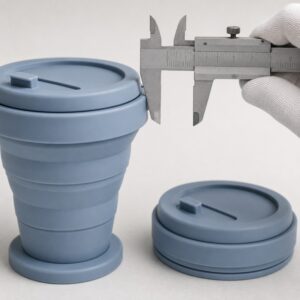
The cup and lid should be measured and tested as one assembly.
Critical dimensions may include:
- Rim outside diameter
- Rim thickness
- Lid inside diameter
- Groove depth
- Engagement height
- Sealing contact width
- Vent-hole dimensions
9. Grip Position Can Trigger Accidental Collapse
Users do not always hold the cup in the location expected by the designer.
They may grip:
- The upper wall
- The center folding ring
- The lower wall
- The rim
- The base
If the main grip area coincides with a folding line, normal hand pressure may collapse the cup.
This is especially relevant for:
- Tall cups
- Large-capacity cups
- Soft silicone
- Hot or cold drinks
- Children’s products
- Cups without sleeves
- One-hand drinking
The design may need:
- A defined grip band
- Textured holding area
- Reinforced upper wall
- External sleeve
- Wider diameter
- Controlled folding-ring position
User testing should include different hand sizes and grip methods.
10. Repeated Folding Can Create Fatigue at the Creases
A collapsible cup is expected to fold repeatedly.
However, repeated deformation concentrates movement around the folding lines.
Possible long-term problems include:
- Permanent creasing
- Reduced recovery
- White stress marks
- Small surface cracks
- Tearing at thin sections
- Uneven folding
- Ring inversion
- Dimensional change
Folding durability depends on:
- Silicone formulation
- Tear strength
- Hardness
- Folding radius
- Wall thickness
- Surface texture
- Mold parting line
- Product storage
- Folding method
A sharp folding crease generally concentrates more stress than a smooth-radius transition.
The folding test should reproduce the intended user action rather than only compressing the cup once during inspection.
Similar folding-line principles also apply to custom silicone collapsible lunch boxes and other space-saving food containers.
11. Thin Sections May Tear During Demolding or Use
Thin folding sections help reduce collapsing force, but they can create manufacturing and durability risks.
A thin section may:
- Fill incompletely
- Tear during demolding
- Stretch permanently
- Lose texture
- Develop flash
- Become damaged during trimming
- Fail after repeated folding
Tear risk is higher near:
- Sharp internal corners
- Parting lines
- Logo edges
- Vent holes
- Straw openings
- Abrupt thickness transitions
- Mold undercuts
The design should avoid placing decorative details or parting lines directly on the most highly flexed folding zones where possible.
A product that can be molded once is not necessarily ready for repeatable production.
12. Hot and Cold Use Can Change the User Experience
A collapsible cup may be marketed for coffee, cold drinks, camping, travel, or general beverage use.
The intended conditions should be confirmed before material, structure, and packaging approval.
Temperature can affect:
- User grip
- Perceived softness
- Lid fit
- Cup-wall stability
- Condensation
- Recovery after folding
- Handling comfort
- Product claims
A cup designed for cold water may not require the same grip or insulation structure as a cup positioned for warm drinks.
For products intended to contain warmer liquids, buyers should evaluate:
- Wall temperature
- Holding comfort
- Rim stability
- Lid retention
- Steam venting
- Fill level
- Tip resistance
- User instructions
Do not place universal microwave, freezer, dishwasher, boiling-water, or temperature claims on packaging without confirming the exact material, final product, test conditions, and target-market requirements.
13. Food-Contact Requirements Depend on Intended Use
The words “food-grade silicone” should not be treated as a complete compliance specification.
Buyers should define:
- Target sales market
- Food or beverage type
- Contact duration
- Intended temperature
- Repeated-use conditions
- Colorant requirements
- Lid and accessory materials
- Cleaning method
- Product claims
- Required laboratory tests
Both FDA food-contact authorizations and European food-contact rules evaluate materials according to their intended uses and conditions of use rather than treating every silicone formulation or finished product as automatically suitable for every application.
The buyer, manufacturer, importer, and testing laboratory should confirm the applicable test plan for the final product and target market.
14. Surface Finish Affects Grip and Cleaning
A collapsible cup may use:
- High-gloss inner surface
- Fine matte outer surface
- Grip texture
- Decorative pattern
- Logo-Prägung
- Anti-slip base texture
Surface finish affects:
- Hand grip
- Dust visibility
- Cleaning
- Water spots
- Product photography
- Demolding
- Retail appearance
A smooth inner surface is generally easier to rinse than a deep decorative texture.
A coarse outer texture may improve grip but can collect more particles or become difficult to wipe.
Logo and texture should not interfere with folding lines or lid engagement.
The surface specification should be confirmed before mold finishing because changing texture later may require mold modification.
15. Packaging Can Permanently Deform the Cup
Collapsible cups are often packed in their compressed state to reduce shipping volume.
However, long-term compression can create problems when:
- Folding rings are not aligned
- The lid presses unevenly on the rim
- The cup is forced into a small box
- Multiple products are stacked tightly
- Shipping cartons apply side pressure
- Products are stored under heat
- The cup remains twisted during storage
Possible results include:
- Oval rim
- Warped base
- Permanent crease
- Uneven recovery
- Lid-fit problems
- Cup leaning after expansion
Packaging testing should use actual molded products and final packaging materials.
The product should be inspected:
- Before packaging
- Immediately after packaging
- After a defined storage period
- After transport simulation
- After expansion and recovery
16. Sample Testing Should Reproduce Real Use
A sample should not be approved only because it folds successfully and looks attractive.
A practical evaluation may include:
- Empty standing test
- Full-capacity standing test
- Partial-fill test
- One-hand grip test
- Drinking-angle test
- Rim deformation test
- Lid installation and removal
- Upright leakage test
- Carrying and movement test
- Repeated folding
- Recovery after storage
- Base stability
- Cleaning
- Packaging recovery
- Surface inspection
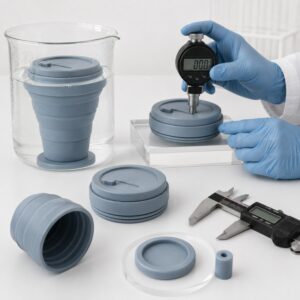
The buyer and manufacturer should define the test method.
For example, “the cup should not collapse” is subjective unless the fill volume, grip location, force, drink temperature, and test duration are defined.
17. Why Can Samples Pass While Mass Production Fails?
Development samples are often made under close supervision.
During sampling:
- Material is prepared carefully
- Mold parameters are adjusted slowly
- Every product is inspected
- Folding rings may be corrected manually
- Only a small number of samples are packed
- One material batch may be used
Mass production introduces:
- Multiple mold cavities
- Longer production runs
- Material-batch variation
- Color-batch variation
- Operator changes
- Demolding variation
- Mold-temperature variation
- Tool wear
- Packaging pressure
- Storage time
A structure with very little stability margin may pass a small sample trial but become inconsistent during continuous production.
Pilot production should compare:
- All mold cavities
- Cup dimensions
- Rim roundness
- Folding force
- Expanded stability
- Lid fit
- Base flatness
- Hardness
- Farbe
- Packaging recovery
18. A Practical Failure-Analysis Sequence
When a collapsible cup collapses, leaks, or loses its shape, investigate the problem systematically.
Recommended sequence:
- Identify the exact failure condition.
- Confirm whether the cup was empty, partially filled, or fully filled.
- Record the grip location and user action.
- Measure the cup height, diameter, rim, wall, and folding rings.
- Confirm material grade and hardness.
- Compare passing and failing samples.
- Check mold-cavity information.
- Inspect folding-line thickness and transition radius.
- Check rim roundness and base flatness.
- Test the cup without the lid.
- Test the cup with the lid installed.
- Check lid and cup tolerances separately.
- Review molding and curing records.
- Inspect for tearing, permanent creases, or demolding damage.
- Review packaging compression and storage time.
- Repeat the test after changing one controlled variable.
Do not change material hardness, wall thickness, lid dimensions, and packaging simultaneously.
Changing one variable at a time makes the root cause easier to identify.
19. What Should Be Validated Before Mass Production?
Before approving a custom silicone collapsible cup, buyers and manufacturers should confirm:
- Intended use
- Target user
- Target sales market
- Expanded capacity
- Folded height
- Expanded dimensions
- Silicone material
- Shore A hardness
- Wall thickness
- Folding-ring geometry
- Folding force
- Rim structure
- Base stability
- Lid material
- Lid engagement
- Vent or straw opening
- Leakage-test conditions
- Surface finish
- Farbe
- Logo position
- Repeated-folding requirement
- Cleaning method
- Packaging structure
- Storage condition
- Inspection standard
- Pilot-production consistency
- Reference sample
- Traceability requirements
Approval should cover both the cup in its expanded condition and the product after folding, packaging, storage, and recovery.
How LYA Silicone Supports Custom Collapsible Cup Projects
LYA Silicone supports OEM and ODM development for custom silicone outdoor products, travel, drinkware, baby, pet, household, and lifestyle products.
Our project support can include:
- Product-requirement review
- Drawing and sample evaluation
- Folding-structure review
- Material and hardness selection
- Wall-thickness review
- Rim and base development
- Lid-fit discussion
- Custom mold development
- Pantone-Farbabstimmung
- Logo and surface-texture development
- Molded sample production
- Functional testing support
- Packaging coordination
- Pilot production
- Quality inspection
- OEM/ODM mass production
With 25+ years of silicone manufacturing experience, we help buyers evaluate the complete product rather than focusing only on whether the cup can fold.
The goal is to develop a cup that remains stable when expanded, folds smoothly, fits its lid, recovers after storage, and can be produced consistently in bulk.
What Information Should Buyers Provide?
To evaluate a custom collapsible cup project, buyers should provide:
- Product photo or reference sample
- 2D drawing
- 3D file, when available
- Intended use
- Target user
- Required capacity
- Expanded height
- Folded height
- Cup diameter
- Silicone material requirement
- Hardness preference
- Lid structure
- Straw or vent requirement
- Farbe
- Logo
- Surface finish
- Packaging concept
- Target sales market
- Testing requirements
- Estimated quantity
- Expected launch schedule
Buyers should also explain whether the product must match an existing lid, straw, storage case, bottle, lunch box, or complete silicone travel set.
Frequently Asked Questions
Why does a silicone collapsible cup collapse when it is full?
The wall may be too soft or thin, the cup may be too tall, the folding rings may lack support, or the user may be gripping directly on a folding zone.
Does harder silicone make a collapsible cup better?
Not automatically. Harder silicone may improve stability but make the product difficult to fold. Hardness must be evaluated together with wall thickness, geometry, capacity, and folding force.
Why does the lid leak even when the cup body looks correct?
Leakage may result from rim deformation, lid tolerance, insufficient engagement, an unstable vent plug, contamination, or incorrect user assembly.
Can an existing collapsible cup mold be customized?
Existing molds may support color, logo, and packaging customization when the existing shape and structure are acceptable. Exclusive dimensions, folding structures, capacities, or lid systems generally require a new mold.
Can a collapsible cup be completely leakproof?
That depends on the lid, rim, vent, straw opening, assembly method, orientation, pressure, and test conditions. The correct claim should be based on actual product validation.
How should folding durability be tested?
The cup should be folded and expanded using a defined method and number of cycles. Buyers should then inspect recovery, folding sequence, tearing, creasing, rim shape, base stability, and lid fit.
Can the cup be packed in the collapsed position?
Yes, but the final packaging should be tested to confirm that long-term compression does not deform the rim, base, folding rings, or lid-fit area.
What should be approved before bulk production?
Buyers should approve material, hardness, dimensions, capacity, folding performance, rim stability, base flatness, lid fit, leakage conditions, surface finish, color, logo, packaging, and the final reference sample.
Schlussfolgerung
A successful silicone collapsible cup must do more than fold into a smaller size.
It must remain stable when expanded, support the intended liquid volume, provide a reliable rim and base, work with the lid, recover after repeated folding, and withstand packaging and storage.
Cup collapse, leakage, permanent deformation, tearing, and poor lid fit are rarely caused by one material specification alone.
The most reliable approach is to evaluate hardness, wall thickness, folding-ring geometry, rim, base, lid, mold, testing method, and packaging as one complete system.
If you are developing a custom silicone collapsible cup, contact LYA Silicone and send us your reference sample, drawing, required capacity, folded height, expanded dimensions, material, hardness, lid design, color, logo, packaging, target market, and estimated quantity. Our team will review the project and provide an appropriate OEM or ODM manufacturing proposal.