 Russian
  English
  French
  German
  Spanish
  Polish
  Chinese
  Japanese
  Korean
 Содержание
Answer Excerpt
Good silicone educational toy design requires more than choosing colors and adding letters, numbers or animal shapes to the surface. Fine molded details must be large enough to reproduce consistently, rounded enough for comfortable handling, spaced clearly enough to remain readable, and designed around the actual silicone material, product geometry and molding process.
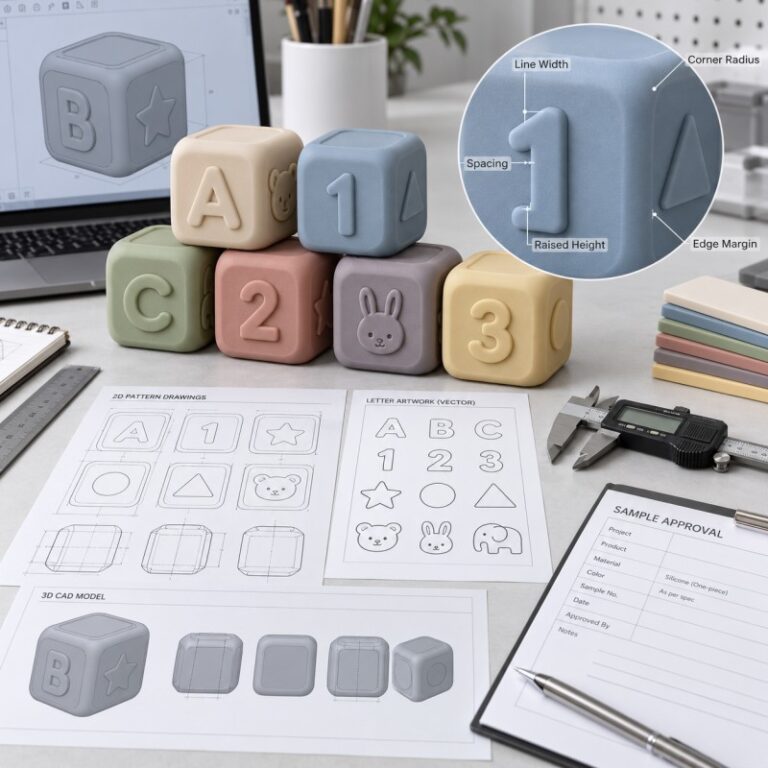
For custom silicone blocks, matching games and puzzle toys, raised or recessed learning details should be reviewed at their real production size before tooling and mass production.
Why Do Small Molded Details Need Separate Design Review?
Educational silicone products often rely on surface information.
Examples include:
- Letters
- Numbers
- Animal icons
- Fruit shapes
- Geometric symbols
- Counting dots
- Matching patterns
- Simple textures
- Brand marks
These details may appear simple on a computer screen.
But when they are molded into soft silicone, very small lines or narrow gaps can become difficult to reproduce clearly.
A detail that looks sharp at 500% zoom may become:
- Too shallow
- Too narrow
- Difficult to read
- Difficult to clean
- Difficult to demold
- Visually inconsistent between samples
The design team should therefore evaluate every molded feature at the actual product scale.
What Is the Difference Between Raised and Recessed Details?
Educational symbols can be created as either raised or recessed molded features.
Raised Details
Raised letters or numbers sit above the surrounding silicone surface.
Possible advantages include:
- Strong tactile feedback
- Clear shadow and contour
- Easy finger recognition
- Integrated one-piece construction
However, very tall raised details can:
- Catch on neighboring objects
- Bend locally
- Feel too prominent
- Become harder to clean around the base
Recessed Details
Recessed letters or numbers sit below the surrounding surface.
Possible advantages include:
- Cleaner overall silhouette
- Less protrusion
- Subtle visual appearance
- Good integration with flat surfaces
However, very deep or narrow recessed details may collect:
- Dust
- Water
- Food residue
- Cleaning residue
The correct method depends on product function, surface area and cleaning requirements.
How Small Can Molded Letters and Numbers Be?
There is no universal minimum dimension that applies to every silicone product.
The practical limit depends on:
- Silicone formulation
- Product hardness
- Mold manufacturing method
- Feature depth or height
- Surface texture
- Mold filling
- Demolding direction
- Product wall thickness
Very narrow letters such as E, M, W or small punctuation can be more difficult than broad geometric shapes.
The safest approach is to review the artwork at the actual molded size.
Do not approve a tiny letter only because it looks clear on a large computer monitor.
This same principle also applies to silicone product logo customization methods, where very small text, narrow lines and tiny gaps can lose clarity during molding.
Why Does Line Width Matter?
Every molded letter or icon contains lines.
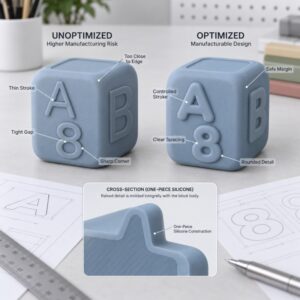
If those lines are extremely thin, they may:
- Fill incompletely
- Lose definition
- Look inconsistent
- Become fragile when raised
- Disappear visually on matte surfaces
If the lines are excessively thick:
- Letters can look heavy
- Small internal spaces disappear
- Closely spaced symbols merge visually
Designers should therefore simplify educational graphics before mold release.
For example:
A simple capital letter usually molds more predictably than an extremely decorative font with thin strokes.
A clean animal silhouette usually performs better than a highly detailed illustration.
The goal is readability and manufacturability, not maximum graphic complexity.
Why Is Spacing Between Details Important?
Spacing affects both appearance and manufacturing.
If two raised features are too close:
- The gap may become difficult to clean
- Shadows can merge visually
- Mold machining becomes more difficult
- Silicone may not define the separation clearly
If recessed lines are too close, they can create a narrow channel that is difficult to inspect.
Good spacing helps each detail remain visually independent.
For educational blocks, designers should consider:
- Space between letters
- Space between icons
- Space from the product edge
- Space from stacking or mating features
- Space from parting lines
Details should not interfere with the functional areas of the toy.
Why Should Sharp Internal Corners Be Avoided?
Very sharp internal corners may look attractive in vector artwork, but they are not always ideal for molded silicone.
Small internal radii can help:
- Improve mold machining
- Improve molded definition
- Reduce sharp visual transitions
- Support easier cleaning
- Reduce local stress in raised features
For example, a recessed star with extremely sharp narrow points may be less practical than a slightly softened version.
Likewise, a raised letter should not rely on needle-like corners.
The final symbol can remain recognizable while using more production-friendly geometry.
How Deep Should Recessed Letters Be?
A deeper recessed feature creates stronger shadow and tactile contrast.
But deeper is not automatically better.
Excessive depth may create:
- Hard-to-clean grooves
- Narrow mold features
- Local wall-thickness concerns
- More noticeable trapped residue
The depth should be enough to make the design recognizable without turning the product surface into a collection of deep pockets.
For products used by children, the cleaning method should be considered together with the visual design.
This is where easy-clean design becomes part of graphic engineering rather than a separate consideration.
How High Should Raised Details Be?
Raised details need similar balance.
If the height is too low:
- The symbol may be difficult to feel
- Contrast can disappear
- The molded detail may look weak
If the height is too high:
- The feature may flex
- Edges can feel too prominent
- The base may collect residue
- The detail may interfere with stacking
Raised letters on a stacking block should therefore be designed differently from large decorative texture on a chew toy.
The surface feature should support the toy function, not interfere with it.
How Does Silicone Hardness Affect Fine Details?
The same mold geometry can look and feel different when the silicone hardness changes.
A softer material may make raised details feel:
- More flexible
- Softer under the finger
- Less sharply defined
A firmer material may provide:
- Stronger shape definition
- Clearer edges
- More stable raised features
However, hardness should not be increased only to make letters look sharper.
The whole product still needs to meet its intended feel and function.
The correct silicone hardness should therefore be evaluated together with the complete toy structure.
Should Letters and Numbers Use Decorative Fonts?
Usually, simple fonts are easier to interpret and manufacture.
Highly decorative fonts can contain:
- Very thin strokes
- Tight internal spaces
- Sharp corners
- Small serifs
- Complex curves
These features may reduce readability when molded.
For educational toys, the graphic should be evaluated from the end user’s perspective.
A simple, rounded letter form can often provide:
- Better visual recognition
- Better tactile recognition
- Easier mold machining
- More stable mass production
The design does not need to look industrial.
It simply needs to avoid unnecessary complexity.
How Should Molded Details Be Positioned on Silicone Blocks?
LYA Silicone’s current product structure includes Силиконовые образовательные блоки and other educational silicone toys.
For a cube-shaped educational block, each face may contain different learning content.
For example:
- Face 1: Letter
- Face 2: Number
- Face 3: Animal
- Face 4: Geometric shape
- Face 5: Counting dots
- Face 6: Simple texture
The designer should maintain consistent visual margins around each face.
Avoid placing a raised symbol too close to:
- Rounded corners
- Mold split lines
- Stacking grooves
- Product edges
A centered detail with enough surrounding space is usually easier to inspect and visually cleaner.
Should Every Side of a Block Have the Same Feature Depth?
Not necessarily, but excessive variation should be justified.
If one face uses very shallow numbers while another uses extremely tall animals, the block can feel visually inconsistent.
A coordinated product family should define:
- Raised height range
- Recessed depth range
- Line-width style
- Corner-radius style
- Graphic complexity
This gives the entire educational set a consistent design language.
How Do Fine Details Affect Mold Filling?
Fine molded features become part of the mold cavity.
Very narrow recesses in the mold need to be filled consistently by silicone.
Potential problems include:
- Missing detail
- Rounded-off corners
- Incomplete lettering
- Uneven depth
- Local air trapping
The risk depends on the actual design and manufacturing process.
This is why fine educational symbols should be reviewed during custom silicone mold development rather than added after the mold layout is already complete.
The tooling team should review the feature together with:
- Flow direction
- Venting
- Product thickness
- Mold surface
- Demolding
How Does Demolding Affect Raised Details?
After molding, the silicone product needs to leave the mold without damaging the details.
Tall, narrow raised features can deform during demolding.
Deep recessed features require corresponding mold projections, which also need suitable geometry.
The team should therefore consider:
- Draft
- Feature height
- Sidewall angle
- Corner radii
- Silicone flexibility
- Demolding direction
The objective is to preserve detail without making the mold unnecessarily difficult to operate.
Why Does Surface Finish Matter?
A matte silicone surface and a glossy silicone surface can display small details differently.
Matte surfaces can create softer visual contrast.
Glossy surfaces can highlight edges and reflections.
If the entire product has heavy texture, very fine letters may become less visible.
The designer should therefore avoid placing small educational details on an overly busy background.
A useful hierarchy is:
Main Learning Symbol → Supporting Texture → Background Surface
The learning symbol should remain the clearest element.
How Should Color Be Used With Molded Details?
A single-color molded block relies on:
- Light
- Shadow
- Height
- Depth
to make details visible.
A contrasting printed color can increase visual clarity, but it also introduces another process.
If printing is used, brands should evaluate:
- Ink compatibility
- Alignment
- Долговечность
- Washing
- Flexing
- Abrasion
Molded single-color details may be more suitable when tactile learning and production simplicity are the priority.
Printed details may be appropriate when strong visual contrast is required.
The choice should follow the product concept rather than adding color automatically.
How Should Matching-Game Symbols Be Designed?
A silicone memory matching game creates a different design challenge from blocks.
Matching pieces need pairs that are:
- Clearly distinguishable from other symbols
- Clearly identical to their matching partner
- Easy to recognize
- Consistent across production
If two symbols are too similar, the game becomes visually confusing.
If the detail is too fine, molded variation can make identical pairs look different.
For matching games, the designer should prioritize strong silhouettes.
Examples include:
- Sun
- Moon
- Рыба
- Leaf
- Star
- Flower
Simple icons can be easier to recognize and manufacture than complex illustrations.
How Should Educational Puzzle Details Be Designed?
Silicone puzzle products may include:
- Molded shapes
- Matching outlines
- Raised symbols
- Recessed pockets
The visual design should not interfere with the actual puzzle fit.
For example, raised decoration placed on a critical fitting edge may change how a piece sits.
Likewise, extremely deep decoration can change local stiffness.
The product should therefore separate:
Learning Detail Areas
from:
Functional Fit Areas
where practical.
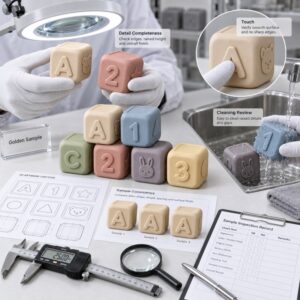
What Should Brands Test During Sample Approval?
Readability
Check letters, numbers and icons at normal viewing distance.
Do not inspect only with magnification.
Tactile Clarity
Run a finger across raised or recessed details.
Confirm that the feature is recognizable without sharp edges.
Detail Completeness
Inspect for:
- Missing corners
- Short fill
- Uneven height
- Incomplete lines
- Distortion
Очистка
Wash the actual sample.
Check whether narrow grooves or raised-detail bases hold residue.
Repeated Handling
For flexible products, bend and squeeze the sample.
Check whether molded details distort excessively.
Set Consistency
Compare all blocks or matching pieces in the set.
The graphic style should remain consistent.
Multi-Cavity Consistency
If multiple mold cavities are used, compare the same symbol between cavities.
Practical Example: Custom Silicone Educational Block Set
Consider a six-piece silicone educational block set.
Each block uses the same rounded cube body but has different molded learning details.
The collection includes:
- Capital letters
- Numbers
- Animal icons
- Geometric shapes
- Counting dots
- Simple sensory lines
The brand wants each surface to be soft, readable, tactile and easy to clean.
Poor Version
The first design contains:
- Very thin letters
- Deep narrow grooves
- Sharp star points
- Tiny animal features
- Symbols too close to the rounded block edges
The artwork looks attractive on screen but is difficult to translate into a consistent molded product.
Improved Version
The optimized design uses:
- Thicker letter strokes
- Larger spaces
- Rounded internal corners
- Simplified animal silhouettes
- Controlled raised height
- Clear margins around each block face
The result keeps the learning concept while improving production feasibility.
Silicone Molded Detail Design Checklist
| Артикул | What the Brand Should Confirm |
|---|---|
| Learning function | Letter, number, icon, texture or matching symbol |
| Actual size | Reviewed at 1:1 production scale |
| Line width | Not unnecessarily thin |
| Spacing | Enough separation between features |
| Raised height | Visible and tactile without excessive projection |
| Recessed depth | Readable without deep cleaning pockets |
| Corner radius | Avoid unnecessary needle-sharp details |
| Font | Simple and readable |
| Icon complexity | Simplified for molded reproduction |
| Surface finish | Does not hide fine details |
| Product edge | Adequate margin from corners |
| Fit areas | Detail does not interfere with assembly or stacking |
| Очистка | Grooves and bases remain accessible |
| Mold filling | Feature forms completely |
| Demolding | Detail can release without distortion |
| Sample consistency | All pieces follow one design language |
| Cavity consistency | Same detail reproduced consistently |
How LYA Silicone Supports Educational Silicone Product Development
LYA Silicone’s current product range includes educational blocks, fidget toys, stacking toys, memory matching games and silicone puzzle toys, fitting the site’s broader custom silicone OEM positioning.
For OEM and ODM development, project review may include:
- Product dimensions
- Learning theme
- Letter and number artwork
- Icon simplification
- Raised or recessed structure
- Silicone hardness
- Surface finish
- Mold-development review
- Color planning
- Sample production
- Detail inspection
- Cleaning review
- Set consistency
- Упаковка
- Mass-production quality control
The goal is not to reproduce the most complicated artwork possible.
The goal is to create details that remain recognizable, manufacturable and consistent on the finished silicone product.
Frequently Asked Questions
Can very small letters be molded into silicone?
Yes in some designs, but the practical minimum depends on material, mold process, feature depth, line width and product geometry. Artwork should be reviewed at actual production size.
Is embossed or debossed lettering better for educational toys?
Neither method is universally better. Raised details provide tactile feedback, while recessed details can create a cleaner profile. The product function and cleaning method should guide the decision.
Why do small molded letters lose definition?
Possible causes include overly thin strokes, insufficient spacing, difficult mold filling, excessive surface texture or inappropriate feature depth.
Should letters on silicone blocks have sharp corners?
They do not need needle-sharp geometry to remain recognizable. Slightly rounded internal and external corners can improve manufacturability and handling.
Can different icons be molded on every side of a silicone block?
Yes, when the mold structure supports the design. All surfaces should still follow a coordinated detail style.
Should molded educational details be checked after washing?
Yes. Recessed grooves and raised-detail bases should remain practical to clean according to the intended product use.
Should fine details be finalized before tooling?
Yes. Molded letters, numbers and icons become part of the tooling geometry, so their final size, position, height and depth should be reviewed before mold machining is completed.
Design the Learning Detail for the Molded Product, Not the Computer Screen
Educational graphics need to survive the transition from artwork to real silicone.
Brands should review:
Actual Size → Line Width → Spacing → Height/Depth → Radius → Hardness → Surface → Mold Filling → Demolding → Cleaning
before final tooling approval.
A simpler symbol that molds clearly and consistently can provide more value than an extremely detailed graphic that loses definition during production.
If you are developing custom silicone educational blocks, matching games or puzzle toys, contact us with your product drawing, learning theme, artwork, target dimensions, silicone requirements, color plan, packaging concept and estimated quantity.