 Russian
  English
  French
  German
  Spanish
  Polish
  Chinese
  Japanese
  Korean
 Содержание
Answer Excerpt
The best logo method for a custom silicone product depends on product structure, logo size, number of colors, expected abrasion, cleaning conditions, order quantity and brand appearance. Embossed and debossed logos are molded directly into the product and usually provide strong durability. Printed logos offer color flexibility, while laser marking depends heavily on silicone formulation and surface response. The final method should be validated on production-intent samples.
Adding a brand logo may appear to be a simple final step in silicone product development.
However, the logo process can affect:
- Mold structure
- Tooling cost
- Product appearance
- Surface cleanliness
- Production yield
- Unit price
- Minimum order quantity
- Sampling time
- Упаковка
- Long-term durability
A logo that looks clear on a computer screen may become unreadable when molded into soft silicone.
A printed logo may appear correct during sampling but wear after repeated washing.
A debossed logo may collect residue if the groove is too deep.
A laser-marked logo may not create sufficient contrast on every silicone formulation or color.
For brand owners, importers and private-label buyers, the logo method should therefore be selected during product and mold planning—not after the product has already entered mass production.
What Are the Main Logo Options for Silicone Products?
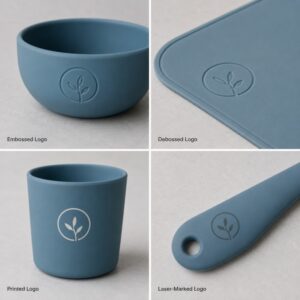
Common silicone product branding methods include:
- Embossed molded logo
- Debossed molded logo
- Silicone ink printing
- Pad printing
- Screen printing
- Laser marking or laser engraving
- Separate logo insert or badge
- Packaging-only branding
Not every method is suitable for every product.
The correct option depends on:
- Silicone material
- Product hardness
- Surface texture
- Product curvature
- Logo dimensions
- Logo color
- Cleaning conditions
- Oral-contact or food-contact areas
- Expected order quantity
- Product lifecycle
- Target retail positioning
What Is an Embossed Silicone Logo?
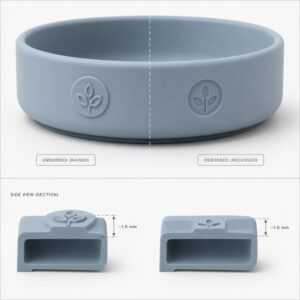
An embossed logo is raised above the surrounding silicone surface.
The logo shape is created directly in the mold, so the logo is formed during the silicone molding process.
Common applications include:
- Silicone baby bibs
- Silicone bowls and plates
- Pet feeding mats
- Collapsible cups
- Силиконовые игрушки
- Handles
- Protective sleeves
- Promotional products
Advantages of an Embossed Logo
- Formed directly with the product
- No separate printing step
- Good long-term durability
- Suitable for single-color products
- Can create a tactile brand feature
- No risk of printed ink rubbing away
- Suitable for repeated washing when properly designed
Limitations of an Embossed Logo
- Normally the same color as the product
- Fine details may not reproduce clearly
- Raised edges may collect dust or residue
- Large raised logos can affect touch or cleaning
- Logo changes may require modifying the mold or logo insert
- Placement must allow reliable demolding
An embossed logo is often suitable when durability is more important than multi-color visual contrast.
What Is a Debossed Silicone Logo?
A debossed logo is recessed below the product surface.
Like an embossed logo, it is normally formed directly by the mold.
Debossed logos are commonly used when brands want a cleaner, more subtle appearance.
Advantages of a Debossed Logo
- Integrated into the molded product
- Durable during washing and handling
- Does not add height above the surface
- Can create a premium, understated appearance
- Suitable for matte silicone products
- Can be combined with a simple one-color design
Limitations of a Debossed Logo
- Very narrow grooves may not fill or demold well
- Deep grooves can collect food, dust or cleaning residue
- Small text may become difficult to read
- Logo contrast depends on light and shadow
- A poorly positioned groove may weaken a thin product wall
- The logo may become less visible on dark or highly textured silicone
For food-contact or baby products, the groove depth and edge radius should be designed for easy cleaning.
Embossed vs Debossed Silicone Logos
| Сравнение | Embossed Logo | Debossed Logo |
|---|---|---|
| Appearance | Raised above the surface | Recessed below the surface |
| Долговечность | Высокий | Высокий |
| Logo color | Normally same as product | Normally same as product |
| Touch | More noticeable | More subtle |
| Cleaning risk | Raised edges may trap residue | Deep grooves may trap residue |
| Mold requirement | Logo geometry built into mold | Logo geometry built into mold |
| Best for | Visible tactile branding | Minimal premium branding |
| Logo change | May require mold insert or modification | May require mold insert or modification |
Neither method is automatically better.
The correct choice depends on the product surface, logo design and customer experience.
What Is Silicone Logo Printing?
Printed logos add a separate ink layer to the silicone surface after molding.
Depending on the product shape and logo design, manufacturers may use:
- Screen printing
- Pad printing
- Specialized silicone ink
- Multi-step printing
- Surface pretreatment where required
Printing is often selected when the logo needs a different color from the silicone product.
Advantages of Printed Logos
- Supports contrasting colors
- Suitable for brand names and graphic elements
- Does not require a raised or recessed molded structure
- Existing products may sometimes be branded without opening a completely new mold
- Useful for private-label market testing
- Can support several packaging and product color combinations
Limitations of Printed Logos
- Durability depends on ink, pretreatment and curing
- Adhesion must be tested on the actual silicone
- Repeated washing can reduce logo life if the process is unsuitable
- Very flexible areas can stretch the print
- Textured surfaces can reduce print clarity
- Curved surfaces may create distortion
- Each print color may require additional setup
- Printing may increase unit cost and production time
A printed logo should not be approved based only on appearance immediately after printing.
It should also pass the agreed adhesion, washing, abrasion and bending tests.
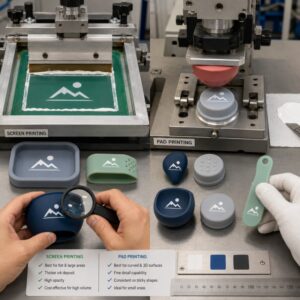
Screen Printing vs Pad Printing on Silicone
Screen Printing
Screen printing is generally more suitable for relatively flat or gently curved areas.
It may be used for:
- Larger logos
- Simple graphics
- Text
- Measurement marks
- Flat silicone mats
- Bibs
- Sleeves
- Product bases
Advantages may include:
- Good coverage
- Suitable for larger printed areas
- Relatively clear single-color graphics
- Repeatable placement when fixtures are controlled
Challenges may include:
- Difficulty on highly curved surfaces
- Ink buildup on textured areas
- Registration issues with multiple colors
- Stretching or cracking on very flexible zones
Pad Printing
Pad printing can transfer a logo onto a smaller or more curved surface.
It may be used for:
- Small product areas
- Curved handles
- Product sides
- Irregular surfaces
- Compact brand marks
Advantages may include:
- Better adaptation to curved surfaces
- Suitable for smaller logos
- Useful where screen-printing access is limited
Challenges may include:
- Smaller printable area
- Fixture and positioning requirements
- Possible distortion on very soft products
- Limited coverage on rough textures
The factory should review the actual product geometry before selecting the printing process.
What Is Laser Marking on Silicone?
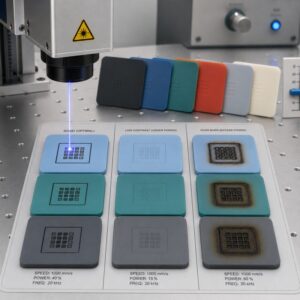
Laser marking uses controlled laser energy to create a visible change on the silicone surface.
Depending on the material formulation and process, the result may appear as:
- A darker mark
- A lighter mark
- A surface texture change
- A shallow engraved effect
- A permanent identification code
Laser marking is often considered for:
- Small logos
- Serial numbers
- Batch codes
- Product identification
- Simple graphics
- Technical markings
Advantages of Laser Marking
- No wet ink
- No printing plate for each color
- Good positioning control
- Suitable for variable codes in some applications
- Can produce clean, permanent marks on compatible materials
- Useful for traceability
Limitations of Laser Marking
- Not every silicone formulation produces clear contrast
- Marking result can vary by color and pigment
- Very soft silicone may deform during fixturing
- Incorrect settings may burn, discolor or damage the surface
- Large filled logos may look uneven
- Oral-contact or food-contact locations require careful review
- A laser-markable additive or compatible formulation may be required
Laser marking should always be tested on the final material, final color and final surface texture.
A successful result on black silicone does not guarantee the same result on beige, transparent or pastel silicone.
Can a Printed Logo Be Added to an Embossed or Debossed Logo?
Yes, a molded logo can sometimes be combined with printing.
Examples include:
- Printed color inside a debossed logo
- Contrasting print on a raised logo
- Molded logo plus additional product information
- Molded brand name plus printed measurement marks
This approach can improve visibility, but it also increases process complexity.
Additional risks include:
- Ink alignment
- Logo edge coverage
- Print overflow
- Inconsistent filling of recessed areas
- Higher rejection rate
- Additional fixtures
- Longer production cycle
The combined process should be used only when the branding benefit justifies the added production control.
Which Logo Method Is Most Durable?
In general, molded logos are less dependent on a separate surface layer because the logo is part of the product itself.
However, durability should still be evaluated according to:
- Product use
- Repeated washing
- Dishwasher exposure
- Boiling
- Bending
- Scratching
- Chewing
- Outdoor use
- Oil exposure
- Cleaning chemicals
- Surface abrasion
A molded logo can remain readable for a long time, but a poorly designed thin logo may tear or distort.
A printed logo can also perform well when the correct ink, pretreatment, curing and inspection method are used.
The decision should not be based only on the name of the process.
How Does Product Surface Affect Logo Quality?
Smooth Surface
A smooth surface usually provides clearer printing and sharper molded details.
However, highly glossy silicone may show:
- Dust
- Fingerprints
- Print-edge defects
- Surface marks
Matte Surface
Matte silicone can create a premium appearance and reduce visible fingerprints.
However, a heavy texture can reduce:
- Printing clarity
- Laser-mark contrast
- Small-text readability
- Fine molded detail
Curved Surface
Curved areas can distort logos and make printing alignment more difficult.
Thin Flexible Surface
A very soft or thin area may stretch during printing or deform around a molded logo.
Ribbed or Patterned Surface
The logo should not compete with strong текстура поверхности.
The logo location may need a dedicated smooth branding area.
Why Does Logo Location Matter?
Logo placement affects both appearance and manufacturing.
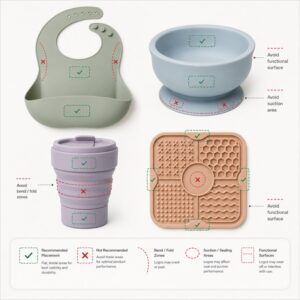
Avoid placing logos directly on:
- Severe bend lines
- Folding rings
- Sealing surfaces
- Suction edges
- Oral-contact edges
- Thin tear-sensitive sections
- Highly textured zones
- Parting lines
- Gates
- Venting areas
- Areas compressed by packaging
A good logo area should provide:
- Enough flat or stable surface
- Adequate wall thickness
- Clear visual orientation
- Reliable demolding
- Easy inspection
- Easy cleaning
- Protection from repeated friction
The brand team should confirm logo placement with the product engineer before final mold approval.
What Logo File Should the Buyer Provide?
For custom silicone product development, buyers should preferably provide a vector logo file.
Common formats include:
- AI
- EPS
- SVG
- Editable PDF
- CDR, when supported
A low-resolution JPG or screenshot may not provide enough detail for tooling or printing.
The logo package should confirm:
- Final artwork
- Logo width and height
- Font
- Minimum line thickness
- Minimum spacing
- Color specification
- Orientation
- Location
- Embossed or debossed direction
- Required depth or height
- Print color
- Approved Pantone number
Outlined vector artwork is normally safer than an editable font that may be missing from the manufacturer’s computer.
What Logo Details Are Too Small for Silicone Molding?
Very small text and sharp details may not reproduce reliably.
Risks increase when the logo contains:
- Thin lines
- Small gaps
- Sharp internal corners
- Tiny punctuation
- Narrow letters
- Complex gradients
- Fine trademarks
- Small negative spaces
The minimum practical feature depends on:
- Silicone viscosity
- Mold process
- Product hardness
- Mold machining
- Logo depth
- Surface texture
- Demolding direction
- Product wall thickness
The engineering team should review the logo at actual production size.
Do not approve the logo only while viewing it enlarged on a computer screen.
How Do Logo Methods Affect Mold Cost and MOQ?
Molded Logo
A molded logo may require:
- Logo machining in the mold
- A replaceable logo insert
- Separate customer mold components
- Mold modification
- New sampling
The initial tooling cost may be higher, but there is no separate printing operation for each product.
Printed Logo
A printed logo may require:
- Printing plate or screen
- Ink matching
- Fixture
- Surface treatment
- Printing setup
- Curing
- Additional inspection
Printing can be suitable for lower-volume private-label orders when an existing mold is used, but each color and design may create a separate production setup.
Laser Marking
Laser marking may require:
- Material compatibility testing
- Fixture development
- Parameter setup
- Marking program
- Sample validation
MOQ and pricing depend on logo size, marking time and order structure.
The buyer should ask whether the quotation includes:
- Logo tooling
- Printing plate
- Color matching
- Fixture
- Sample approval
- Inspection
- Rejection allowance
- Упаковка
Logo Method Comparison for B2B Buyers
| Logo Method | Варианты цвета | Долговечность | Tooling Requirement | Suitable Quantity | Main Risk |
|---|---|---|---|---|---|
| Embossed molded logo | Same as product | Высокий | Mold machining or insert | Medium to high volume | Small details or difficult cleaning |
| Debossed molded logo | Same as product | Высокий | Mold machining or insert | Medium to high volume | Deep grooves or weak visibility |
| Screen printing | One or more colors | Process-dependent | Screen and fixture | Low to high volume | Adhesion and washing durability |
| Pad printing | One or more colors | Process-dependent | Pad plate and fixture | Low to medium volume | Distortion on soft curved parts |
| Laser marking | Material-dependent contrast | Potentially high on compatible silicone | Fixture and parameter setup | Low to high volume | Insufficient contrast or surface damage |
| Packaging logo only | Full-color printing | Packaging-dependent | Packaging artwork and printing | Market testing | Product itself remains unbranded |
Recommended Logo Method by Product Type
Детские товары из силикона
Suitable options may include:
- Embossed logo
- Shallow debossed logo
- Packaging branding
- Validated printed logo away from oral-contact areas
Important checks:
- Easy cleaning
- Rounded edges
- No deep residue traps
- Resistance to repeated washing
- Correct logo location
- Product-specific compliance review
Силиконовые товары для животных
Suitable options may include:
- Embossed or debossed logo
- Printed logo on low-wear areas
- Laser marking on compatible materials
- Custom packaging
Important checks:
- Chewing and scratching
- Outdoor exposure
- Oil and food contact
- Repeated washing
- Abrasion resistance
Silicone Outdoor and Travel Products
Suitable options may include:
- Molded logo
- High-contrast printed logo
- Laser-marked identification
- Packaging branding
Important checks:
- Folding
- Friction
- Sunlight
- Water exposure
- Temperature change
- Product-to-product contact during transport
Silicone Educational and Sensory Products
Suitable options may include:
- Molded brand logo
- Molded numbers or shapes
- Printed color graphics
- Packaging branding
Important checks:
- Small-part safety
- Edge quality
- Repeated handling
- Color consistency
- Logo readability
- Cleaning method
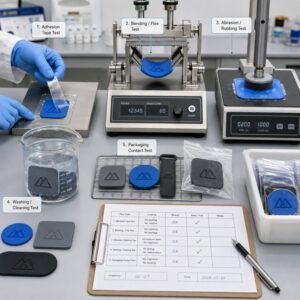
How Should Logo Samples Be Tested?
1. Visual Inspection
Check:
- Position
- Orientation
- Размер
- Цвет
- Sharpness
- Missing areas
- Overflow
- Uneven depth
- Distortion
- Surface damage
2. Adhesion Test for Printed Logos
The exact method should be agreed according to the product and ink system.
The test may include:
- Controlled tape test
- Rubbing
- Bending
- Stretching
- Washing
- Repeated handling
3. Cleaning and Washing Test
Test the product using the intended cleaning method.
Possible conditions include:
- Hand washing
- Dishwasher cycles
- Warm water
- Boiling, where applicable
- Mild detergent
- Wiping
4. Abrasion Test
Rub the logo against a defined material for an agreed number of cycles.
5. Flexing Test
Bend, fold or stretch the product in the actual use direction.
6. Packaging Test
Confirm that the logo does not:
- Stick to packaging
- Transfer ink
- Become scratched
- Leave an impression
- Contact another product
- Deform during folding
7. Batch Consistency Check
Compare production logos from:
- Different mold cavities
- Different print positions
- Different shifts
- Different colors
- Beginning and end of production
DFM Checklist for Silicone Product Logos
Before approving the product and mold, confirm:
- Which logo method is required?
- Is the logo area flat, curved or flexible?
- Is the surface smooth or textured?
- Is the logo located near a parting line?
- Is the logo near a sealing or suction surface?
- Are all lines and gaps large enough?
- Is the logo easy to clean?
- Can the product be demolded without damaging the logo?
- Is a replaceable logo insert needed?
- Will the logo be changed for different customers?
- Does each brand require a separate mold insert?
- Does the printing area require pretreatment?
- Does laser marking create sufficient contrast?
- Will the logo survive washing and abrasion?
- Has the final logo been tested in packaging?
- Is the approved artwork revision clearly recorded?
Common Logo Customization Mistakes
Selecting the Logo Process After the Mold Is Finished
This may create limited placement options or require expensive mold modification.
Using a Low-Resolution Logo File
A blurred JPG may create inaccurate tooling or printing artwork.
Making the Logo Too Small
Fine details may disappear in molding or printing.
Placing the Logo on a Folding Area
Repeated deformation may damage printed logos or distort molded logos.
Assuming All Silicone Accepts the Same Ink
Ink adhesion depends on material and surface condition.
Assuming Laser Marking Works on Every Color
Laser response may vary significantly between materials and pigments.
Approving Appearance Without Durability Testing
A clear sample may still fail after washing or abrasion.
Ignoring Packaging Contact
Printed logos may rub against boxes, bags or accessories during transport.
How LYA Silicone Supports Logo and Private-Label Customization
LYA Silicone supports custom branding for silicone baby, pet, household, outdoor and educational products.
Project support may include:
- Logo structure review
- Embossed logo design
- Debossed logo design
- Replaceable mold-logo inserts
- Silicone ink printing
- Screen-printing evaluation
- Laser-marking evaluation
- Pantone color matching
- Surface-finish selection
- Sample production
- Logo adhesion and appearance inspection
- Private-label packaging
- Pilot production
- Mass-production quality control
The brand manual also lists silk-printing and laser equipment as part of the company’s production resources.
The final process should be selected after reviewing the product shape, logo artwork, material, color, quantity and intended use.
FAQ About Silicone Product Logo Customization
Is an Embossed Logo More Durable Than a Printed Logo?
A molded embossed logo does not depend on an ink layer, so it generally has strong long-term durability.
However, the complete product design, washing method and use conditions still need to be evaluated.
Is a Debossed Logo Suitable for Silicone Baby Products?
It can be suitable when the groove is shallow, rounded and easy to clean.
Deep or narrow grooves should be avoided in areas that contact food or collect residue.
Can a Logo Be Printed on Soft Silicone?
Yes, but the ink, pretreatment, curing and product flexibility must be validated.
Very soft or highly stretched areas can reduce print durability.
Can Silicone Products Have Multi-Color Logos?
Yes, but multi-color printing normally requires additional alignment, setup and inspection.
The cost and MOQ may increase with each print color.
Can the Logo Be Changed Without Opening a Completely New Mold?
A replaceable logo insert may allow the logo to be changed while retaining the main mold.
This must be planned during mold design.
Can Laser Marking Produce a White Logo on Black Silicone?
Some compatible silicone formulations may produce a light contrasting mark, but the result depends on material and laser parameters.
A sample test is required.
Which Logo Method Is Best for a Low-Volume First Order?
For an existing product, printing or packaging branding may reduce initial mold investment.
The best option still depends on product surface and durability requirements.
Can We Put the Brand Logo Only on the Packaging?
Yes.
Packaging-only branding can be used for early market testing, although the silicone product itself will not carry permanent brand identification.
Should the Logo Be Approved Before Mold Manufacturing?
Yes.
Logo size, position, height, depth and artwork should be confirmed before final mold machining.
What Information Should We Send for a Logo Quote?
Send:
- Vector logo file
- Product drawing or photo
- Logo dimensions
- Logo position
- Required method
- Product color
- Logo color
- Estimated quantity
- Packaging requirement
- Cleaning and durability expectations
Choose the Logo Method Before Production Starts
A silicone product logo is not only a decorative detail.
It affects tooling, production, quality control, cleaning, durability and brand recognition.
Before confirming the method, evaluate:
- Product structure
- Surface texture
- Logo size
- Logo color
- Cleaning conditions
- Abrasion
- Flexing
- Order quantity
- Tooling plan
- Упаковка
To review the best logo method for your custom silicone product, send LYA Silicone your product drawing, logo artwork, dimensions, colors, estimated quantity and packaging requirements.