 Korean
  English
  French
  German
  Spanish
  Polish
  Chinese
  Japanese
  Russian
 콘텐츠
Answer Excerpt
To receive an accurate custom silicone product quote, buyers should provide the product application, drawing or reference sample, dimensions, material requirements, silicone hardness, functional expectations, colors, logo, packaging, target market, estimated quantity and project schedule. The more clearly these requirements are defined, the more accurately a manufacturer can evaluate tooling, molding process, sampling, testing, production time and total project cost.
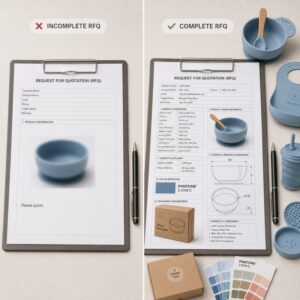
A request such as “Please quote this silicone product” with only one product photo rarely provides enough information for an accurate manufacturing quotation.
For brand owners, importers, distributors and private-label sellers, a complete RFQ does more than help a factory calculate price. It also allows the engineering team to identify potential design risks before mold development, confirm which specifications still need clarification and create a more realistic sampling and production plan.
This guide explains what information buyers should prepare before requesting a quote from a custom silicone product manufacturer.
Why Can an Incomplete RFQ Lead to an Inaccurate Quote?
A custom silicone product quotation is normally based on several separate cost elements:
- Raw silicone material
- Product weight
- Mold structure
- Number of mold cavities
- Molding cycle
- Secondary processing
- Logo or printing
- Assembly
- Quality inspection
- 패키징
- Estimated order quantity
- Testing or documentation requirements
When these details are missing, the manufacturer must make assumptions.
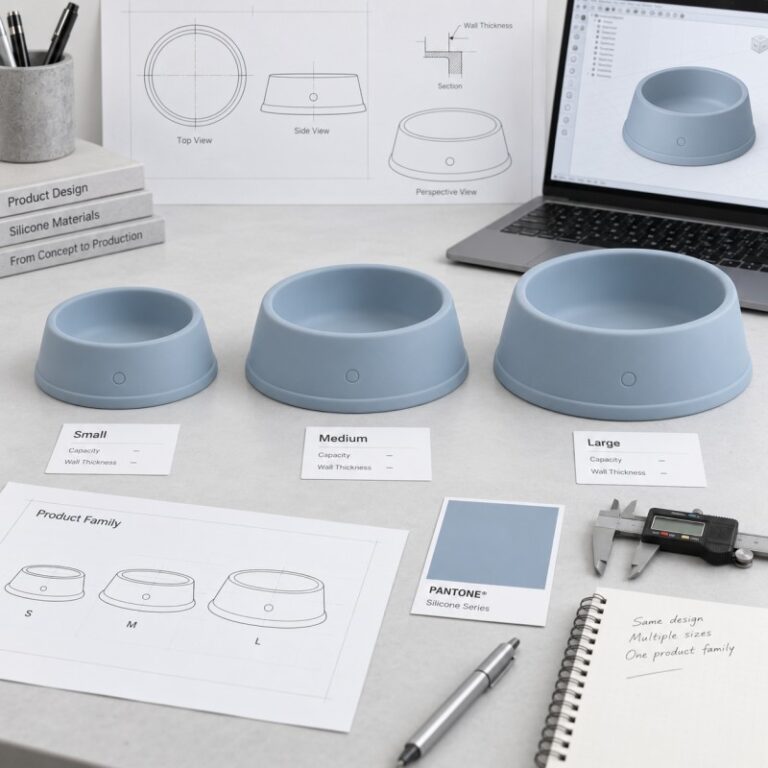
For example, a product photo may show the general shape of a silicone baby bowl, but it does not show the actual wall thickness, silicone hardness, suction-base geometry, product weight, surface finish or dimensional tolerance.
A preliminary estimate may still be possible, but the final price could change after the specifications are confirmed.
A complete RFQ helps both the buyer and manufacturer reduce repeated communication, avoid conflicting assumptions and shorten the time needed to move from quotation to sample development.
1. Explain the Product and Its Intended Application
Start by telling the manufacturer what the product is and how it will be used.
This information helps the engineering team understand which material, structure and production process may be appropriate.
A useful product description may include:
- 제품 이름
- Intended user
- Primary function
- Usage environment
- Contact conditions
- Cleaning method
- Expected service life
- Target sales channel
For example:
We are developing a silicone baby feeding bowl for children aged six months and above. The bowl requires a suction base, rounded inner corners, dishwasher cleaning and custom retail packaging for the United States market.
This is more useful than simply writing:
Please quote one silicone bowl.
Applications also influence design priorities. 실리콘 유아용 제품 may require soft edges, easy-clean structures and age-appropriate dimensions, while silicone pet products may require stronger tear resistance, thicker walls or repeated outdoor use.
The manufacturer should understand the actual application before recommending a material or mold structure.
2. Provide the Best Design Reference Available
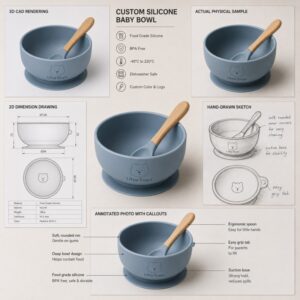
A completed 3D drawing is helpful, but it is not the only way to begin a silicone project.
Buyers may provide one or more of the following:
3D Drawing
Common formats may include STEP, STP, IGS, IGES or X_T.
A 3D drawing allows the engineering team to review the complete geometry, wall thickness, draft, undercuts, openings, ribs, textures and possible mold-parting direction.
2D Drawing
A 2D drawing should show the critical dimensions, tolerances, material notes, hardness, logo location and functional requirements.
Physical Sample
A physical sample can be useful when the buyer wants to reproduce, improve or redesign an existing structure.
The buyer should explain which features must remain unchanged and which features may be modified.
Reference Photos
Photos can support an early discussion, especially when a project is still at the concept stage.
However, buyers should add approximate dimensions, annotations and a written description. Photos alone usually cannot define wall thickness, tolerances or internal structures.
Hand Sketch or Product Concept
A hand sketch can also be used for an initial feasibility discussion.
The manufacturer can then help determine whether the concept requires industrial design, 3D modeling, DFM review or direct mold development.
Before starting custom mold development, both parties should confirm which file will be treated as the final approved design.
3. Identify Critical Dimensions and Tolerances
Not every dimension on a silicone product requires the same tolerance.
Applying unnecessarily tight tolerances to the entire product can increase mold complexity, inspection time and production cost without improving the user experience.
Buyers should identify the dimensions that directly affect:
- Assembly
- Sealing
- Suction
- Fit
- Product capacity
- Closure
- Balance
- Ergonomics
- 안전
- 패키징
Examples include:
- Overall length, width and height
- Wall thickness
- Hole diameter
- Mating dimensions
- Suction-base diameter
- Lid or cap fit
- Handle opening
- Logo position
- Product volume
- Assembly interface
For a standalone flexible silicone product, some non-functional surfaces may tolerate normal molding variation. By contrast, an interface that fits another component may require closer dimensional control.
The drawing should clearly distinguish critical dimensions from reference dimensions.
When the buyer does not yet know the appropriate tolerance, the manufacturer can review the application and recommend a practical manufacturing tolerance instead of applying a single value to every feature.
4. State the Material and Silicone Hardness Requirements
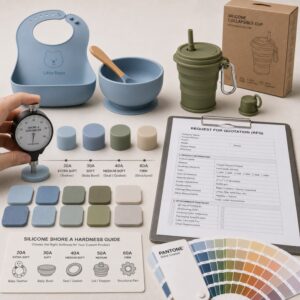
Silicone is available in different formulations, hardness levels, colors and curing systems.
The correct selection depends on the product application rather than the product name alone.
Buyers should provide any known requirements for:
- Liquid silicone rubber or solid silicone rubber
- Platinum-cured or other approved curing system
- Shore A hardness
- Transparency
- Tear strength
- Elongation
- Temperature resistance
- Food-contact or oral-contact use
- Odor requirements
- Color stability
- Cleaning and sterilization conditions
When the exact material is unknown, explain the required product behavior.
For example:
그리고 teether should be soft enough for gum contact but firm enough to retain its shape during repeated chewing.
Or:
The collapsible cup must fold repeatedly without permanent deformation and remain stable when fully expanded.
This functional description helps the manufacturer prepare samples in suitable hardness ranges instead of selecting hardness only by appearance.
The final material and compliance plan should be confirmed according to the product design, target country, age group and intended use.
5. Define the Required Functional Performance
A successful silicone product must do more than match a drawing.
The buyer should explain how the product is expected to perform in real use.
Possible functional requirements include:
- Suction strength
- Flexibility
- Tear resistance
- Compression recovery
- Leak resistance
- Folding durability
- Grip performance
- Closure force
- Heat resistance
- Cold resistance
- Dishwasher cleaning
- Boiling or sterilization
- Drop resistance
- Repeated assembly
- Surface cleanliness
A performance requirement should ideally include an evaluation method.
Instead of writing:
The suction must be strong.
A clearer requirement would be:
The bowl should remain attached to a clean, smooth tabletop during normal toddler feeding and pass the agreed pull-off or lateral-sliding test during sample approval.
Instead of writing:
The product must be durable.
A better requirement would explain how many folding, twisting, washing or use cycles the product is expected to withstand.
Clear acceptance criteria make sample review more objective and reduce disagreements before mass production.
6. Confirm Color, Logo and Surface Finish
Color and branding options should be discussed before the quotation is finalized because different processes may require different molds, tooling inserts, fixtures or secondary operations.
색상
Provide:
- Pantone color number
- Number of colors
- Single-color or multi-color structure
- Transparent or opaque appearance
- Acceptable color tolerance
- Requirement for batch-to-batch color consistency
A screen photo is not a reliable color standard. A Pantone reference or approved physical color sample is more appropriate for production approval.
로고
Provide the logo as a vector file where possible, such as AI, EPS, PDF or SVG.
Confirm:
- Logo dimensions
- Logo position
- Embossed or debossed logo
- Molded logo or printed logo
- Single-color or multi-color logo
- Orientation
- Minimum readable size
Surface Finish
Common options may include:
- High-gloss finish
- Matte finish
- Fine texture
- Molded decorative pattern
- Polished surface
- Functional grip texture
The selected finish can influence appearance, touch, dust attraction, release from the mold and cleaning performance.
Buyers should review physical surface samples whenever the finish is a key part of the product’s brand positioning.
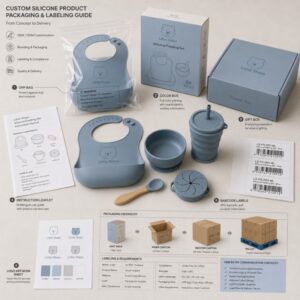
7. Explain Packaging, Assembly and Labeling Requirements
Packaging is often missing from early RFQs, but it can significantly affect the final unit price.
A complete packaging request may include:
- Individual OPP bag
- Kraft box
- Color box
- Gift box
- Blister packaging
- Hanging card
- Paper sleeve
- Instruction sheet
- Barcode label
- Country-of-origin label
- Warning label
- Carton quantity
- Product set assembly
- 액세서리
- Retail display requirements
For product sets, clearly state which components must be packed together.
For example:
One gift set includes one silicone bib, one suction bowl, one divided plate, one spoon and one drinking cup. All items require coordinated Pantone colors and one custom gift box.
The factory must know whether it is quoting only the molded silicone product or a complete retail-ready product.
Buyers should also provide packaging artwork deadlines, barcode requirements, labeling language and expected carton specifications before mass production.
8. Provide the Estimated Order Quantity
Order quantity affects:
- Material purchasing
- Mold cavity planning
- Production cycle
- Unit price
- Packaging cost
- Inspection method
- Production scheduling
A quotation request should include at least:
- Sample quantity
- First order quantity
- Expected repeat order quantity
- Annual forecast, when available
- Number of colors
- Quantity per color
For example:
Initial order: 2,000 pieces
Three colors: 800, 600 and 600 pieces
Estimated annual demand: 10,000–15,000 pieces
A request for the “best price” without a quantity does not give the manufacturer enough information to calculate an appropriate production plan.
For a new private-mold project, buyers should also distinguish mold-development cost from product unit cost.
9. Confirm the Target Market and Compliance Requirements
A product sold in the United States may have different testing, labeling and documentation requirements from the same product sold in the European Union, Canada, Japan or another market.
The RFQ should state:
- Target country or region
- 제품 카테고리
- Intended age group
- Food-contact or oral-contact use
- Retail or promotional use
- Applicable buyer standards
- Third-party laboratory requirements
- Required reports or declarations
- Packaging language
- Traceability requirements
The manufacturer can provide material information and manufacturing documentation, but the final test plan should be confirmed according to the completed product, its intended use and the applicable regulations in the target market.
Avoid asking only for a general “FDA certificate” or “EU certificate” without explaining which product and test requirement are involved.
A specific compliance request helps prevent testing the wrong material, product version or standard.
10. Clarify Whether You Need an Existing Mold or a New Private Mold
There are two common ways to develop a custom silicone product.
Customize an Existing Product
This option may allow the buyer to change:
- 색상
- 로고
- 패키징
- Product set
- 액세서리
- Quantity combination
It can reduce development time and initial tooling investment.
However, the basic product geometry may not be exclusive to one buyer.
Develop a New Private Mold
A private mold is more suitable when the buyer requires:
- Exclusive product shape
- Proprietary structure
- Unique dimensions
- Special function
- Custom texture
- Brand-owned industrial design
- Product differentiation
Before mold development, confirm:
- Mold ownership
- Design ownership
- Confidentiality
- Exclusivity
- Mold maintenance
- Mold storage
- Modification responsibility
- Expected mold life
- Sample approval process
The quotation should clearly separate the mold fee, sample fee, product price and any secondary tooling cost.
Custom Silicone Product RFQ Checklist
Before sending your inquiry, confirm that you have included as much of the following information as possible:
| RFQ Item | Information to Provide |
|---|---|
| 제품 | Product name and intended application |
| User | Baby, pet, household, outdoor or educational use |
| 디자인 | 3D drawing, 2D drawing, sample, sketch or annotated photo |
| Dimensions | Overall dimensions and critical functional dimensions |
| Tolerances | Critical fit, sealing, assembly or capacity requirements |
| 재료 | LSR or solid silicone requirement, when known |
| Hardness | Target Shore A or required softness and flexibility |
| 기능 | Suction, folding, sealing, grip, tear or heat performance |
| 색상 | Pantone number and quantity per color |
| 로고 | File, size, position and manufacturing method |
| Surface | Glossy, matte, texture or other finish |
| 패키징 | Bag, box, set assembly, labeling and barcode |
| Quantity | Sample, first order and annual forecast |
| Market | Target country, age group and intended use |
| 규정 준수 | Testing, documentation and inspection requirements |
| Schedule | Target sample date and mass-production delivery date |
It is acceptable if some information is not yet available.
The important point is to clearly identify which requirements are confirmed and which still require engineering discussion.
What Happens After the Manufacturer Receives the RFQ?
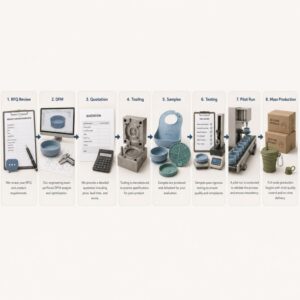
A professional quotation process normally includes the following steps:
Step 1: Requirement Review
The sales and engineering teams review the product application, files, quantity and target market.
Step 2: Clarification
The manufacturer identifies missing dimensions, uncertain functions or conflicting specifications.
Step 3: Feasibility and DFM Review
The engineering team reviews wall thickness, parting line, undercuts, mold release, venting, surface finish, logo structure and possible molding risks.
Step 4: Quotation
The quotation may include:
- Mold cost
- Sample cost
- Product unit price
- Packaging cost
- Testing cost
- Estimated lead time
- Payment terms
- Quotation validity
Step 5: Design Confirmation and Mold Development
The buyer approves the final drawing and development conditions before tooling begins.
Step 6: Sampling and Validation
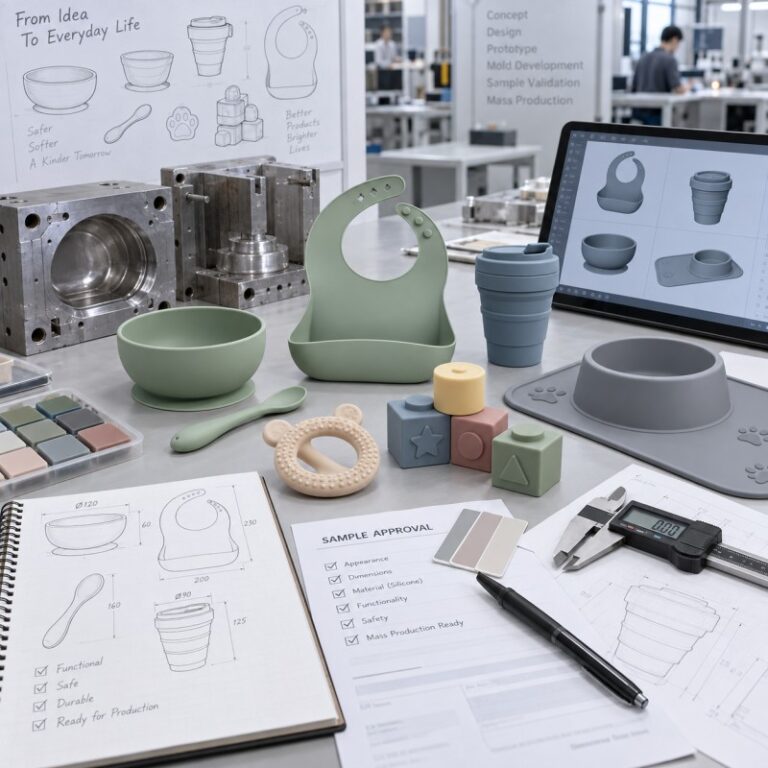
Samples are evaluated for dimensions, appearance, function, hardness, color, logo, packaging and required tests.
Step 7: Pilot Production and Mass Production
After sample approval, the project moves into pilot production or mass production according to the agreed quality plan.
A clear RFQ makes every stage more efficient because the project begins with shared and documented expectations.
How LYA Silicone Supports Custom Product Development
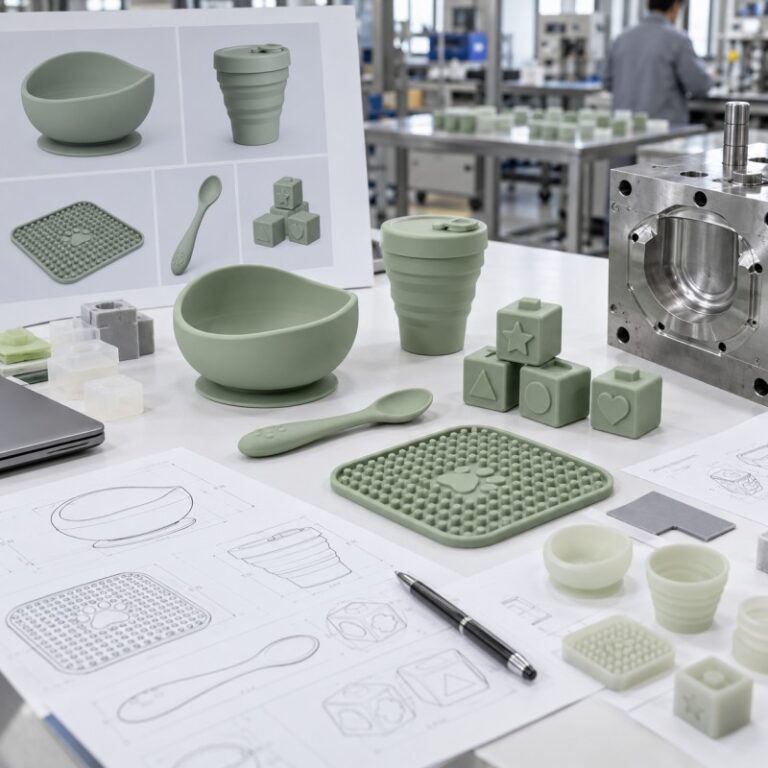
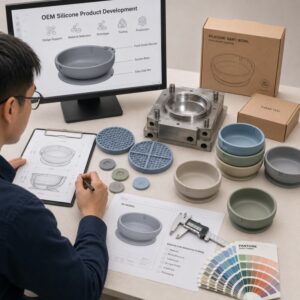
LYA 실리콘 supports OEM and ODM development for silicone baby products, pet products, household products, outdoor products and educational products.
Project support may include:
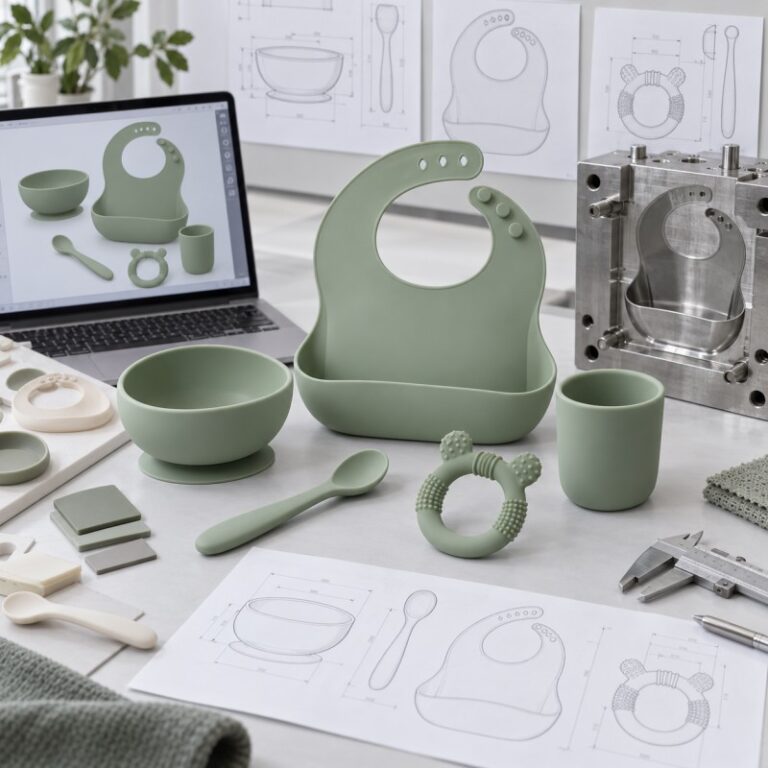
- Review of drawings, samples, sketches or product concepts
- Material and hardness discussion
- DFM and mold-development review
- Custom mold manufacturing
- 팬톤 컬러 매칭
- Logo and surface customization
- Prototype and sample production
- Packaging and product-set development
- Dimensional and appearance inspection
- Pilot production
- 대량 생산
Buyers may begin with a complete engineering drawing, an existing physical sample or an early product idea.
The first step is to provide a clear description of the product, target market, expected quantity and development goals.
FAQ About Custom Silicone Product Quotations
Do I Need a Complete 3D Drawing Before Requesting a Quote?
No.
A 3D drawing provides the most accurate basis for mold and product evaluation, but buyers may also begin with a 2D drawing, sample, sketch or annotated reference photos.
The initial quotation may be a price range until the final dimensions and structure are confirmed.
Can a Manufacturer Quote from One Product Photo?
A manufacturer may provide a preliminary estimate, but a photo cannot confirm wall thickness, product weight, hardness, internal structure, tolerance or exact dimensions.
A final quotation normally requires more detailed specifications.
Why Does the Price Sometimes Change After Sample Development?
The price may change when the final sample reveals differences in product weight, molding cycle, secondary processing, packaging, inspection or functional requirements.
A complete RFQ reduces the likelihood of significant changes.
What Factors Affect Silicone Mold Cost?
Important factors include product size, structure, undercuts, cavities, surface finish, tolerance, logo inserts, mold material, expected production volume and required mold life.
Can I Customize Only the Logo and Color?
Yes, when a suitable existing product and mold are available.
The buyer should confirm which parts of the design can be customized and whether the product structure is shared or exclusive.
Should Packaging Be Included in the First Quotation?
Yes.
Packaging should be included as early as possible, especially when the product will be supplied as a retail set, private-label item or e-commerce-ready product.
Start Your Custom Silicone Product Project
Preparing a complete RFQ does not mean every technical detail must already be finalized.
It means giving the manufacturer enough information to understand your product, identify missing requirements and prepare a realistic development proposal.
To request a custom silicone product quote, send:
- Drawing, sample or reference image
- Product dimensions
- Application and target user
- Material and hardness requirements
- Color and logo files
- Packaging requirements
- Target market
- Estimated quantity
- Expected project schedule
LYA 실리콘에 문의 to discuss your custom silicone baby, pet, household, outdoor or educational product project.