 Korean
  English
  French
  German
  Spanish
  Polish
  Chinese
  Japanese
  Russian
 콘텐츠
Answer Excerpt
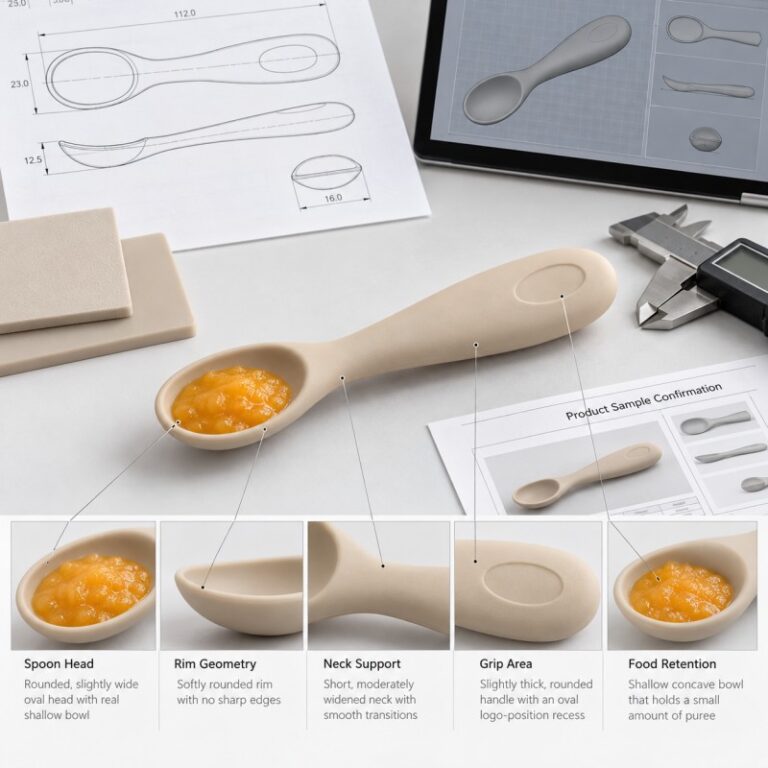
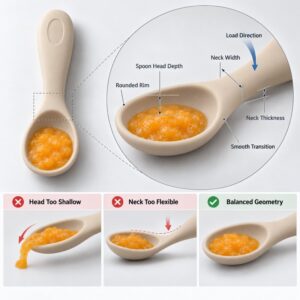
A well-designed silicone baby spoon should hold an appropriate portion of food, provide controlled flexibility and remain comfortable to handle. If the spoon head is too shallow, food may slide off easily. If the neck is too thin or the material is excessively flexible for the geometry, the entire spoon may bend during scooping or lifting.
For baby brands developing custom silicone baby spoons, the key design factors include spoon head depth, rim shape, neck stiffness, handle geometry, silicone hardness, intended feeding method and testing with representative foods.
These factors should be reviewed together before mold development and mass production.
Why Does Silicone Baby Spoon Design Matter?
A baby feeding spoon looks like a simple consumer product.
However, it has to perform several different functions:
-
Pick up an appropriate amount of food
-
Retain food while being lifted
-
Allow comfortable handling
-
Provide suitable flexibility
-
Avoid unnecessarily sharp or rough edges
-
Remain practical to clean
-
Withstand intended repeated use
A spoon that looks attractive in a product photograph may still perform poorly during actual feeding.
For example, the spoon head may be too broad for its intended use, the neck may bend excessively under the weight of food, or the handle may provide insufficient control.
The goal is not to create the softest possible spoon.
It is to balance:
Spoon Head → Food Retention → Neck Support → Handle Control → Material Flexibility
Why Do Some Silicone Baby Spoons Spill Food Easily?
Food retention depends on the geometry of the spoon head and how the product behaves during movement.
Potential causes of spilling include:
-
Excessively shallow spoon head
-
Poorly balanced head width and length
-
Inappropriate rim geometry
-
Excessive neck bending
-
Unstable handling angle
-
Food consistency that does not match the intended design
The final result also depends on whether the spoon is designed for adult-assisted feeding or early self-feeding.
A spoon intended for puree may behave differently from one intended for thicker cereals or soft food pieces.
For OEM buyers, this means a spoon should be evaluated with representative food rather than only inspected while empty.
How Does Spoon Head Depth Affect Food Retention?
Spoon head depth controls the space available for food.
If the Spoon Head Is Too Shallow
A very shallow head may make it difficult to carry an appropriate portion without spilling.
It may be suitable for certain small amounts of soft food, but performance depends on the head width, shape and feeding method.
If the Spoon Head Is Too Deep
A deeper head may retain more food, but can create other trade-offs.
These may include:
-
Difficulty accessing food near the bottom
-
Greater overall head height
-
More noticeable sidewall geometry
-
Harder cleaning around tight transitions
-
Different comfort and suitability for the intended user
The best design is therefore not simply the deepest spoon head possible.
Brands should define the intended portion and use scenario first, then evaluate the necessary depth.
Why Is the Spoon Head Rim Important?
The rim is the part of the spoon head that helps define the opening and food-retention boundary.
Important design variables include:
-
Rim thickness
-
Edge radius
-
Head width
-
Head length
-
Transition into the interior bowl
-
Local flexibility
A very thin rim may feel highly flexible but may not provide the desired structural control.
An unnecessarily thick rim may become bulky relative to the intended use.
The rim should have a smooth, consistent geometry suitable for the finished product’s intended age group and applicable safety requirements.
Sharp flash, rough trimming or irregular molded edges should not be accepted simply because silicone is a flexible material.
How Does Spoon Head Width Affect Feeding?
A wider spoon head can provide more surface area for carrying food.
However, width also affects how the spoon is introduced and positioned during feeding.
A narrow spoon head may be more appropriate for certain product concepts, while a broader head may be suitable for other feeding stages or users.
Before tooling, brands should confirm:
-
Target user
-
Intended feeding method
-
Expected food consistency
-
Desired portion size
-
Head width and length
-
Overall product dimensions
A universal spoon-head size should not be assumed appropriate for every baby feeding application.
For product-development projects, dimensions should be evaluated against the applicable product requirements rather than selected from appearance alone.
Why Does the Spoon Neck Bend Too Much?
The neck is the transition between the spoon head and the handle.
This region is important because it transfers the force applied through the handle into the spoon head.
If the neck is excessively narrow or flexible, the head may tilt during lifting.
Possible problems include:
-
Food sliding toward one side
-
Reduced control when scooping
-
Excessive downward bending
-
Unstable handling
-
Local deformation during repeated use
A stronger neck does not necessarily require making the complete spoon harder.
Instead, designers can evaluate:
-
Neck width
-
Neck thickness
-
Transition radius
-
Cross-section shape
-
Unsupported neck length
-
Overall spoon geometry
A smoother and more supportive neck transition can improve control while preserving suitable flexibility elsewhere.
Should the Spoon Head and Handle Have the Same Flexibility?
Not necessarily.
Different parts of the spoon perform different functions.
The spoon head must provide suitable food-contact geometry, the neck transfers load, and the handle gives the user control.
A one-piece silicone spoon may use the same silicone compound throughout, while its local geometry creates different levels of flexibility.
For example:
-
The spoon-head rim may be relatively flexible.
-
The neck may have a more supportive cross-section.
-
The handle may be thicker to improve grip stability.
This is why wall thickness should be evaluated according to each functional zone rather than increased or reduced uniformly across the entire product.
A carefully planned cross-section may improve control without requiring a completely different material.
How Does Silicone Hardness Affect Spoon Performance?
The selected silicone hardness affects how the product bends and recovers.
A softer formulation may provide greater flexibility, but excessive deformation can reduce control during lifting.
A firmer material may improve structural stability but may also change the intended handling and contact characteristics.
The correct specification depends on the complete design.
Brands should compare:
-
Spoon-head bending
-
Neck deflection
-
Handle stability
-
Shape recovery
-
Food-retention behavior
using actual molded samples.
The same nominal Shore A hardness can produce different results in spoons with different thicknesses, head widths and neck geometry.
For this reason, material hardness should be approved together with the finished spoon structure, not independently.
How Should a Silicone Baby Spoon Handle Be Designed?
Handle design depends on whether the product is intended mainly for adult-assisted feeding or early self-feeding.
These are different usage scenarios.
Adult-Assisted Feeding
A longer handle may help caregivers reach into feeding bowls and maintain control.
Important considerations include:
-
Grip comfort
-
Handle rigidity
-
Spoon balance
-
Overall length
-
Easy cleaning
Early Self-Feeding
A shorter handle may suit certain self-feeding concepts, depending on the intended age group and product requirements.
Important considerations include:
-
Handle diameter
-
Grip shape
-
Weight distribution
-
Overall dimensions
-
Surface comfort
-
Functional control
The product should be evaluated with representative users or appropriate user simulations.
A short handle does not automatically make a spoon suitable for every infant or toddler.
The final design must match the intended user, age grading and applicable safety requirements.
Does a Curved Handle Improve Feeding?
A curved handle can change the relationship between the grip and the spoon head.
This may affect:
-
Lifting angle
-
Hand position
-
Food-retention orientation
-
Overall balance
-
Storage and packaging
However, curved geometry is not automatically superior to a straight handle.
For some feeding concepts, a straight handle may be easier to manufacture, inspect and package.
For others, a carefully designed curve may provide useful ergonomic benefits.
The decision should follow the intended use scenario and sample evaluation, not merely a market trend.
How Does Food Consistency Change the Design Requirements?
A spoon should be tested with the types of food it is intended to carry.
Different foods behave differently when the spoon is lifted.
For example:
Smooth Purees
Flow behavior and the head’s curvature can influence how easily the food remains on the spoon.
Thicker Cereals
The spoon may carry a more cohesive portion, but head depth and removal of food still matter.
Soft Food Pieces
The product may need a different head profile or use characteristics compared with a spoon intended only for puree.
The brand should define representative foods before evaluating the final spoon geometry.
Otherwise, a product may perform well during an empty-hand demonstration but deliver inconsistent results during actual feeding.
Why Is Overall Spoon Balance Important?
Balance affects how the spoon feels when held and lifted.
A very large, heavy spoon head connected to a narrow flexible neck may create noticeable bending.
A thick handle and small head may produce a different grip sensation.
Designers should review:
-
Total product length
-
Spoon-head volume
-
Neck proportions
-
Handle cross-section
-
Overall weight distribution
The goal is controlled handling rather than simply minimizing total product weight.
Sample testing should include the loaded condition because the spoon may behave differently when carrying food.
How Should Surface Finish Be Selected?
The spoon’s surface finish affects appearance, tactile experience and cleaning.
A very deep decorative texture near the spoon head can create unnecessary cleaning difficulty.
Raised logos or patterns may also change local geometry.
For a baby feeding spoon, brands should review:
-
Smoothness of food-contact surfaces
-
Molded edge quality
-
Surface texture location
-
Logo placement
-
Parting-line appearance
-
Cleaning access
A fine matte finish may be suitable for some handle areas, while the spoon head may benefit from a smooth, accessible surface.
The final finish should be agreed during design development and assessed on molded samples.
Why Must Spoon Geometry Be Checked Before Tooling?
The final design should be reviewed during custom silicone mold development.
Important DFM considerations include:
-
Spoon-head shape
-
Rim thickness and radius
-
Neck cross-section
-
Handle geometry
-
Material flow
-
Mold parting-line position
-
Venting
-
Demolding
-
Logo placement
-
Critical inspection features
Long, relatively thin products can create manufacturing considerations different from compact silicone parts.
A thin spoon neck or edge may be more sensitive to incomplete formation or dimensional variation.
The manufacturer should also review where any parting line or molding vestige may appear.
Critical food-contact surfaces should not be compromised by avoidable rough edges or unacceptable molding defects.
Why Should Dimensions Be Controlled by Function?
Not every dimension on a silicone spoon carries the same functional importance.
For example, some decorative dimensions may tolerate more variation than the spoon-head opening, neck section or overall length.
A practical inspection plan should distinguish between:
-
Functional dimensions
-
Important appearance dimensions
-
Noncritical decorative dimensions
The specification should also define a consistent measurement method.
Flexible silicone can deform when measured, particularly if excessive pressure is applied with a measuring tool.
The goal is a repeatable inspection method that reflects how the final product will actually be used.
Practical Example: A One-Piece Silicone Baby Training Spoon
Consider a custom one-piece baby training spoon with:
-
Rounded shallow spoon head
-
Short, gently tapered neck
-
Rounded ergonomic handle
-
Smooth food-contact surface
-
Subtle molded logo area
The brand wants the product to carry a small portion of puree while maintaining controlled flexibility.
Version A — Spoon Head Too Shallow
The head does not retain the intended portion consistently during lifting.
Version B — Neck Too Flexible
The spoon head bends downward when food is lifted, reducing handling control.
Version C — Handle Too Narrow
The product is difficult to grip consistently during the intended use scenario.
Improved Design
The revised concept balances:
-
Appropriate spoon-head depth
-
Rounded rim geometry
-
Controlled neck stiffness
-
Comfortable handle profile
-
Suitable silicone hardness
-
Manageable overall product weight
The result should be validated through testing, not treated as an automatically approved design.
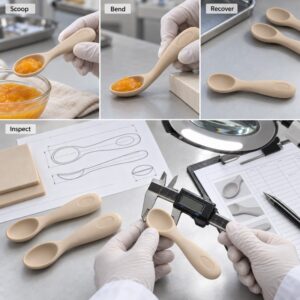
What Should Brands Test Before Mass Production?
Food-Retention Test
Use representative food or an agreed test medium.
Check whether the spoon can carry the intended portion under defined lifting conditions.
Neck-Bending Test
Apply a representative load to the spoon head while the handle is supported.
Observe whether the neck bends beyond the agreed functional limit.
Grip Evaluation
Check whether the intended user can hold and control the spoon comfortably.
Shape-Recovery Test
After controlled deformation, inspect whether the spoon returns toward its approved geometry.
Surface and Edge Inspection
Check the spoon-head rim, neck transitions and handle for:
-
Flash
-
Incomplete molding
-
Rough edges
-
Surface defects
-
Unacceptable deformation
Cleaning Evaluation
Wash the finished sample according to the intended method.
Inspect food-contact surfaces and any decorative features.
Multi-Sample Comparison
Evaluate several molded samples rather than approving only one ideal specimen.
Packaging Review
Check whether packaging bends the spoon neck or holds the product in an unnatural position for prolonged storage.
A brand should agree on test conditions and acceptance criteria before approving production.
Silicone Baby Spoon Design Checklist
| Design Item | What the Brand Should Confirm |
|---|---|
| Intended use | Adult-assisted feeding or early self-feeding |
| Target user | Appropriate age grading and requirements |
| Spoon-head width | Suitable for intended application |
| Spoon-head depth | Matches target portion and food consistency |
| Rim geometry | Smooth and suitable for food contact |
| Neck width | Provides adequate functional support |
| Neck thickness | Balances flexibility and control |
| Handle shape | Matches intended grip |
| Silicone hardness | Validated with actual geometry |
| Surface finish | Practical for cleaning and handling |
| Molded logo | Does not disrupt critical surfaces |
| Mold design | Functional areas reviewed before tooling |
| Food-retention test | Uses representative food or test medium |
| Bending evaluation | Checks loaded spoon behavior |
| Shape recovery | Evaluated after controlled deformation |
| Quality inspection | Dimensions, edges and appearance checked |
| 패키징 | Avoids unwanted neck deformation |
How LYA Silicone Supports Baby Spoon OEM Development
LYA Silicone supports OEM and ODM development for custom silicone consumer products, including baby feeding bowls, spoons and related accessories.
Its existing 실리콘 유아용 제품 range provides opportunities for coordinated feeding collections that share colors, product styling and retail packaging.
Depending on the project, custom baby spoon development may include:
-
Product concept review
-
2D and 3D drawing evaluation
-
Spoon-head geometry discussion
-
Neck and handle structure review
-
Material and hardness selection
-
Mold development
-
Color matching
-
Logo customization
-
Sample production
-
Functional testing
-
Appearance inspection
-
Packaging coordination
-
Mass-production quality control
The final material specification, finished-product safety requirements and testing plan should be defined for the intended market and product.
The objective is to create a spoon that combines practical feeding performance with repeatable manufacturing.
Frequently Asked Questions
Why Does a Silicone Baby Spoon Bend Too Much?
Possible causes include insufficient neck support, an overly flexible material for the geometry, or an unfavorable relationship between the spoon head and handle.
Is a Deeper Spoon Head Always Better?
No. Greater depth can help retain certain foods, but excessive depth may affect how the food is accessed and how the spoon is used.
Should Silicone Baby Spoons Be Completely Soft?
Not necessarily. Flexibility should be controlled by material selection and structural design so the product can perform its intended function.
What Is More Important: Silicone Hardness or Spoon Thickness?
Both matter. Hardness and local geometry work together to determine how the spoon deforms.
Can Baby Feeding Spoons Have Custom Handles?
Yes. Handle length, shape, surface texture and color can be customized according to the intended product concept and tooling feasibility.
Should Food-Retention Tests Be Conducted Before Production?
Yes. The test should use representative food or an agreed medium under defined conditions.
Can a Baby Bowl and Spoon Be Developed as One OEM Product Set?
Yes. Brands can coordinate the spoon and bowl in terms of color, design language, packaging and other requirements while still validating each product’s function independently.
Design the Spoon Around Real Feeding Performance
A successful silicone baby spoon depends on:
Spoon Head → Rim → Neck → Handle → Hardness → Food Retention → Testing → Production
These variables need to work together.
A spoon should not be made extremely soft simply to create a premium touch, and its head should not be made unnecessarily deep simply to hold more food.
For a new baby feeding product, the best approach is to define the intended use, evaluate the structure, produce molded samples and validate the final performance before mass production.
If you are developing a custom silicone baby feeding spoon or a complete feeding set, contact us with your product drawing, reference sample, intended user, target dimensions, material requirements, color, packaging concept and estimated quantity.