 Korean
  English
  French
  German
  Spanish
  Polish
  Chinese
  Japanese
  Russian
 콘텐츠
Answer Excerpt
Silicone mass production parts may differ from an approved sample when material batches, color mixing, mold conditions, curing parameters, trimming, inspection, packaging or acceptance standards are not fully controlled. A signed golden sample alone is not enough. Buyers and manufacturers should also approve drawings, dimensions, hardness, color limits, functional tests, defect criteria, packaging and production records before mass production.
A custom silicone product may look excellent during sampling.
The color is correct. The surface is clean. The product feels soft. The suction base works. The logo is clear. The packaging looks acceptable.
But after mass production begins, the buyer may find:
- The color is slightly different
- Some products feel softer or harder
- Dimensions vary between cavities
- Flash is more visible
- The suction force becomes inconsistent
- A lid fits differently
- Brush bristles bend unevenly
- A bib pocket does not remain open
- A collapsible product does not recover correctly
- Packaging changes the final shape
This does not always mean the supplier intentionally changed the product.
The difference often appears because a small sample run and a full production batch do not operate under exactly the same material, equipment, timing, inspection and packaging conditions.
The correct solution is to convert the approved sample into a complete and measurable mass-production standard.
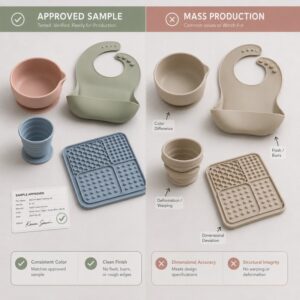
What Is an Approved Silicone Sample?
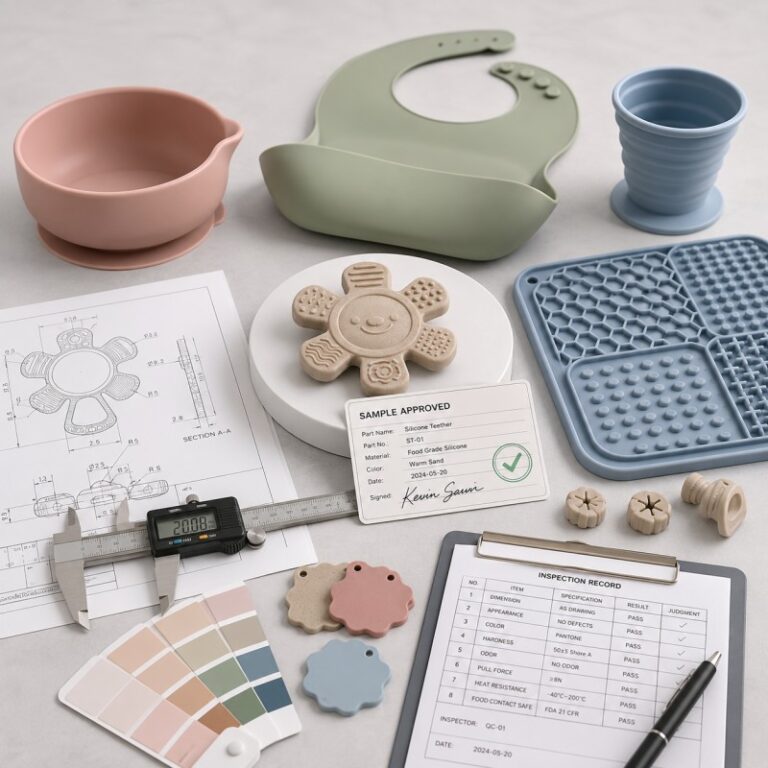
An approved sample is a product that the buyer accepts before mass production.
Depending on the project, it may also be called:
- Golden sample
- Master sample
- Reference sample
- Approval sample
- Signed sample
- Limit sample
- Production reference sample
The approved sample is normally used to confirm:
- Product shape
- Dimensions
- Silicone hardness
- 색상
- Surface finish
- 로고
- Assembly
- Functional performance
- 패키징
- Overall appearance
However, one physical sample cannot communicate every acceptable production variation.
For example, a sample does not automatically define:
- The permitted color difference
- The dimensional tolerance
- The acceptable flash limit
- The allowed parting-line height
- The approved hardness range
- The minimum suction force
- The acceptable surface mark
- The maximum deformation after packaging
- The sampling inspection level
- The test method
Therefore, the golden sample should be supported by drawings, specifications, inspection standards and test records.
What Differences Commonly Appear in Mass Production?
Color Difference
Mass-produced products may appear:
- Lighter or darker
- More transparent or opaque
- More yellow, red, blue or gray
- Different under natural and artificial lighting
- Different from one production batch to another
- Different between thin and thick areas
색상 is influenced by material batch, pigment ratio, product thickness, curing conditions, surface texture and lighting.
A Pantone number alone may not be enough to define the final silicone appearance.
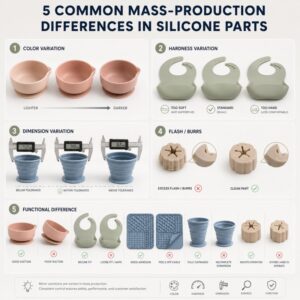
Hardness and Hand-Feel Difference
Two products with the same nominal Shore A hardness may not feel identical when they have different:
- Wall thickness
- Rib structure
- Product geometry
- Curing degree
- Surface finish
- Internal stress
- Temperature during testing
- Material formulation
Buyers sometimes describe this as:
The mass-production product feels harder than the sample.
The actual cause may be hardness, but it may also be a structural or curing difference.
Dimensional Difference
Silicone products can show dimensional variation due to:
- Material shrinkage
- Mold temperature
- Curing time
- Mold cavity variation
- Demolding method
- Cooling condition
- Post-curing
- Product storage position
- Measurement method
Flexible products must be measured under controlled conditions.
If one inspector stretches the product while another lets it rest naturally, the measurement result may differ.
Flash and Parting-Line Difference
A sample may be carefully trimmed by an experienced technician.
Mass production involves more pieces, more cavities and faster processing.
Possible differences include:
- Thicker flash
- Uneven trimming
- Visible parting lines
- Small tears after deflashing
- Rough edges
- Flash remaining inside holes or textures
- Different finish between operators
The approval standard should define where flash is allowed and how much is acceptable.
Functional Difference
Functional variation may appear in:
- Suction force
- Leak resistance
- Folding recovery
- Lid fit
- Valve opening force
- Brush flexibility
- Bib-pocket opening
- Product stability
- Grip performance
- Tear resistance
A product can pass visual inspection but still fail during use.
Mass-production approval therefore cannot rely only on appearance.
Why Can Sampling and Mass Production Produce Different Results?
1. Sample Production Uses a Smaller Material Batch
Sample production may use only a small quantity of silicone.
Mass production requires a much larger batch or several batches.
Differences may occur in:
- Pigment weighing
- Material mixing
- Hardness adjustment
- Batch traceability
- Storage time
- Material temperature
- Mixing uniformity
A small laboratory color sample may appear correct, but the color formula must be repeated consistently in larger production batches.
The approved color formula should therefore record:
- Base silicone
- Pigment code
- Mixing ratio
- Hardness
- Curing system
- Sample thickness
- Approved lighting condition
2. Production Parameters May Change
During sampling, technicians may repeatedly adjust:
- Mold temperature
- Injection or compression pressure
- Material weight
- Curing time
- Venting
- Demolding timing
- Post-curing
- Cooling time
Once the sample is approved, the final approved parameter window should be recorded.
Mass production should not begin with an operator trying to recreate the sample only from memory.
Important parameters should be transferred into controlled production instructions.
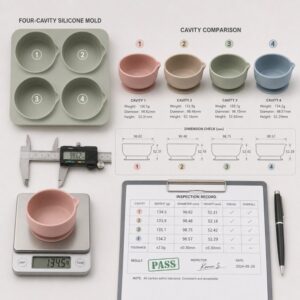
3. Different Mold Cavities May Produce Different Parts
A multi-cavity mold increases production efficiency, but each cavity must be evaluated.
Cavity differences may affect:
- Dimensions
- Flash
- Material filling
- Surface finish
- Logo clarity
- Product weight
- Venting
- Demolding
- Functional performance
A sample approved from cavity 1 does not automatically prove that cavity 2, cavity 3 and cavity 4 are identical.
Before mass production, the manufacturer should check samples from every cavity.
Cavity identification can also help trace a future defect to a specific mold position.
4. The Approved Sample May Have Been Manually Corrected
During sampling, a technician may manually:
- Trim flash
- Straighten a flexible edge
- Open a bib pocket
- Adjust a folding ring
- Clean a surface
- Remove dust
- Rework a logo edge
- Reshape a suction base
The sample may then look perfect, but the normal production process cannot depend on repeated manual correction.
Buyers should ask whether the approved sample was produced under the intended mass-production process.
A sample should be reviewed after normal molding, demolding, trimming, cleaning and packaging—not after unusual rework.
5. Inspection Standards May Be Too Subjective
Statements such as the following are not precise enough:
- Color must be good
- Flash must be small
- Product must be soft
- Suction must be strong
- Surface must be clean
- Logo must be clear
Different inspectors may interpret these requirements differently.
The approval standard should define measurable or visual limits.
For example:
No visible flash above the agreed limit on oral-contact edges.
The suction bowl must pass the agreed pull-off test on the specified clean test surface.
Color must be compared with the signed reference sample under the agreed lighting condition.
The bib pocket must remain open after the specified packaging-recovery period.
Clear standards reduce disagreement between sampling and mass production.
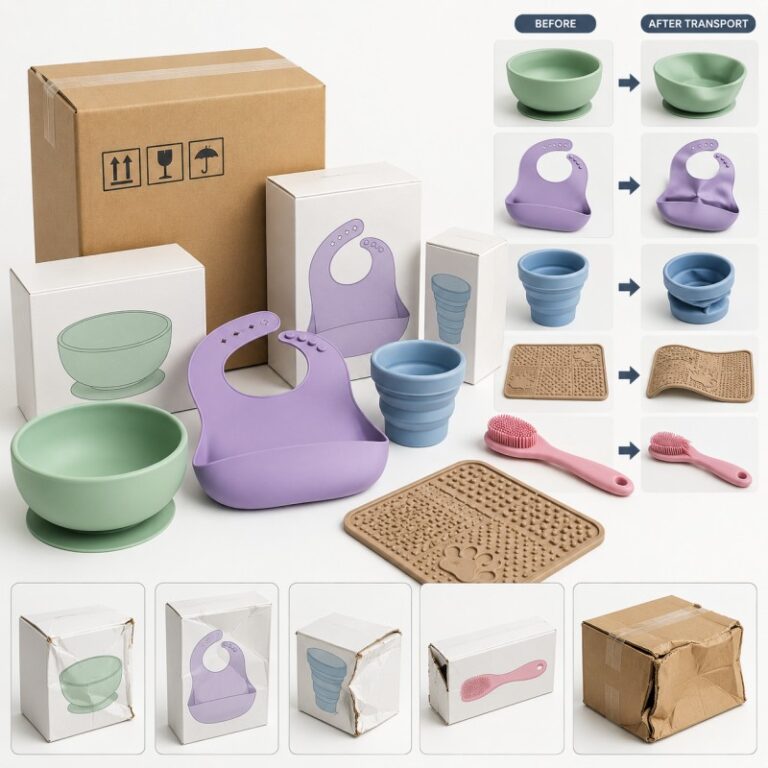
6. Packaging May Change the Approved Product
A product may pass inspection before packaging but change after:
- Folding
- Compression
- Carton stacking
- Long-term storage
- Container transportation
- Elevated temperature
- Contact with other accessories
Packaging can affect:
- Suction-base flatness
- Bib-pocket opening
- Bristle direction
- Collapsible rings
- Product edges
- Surface marks
- Lid fit
- Shape recovery
The final approved reference should therefore include the packaged product, not only the unpackaged molded product.
Why Is One Golden Sample Not Enough?
One golden sample shows one product at one moment.
Mass production must control hundreds or thousands of products.
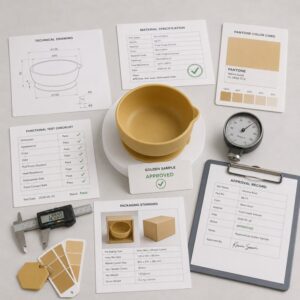
A complete approval package should include:
- Final 2D or 3D drawing
- Signed physical sample
- Material specification
- Approved hardness range
- Approved color reference
- Surface-finish standard
- Logo artwork and dimensions
- Critical dimensional tolerances
- Functional test method
- Packaging specification
- Defect acceptance criteria
- Inspection sampling plan
- Approved production process
- Revision number and approval date
The revision number is especially important.
If the buyer approves sample version B but the factory uses drawing version A, production may follow an outdated requirement.
Every approved document and sample should refer to the same final revision.
What Should Buyers Check Before Approving a Silicone Sample?
1. Appearance
Check:
- Overall shape
- Surface cleanliness
- Flash
- Parting line
- Flow marks
- Air traps
- Black spots
- Dust
- Color marks
- Surface scratches
- Logo clarity
- Texture consistency
Do not inspect only the most visible front surface.
Check the bottom, edges, openings, holes and internal surfaces.
2. Dimensions
Measure the dimensions that affect:
- Assembly
- Fit
- Suction
- Sealing
- 용량
- Stability
- User comfort
- 패키징
- Functional movement
Do not apply an unnecessarily tight tolerance to every flexible area.
Clearly identify critical dimensions and reference dimensions.
3. Hardness and Flexibility
Confirm:
- Shore A hardness
- Wall thickness
- Bending feel
- Folding recovery
- Compression recovery
- Grip
- User comfort
- Product stability
A hardness reading should be taken using an agreed test sample and method.
Thin product walls may not provide a reliable direct hardness reading.
4. Functional Performance
The product should be tested in its real use condition.
Examples include:
- Fill a baby bowl with food or water
- Test a suction base on the specified surface
- Install a lid repeatedly
- Fold and reopen a collapsible cup
- Pull, twist or bend a pet toy
- Open and close a bib button
- Test brush bristles during cleaning
- Check a product set after assembly
The test should use defined conditions rather than personal feeling alone.
5. Color and Surface Finish
Color should be reviewed under a controlled light source.
Compare:
- Signed color sample
- Pantone reference
- Thin and thick product areas
- Matte and glossy surfaces
- Different components in one product set
- Product after curing and cleaning
The buyer should also decide whether the standard is:
- Exact color matching
- Commercially acceptable visual matching
- A defined instrumental color-difference range
6. Packaging
Approve:
- Folding direction
- Individual bag
- Internal tray
- Retail box
- Instruction sheet
- Label
- Barcode
- Product orientation
- Quantity per carton
- Master-carton arrangement
After packaged storage, reopen the product and repeat the functional test.
How Should a Golden Sample Be Managed?
A good golden-sample system should include at least two or three retained samples.
Buyer Sample
Kept by the buyer for future comparison.
Manufacturer Sample
Kept by the manufacturer’s quality department.
Production or Inspection Sample
Used by production or final inspection where necessary.
Each sample should be labeled with:
- 제품 이름
- Product code
- Drawing revision
- 색상
- Hardness
- Approval date
- Customer name or project number
- Sample status
- Approver
- Expiry or review date, if applicable
The sample should be stored away from:
- Direct sunlight
- Excessive heat
- Dust
- Compression
- Chemical contamination
- Incorrect folding
Silicone appearance and shape can change if the reference sample itself is stored incorrectly.
What Is a Limit Sample?
A golden sample represents the approved target.
A limit sample represents the maximum acceptable defect or variation.
Limit samples may be useful for:
- Flash height
- Parting-line visibility
- Color difference
- Small surface marks
- Texture variation
- Minor logo defects
- Packaging impressions
- Acceptable deformation
Without limit samples, inspectors may reject acceptable products or accept products that the buyer considers defective.
Not every project requires a physical limit sample, but important visual defects should have clear photos, dimensions or acceptance descriptions.
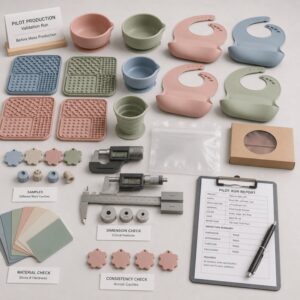
Why Is Pilot Production Important?
Pilot production is the bridge between sampling and full mass production.
It helps verify:
- Mold-cavity consistency
- Material-batch consistency
- Production cycle
- Trimming method
- Inspection time
- Packaging workflow
- Product recovery
- Functional performance
- Production yield
- Operator instructions
A pilot run can reveal problems that do not appear during a few engineering samples.
For example:
- One cavity creates more flash
- One color is harder to control
- Packaging workers fold the product differently
- The product deforms after 48 hours in the box
- A logo is difficult to inspect consistently
- The test method takes too long for production
These problems should be corrected before full-volume production.
Recommended Mass Production Control Plan
| Control Stage | What Should Be Checked |
|---|---|
| Incoming material | Material code, batch, color masterbatch, hardness and traceability |
| First-piece approval | Dimensions, color, weight, surface, logo and function |
| Each mold cavity | Dimensions, flash, filling, surface and function |
| In-process inspection | Parameter stability, appearance, dimensions and defect trend |
| Trimming and cleaning | Edge quality, tears, dust, residue and surface damage |
| Functional test | Suction, leakage, folding, fit, grip or other agreed function |
| 패키징 | Orientation, folding, accessories, label and box fit |
| Final inspection | Quantity, appearance, function, packaging and records |
| Shipment retention | Retained samples and inspection report |

What Should Happen When Mass Production Differs from the Sample?
The first step is not to argue whether the product is “good” or “bad.”
The buyer and manufacturer should compare the difference using the approved standard.
The investigation should review:
- Material batch
- Pigment ratio
- Mold cavity
- Machine parameters
- Curing condition
- Post-curing
- Demolding
- Trimming
- Cleaning
- Inspection records
- 패키징
- Storage
- Transportation
- Measurement method
The affected products should be identified by:
- Production date
- Batch number
- Mold cavity
- 색상
- Operator
- Packaging batch
Possible corrective actions may include:
- Parameter adjustment
- Mold maintenance
- Revised trimming method
- Improved packaging support
- Additional inspection
- Product sorting
- Reproduction
- Updated work instructions
The approved sample should not be changed silently to match the defective batch.
Any standard change should be reviewed and approved by both parties.
DFM Checklist for Sample-to-Production Consistency
Before final tooling and sample approval, confirm:
- Is the product geometry stable during demolding?
- Are wall thickness transitions reasonable?
- Can every mold cavity be measured?
- Is the parting line located away from critical surfaces?
- Can flash be trimmed consistently?
- Is the logo large and deep enough to reproduce?
- Is the color standard defined using the actual product thickness?
- Can the function be tested with a repeatable method?
- Will packaging deform the product?
- Are critical dimensions identified?
- Is the hardness range practical?
- Is the acceptance standard suitable for mass inspection?
- Is pilot production required?
- How will the approved sample be retained?
- Which revision controls production?
Application Examples
Silicone Baby Feeding Products
Check:
- Suction force
- Bowl or plate flatness
- Oral-contact edges
- Color consistency
- Food-catching pocket shape
- Lid fit
- Dishwasher or heat-use requirements
- Packaging deformation
실리콘 반려동물 제품
Check:
- Tear resistance
- Brush-bristle recovery
- Bowl stability
- Lick-mat flatness
- Grip texture
- Chewing areas
- Outdoor-use durability
- Packaging and odor control
Collapsible and Outdoor Products
Check:
- Folding sequence
- Shape recovery
- Base stability
- Lid fit
- Repeated folding
- Wall thickness
- Storage position
- Carton compression
Silicone Educational and Sensory Products
Check:
- Component fit
- Product balance
- Surface texture
- Color set consistency
- Small-part dimensions
- Edge quality
- Repeated assembly
- Packaging arrangement
How LYA Silicone Supports Sample and Mass Production Control
LYA Silicone supports OEM and ODM development for silicone baby, pet, household, outdoor and educational products.
Project support may include:
- Drawing and requirement review
- DFM analysis
- Material and hardness discussion
- 맞춤형 금형 개발
- Color matching
- Sample production
- Dimensional inspection
- Functional testing
- Golden-sample retention
- Pilot production
- Packaging validation
- Mass-production inspection
- Batch traceability
Before mass production, buyers should confirm the product specification, sample revision, acceptance standard and packaging method.
This helps convert the approved sample from a visual reference into a practical production-control standard.

FAQ About Silicone Sample and Mass Production Consistency
Is a Signed Golden Sample Legally Enough to Control Production?
A signed sample is useful, but it should be supported by drawings, specifications, test methods, acceptance criteria and revision records.
A physical sample cannot define every permitted variation.
How Many Golden Samples Should Be Retained?
Normally, both buyer and manufacturer should retain at least one approved sample.
Additional samples may be retained for quality inspection or production reference.
Can Mass Production Be Exactly Identical to One Sample?
Manufacturing always has some controlled variation.
The goal is not mathematical identity. The goal is to keep all production within the agreed appearance, dimensional and functional limits.
Why Does the Bulk Product Feel Harder Than the Sample?
Possible reasons include material hardness, curing condition, wall thickness, temperature, geometry or surface finish.
The product should be tested using the agreed method instead of relying only on hand feel.
Should Every Mold Cavity Be Approved?
At minimum, each cavity should be evaluated during mold qualification or pilot production, especially for dimensions, flash and functional performance.
Can Packaging Be Approved After Production?
Packaging should be reviewed before full production because folding and compression may change the silicone product.
Final packaged samples should be validated before shipment.
What Is the Difference Between a Golden Sample and a Limit Sample?
The golden sample represents the target quality.
A limit sample represents the maximum acceptable variation or defect.
When Should Pilot Production Be Used?
Pilot production is recommended when the product has new tooling, several cavities, multiple colors, critical functions, complex packaging or high quality risk.
Build Mass Production Around the Approved Standard
A successful silicone project does not end when the first sample is approved.
The manufacturer must convert the approved result into repeatable control of:
- 재료
- 색상
- Hardness
- Mold cavities
- Process parameters
- Dimensions
- Surface quality
- 기능
- 패키징
- Inspection
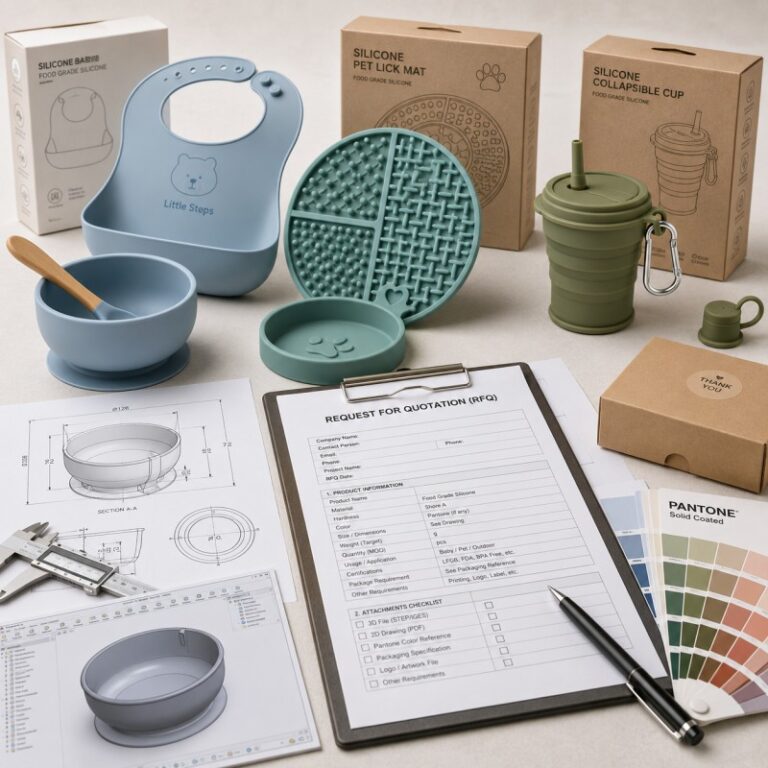
To review sample approval and mass-production consistency for your custom silicone project, send LYA 실리콘 the product drawing, approved sample requirements, color, hardness, functional criteria, packaging plan and estimated order quantity.