 French
  English
  German
  Spanish
  Polish
  Chinese
  Japanese
  Korean
  Russian
 Contenu
Answer Excerpt
Texture depth and spacing in produits en silicone sur mesure should be selected according to product function, silicone hardness, wall thickness, cleaning requirements, mold filling and demolding. A texture that is too shallow may provide little functional benefit, while a texture that is too deep, narrow or dense may become difficult to clean or mold consistently. Final texture geometry should be validated on molded samples before mass production.
Texture is used on many silicone products for more than appearance.
It may provide:
- Grip
- Gum massage
- Slow-feeding function
- Sensory feedback
- Anti-slip performance
- Water drainage
- Decorative identity
- Surface differentiation
However, adding more texture does not automatically make a product better.
A pattern that looks attractive in CAD can become uncomfortable, difficult to clean, difficult to demold or visually inconsistent after molding.
For OEM buyers, texture should therefore be treated as a functional product structure rather than simple decoration.
Which Silicone Products Commonly Use Molded Textures?
Texture is common across many consumer silicone products.
Examples include:
- Baby teethers
- Pet lick mats
- Pet grooming brushes
- Silicone bibs
- Feeding bowls
- Handles
- Collapsible products
- Sensory toys
- Educational products
- Anti-slip mats
Your current custom silicone baby teether range already supports molded dots, waves, ridges, grip textures and other custom surface structures.
Different applications need different texture behavior.
A baby teether texture is mainly touched and chewed.
A pet lick mat texture must hold food while still allowing practical cleaning.
A handle texture needs grip without making the surface uncomfortable.
The same texture cannot simply be copied from one product to another.
What Happens If Silicone Texture Is Too Shallow?
A very shallow molded texture may look acceptable but provide little functional difference.
For example, a shallow grip texture may:
- Feel almost identical to a smooth surface
- Provide limited wet grip
- Become difficult to distinguish visually
- Lose definition on a heavily matte surface
A shallow teether texture may also provide less noticeable tactile variation.
However, shallow texture can still be useful when the purpose is mainly:
- Subtle decoration
- Fine surface differentiation
- Light grip
- L'image de marque
- Visual refinement
The correct depth depends on the intended function rather than one universal dimension.
What Happens If Texture Is Too Deep?
Deeper texture creates stronger geometry.
That can improve some functions, but it can also introduce new risks.
Possible problems include:
- Food trapped between features
- Slower cleaning
- Water remaining in deep grooves
- Difficult demolding
- Greater local stretching
- Air traps
- Incomplete filling
- Thin texture roots
- Higher tear risk
For a pet lick mat, a deep feeding pattern may hold more spreadable food, but very narrow channels can become inconvenient to clean.
For a teether, tall raised structures may create stronger tactile feedback, but the root of each feature must remain structurally strong.
Texture depth should therefore be reviewed together with spacing and root geometry.
Why Is Texture Spacing Important?
Spacing determines how much open surface remains between individual molded features.
If dots, ribs or ridges are placed too close together, several problems may appear:
- Cleaning tools cannot easily reach between them
- Food or residue can remain trapped
- Mold features become narrow
- Air may be harder to evacuate
- Adjacent features may visually merge
- Texture roots may become too thin
If spacing is too large, the functional effect may become weak.
For example, a grip area with only a few widely separated ribs may not create the desired tactile feel.
The design should therefore balance:
Texture height + width + spacing + product function.
Why Should Texture Roots Be Rounded?
The root is the location where a raised texture joins the main silicone body.
A sharp root can create a local stress concentration.
This becomes more important when the texture is:
- Tall
- Thin
- Repeatedly bent
- Pulled during demolding
- Chewed or flexed during use
Rounded transitions can help distribute deformation more smoothly.
This is particularly relevant for:
- Teether dots
- Brush bristles
- Grip ribs
- Raised sensory elements
- Flexible massage structures
The exact geometry should be reviewed during the DFM review because mold release and product durability depend on the complete structure.
How Does Silicone Hardness Affect Texture?
Silicone hardness changes how the user experiences the same geometry.
A raised texture made from softer silicone may:
- Bend more easily
- Feel gentler
- Compress under pressure
The same texture made from harder silicone may:
- Feel more pronounced
- Maintain its shape more strongly
- Require more force to deform
This means texture cannot be finalized independently from material hardness.
A buyer should not approve the CAD geometry first and only decide hardness after tooling.
The combination of:
- Hardness
- Texture height
- Texture width
- Root shape
- Wall thickness
determines the final tactile result.
How Does Wall Thickness Affect Textured Areas?
Texture adds local material to a product.
If a heavily textured area is placed on a very thin base, the structure may become unbalanced.
Possible results include:
- Local deformation
- Uneven bending
- Warping
- Stress concentration
- Different cooling or curing behavior
- Visible surface differences
For example, a thin mat containing tall dense texture across only one side may behave differently from a flat uniform sheet.
The engineering team should therefore inspect the product in cross-section rather than evaluating only the top-view pattern.
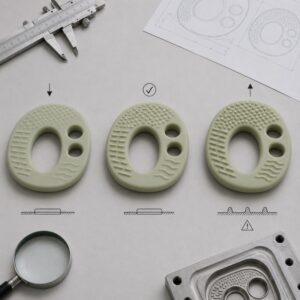
How Should Baby Teether Texture Be Designed?
A baby teether is one of the clearest examples of texture being both functional and visual.
A typical design may include:
- Raised dots
- Short ridges
- Waves
- Rounded bumps
- Grip texture
- Different tactile zones
LYA’s current teether product page supports custom texture, hardness, shape, mold development and sampling for OEM/ODM projects.
For a teether, texture review should consider:
Rounded Geometry
Avoid unnecessary sharp tips or sharp internal transitions.
Structural Strength
Raised features should connect to the main body with sufficient support.
Cleaning Access
Very narrow gaps should not create difficult-to-clean areas.
Demolding
Textures should release from the mold without excessive stretching.
Tactile Difference
Different zones should provide a deliberate rather than random feel.
The final texture should be evaluated using an actual molded sample.
How Should Pet Lick Mat Texture Be Designed?
Your current produits en silicone pour animaux de compagnie range includes lick mats, feeding products and grooming products, all of which can rely heavily on molded texture.
For a lick mat, texture must balance two competing goals:
- Hold food and slow access
- Remain practical to clean
Typical patterns may include:
- Dots
- Waves
- Honeycomb
- Ridges
- Channels
- Geometric fields
A pattern that is extremely dense may look visually impressive but become inconvenient when peanut butter, wet food or other soft food remains between narrow structures.
The buyer should therefore test the actual product with the intended food type and cleaning method.
How Can Texture Affect Mold Filling?
Texture creates additional cavity details that silicone must reproduce.
LSR is used for precision molded parts and can reproduce complex fine-detail geometries, but mold design, material flow and processing conditions still need to support complete filling.
High-risk texture areas may include:
- Narrow deep grooves
- Tall thin projections
- Fine recessed text
- Dense patterns
- Features far from the gate
Possible defects include:
- Missing texture tips
- Rounded-off details
- Air marks
- Incomplete grooves
- Local flow differences
Texture should therefore be reviewed together with gate and venting strategy.
How Can Texture Affect Demolding?
A deep textured surface creates more contact and mechanical interaction with the mold.
During demolding, flexible silicone may need to peel or stretch around:
- Ribs
- Dots
- Grooves
- Recesses
- Bristles
Silicone flexibility makes many complex molded shapes feasible, and commercial LSR grades are specifically developed for injection molding and mold release.
But very aggressive textures can still slow production or create local deformation.
The mold-release direction should therefore be considered before texture is finalized.
Should the Entire Product Use the Same Texture?
Usually not.
Different functional zones can use different surfaces.
For example, a silicone teether may use:
- Smooth grip opening
- Fine dots on one side
- Waves on another side
- Ridges near the upper chewing area
- Smooth logo zone
A feeding product may use:
- Smooth food-contact bowl
- Matte outer body
- Anti-slip grip texture on the handle
This zoning approach often produces a more controlled user experience than covering the entire product with one aggressive texture.
What Should Buyers Check During Sample Approval?
Texture Completeness
Check whether all:
- Dots
- Ribs
- Grooves
- Waves
- Logos
are completely formed.
Surface Consistency
Compare texture appearance across:
- Different areas
- Different mold cavities
- Multiple samples
Cleaning Test
Use the actual intended washing method.
Check whether residue remains between textures.
Flexing Test
Bend or press raised texture and inspect the roots.
Demolding Inspection
Look for:
- White stress marks
- Torn roots
- Distorted texture
- Permanent deformation
Functional Test
Test the product according to its actual use.
A grip texture should improve handling.
A lick mat pattern should hold food appropriately.
A teether texture should provide the intended tactile variation.

Silicone Texture DFM Checklist
| Objet | What Buyers Should Confirm |
|---|---|
| Texture purpose | Grip, feeding, chewing, sensory or decoration |
| Height/depth | Appropriate for the intended function |
| Spacing | Enough access between features |
| Root geometry | Smooth and structurally supported |
| Hardness | Evaluated together with texture geometry |
| Wall thickness | Base remains structurally balanced |
| Cleaning | Residue can be removed practically |
| Filling | Fine details can form completely |
| Venting | Air does not remain trapped in texture ends |
| Demolding | Texture releases without damage |
| Mold cavities | Texture remains consistent between cavities |
| Échantillons | Final tactile and cleaning performance approved |
How LYA Silicone Supports Texture Development
LYA Silicone supports OEM and ODM development across baby, pet, outdoor and educational silicone products, and its current product range includes textured teethers, pet products, feeding products and sensory products.
Project review may include:
- Product drawing review
- Texture-function analysis
- Hardness selection
- Wall-thickness review
- Texture-root optimization
- Mold-development review
- Filling and venting review
- Sample production
- Cleaning validation
- Demolding inspection
- Pilot production
- Mass-production quality control
The goal is not to create the deepest or most complex texture.
The goal is to create the texture that performs correctly and can be produced consistently.
Frequently Asked Questions
Is Deeper Silicone Texture Always Better?
Non.
Greater depth can increase tactile or feeding effect, but it may also make cleaning, molding and demolding more difficult.
Is There One Standard Texture Depth for Silicone Products?
Non.
The suitable geometry depends on product function, hardness, wall thickness, molding process and user requirements.
Can Fine Texture Be Molded in Silicone?
Yes, silicone molding can reproduce detailed structures, but the actual design still needs suitable mold filling and release conditions.
Does Softer Silicone Need Deeper Texture?
Not necessarily.
Softer silicone changes how the texture deforms and feels, so geometry and hardness should be tested together.
Can a Texture Cause Tearing?
A tall, thin feature or sharp root can create a weaker local structure, especially if it is repeatedly bent or heavily stretched during demolding.
Should Texture Be Approved Before Mold Manufacturing?
Oui.
The buyer should confirm texture zones, basic geometry, hardness and function during DFM, then approve the final result with molded samples.
Design Texture for Function, Not Only Appearance
Texture can change how a silicone product:
- Feels
- Grips
- Cleans
- Holds food
- Flexes
- Demolds
- Looks
Before tooling, buyers should review texture together with:
- Product use
- Silicone hardness
- Wall thickness
- Cleaning method
- Gate and venting
- Demolding
- Functional testing
To review texture design for your custom silicone product, send LYA Silicone your 3D drawing, target application, texture concept, hardness requirement, estimated quantity and cleaning or functional requirements.