 French
  English
  German
  Spanish
  Polish
  Chinese
  Japanese
  Korean
  Russian
 Contenu
Answer Excerpt
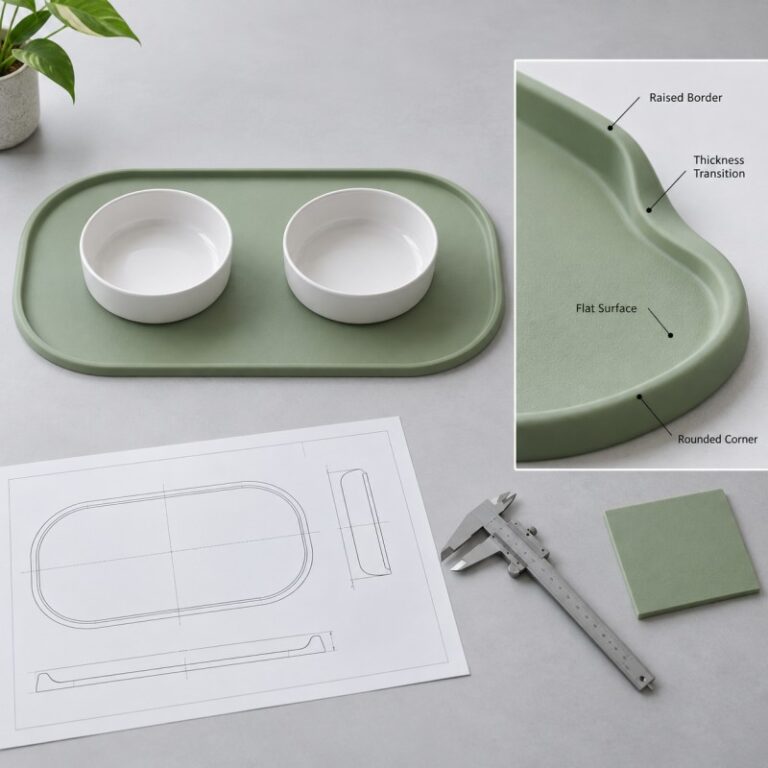
A successful silicone pet feeding mat design requires more than creating a flat silicone sheet with raised edges. The edge height, thickness transition, corner radius, flexibility, surface texture and overall shape all influence whether the mat stays flat, contains spilled water and remains easy to clean.
For OEM pet product brands, the anti-curl structure should be reviewed together with silicone hardness, molding process and packaging conditions before mass production.
Why Does a Silicone Pet Feeding Mat Need Structural Design?
A silicone pet feeding mat may look like a simple product.
However, during daily use it needs to perform several functions:
- Stay flat on different floor surfaces
- Hold food and water spills
- Resist edge deformation
- Remain easy to clean
- Store and package efficiently
- Maintain appearance after repeated use
A flat silicone sheet with a raised border is not automatically a good feeding mat.
The product needs controlled flexibility.
The main design relationship is:
Outer Edge → Thickness Transition → Corner Structure → Silicone Hardness → Flatness → Cleaning
A small change in one area can affect the entire product experience.
What Problems Occur When Silicone Mats Curl?
Edge curling is one of the most common concerns for flexible silicone mats.
A curled edge may cause:
- Water escaping underneath
- Food residue collecting below the mat
- Reduced contact with the floor
- Poor appearance
- Difficulty stacking during packaging
Curling can happen because of:
- Uneven thickness
- Excessive softness
- Poor corner design
- Internal stress after molding
- Incorrect storage pressure
The solution is not always to make the entire mat harder.
The product needs a balanced structure.
Why Is Edge Thickness Important?
The outer edge of a pet feeding mat often has a raised containment area.
This edge needs enough structure to hold:
- Water
- Pet food
- Liquid spills
But it should not become too rigid.
If the edge is too thin:
- The border may collapse
- Liquid can overflow easily
- The mat may lose shape
If the edge is too thick:
- The product becomes heavier
- Flexibility decreases
- Rolling or packaging becomes more difficult
- The transition area may create stress concentration
The ideal design creates enough support while maintaining the soft silicone feeling.
How Should the Raised Border Be Designed?
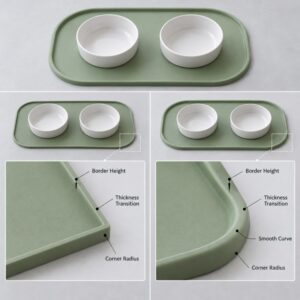
The raised border is one of the most important functional areas.
It controls the containment area around the feeding zone.
A good border design should consider:
- Border height
- Border width
- Inner transition radius
- Outer edge shape
- Local thickness
A very vertical wall may hold more liquid, but it can also:
- Increase cleaning difficulty
- Create a sharper corner
- Make the product less flexible
A smoothly curved raised edge often provides a better balance between containment and cleaning.
Why Are Rounded Corners Important?
Pet feeding mats commonly use:
- Rectangle shapes
- Oval shapes
- Irregular pet-themed shapes
Regardless of the outline, corners require special attention.
Sharp corners can create:
- Difficult cleaning areas
- Local stress concentration
- Higher risk of deformation
Rounded corners help improve:
- Liquid flow
- Cleaning access
- Stress distribution
- Visual softness
For silicone products, a smooth corner transition is usually more compatible with repeated flexible use.
How Does Corner Radius Affect Water Collection?
Corners are where liquids naturally move and collect.
A very small corner radius may create:
- Tight residue areas
- Difficult wiping
- Visible dirt accumulation
A larger rounded corner allows:
- Easier cleaning
- More continuous liquid movement
- Better appearance
However, an extremely large radius can reduce the usable feeding area.
The designer should balance:
Cleaning Space + Feeding Area + Product Size
Why Does Silicone Hardness Affect Mat Stability?
The same pet feeding mat geometry can behave differently with different silicone hardness levels.
A softer silicone may provide:
- Better flexibility
- Easier storage
- Softer touch
But excessive softness may cause:
- Edge movement
- Curling
- Less stable bowl positioning
A firmer silicone may provide:
- Better flatness
- Stronger edge support
- More stable placement
But it may become:
- Less flexible
- Harder to fold
- Less comfortable during handling
The correct silicone hardness should be selected together with the actual mat geometry.
Should the Whole Mat Have the Same Thickness?
Not always.
Many functional silicone mats benefit from controlled thickness zones.
For example:
- Main surface area
- Raised border
- Corner area
- Bowl placement zone
Each region may have different requirements.
The feeding surface needs:
- Flatness
- Easy cleaning
The border needs:
- Structural support
- Spill containment
The corner needs:
- Smooth deformation
A carefully designed thickness transition can improve performance without making the entire product unnecessarily thick.
How Do Thickness Transitions Affect Durability?
Sudden thickness changes can create areas where deformation concentrates.
For example:
A very thick border connected directly to a thin flat surface may create a stress transition.
During repeated rolling, washing or bending, this area may experience:
- Whitening
- Permanent bending
- Surface marks
A smoother transition allows the silicone material to deform more gradually.
This principle is especially important for large-format flexible silicone products.
Why Does the Bottom Surface Design Matter?
The top surface receives food and water.
But the bottom surface determines how the mat interacts with the floor.
A completely smooth bottom may slide on some surfaces.
A heavily textured bottom may collect dust.
The designer should evaluate:
- Surface friction
- Cleaning
- Stability
- Manufacturing complexity
The goal is not maximum grip.
The goal is controlled contact with practical cleaning.
Should Silicone Pet Feeding Mats Have Textured Surfaces?
Texture can provide:
- Visual appearance
- Brand differentiation
- Improved tactile feeling
However, excessive texture can create cleaning problems.
Deep patterns may collect:
- Food residue
- Hair
- Water
For pet products, cleaning convenience is especially important.
Surface texture should therefore be designed according to:
- Cleaning method
- Product use
- Contact area
- Manufacturing feasibility
How Does the Feeding Bowl Position Affect Design?
Many silicone feeding mats are designed around one or two bowls.
The bowl position affects:
- Border layout
- Surface area
- Spill collection zone
- Overall balance
The designer should consider:
- Bowl diameter
- Bowl weight
- Bowl movement
- Pet size
- Expected food spill area
A good mat supports the complete feeding setup, not only the silicone sheet itself.
Why Should Bowl Contact Areas Be Reviewed?
If a mat includes raised positioning areas or bowl recesses, these features become functional structures.
They need to balance:
- Bowl stability
- Cleaning
- Manufacturing
- Flexibility
A recess that is too deep may trap food.
A positioning ring that is too high may interfere with different bowl sizes.
The design should support the intended bowl range rather than only one sample.
How Does Packaging Affect Silicone Mat Flatness?
Large silicone mats are often compressed or rolled during shipping.
Packaging can influence:
- Edge memory
- Corner deformation
- Temporary curling
A product that looks perfect before packaging may arrive with unwanted shape changes.
Sample validation should therefore include:
- Folded storage
- Rolled storage
- Transportation simulation
- Recovery time after unpacking
The product should be judged after reasonable recovery rather than immediately after compression.
How Are Silicone Pet Feeding Mats Manufactured?
For OEM production, silicone feeding mats commonly require:
- Mold development
- Material preparation
- Compression molding or molding process review
- Surface inspection
- Dimensional control
- Packaging evaluation
Large thin silicone products can have different challenges compared with small silicone parts.
The manufacturer should review:
- Mold flatness
- Material flow
- Edge formation
- Venting
- Demolding
during custom silicone mold development.
Why Can Large Silicone Mats Have Production Variation?
A larger flexible silicone product has a larger surface area.
Small process differences may become more visible.
Possible variation includes:
- Edge thickness difference
- Flatness variation
- Surface marks
- Local deformation
Quality control should therefore focus on functional requirements rather than only visual inspection.
Important checks include:
- Flatness
- Border consistency
- Corner shape
- Surface quality
- Overall dimensions
Practical Example: Custom Silicone Pet Feeding Mat
Consider a rectangular silicone pet feeding mat designed for dogs and cats.
The product includes:
- Raised spill-control border
- Rounded corners
- Smooth feeding surface
- Flexible silicone body
Version A — Border Too Low
The mat looks simple, but water and food easily escape.
Version B — Border Too High
The containment improves, but cleaning becomes more difficult and the product feels bulky.
Version C — Thickness Transition Too Sharp
The product develops stress concentration between the flat area and raised border.
Optimized Version
The final design balances:
- Border height
- Corner radius
- Thickness transition
- Silicone hardness
- Flatness
- Cleaning access
The best structure is not the thickest or highest design.
It is the one that matches real usage.
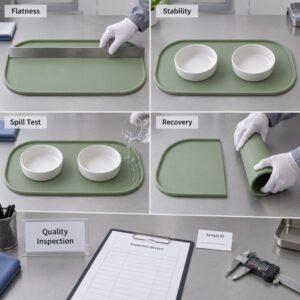
What Should Brands Test During Sample Approval?
Flatness Test
Place the mat on a representative surface.
Check whether corners and edges remain stable.
Spill Containment
Introduce representative water or food conditions.
Evaluate the border performance.
Cleaning Test
Wash the product and inspect:
- Corners
- Border transitions
- Textured areas
Folding Recovery
Fold or roll the mat according to expected packaging conditions.
Check recovery after unpacking.
Bowl Stability
Place representative bowls and evaluate movement.
Surface Inspection
Check:
- Marks
- Thickness variation
- Edge quality
- Color consistency
Multi-Sample Comparison
Compare several molded samples for:
- Flatness
- Border height
- Corner shape
- Overall appearance
Silicone Pet Feeding Mat Design Checklist
| Objet | What the Brand Should Confirm |
|---|---|
| Product shape | Rectangle, oval or custom shape |
| Border height | Enough spill containment |
| Border thickness | Balance between support and flexibility |
| Corner radius | Easy cleaning and stress control |
| Thickness transition | Smooth deformation |
| Silicone hardness | Suitable stability and handling |
| Bottom surface | Practical floor contact |
| Texture | Easy cleaning |
| Bowl area | Compatible with target bowls |
| Emballage | Prevents permanent curling |
| Flatness | Stable after recovery |
| Mold design | Suitable for large flexible parts |
| Surface quality | Consistent appearance |
| Cleaning | No unnecessary residue traps |
How LYA Silicone Supports Custom Pet Product Development
Pour OEM and ODM silicone pet products, development should include both product appearance and functional performance.
Project review can include:
- Taille du produit
- Pet application
- Border structure
- Surface texture
- Bowl positioning
- Silicone hardness
- Thickness design
- Mold development
- Sample testing
- Packaging review
- Color customization
- Mass-production inspection
The goal is not simply to create a soft silicone mat.
The goal is to create a stable, cleanable and manufacturable pet product.
Frequently Asked Questions
Why do silicone pet mats curl at the edges?
Possible causes include uneven thickness, excessive softness, corner stress, molding variation or packaging pressure.
Should a silicone pet feeding mat be very thick?
Not necessarily. Thickness should support function without reducing flexibility and usability.
Are higher silicone borders always better?
No. Higher borders improve containment but may reduce cleaning convenience and increase product bulk.
Does softer silicone make a better pet mat?
Not always. The correct hardness depends on the complete structure and stability requirements.
Why do silicone mats become uneven after shipping?
Compression, rolling and storage pressure can temporarily affect shape recovery.
Should corners always be rounded?
For many flexible silicone mats, rounded corners improve cleaning and stress distribution, but the final shape depends on product requirements.
Design the Mat Around Real Use, Not Only Appearance
A successful silicone pet feeding mat depends on:
Border → Corner → Thickness → Hardness → Flatness → Cleaning → Packaging → Production
These factors work together.
A good OEM design is not simply a soft silicone sheet.
It is a controlled flexible structure designed for repeated daily use.
If you are developing a custom silicone pet feeding mat, contact us with your product concept, size requirements, bowl dimensions, design drawings, silicone requirements, color preferences and estimated order quantity.