 French
  English
  German
  Spanish
  Polish
  Chinese
  Japanese
  Korean
  Russian
 Contenu
Answer Excerpt
Developing a multi-size silicone product family is more complex than scaling one CAD model into Small, Medium and Large versions. Each size may require separate review of wall thickness, capacity, flexibility, rim geometry, base stability, logo proportion, tooling layout, dimensional control and packaging.
For brands planning several SKUs from one product concept, the best approach is to define the shared design language first, then validate each size as an independent functional product before mass production.
Why Should Brands Plan a Silicone Product Family Instead of Individual Sizes?
A successful product family should look consistent on a shelf while still working correctly at every size.
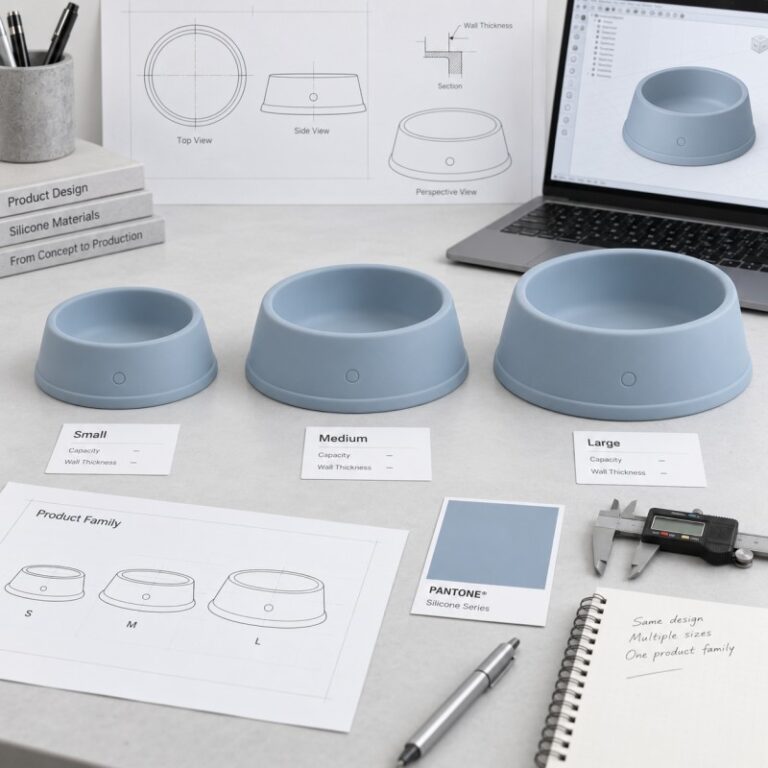
For example, a pet brand may want to launch the same silicone feeding bowl in:
- Small
- Medium
- Large
The three bowls should clearly belong to the same collection.
They may share:
- Overall shape
- Rim style
- Surface texture
- Color system
- Logo position
- Conception de l'emballage
However, they should not automatically share exactly the same proportions.
A small bowl designed for a small pet may need a shallower profile, while a large bowl may require more structural support to maintain shape.
This means product-family development should balance two goals:
Visual consistency + functional optimization
Why Is Simple CAD Scaling Often a Poor Approach?
A common shortcut is to design one product and scale the complete 3D model to 80%, 100% and 120%.
Visually, this may look convenient.
Functionally, it can create problems.
When every dimension is scaled at the same ratio:
- Wall thickness may become unnecessarily thick on the large version
- The small version may become too thin
- Logo size may become inappropriate
- Rim stiffness may change
- Capacity may not match the target market
- Base proportions may become unstable
- Packaging volume may increase unnecessarily
Silicone is flexible, so these changes affect more than appearance.
Each size should therefore be reviewed according to its intended function rather than treated as a mathematically enlarged or reduced copy.
Which Features Should Stay Consistent Across the Product Family?
The goal is not to make every measurement identical.
The goal is to maintain a recognizable family design.
Overall Design Language
The S, M and L versions can share:
- Similar silhouette
- Similar corner radius
- Consistent rim styling
- Consistent surface finish
- Matching color collection
- Similar logo treatment
These features help customers recognize the products as one range.
Functional Logic
The products should also follow the same basic functional concept.
For a Bol en silicone pour animaux de compagnie, this may mean each size uses:
- A stable circular or rounded base
- Smooth internal transitions
- A comfortable rim profile
- A similar anti-slip base concept
- Easy-access interior geometry
LYA Silicone currently lists Silicone Pet Feeding Bowl as part of its pet-product range, alongside pet lick mats, travel bowls and other silicone pet products.
Which Dimensions Should Be Recalculated for Every Size?
Some dimensions should be treated independently.
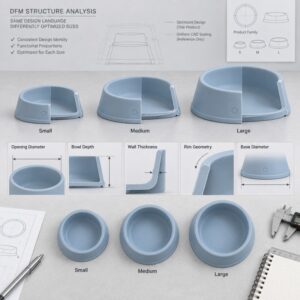
Product Capacity
Capacity should reflect the actual use case.
A Small bowl should not simply hold a fixed percentage of the Medium bowl because target portion sizes may not scale linearly.
The product team should define:
- Target internal volume
- Usable capacity
- Overall footprint
- Bowl depth
before finalizing each CAD model.
Wall Thickness
Wall thickness affects:
- Flexibility
- Shape retention
- Product weight
- Material consumption
- Handling feel
The Large version may need structural adjustment to prevent excessive sidewall movement.
The Small version may need a different balance to avoid becoming unnecessarily rigid.
This is why wall thickness should be reviewed functionally rather than scaled automatically.
Rim Geometry
The rim is both a visual and structural feature.
For different sizes, designers should check:
- Rim thickness
- Rim radius
- Opening diameter
- Grip or handling behavior
- Resistance to local deformation
A rim that feels balanced on a small bowl may feel too thin on a much larger bowl.
Base Diameter
A larger product normally creates different stability requirements.
The base should be reviewed against:
- Product height
- Filled weight
- Wall flexibility
- Intended surface
- Overall center of gravity
A wider product does not automatically need every base feature increased at the same ratio.
How Should Silicone Hardness Be Managed Across Different Sizes?
A product family may use the same silicone hardness across all sizes, but this should be validated rather than assumed.
The same nominal material can feel different when:
- The wall becomes thicker
- The diameter increases
- The product becomes deeper
- The unsupported surface area becomes larger
For example, the Large bowl may feel much more flexible even if it uses exactly the same silicone hardness as the Small version.
Before approving the range, compare:
- Hand feel
- Rim stiffness
- Sidewall movement
- Base stability
- Shape recovery
If a hardness change is considered, the manufacturer should check whether it creates unnecessary differences in color, feel or production control across the family.
How Should Capacity Be Validated?
For products such as bowls, cups and containers, CAD-calculated volume is useful during design, but the finished molded product should still be checked.
Silicone can change slightly through:
- Moulage
- Shrinkage
- Cooling
- Flexible-wall deformation
Capacity testing should therefore use a clearly defined method.
For each size, define:
- Target capacity
- Fill reference
- Test condition
- Measurement method
- Acceptable functional range
Your existing capacity-control content already emphasizes that actual geometry and molding conditions need to be considered when validating capacity-related silicone products.
Should All Sizes Use the Same Logo Size?
Not necessarily.
There are two common strategies.
Fixed Logo Size
The same physical logo dimensions are used on S, M and L.
This can create consistent branding, especially when the products are displayed together.
However, the logo may look too large on Small and too small on Large.
Proportional Logo Size
The logo is resized for each product.
This can create better visual balance but requires more careful tooling and artwork control.
Before tooling, confirm:
- Logo width
- Logo height
- Logo depth
- Position
- Orientation
- Distance from edges or functional areas
The brand should decide whether visual consistency means “same dimensions” or “same visual proportion.”
These are not always the same thing.
How Should Tooling Be Planned for a Multi-Size Product Family?
Tooling strategy should be discussed early during custom silicone mold development.
LYA Silicone’s current mold-development guide specifically emphasizes defining product use, material, hardness, wall thickness, critical dimensions and tooling requirements before releasing the mold.
For a three-size family, possible tooling approaches depend on actual product dimensions, production quantities and mold layout.
Important questions include:
- Does each size require a separate tool?
- Can several sizes be arranged efficiently within one tooling strategy?
- What production volume is expected for each SKU?
- Does one size have much higher demand than the others?
- How will cavity identification be handled?
- How will future repeat orders be managed?
The lowest initial tooling cost is not always the lowest long-term manufacturing cost.
Production efficiency and future order quantities should also be considered.
Should Every Size Have the Same Number of Mold Cavities?
Not necessarily.
Suppose expected annual demand is:
- Small: 20%
- Medium: 50%
- Large: 30%
Using exactly the same cavity strategy for every size may not match actual production demand.
The manufacturer should consider:
- Part dimensions
- Tool size
- Production cycle
- Forecast quantity
- SKU demand ratio
If multi-cavity tooling is used, multi-cavity mold consistency should be validated rather than assuming every cavity produces identical parts automatically. Your existing multi-cavity guide already recommends reviewing dimensions, appearance and functional performance by cavity.
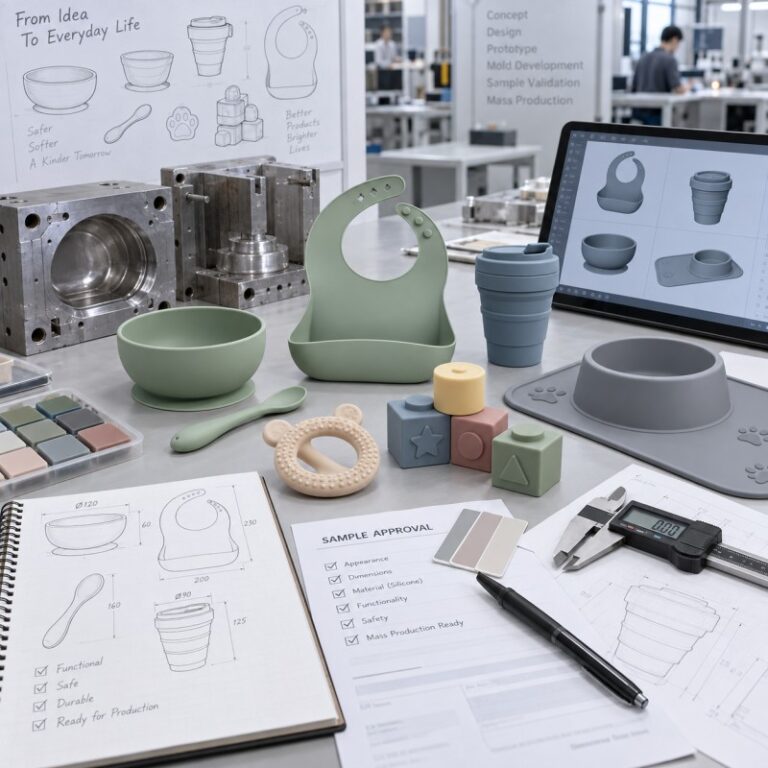
How Should S, M and L Samples Be Approved?
Brands should avoid approving only the Medium size and assuming the other sizes will behave the same.
Each size should have its own sample review.
Small Size
Check whether:
- Walls are not excessively thin
- Interior access remains practical
- Logo remains readable
- Rim does not become too rigid
- Base remains stable
Medium Size
This often becomes the reference size for the family, but it still requires complete functional approval.
Large Size
Check whether:
- Sidewalls remain stable
- Rim does not collapse excessively
- Base remains flat
- Product weight remains reasonable
- Overall proportions still look balanced
Each SKU should have its own approved specification.

Why Are Dimensional Tolerances Different From Size Scaling?
One important mistake is assuming that tolerance should scale with product dimensions.
For example:
If a Medium bowl has a certain dimensional tolerance, the Large version does not automatically need 120% of that tolerance.
The correct dimensional tolerances should depend on function, measurement method and the importance of the feature.
LYA Silicone’s existing dimensional-tolerance guide also distinguishes critical functional dimensions from flexible non-functional dimensions rather than applying one unnecessarily tight tolerance everywhere.
For a pet bowl family, important dimensions might include:
- Opening diameter
- Overall height
- Base diameter
- Rim geometry
- Wall thickness
- Capacity-related internal dimensions
How Should Colors Be Managed Across Multiple Sizes?
A product family may be sold in:
- One color across all sizes
- Several colors across all sizes
- Different colors for each size
The brand should decide the SKU structure before mass production.
For example:
3 sizes × 4 colors = 12 SKUs.
That affects:
- Production planning
- Emballage
- Labels
- Inventory
- Carton identification
- Repeat ordering
A beautiful color collection can quickly create unnecessary operational complexity if SKU planning is ignored during product development.
Why Should Packaging Be Planned at the Same Time?
Packaging is frequently delayed until after product development.
For a multi-size product family, that can create unnecessary cost.
S, M and L versions may require different:
- Retail box dimensions
- Inserts
- Carton quantities
- Shipping volume
- Label information
Brands should also consider whether bowls are:
- Packed individually
- Nested together
- Sold as a size set
- Packed with accessories
The packaging method should not distort flexible rims, sidewalls or bases during storage.
How Should SKU and Revision Control Be Organized?
Once multiple sizes and colors exist, clear SKU management becomes increasingly important.
A simple structure could distinguish:
- Product family
- Taille
- Couleur
- Revision
For example:
- Bowl-S-Blue
- Bowl-M-Blue
- Bowl-L-Blue
If the Large version later receives a structural change while Small and Medium remain unchanged, the revision record should clearly identify which SKU was modified.
This prevents old drawings, old packaging files or incorrect specifications from being used during repeat production.
Example: Developing a Three-Size Silicone Pet Feeding Bowl Family
Consider an overseas pet brand developing the same rounded silicone feeding bowl in S, M and L.
The family uses:
- The same overall silhouette
- The same matte surface
- The same rounded rim style
- The same small debossed brand area
- The same color collection
But each size is individually optimized.
Small
Designed for smaller pets.
Engineering focus:
- Appropriate depth
- Stable base
- Comfortable access
- Balanced rim thickness
Medium
Designed as the main volume SKU.
Engineering focus:
- Balanced capacity
- Stable sidewall
- Efficient packaging
- Representative family proportions
Large
Designed for larger pets.
Engineering focus:
- Increased capacity
- Sidewall stability
- Wider base support
- Controlled product weight
All three look like one product family, but they are not simply three mathematically scaled copies.
That is the important difference between product-family design and basic model scaling.
Multi-Size Silicone Product Development Checklist
| Objet | What the Brand Should Confirm |
|---|---|
| Product family | Shared visual design language |
| Target users | Intended use for each size |
| Capacité | Separate target for S / M / L |
| Overall dimensions | Optimized by size |
| Wall thickness | Reviewed for flexibility and stability |
| Rim | Structural and visual proportion |
| Base | Stability appropriate to each size |
| Hardness | Validated on every size |
| Logo | Fixed size or proportional size strategy |
| Tooling | Planned against demand and dimensions |
| Échantillons | Every size approved independently |
| Tolerances | Based on function, not simple scaling |
| Couleurs | SKU structure defined |
| Emballage | Designed for each size |
| Revision control | Size-specific drawing and records |
How LYA Silicone Supports Multi-Size OEM Product Development
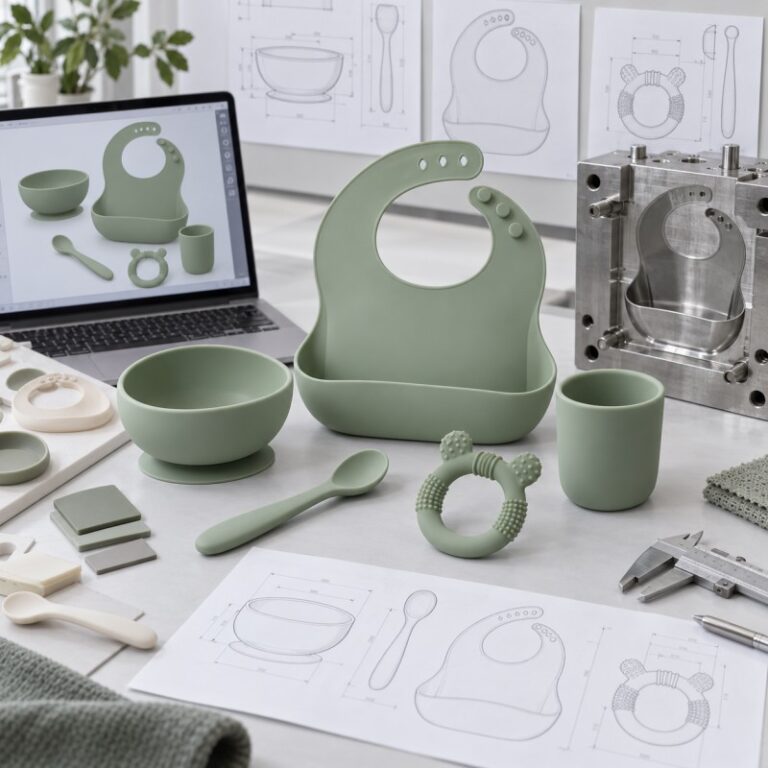
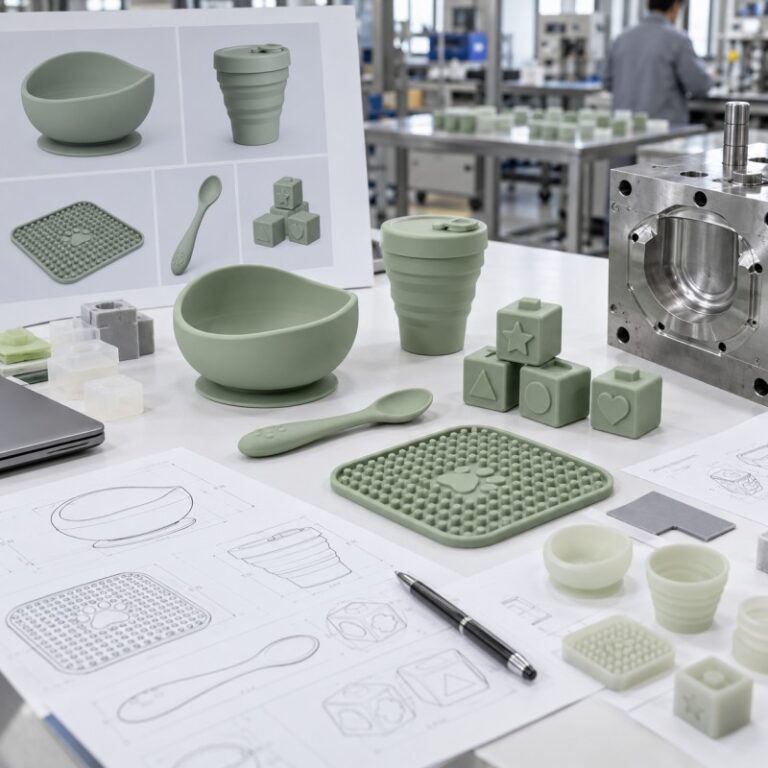
LYA Silicone’s current website positions the company as an OEM/ODM silicone-product manufacturer supporting product development, mold making, production and quality inspection across baby, pet, outdoor and educational silicone categories.
For a multi-size product family, OEM and ODM development can include:
- Product concept review
- 2D/3D drawing review
- Size-range planning
- Material and hardness discussion
- Wall-thickness review
- Mold development
- Sample production
- Dimensional inspection
- Capacity testing where relevant
- Color customization
- Logo evaluation
- Packaging review
- SKU and revision confirmation
- Mass-production quality control
The objective is to make every size recognizable as part of the same family while ensuring each SKU performs correctly on its own.
Frequently Asked Questions
Can I simply scale one silicone product into three sizes?
Technically a CAD model can be scaled, but this does not automatically create three optimized products. Wall thickness, capacity, stiffness, base stability, logo size and packaging should be reviewed separately.
Should S, M and L use the same silicone hardness?
They can, but the final feel and structural behavior should be validated on molded samples because size and wall geometry affect flexibility.
Does every size need a separate sample approval?
Yes. Each size should be checked for dimensions, appearance, function and production readiness.
Can different sizes share one mold?
That depends on the product geometry, tool layout, demand and production strategy. The tooling approach should be evaluated before mold development rather than assumed.
Should all sizes use the same logo dimensions?
Not necessarily. Brands can use fixed logo dimensions or proportional sizing, depending on the desired visual system.
How many SKUs will a three-size product create?
That depends on color and packaging options. Three sizes offered in four colors already create twelve basic size/color combinations, so SKU planning should begin early.
Build One Product Family, Not Three Enlarged Copies
A strong silicone product family needs more than visual similarity.
Brands should coordinate:
Size → Capacity → Wall Thickness → Hardness → Stability → Tooling → Sampling → Packaging → SKU Control
before mass production begins.
This approach allows the Small, Medium and Large versions to share one recognizable design while still performing correctly for their intended users.
If you are developing a multi-size silicone product range, send LYA Silicone your reference design, target sizes, intended capacity, color requirements, estimated quantities and packaging concept for project evaluation.