 French
  English
  German
  Spanish
  Polish
  Chinese
  Japanese
  Korean
  Russian
 Contenu
Answer Excerpt
Batch traceability for produits en silicone sur mesure should connect the finished product to its relevant raw-material lots, color or additive batches, production date, mold and cavity information, inspection records, packaging lot and shipment record. A traceability system does not necessarily require a code molded into every silicone part. The appropriate identification level depends on the product, buyer requirements and supply-chain risk, but the manufacturer should be able to trace a quality issue backward and identify which finished batches may be affected.
A buyer receives 10,000 silicone products.
Several weeks later, the brand finds a repeated black spot on part of the shipment.
The first question should not be:
Why did this product fail?
The better questions are:
- Which production batch did it come from?
- Which raw-material lot was used?
- Was the same color batch used elsewhere?
- Which mold and cavity produced it?
- When was it molded?
- Which inspection record covered it?
- Which cartons contain the same batch?
- Were other customers or warehouses supplied from the same lot?
If the manufacturer can answer these questions quickly, the problem can be investigated in a controlled way.
If not, the only available solution may be to treat a much larger quantity of products as potentially affected.
That is why traceability is not paperwork for its own sake.
It reduces uncertainty.
What Does Batch Traceability Mean?
Traceability is the ability to retrieve information about the history, application or location of an object.
GS1 describes traceability as potentially covering:
- origin of materials and parts,
- processing history,
- and distribution or location after delivery.
For silicone manufacturing, this can be translated into a practical chain:
Raw material → Mixing / Color → Molding → Cavity → Finishing → QC → Packaging → Shipment
The objective is not to record every possible piece of factory information.
The objective is to record enough information to reconstruct what happened when a quality problem appears.
What Is the Difference Between a Product Number and a Batch Number?
A product number identifies what the product is.
For example:
- Product: Silicone Baby Suction Bowl
- Color: Sage Green
- Size: Standard
- SKU: SB-01
A batch or lot number identifies which production group the product belongs to.
GS1 distinguishes batch/lot-level identification from simple class-level identification because a batch number allows the supply chain to distinguish one production group from another group of the same product.
For example:
SKU SB-01 may be produced:
- in March,
- again in June,
- and again in September.
The SKU remains the same.
The production batch should not.
What Should Be Linked to a Silicone Production Batch?
A useful traceability record usually needs several layers.
1. Raw Silicone Material Lot
Record the material code and supplier lot associated with production.
This becomes particularly important if:
- hardness changes,
- color changes,
- curing behavior changes,
- contamination is suspected,
- or documentation needs to be reviewed.
A material certificate alone is not enough if nobody knows which finished production batch used that material.
The material lot needs to be connected to the production record.
2. Pigment or Color Batch
Custom silicone products often use Pantone-matched colors.
If different pigment preparations or color batches are used, they should be traceable where relevant.
This helps investigate situations such as:
- one production batch appears darker,
- one batch has visible color drift,
- or one color mix produces repeated specks.
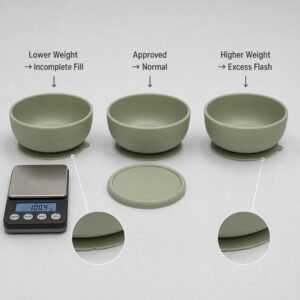
Your existing production-consistency content already identifies material batch, pigment weighing and mixing as potential causes of sample-to-mass-production variation.
3. Production Batch
The production batch becomes the central reference connecting the manufacturing information.
It may include:
- production date,
- work order,
- product SKU,
- quantity,
- material lot,
- color formula or batch,
- mold number,
- machine or production line where relevant,
- operator or shift where required,
- inspection record.
The exact level of detail depends on the project.
More records do not automatically mean better traceability.
The records need to be usable.
Example: Custom Silicone Baby Suction Bowl
Consider a custom silicone baby suction bowl produced for an overseas private-label brand.
The product has:
- a round bowl body,
- integrated suction base,
- flexible sealing lip,
- release tab,
- molded logo,
- custom sage-green color,
- matching retail packaging.
Suppose the buyer places an order for 20,000 pieces.
Production may require more than one material preparation or production run.
Instead of treating all 20,000 pieces as one anonymous quantity, the factory may divide production into identifiable batches.
For example:
Finished Batch A
linked to:
- silicone material lot,
- color batch,
- mold number,
- production period,
- QC record,
- packaging date.
Finished Batch B
has its own corresponding records.
If Batch B later shows a recurring surface problem, Batch A does not automatically need to be treated as affected.
This is the commercial value of traceability.
Why Should Mold and Cavity Information Be Included?
The same material can produce different results if the problem comes from the mold.
Possible cavity-specific problems include:
- blocked vent,
- worn parting line,
- damaged texture,
- gate issue,
- localized flash,
- surface damage,
- dimensional change.
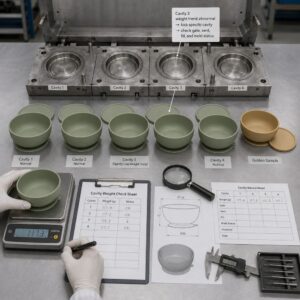
Imagine that only products from Cavity 3 show a repeated mark.
If the product remains traceable to its cavity during qualification or relevant production checks, the engineering team can focus on Cavity 3.
Without cavity information, the team may inspect:
- the material,
- the machine,
- all four cavities,
- and the entire production batch.
Cavity traceability is especially valuable after mold maintenance, because individual cavities may have different maintenance histories. Your current mold-maintenance article already recommends documenting repairs by mold and cavity.
Does Every Silicone Product Need a Lot Number Molded Into It?
Non.
This is an important distinction.
Traceability does not automatically mean adding a visible code to every product.
For many consumer silicone products, the batch information can be maintained through:
- individual packaging labels,
- inner-box labels,
- master-carton labels,
- production records,
- warehouse records,
- electronic ERP or quality records.
GS1 likewise allows traceability identification to exist at different levels depending on the object and supply-chain objective, including batch/lot and serialized levels.
A molded code may be useful in some applications.
But adding unnecessary numbers to a premium silicone baby product can affect:
- appearance,
- tooling,
- cleaning,
- mold-change requirements,
- and retail presentation.
The identification strategy should match the project.
How Should Packaging Be Connected to the Production Batch?
Packaging is one of the most useful traceability interfaces.
A carton label may connect the physical goods to:
- product SKU,
- color,
- quantity,
- production batch,
- packing date,
- purchase order,
- destination.
This means a complaint involving one carton can be traced back without opening every shipment record manually.
For more structured supply chains, GS1 supports the use of batch/lot information together with product identifiers on logistic labels.
The exact barcode or label system should be agreed with the customer.
Do not create complex coding simply because it looks professional.
The important requirement is that the label and the production record agree.
Why Should QC Records Use the Same Batch Identification?
Inspection results have limited value if they cannot be connected to actual products.
An AQL inspection report, for example, should identify which production lot was inspected.
The report may contain:
- product name,
- SKU,
- drawing revision,
- lot quantity,
- sample quantity,
- appearance result,
- critical dimensions,
- functional results,
- packaging check,
- acceptance result.
Your current AQL guide already recommends defining the production lot, final drawing revision and inspection report before shipment.
Traceability connects that report to the physical shipment.
What Is a Golden Sample’s Role in Traceability?
A Golden Sample is not a batch code.
It serves a different purpose.
The Golden Sample represents the approved product target.
Traceability records explain:
how a particular production batch was made.
The Golden Sample shows:
what the approved product should look and perform like.
Both are useful.
For example, if Batch C receives a complaint about excessive flash, the team can:
- Identify Batch C.
- Retrieve its manufacturing and inspection records.
- Identify the mold and cavity.
- Compare retained products with the Golden Sample.
- Check whether the condition existed before shipment.
This creates a much stronger investigation than relying on memory.
Should Retained Samples Be Kept From Every Batch?
Retained samples can be useful, especially for products with:
- strict colors,
- important cosmetic surfaces,
- critical fit,
- multiple cavities,
- repeated long-term orders.
However, the appropriate retention plan depends on:
- product risk,
- order frequency,
- storage space,
- customer requirements,
- expected complaint period.
The factory and buyer should agree on:
- how many samples are retained,
- from which production batches,
- how long they are retained,
- how they are labeled.
Do not keep samples without identification.
An unlabelled retained sample has limited traceability value.
How Should a Customer Complaint Be Traced Back?
Suppose a distributor reports that several suction bowls have small black particles.
A structured investigation may follow this path:
Step 1 — Identify the Finished Product
Confirm:
- SKU,
- color,
- packaging,
- batch number,
- purchase order.
Step 2 — Identify the Shipment
Determine:
- which cartons were shipped,
- shipping date,
- quantity,
- destination.
Step 3 — Retrieve the Production Record
Check:
- production date,
- mold,
- cavity information,
- production quantity,
- QC status.
Step 4 — Check Material Lots
Review which:
- silicone lot,
- pigment batch,
- additives where relevant
were used.
Step 5 — Check Other Products From the Same Inputs
Determine whether the same material or color preparation was used in other batches.
Step 6 — Review Retained Samples and QC Records
Compare retained products with:
- Golden Sample,
- defect standard,
- inspection report.
Step 7 — Define the Actual Scope
Only after the evidence is reviewed should the manufacturer determine which:
- batch,
- cartons,
- warehouse stock,
- or shipments
may require additional action.
Traceability helps narrow the investigation based on evidence.
Why Is Forward Traceability Also Important?
Traceability is not only about tracing backward to raw materials.
The manufacturer should also be able to identify where a production batch went.
GS1’s traceability framework includes distribution and location after delivery as part of traceability.
For example:
Batch A → Customer warehouse USA
Batch B → Customer warehouse Germany
Batch C → Customer warehouse Singapore
If a problem is confirmed only in Batch B, the brand can focus investigation on the relevant stock.
Without shipment linkage, all locations may need to be investigated.
What Should Buyers Confirm Before Mass Production?
Buyers do not need to design the supplier’s entire ERP system.
But they should clarify the traceability outcome they require.
Useful questions include:
- How is the raw silicone material lot recorded?
- How is the color batch recorded?
- Is each production batch assigned an identifier?
- Can mold and cavity information be retrieved?
- Which QC report belongs to which batch?
- How is the batch linked to packaging?
- Can cartons be traced back to production?
- Are retained samples labeled?
- How long are records retained?
- What information can be provided if a complaint occurs?
These requirements should be agreed before a serious quality issue appears.
Silicone Batch Traceability Checklist
| Traceability Stage | What Should Be Connected |
|---|---|
| Raw material | Material code, supplier lot where relevant |
| Color preparation | Pigment / color batch or formula record |
| Production | Work order, date and production batch |
| Mold | Mold identification |
| Cavity | Cavity identification where quality risk justifies it |
| QC | Inspection report linked to production batch |
| Golden Sample | Approved revision clearly identified |
| Retained sample | Batch and date labeled |
| Emballage | SKU, color and batch linkage |
| Master carton | Batch / shipment information |
| Shipment | PO, quantity, date and destination |
| Complaint | Finished product traced backward and affected stock traced forward |
How LYA Silicone Supports Batch Traceability
LYA Silicone provides OEM and ODM development for custom silicone baby, pet, outdoor and educational products.
LYA’s current site describes incoming-material, process and shipment quality controls, and its current training-cup product page states support for batch numbers and material-lot traceability.
Depending on the project, traceability planning may include:
- material identification,
- production batch records,
- mold and cavity records,
- QC documentation,
- Golden Sample control,
- retained samples,
- packaging labels,
- shipment records.
The appropriate system should be defined according to the product, customer and market requirement rather than using one identical traceability format for every project.
Frequently Asked Questions
Does every silicone product need a serial number?
Non.
Batch-level identification is sufficient for many products. Individual serialization is a higher level of identification and should be used only where the product or supply-chain requirement justifies it.
Is a batch number the same as a SKU?
Non.
The SKU identifies the product type. The batch number distinguishes one production group from another.
Should the batch number be molded directly into the silicone?
Not necessarily.
It may instead be controlled through packaging, cartons and manufacturing records.
Can one production order contain multiple material lots?
It can, depending on order size and manufacturing planning.
If multiple material lots are used, the traceability system should maintain the appropriate relationship between those inputs and finished production.
Why should mold cavity information be recorded?
It can help identify cavity-specific issues such as flash, filling, texture or surface differences.
Is an AQL report enough for traceability?
Non.
The inspection report should be linked to a clearly identified production lot or batch.
How long should traceability records be retained?
There is no single retention period that should automatically be applied to every silicone consumer product. The appropriate period should be based on customer requirements, applicable market requirements, product lifecycle and internal quality policy.
Build the Traceability Chain Before a Complaint Happens
Good traceability should answer two questions:
Where did this product come from?
et
Where did the rest of this batch go?
For custom silicone manufacturing, the useful chain is:
Material → Color → Production → Mold / Cavity → QC → Packaging → Shipment
The traceability system does not need to be complicated.
It needs to be complete enough to support fast, evidence-based investigation.
Before starting mass production, buyers and manufacturers should agree on the required batch, inspection and shipment records.
To discuss traceability requirements for your silicone OEM project, send LYA Silicone your product drawing, SKU structure, packaging requirements, target market, estimated quantity and quality-documentation requirements.