 Chinese
  English
  French
  German
  Spanish
  Polish
  Japanese
  Korean
  Russian
 目录
Answer Excerpt
Silicone baby products are widely used for feeding, teething and childcare products because of their softness, flexibility and heat resistance. However, some parents and brands still ask whether silicone baby products can cause allergic reactions.
In most cases, high-quality food-grade silicone itself is considered a stable material. Potential concerns are usually related to improper material selection, additives, pigments, incomplete curing, surface contamination or poor manufacturing control.
For baby product brands, choosing a reliable custom silicone manufacturer and controlling materials, production processes and quality inspection are essential steps to ensure safe and consistent silicone products.
Can Silicone Baby Products Cause Allergies?
Silicone is commonly used in baby products such as:
- Silicone feeding sets
- Silicone baby bibs
- Silicone suction bowls
- 硅胶奶嘴
- 硅胶牙胶
- Silicone snack cups
because it provides:
- Soft touch
- High temperature resistance
- Easy cleaning
- Flexible structure
- Long service life
However, when consumers report reactions related to silicone products, the cause is not always the silicone polymer itself.
Possible factors include:
- Low-quality raw materials
- Incorrect silicone formulation
- Excessive additives
- Poor pigment selection
- Residual processing materials
- Insufficient post-curing
- Improper cleaning after production
Therefore, evaluating silicone baby products requires looking at the complete manufacturing process instead of only the material name.
What Causes Safety Concerns in Silicone Baby Products?
1. Raw Material Quality and Silicone Grade
Not all silicone materials are manufactured with the same requirements.
For baby products, manufacturers usually need to consider:
- Food-contact compliance requirements
- Material purity
- Odor control
- Temperature resistance
- Long-term stability
High-quality silicone products normally start with controlled silicone raw materials rather than simply selecting the cheapest silicone compound.
For brands developing custom baby products, material selection should be confirmed before mold development begins.
A silicone manufacturer should be able to provide clear information about:
- Silicone hardness options
- Color pigment selection
- Material testing process
- Production traceability
2. Pigments and Color Additives
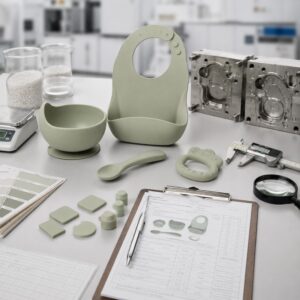
Many baby products require attractive colors, such as:
- Sage green
- Beige
- Blue
- Pink
- Yellow
The silicone base material may be stable, but color systems also require careful control.
Poor pigment selection may cause:
- Unpleasant odor
- Color migration concerns
- Appearance instability
- Batch differences
For OEM silicone baby products, color matching should not only focus on appearance but also consider:
- Material compatibility
- 耐热性
- Long-term aging performance
3. Odor Does Not Always Mean Allergy
One common concern from customers is:
“Why does my silicone baby product smell?”
A slight manufacturing odor may sometimes appear after production or packaging.
Possible reasons include:
- Manufacturing environment
- Packaging conditions
- Cleaning process
- Insufficient ventilation after production
However, strong or persistent odors may indicate that the product requires further evaluation.
For baby brands, odor control should be included during:
- Prototype approval
- Pilot production
- Mass production inspection
How Can Baby Brands Improve Silicone Product Safety?
For companies developing custom silicone baby products, safety control should start from product design.
1. Choose the Correct Silicone Material
Different products require different properties.
For example:
Silicone bibs may require:
- Softness
- 灵活性
- Comfortable skin contact
Silicone suction bowls may require:
- Shape retention
- Stable sealing performance
- Appropriate hardness
Silicone teethers may require:
- Elastic recovery
- Tear resistance
- Safe surface finishing
Material hardness should be selected based on the product function, not only customer preference.
You can also review:
to understand how material selection affects different silicone applications.
2. Control Mold and Production Quality
A safe silicone baby product is not only determined by the material.
The mold design and production process also affect:
- Surface quality
- Flash control
- Dimensional consistency
- Cleaning performance
During silicone molding, manufacturers need to control:
- Mold cleanliness
- Venting design
- Curing conditions
- Parting line quality
- Inspection standards
For example, excessive flash around a silicone teether or feeding product may affect user experience and product appearance.
3. Perform Proper Quality Inspection
Before mass production, baby brands should confirm:
- Appearance inspection
- Odor inspection
- Dimension inspection
- Color consistency
- Elastic recovery
- Packaging protection
A reliable manufacturer should provide quality control from prototype to production.
What Should Brands Ask Before Choosing a Silicone Baby Product Manufacturer?
Before starting a custom silicone project, brands should ask:
Material questions
- What silicone material is used?
- How is the material controlled?
- How are colors matched?
Manufacturing questions
- Does the factory have silicone molding experience?
- Can they support prototype development?
- How is mass production consistency controlled?
Quality questions
- What inspection process is used?
- How are defects controlled?
- How are production batches traced?
Choosing an experienced silicone manufacturer can reduce risks during product development and scaling.
Why OEM Silicone Manufacturing Control Matters
For baby product companies, the challenge is not only creating a soft silicone product.
The real challenge is maintaining consistent quality across thousands of units.
A professional OEM partner should support:
- Product design review
- Silicone material selection
- Mold development
- Prototype testing
- Mass production control
- Quality inspection
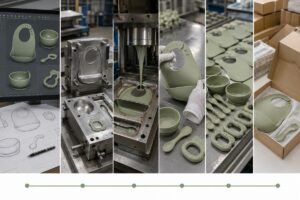
LYA Silicone supports custom silicone product development from prototype to production, helping brands create reliable silicone baby products with controlled manufacturing processes.
常见问题
Are silicone baby products safe for babies?
High-quality food-grade silicone products are widely used for baby products. Safety depends on material selection, manufacturing control, cleaning and quality inspection.
Why does my silicone baby product smell?
Possible causes include packaging, manufacturing conditions, cleaning process or material issues. Persistent strong odors should be evaluated carefully.
Can silicone baby products cause skin reactions?
Some reactions may be related to individual sensitivity or other factors such as additives, pigments or contaminants rather than silicone itself.
How can brands ensure silicone baby products are safe?
Brands should work with experienced silicone manufacturers, confirm material requirements, control mold production and perform proper quality inspection before mass production.
结论
Silicone baby products are popular because of their flexibility, durability and easy-care characteristics. However, product safety depends on much more than choosing silicone as a material.
For baby brands developing custom silicone products, controlling raw materials, pigments, mold quality and manufacturing processes is essential for stable production.
LYA Silicone provides OEM and ODM custom silicone manufacturing services, supporting brands from product design and mold development to mass production.
联系方式 LYA 硅胶 to discuss your custom silicone baby product project.