 Chinese
  English
  French
  German
  Spanish
  Polish
  Japanese
  Korean
  Russian
 目录
Answer Excerpt
Choosing between a hollow and solid structure is an important decision when developing custom silicone toys. A solid structure may provide a heavier and firmer feel, while a hollow or internally cored structure can reduce weight and change flexibility, compression and user interaction.
The correct choice depends on product function, overall size, silicone hardness, wall structure, target user, cleaning requirements, mold feasibility and the type of force the product will experience. Brands should validate the final structure with molded samples rather than selecting hollow or solid construction only to reduce material cost.
What Is the Difference Between a Hollow and Solid Silicone Structure?
A solid silicone product contains silicone through most or all of its main cross-section.
A hollow structure contains an internal cavity, through-hole or intentionally cored area.
The difference may look simple in a drawing, but it can significantly affect:
- Product weight
- 灵活性
- Compression
- Shape recovery
- Bite or squeeze feel
- Material consumption
- Mold design
- Demolding
- Cleaning
- Product durability
For custom silicone toys, neither structure is automatically better.
The correct architecture depends on what the toy is expected to do.
When Does a Solid Silicone Structure Make Sense?
Solid structures are useful when a product needs relatively high local support and does not need significant internal compression.
Typical advantages may include:
- Simple internal geometry
- Predictable shape
- Firm product feel
- Fewer internal cavities
- Reduced risk of hidden water or residue inside the product
A small silicone toy may work well as a mostly solid structure when its total size and weight remain reasonable.
However, increasing the amount of silicone does not automatically make a toy more durable.
An excessively thick solid product may become:
- Heavy
- Too stiff
- Uncomfortable to handle
- Slow to recover from local deformation
- More material-intensive
- More difficult to process consistently in very thick sections
The product should use material where it contributes to function rather than filling every internal area without a clear reason.
When Can a Hollow Structure Be Useful?
A hollow or cored structure may be useful when the product needs:
- Lower weight
- Controlled compression
- Softer tactile response
- Treat-dispensing space
- Internal airflow
- Reduced material volume
- A different squeeze or bite response
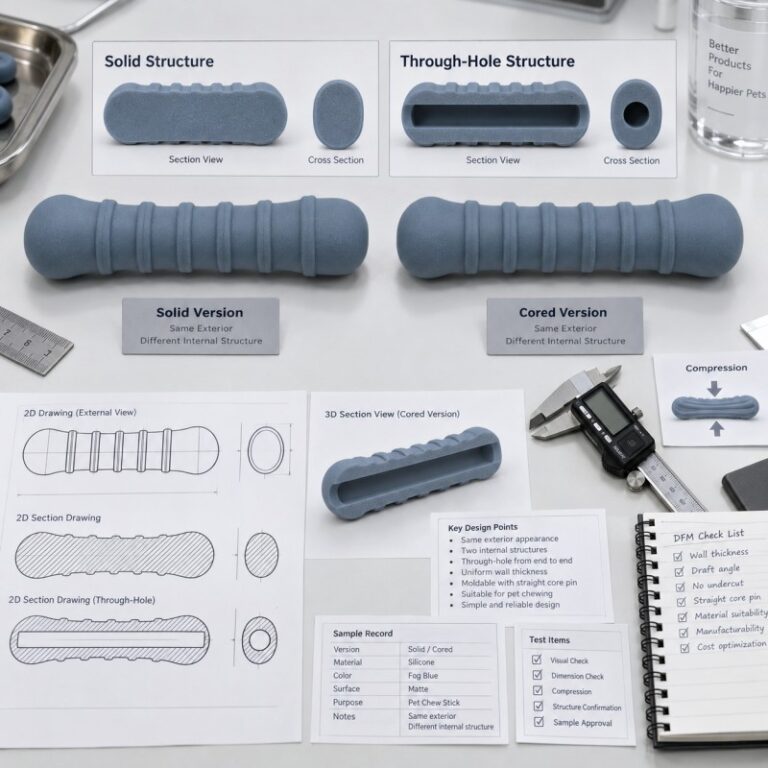
For example, a custom silicone dog chew toy may use a central through-hole so the exterior maintains a substantial working wall while the product remains lighter and more flexible.
The internal cavity should have a clear purpose.
Creating an enclosed hollow area only to save material can introduce new manufacturing and cleaning problems.
Hollow Does Not Mean Thin
One of the most important distinctions is that a hollow product does not need to have very thin walls.
A good hollow structure can still have substantial, controlled wall thickness around the functional areas.
The designer should separately define:
- Main body wall
- End regions
- Hole edge
- High-load areas
- Texture roots
- Transition radii
A hollow toy with an insufficient wall may collapse too easily or tear around its opening.
A hollow toy with an excessively thick wall may lose the weight and flexibility benefits that justified the cavity in the first place.
The objective is therefore not simply to remove material.
It is to position the material more efficiently.
How Does Silicone Hardness Change Hollow and Solid Designs?
The same silicone hardness can behave very differently in a solid product and a hollow product.
Consider two chew toys with identical outer dimensions.
The first is solid.
The second contains a large central through-hole.
Even if both use the same silicone compound, the hollow version will usually deform more easily because its effective structural section is different.
This means hardness cannot be selected by itself.
Brands should evaluate:
- Hardness
- Outer shape
- Wall thickness
- Internal cavity
- Hole diameter
- Product length
- Loading direction
together.
Increasing hardness may improve shape support, but it may also change bite feel and flexibility.
Changing the geometry may sometimes be more effective than changing the material.
How Does Product Size Affect the Decision?
Product size strongly affects whether solid construction remains practical.
Small Products
A relatively small toy may remain lightweight even when much of the structure is solid.
In this case, the design may prioritize:
- Shape definition
- Simple cleaning
- Structural support
Medium Products
As the product grows, a fully solid structure can become significantly heavier.
Designers may begin considering:
- Through-holes
- Cored regions
- Reduced internal mass
- Functional cavities
Large Products
For larger toys, simply making a solid version bigger can create unnecessary weight and material consumption.
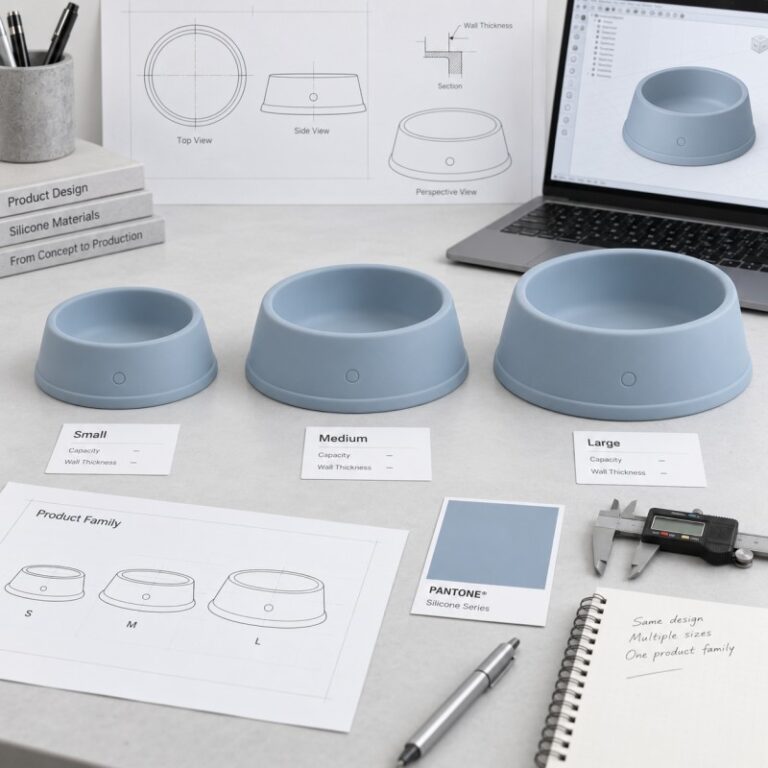
This is similar to developing a multi-size product family: the Large version should be structurally reviewed rather than created by mechanically scaling every dimension.
Why Is a Through-Hole Often Easier to Manage Than a Closed Internal Cavity?
From a product-design perspective, a through-hole provides direct access from one side of the product to the other.
This can simplify:
- Visual inspection
- Rinsing
- Drying
- Mold-core design
- Removal of trapped residue
A completely sealed internal cavity creates different engineering requirements.
The manufacturer needs to evaluate how that cavity is formed and whether the intended geometry is realistically moldable.
For many straightforward silicone toys, an open functional cavity or through-hole can be easier to validate than an inaccessible enclosed void.
The structure should be reviewed during custom silicone mold development before tooling is released.
How Do Holes Affect Tear Risk?
Every hole creates an edge.
That edge can become a high-stress area if the product is repeatedly:
- Pulled
- Bitten
- Bent
- Twisted
- Compressed
A sharp transition between the hole and the surrounding wall may concentrate stress.
Important design variables include:
- Hole diameter
- Edge radius
- Local wall thickness
- Distance from exterior textures
- Distance from other openings
- Material hardness
Rounded transitions usually provide a more controlled structural path than sharp internal corners.
The hole should also remain far enough from thin outer walls and highly stressed textures.
How Do Hollow Structures Affect Shape Recovery?
A hollow product depends heavily on the relationship between the exterior wall and internal cavity.
When compressed, the walls move inward.
After the force is removed, the product should recover toward its intended shape.
Poor recovery may appear as:
- Flattening
- Permanent oval shape
- Local dents
- Twisting
- Uneven wall recovery
During sampling, the product should be compressed in realistic directions rather than only checked while resting freely on a table.
The test should reflect actual play behavior and the intended product positioning.
How Should Chew Texture Be Designed on Hollow Toys?
Raised ribs, dots and grooves can create useful tactile features on pet toys.
However, adding texture to a hollow wall changes the local structure.
A large raised rib creates a thicker region.
A deep groove creates a thinner local section.
The design should avoid:
- Deep grooves directly above thin walls
- Sharp texture roots
- Very narrow texture spacing
- Large thickness changes
- Texture that makes cleaning unnecessarily difficult
The external texture and internal cavity should therefore be designed together.
They should not be created by two separate teams without reviewing the complete cross-section.
How Does Cleaning Affect Hollow vs Solid Selection?
Solid products usually have fewer internal surfaces.
Hollow products can introduce:
- Openings
- Channels
- Internal cavities
- Treat pockets
- Water-retention areas
If the product is expected to contact food, saliva, water or outdoor dirt, brands should include easy-clean design in the structural review.
An open cavity should be large enough to rinse according to the intended cleaning method.
Designers should also consider:
- Drainage direction
- Internal corners
- Drying orientation
- Whether a brush can reach the cavity
- Whether food can become trapped
A functionally interesting cavity that cannot be cleaned conveniently may create poor user experience.
Does a Hollow Toy Always Use Less Material?
Usually it can reduce material compared with an identical fully solid external shape, but the final result depends on the complete redesign.
A hollow structure may require:
- Thicker surrounding walls
- Reinforced hole edges
- Larger transition radii
- Additional tooling features
Therefore, the cost comparison should be based on the actual approved CAD models rather than assuming that “hollow = cheaper.”
Material use is only one part of total manufacturing cost.
Tooling, cycle stability, defect risk, inspection and expected production volume also matter.
Does a Solid Toy Always Last Longer?
No.
Durability depends on the full design.
A poorly designed solid toy can still fail around:
- Thin texture roots
- Sharp corners
- Parting lines
- Small holes
- Abrupt thickness transitions
A well-designed hollow structure can also perform reliably when its wall, openings and transition zones are properly engineered.
Brands should avoid making absolute “indestructible” claims for chew products.
The product should instead be designed and tested for its intended pet size, use pattern and product positioning.
How Does Mold Design Change Between Hollow and Solid Structures?
A solid external shape may use a relatively straightforward cavity.
A product containing a through-hole usually requires an additional core feature to form the opening.
The tooling team should review:
- Core location
- Core support
- Mold opening direction
- Parting line
- Venting
- Demolding
- Hole-edge quality
- Core alignment
If the through-hole is long and narrow, maintaining stable geometry becomes more important.
If the product has multiple internal passages, tooling complexity can increase significantly.
The designer should therefore discuss internal architecture before the outer appearance is completely frozen.
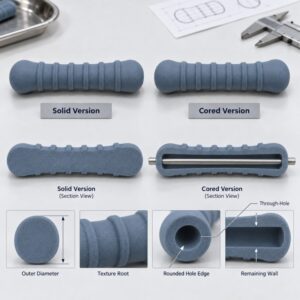
Example: Solid vs Cored Silicone Dog Chew Toy
Consider a rounded bar-style custom silicone dog chew toy with shallow dental ribs along the outer surface.
The brand wants two possible structures.
Option A — Solid Body
The center section is primarily solid silicone.
Potential characteristics:
- Heavier hand feel
- Lower compression
- Simple internal structure
- No internal channel to clean
However, the product may become unnecessarily heavy if its dimensions are large.
Option B — Central Through-Hole
The same external toy uses a controlled axial opening through the center.
Potential characteristics:
- Lower weight
- More compression
- Different bite response
- Possible treat or interaction function
- Accessible internal passage for cleaning
The designer must then review:
- Hole diameter
- Remaining wall
- Hole-edge radius
- Texture depth
- Shape recovery
The decision should be based on intended function rather than only appearance.
What Should Brands Test During Sample Approval?
重量
Compare the real molded product with the desired user experience and packaging target.
Compression
Apply realistic force from several directions.
Check whether the hollow structure collapses too easily or the solid structure feels excessively rigid.
Shape Recovery
After compression, confirm that the product returns to its intended geometry.
Hole and Edge Condition
For hollow or cored products, inspect the entire opening for:
- Flash
- Tears
- Uneven edges
- Local thin sections
Functional Use
Test the product according to its intended use.
For pet toys, this may include supervised chew, pull, treat-dispensing or interactive-play evaluation according to the brand’s own test plan.
Cleaning
Wash and dry the actual sample.
Check whether internal passages remain accessible.
Cavity Comparison
If the production tool contains multiple cavities, compare product weight, hole geometry, flexibility and appearance between cavities.

Hollow vs Solid Silicone Toy Checklist
| 项目 | Solid Structure | Hollow / Cored Structure |
|---|---|---|
| Product weight | Usually higher | Usually lower |
| Compression | Usually lower | Can be higher |
| Internal cleaning | Simple if no cavity | Must review cavity access |
| Material use | Usually higher | Can be reduced |
| Internal geometry | Simpler | Requires structural review |
| Hole-edge risk | Not applicable unless openings exist | Important |
| Shape recovery | Depends on geometry and hardness | Strongly affected by wall/cavity balance |
| Mold design | Often simpler | May require cores or additional features |
| Functional options | Mainly external | Can support treat or airflow functions |
| Sample testing | Still required | Especially important for wall and recovery |
How LYA Silicone Supports Toy Structure Development
对于 OEM and ODM development, the internal architecture should be discussed at the same time as the outer product shape.
Project review may include:
- Intended toy function
- Product dimensions
- Hollow or solid concept
- Silicone hardness
- Wall structure
- Hole geometry
- Texture layout
- Mold feasibility
- Sample production
- Compression testing
- Shape-recovery evaluation
- Cleaning review
- 包装
- Mass-production inspection
The goal is not to use the least material or the most material.
The goal is to place silicone where it contributes to product function and remove unnecessary complexity where it does not.
Frequently Asked Questions
Is a hollow silicone toy softer than a solid toy?
It can feel more flexible even when both products use the same silicone hardness because the internal structure changes how the product deforms.
Is a solid silicone toy always more durable?
No. Durability depends on the complete geometry, wall transitions, openings, texture, material and intended use.
Can a hollow silicone toy have a closed internal cavity?
It may be possible for specific structures and manufacturing approaches, but the actual geometry and mold feasibility should be reviewed before tooling. An open cavity or through-hole can be easier to inspect and clean in many toy applications.
Can a hollow design reduce product weight?
Yes, an internal cavity can reduce material volume and weight, but surrounding walls and high-load regions still need adequate structure.
Should pet chew toys be hollow or solid?
There is no universal answer. The choice depends on target pet size, toy dimensions, intended chewing or interactive function, weight, flexibility and cleaning requirements.
Should the hollow structure be finalized before mold development?
Yes. Internal architecture directly affects tooling, cores, wall thickness, demolding and sample validation.
Choose the Structure Around the Product Function
The decision between hollow and solid silicone structures should follow the actual product requirement.
Brands should evaluate:
Function → Size → Weight → Hardness → Wall Structure → Internal Cavity → Openings → Cleaning → Tooling → Testing
before releasing the design for production.
A solid structure should not be selected simply because it appears stronger, and a hollow structure should not be selected only because it uses less material.
If you are developing a silicone toy and need to evaluate hollow, solid or cored construction, contact us with your drawing, reference sample, product dimensions, target user, intended function, hardness requirement, color, packaging concept and estimated order quantity.