 Russian
  English
  French
  German
  Spanish
  Polish
  Chinese
  Japanese
  Korean
 Содержание
Answer Excerpt
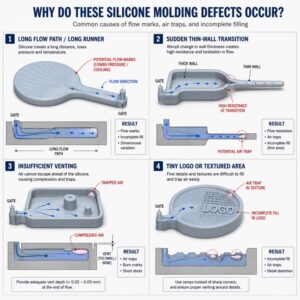
Flow marks, trapped air and incomplete filling usually occur when silicone cannot enter, displace air from or fully pack every part of the mold cavity under stable conditions. Common causes include long or unbalanced flow paths, thin sections, abrupt wall-thickness changes, poor venting, small textures, unsuitable gate positions and unstable molding parameters. These risks should be reviewed during DFM and validated with samples from every mold cavity.
A custom silicone product may have the correct overall shape but still show visible or functional molding defects.
Common examples include:
- Lines or waves on the product surface
- Small bubbles or voids
- Burned or discolored areas
- Missing material at thin edges
- Unfilled logo details
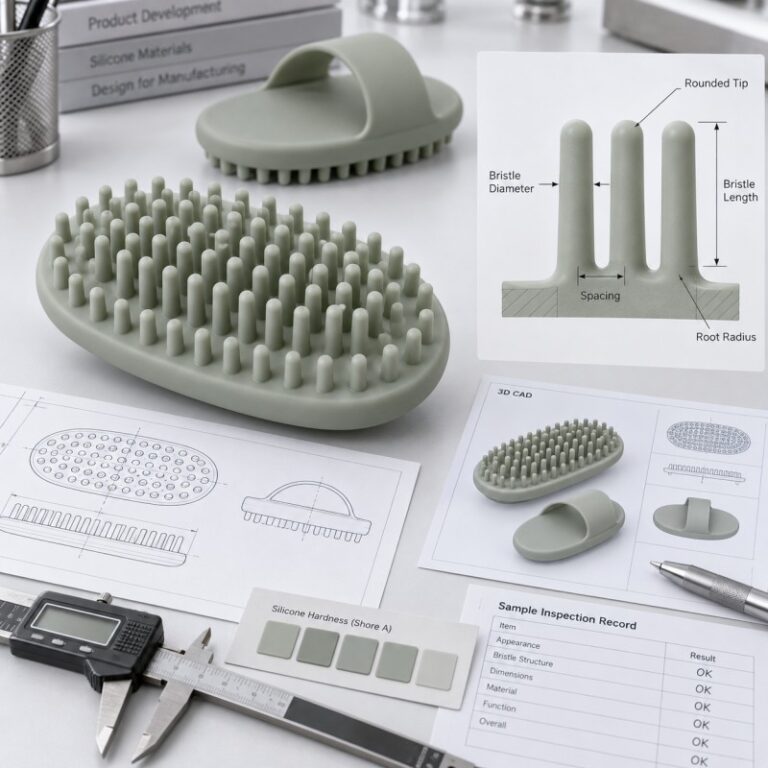
- Incomplete brush bristles
- Rounded-off textures
- Short or partially formed ribs
- Weak areas around holes
- Different results between mold cavities
These problems are sometimes grouped together as “silicone molding defects,” but they do not all have the same cause.
Corrective action should begin by identifying whether the problem is mainly related to material flow, trapped air, filling distance, product geometry, mold venting or process stability.
What Are Flow Marks on Silicone Products?
Flow marks are visible lines, waves or differences in surface appearance created while silicone moves through the mold cavity.
They may appear as:
- Wavy lines
- Gloss differences
- Light and dark bands
- Directional surface patterns
- Lines around a gate or thin area
- Visible joining lines where two flow fronts meet
Flow marks do not always affect product function, but they can reduce the appearance quality of baby products, pet accessories, beauty tools and premium lifestyle products.
They may also indicate that silicone is filling different areas under unequal temperature, pressure or flow conditions.
A flow mark should therefore not be evaluated only as a cosmetic problem. The same flow imbalance may also affect dimensions, texture definition or local strength.
What Is an Air Trap?
An air trap occurs when air inside the mold cavity cannot escape before the silicone reaches and seals the surrounding area.
The trapped air may cause:
- Small voids
- Surface bubbles
- Burn marks
- Incomplete corners
- Missing logo details
- Weak bristle roots
- Short filling at the end of the flow path
Air traps commonly occur at:
- End-of-fill areas
- Deep recesses
- Sharp corners
- Closed pockets
- Fine textures
- Small holes
- Bristle tips
- Logo grooves
- Areas surrounded by several flow fronts
The mold must provide a controlled route for air to leave the cavity.
Simply increasing pressure may not solve the problem. Higher pressure can sometimes compress the trapped air, increase flash or make the defect move to another position.
What Does Incomplete Filling Mean?
Incomplete filling means that silicone does not fully form one or more areas of the product.
It may also be described as:
- Short shot
- Underfill
- Missing material
- Incomplete cavity filling
- Unfilled detail
Typical examples include:
- A brush bristle that is shorter than the others
- A logo letter with missing edges
- A suction lip that is not completely formed
- A thin corner with insufficient material
- An incomplete hanging hole
- A textured pattern with missing details
- A rib that ends before reaching its designed length
Incomplete filling can affect appearance, dimensions and durability.
A partially filled bristle root or thin edge may look acceptable at first but tear more easily during use.
Why Do These Silicone Molding Defects Occur?
1. The Flow Path Is Too Long or Unbalanced
Silicone must travel from the gate to every area of the mold cavity.
When one section is much farther away, thinner or more complex than another, the material may fill the easy areas first.
The remaining areas may receive less stable flow or become isolated by already-filled silicone.
This can cause:
- End-of-fill air traps
- Incomplete thin sections
- Different appearance between product areas
- Unequal filling between mold cavities
Gate position and flow-path balance should be reviewed before mold machining.
2. Thin Sections Restrict Material Flow
Thin silicone sections are often used around:
- Suction edges
- Bib edges
- Folding structures
- Bristle roots
- Sealing lips
- Product openings
- Fine decorative features
When a section is too thin relative to its flow length, the material may not fill it consistently.
The risk increases when a thin section follows a much thicker section or contains several sharp turns.
The solution is not always to make the entire product thicker. Local wall thickness, transition geometry and gate location should be evaluated together.
3. Wall Thickness Changes Too Abruptly
Silicone flows differently through thick and thin areas.
A sudden transition may cause:
- Uneven flow speed
- Visible flow lines
- Local air pockets
- Unequal curing
- Surface differences
- Incomplete filling behind the transition
Gradual transitions generally create more stable flow than abrupt steps.
The engineering team should review the product cross-section rather than looking only at the external shape.
4. Mold Venting Is Insufficient
Air must leave the cavity as silicone enters it.
Venting may be required around:
- End-of-fill locations
- Fine textures
- Bristle cavities
- Logos
- Sharp corners
- Deep pockets
- Thin edges
Vents must be effective enough to release air without creating excessive flash.
Venting design also needs maintenance. Residue, contamination or mold wear can reduce venting performance during production.
A sample that fills correctly at the beginning of production may develop air traps later if the venting condition changes.
5. Small Logos and Textures Are Difficult to Fill
Fine letters, thin lines and deep textures create narrow mold features.
Filling risk increases when the design contains:
- Very small text
- Sharp internal corners
- Deep narrow grooves
- Thin logo strokes
- Long bristles
- Small negative spaces
- Heavy texture beside a thin wall
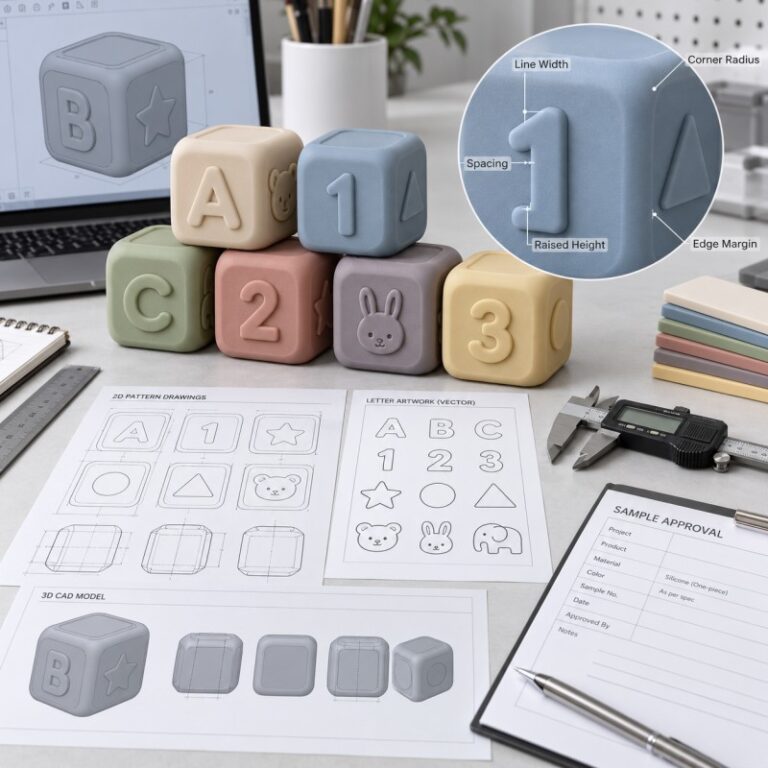
A logo may look clear when enlarged on a computer screen but fail when produced at its actual size.
Logo and texture details should be reviewed during DFM before the final mold is made.
6. Molding Parameters Are Not Stable
Depending on the selected silicone material and molding process, production stability may be influenced by:
- Material amount
- Injection or compression pressure
- Flow speed
- Mold temperature
- Curing time
- Material temperature
- Mold closing condition
- Production cycle
- Demolding time
Changing one parameter may improve filling but create another problem such as flash, deformation or surface variation.
The objective is not to use the highest possible pressure. It is to establish a stable production window that fills the product consistently.
7. Different Mold Cavities Behave Differently
In a multi-cavity mold, each cavity should receive material under similar conditions.
Differences in runners, gates, vents, temperature or cavity dimensions may cause one cavity to show:
- More flow marks
- More bubbles
- Incomplete details
- Greater flash
- Different product weight
- Different dimensions
Samples should be identified and inspected by cavity number.
Approving only one good cavity does not confirm that the complete mold is ready for mass production.
How Can These Defects Be Reduced During DFM?
Before mold manufacturing, review the following:
- Gate position
- Flow-path length
- Wall thickness
- Thin-to-thick transitions
- End-of-fill locations
- Venting positions
- Logo size
- Texture depth
- Bristle length and root geometry
- Parting-line position
- Mold-cavity balance
- Demolding direction
Critical cosmetic surfaces should also be identified.
A flow line on the hidden bottom of a product may have a different acceptance standard from a flow line across a visible logo or premium front surface.
The drawing should distinguish:
- Critical functional areas
- Critical appearance areas
- Normal appearance areas
- Dimensions requiring close control
What Should Be Checked During Sample Approval?
Appearance Inspection
Inspect the product under consistent lighting for:
- Flow marks
- Air marks
- Bubbles
- Burn marks
- Missing details
- Surface differences
- Flash
- Parting lines
- Deformation
Detail Inspection
Use magnification where necessary to check:
- Logos
- Small text
- Texture grooves
- Bristle roots
- Thin lips
- Holes
- Corners
- End-of-fill areas
Product Weight
Unexpected weight variation may indicate inconsistent material filling.
Weight should not replace dimensional or functional inspection, but it can help detect process variation.
Dimensional Inspection
Measure the areas affected by incomplete filling, especially:
- Thin edges
- Bristle height
- Logo dimensions
- Hole diameter
- Suction lips
- Sealing features
Functional Testing
Test the actual product function.
Examples include:
- Suction test
- Folding and recovery test
- Pull test
- Brush bending test
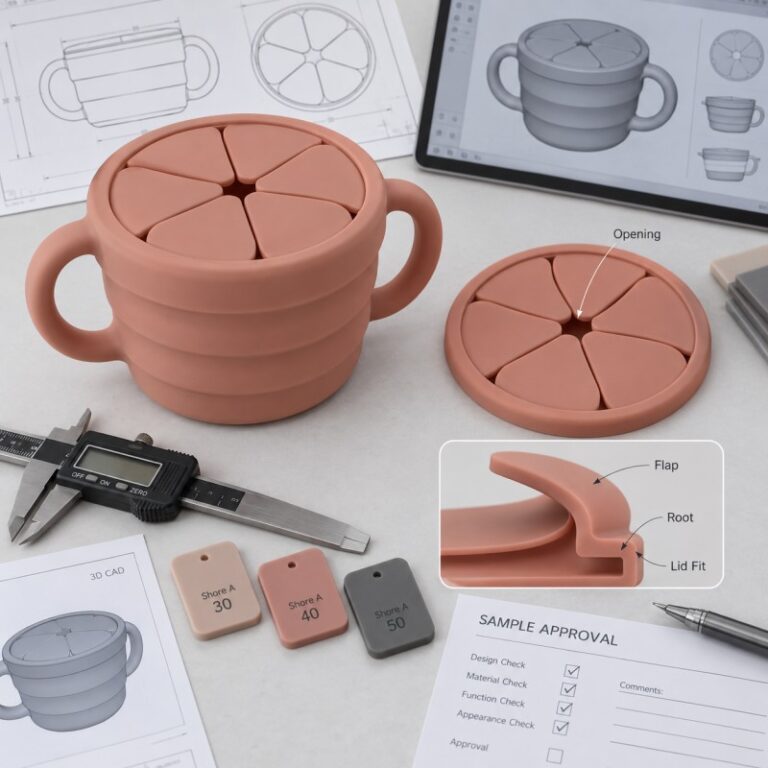
- Lid-fit test
- Leak test
- Repeated assembly
A product may pass visual inspection but still fail functionally because a thin or hidden feature is not fully formed.

Sample and Production Checklist
| Inspection Item | What to Confirm |
|---|---|
| Flow marks | Location, visibility and approved appearance limit |
| Air traps | No voids or missing material in critical areas |
| Product filling | All edges, ribs, bristles, logos and textures are complete |
| Mold cavities | Samples from every cavity meet the same standard |
| Product weight | Stable within the agreed production range |
| Dimensions | Critical features meet drawing requirements |
| Surface quality | No burns, contamination or unacceptable gloss variation |
| Функция | Suction, folding, fit or other functions pass testing |
| Упаковка | Packing does not hide or worsen molding defects |
| Production records | Final approved parameters and sample revision are recorded |
Application Examples
Детские товары из силикона
Pay special attention to:
- Bib edges
- Button holes
- Spoon tips
- Bowl rims
- Suction bases
- Teether textures
- Small logo details
Incomplete filling in oral-contact or thin functional areas should not be accepted only because the overall product looks normal.
Силиконовые товары для животных
Important areas include:
- Brush bristles
- Lick-mat textures
- Hanging holes
- Slow-feeder patterns
- Bowl edges
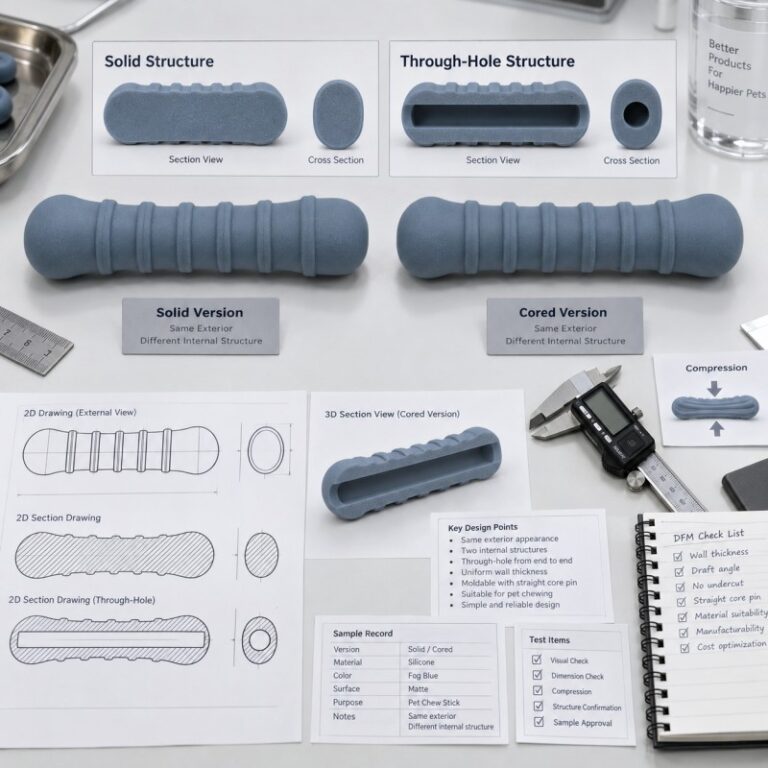
- Chewing structures
Long bristles and deep textures require careful flow and venting review.
Collapsible and Lifestyle Products
Check:
- Folding rings
- Thin transitions
- Lid grooves
- Sealing lips
- Handles
- Decorative textures
- Logo areas
Incomplete filling may affect both shape recovery and product stability.
How LYA Silicone Supports Defect Prevention
LYA Silicone supports OEM and ODM development for silicone baby, pet, household, outdoor and educational products.
Project support may include:
- Drawing and sample review
- DFM analysis
- Wall-thickness evaluation
- Gate and venting discussion
- Logo and texture review
- Разработка пресс-форм на заказ
- Sample production
- Mold-cavity inspection
- Appearance and dimensional testing
- Functional validation
- Pilot production
- Mass-production quality control
The objective is to identify high-risk flow and venting areas before they become repeated production defects.
Frequently Asked Questions
Are Flow Marks Always a Product Failure?
Нет.
Some minor flow marks may be cosmetic and commercially acceptable, depending on location and the agreed standard.
Flow marks on visible premium surfaces or critical functional areas require closer evaluation.
Can Higher Pressure Eliminate Air Traps?
Not necessarily.
If air has no escape route, higher pressure may increase flash, compress the trapped air or move the defect.
Mold venting and flow-path design should be reviewed.
Why Does Only One Mold Cavity Have Incomplete Filling?
The cavity may have different gate, runner, venting, temperature or dimensional conditions.
Samples should be traced by cavity number.
Can Very Small Logos Be Molded Clearly?
Possibly, but minimum line width, depth, spacing and corner radius must suit the product, material and molding process.
The logo should be reviewed at its actual production size.
Can Incomplete Filling Make a Product Easier to Tear?
Yes.
An underfilled edge, hole or bristle root may have less material than designed and become a weak point during bending or pulling.
Should Flow Marks Be Defined in the Quality Standard?
Yes.
The buyer and manufacturer should agree on acceptable location, visibility and limit samples before mass production.
Prevent Filling Defects Before Mass Production
Flow marks, air traps and incomplete filling are easier to correct during product and mold development than after full production begins.
Before approving the mold, confirm:
- Wall thickness
- Flow path
- Gate position
- Venting
- Logo and texture detail
- Mold-cavity balance
- Appearance standard
- Functional testing
- Pilot-production results
To review molding risks for your custom silicone product, send LYA Silicone the drawing, reference sample, product application, critical appearance areas, functional requirements and estimated order quantity.