 Chinese
  English
  French
  German
  Spanish
  Polish
  Japanese
  Korean
  Russian
 目录
Answer Excerpt
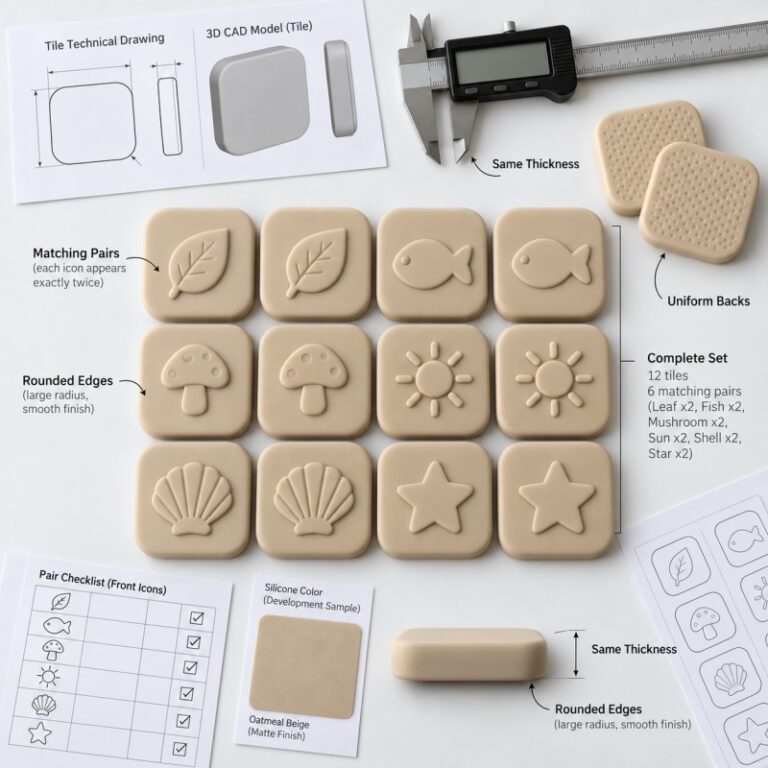
A silicone memory matching game should allow players to identify pairs by remembering the symbols on the front of each tile, not by recognizing differences on the back. If tiles have inconsistent colors, thicknesses, textures, shapes or molding marks, players may discover clues before turning them over.
For OEM educational toy brands, successful development requires more than attractive illustrations. Tile uniformity, back-side design, pair consistency, set completeness, material selection and production inspection should be planned together.
The objective is to create a matching game that remains visually fair, practical to handle and consistent across the complete retail set.
Why Does Tile Uniformity Matter in a Memory Matching Game?
A memory matching game normally uses multiple pairs of cards or tiles.
Players place the tiles face down, turn them over and try to remember where matching symbols are located.
This creates a special design requirement.
The front of each tile needs a recognizable symbol, while the back should not unintentionally reveal which symbol is on the other side.
If one tile is thicker, darker or noticeably different in texture, a player may learn to recognize it without relying on memory.
The problem becomes more significant when several tiles are produced using different molds, material batches or decorative processes.
For brands, tile uniformity affects both the actual game experience and the quality perception of the finished product.
What Can Accidentally Reveal a Matching Pair?
Several apparently minor differences can provide visual or tactile clues.
Typical examples include:
-
A slightly different back color
-
A unique molding mark
-
Uneven tile thickness
-
Different corner shapes
-
A raised logo appearing in different locations
-
Back-side texture differences
-
Distortion near the edges
-
Excessive variation in surface gloss
Some differences may be easy for an adult to notice. Others may become apparent only when the tiles are placed together under consistent lighting.
A good sample review should therefore include a face-down comparison of the complete set.
Inspecting only the illustrated front surfaces is insufficient.
Should Every Tile Have the Same Back Design?
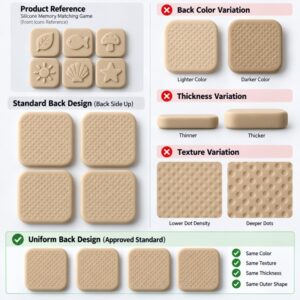
For a conventional memory matching game, a common back design is usually a practical starting point.
The backs may feature:
-
A completely smooth surface
-
A uniform fine texture
-
A single molded geometric pattern
-
A consistent decorative border
-
A standard brand mark
However, the chosen pattern should be reproduced consistently on every piece.
If the brand uses a raised pattern, the height and positioning should not vary visibly between matching pairs.
A common pattern should also avoid creating a distinctive orientation mark linked to the symbol on the front.
For example, placing a different identification number on the reverse side of each design would defeat the purpose of face-down memory play.
The back should support the game, not accidentally disclose the answer.
Why Can Tile Thickness Reveal the Answer?
Silicone tiles have a flexible structure, and thickness affects how they lie on a table.
If one pair is noticeably thicker than the others, players may recognize it from the edge even when the symbols are hidden.
Different thicknesses can also affect:
-
Tile flexibility
-
Edge appearance
-
Stacking height
-
Hand feel
-
Overall product weight
-
Packaging fit
For a matching game, consistent thickness is therefore both a functional and a quality-control requirement.
The manufacturer should identify important thickness dimensions and define an appropriate inspection method.
Because silicone deforms under pressure, measurement methods should avoid introducing excessive compression.
How Should Colors Be Controlled Across Matching Pairs?
Color can be an intentional learning feature or an unintended clue.
If every front symbol uses a different color, the brand needs to decide whether color recognition is part of the intended game.
For a traditional face-down memory game, the reverse side should remain visually consistent.
Two common design approaches are possible.
One-Color Molded Tiles
Every tile uses the same base silicone color, while molded relief features distinguish the front symbols.
This approach avoids creating different base colors for individual pairs.
However, symbol visibility depends on geometry, lighting and surface finish.
Decorated Front Symbols
The silicone tiles use a common base color, while the front symbols receive a contrasting color through an appropriate additional process.
This can improve visual recognition, but introduces further requirements for registration, adhesion, durability and cleaning compatibility.
For either approach, the brand should approve physical color references and evaluate the finished tiles under representative lighting.
The chosen artwork and process should not create unintended marks on the reverse side.
Can Different Surface Textures Create Unfair Clues?
Yes.
Silicone surface texture changes how a tile reflects light and how it feels when handled.
A tile with a noticeably rougher reverse side may be recognizable through touch.
A glossy tile may also stand out among otherwise matte pieces.
The buyer should distinguish between intended tactile learning and unintentional texture variation.
For a visual memory game, all reverse surfaces should normally follow one approved finish.
If different textures are intentionally used as part of a tactile matching activity, that should be a different, clearly defined game concept.
The product’s learning objective should guide the surface design.
How Should the Front Symbols Be Designed?
The front symbols need to be recognizable without becoming unnecessarily complicated.
For example, a matching game might use six distinct concepts:
-
Leaf
-
Fish
-
Mushroom
-
Sun
-
Shell
-
Star
Each symbol appears twice.
Both tiles within a pair should reproduce the same design.
The designer should review:
-
Symbol size
-
Placement
-
Orientation
-
Relief height
-
Edge definition
-
Visual contrast
-
Cleaning accessibility
Detailed technical guidance for molded educational toy details can help buyers evaluate whether thin lines and small decorative features are suitable for silicone manufacturing.
However, the central requirement for a matching game is not maximum artistic complexity.
It is clear differentiation between different pairs and consistency within each pair.
Should Matching Pairs Have Identical Dimensions?
For a conventional game, the external shape should normally remain consistent across all tiles.
Using slightly different overall dimensions for each symbol may allow players to identify tiles while they are face down.
This can happen if every graphic is molded together with a different outer boundary.
A more controlled product architecture uses a standardized tile body while allowing the front-facing symbols to vary.
Important shared dimensions include:
-
Overall length and width
-
Corner radius
-
Nominal thickness
-
Edge profile
-
Back-surface geometry
The design team should also review flatness and local deformation.
A tile that curls upward more than the others can become recognizable even without a unique graphic.
Why Does Edge Shape Matter When Tiles Are Face Down?
A memory tile is repeatedly picked up, turned over and placed back onto a surface.
The edge should therefore provide a practical grip while remaining consistent across the set.
Very thin edges may curl or become difficult to grasp. Excessively thick edges can make the product bulky.
Uneven molding or trimming may also create identifiable differences.
Useful design considerations include:
-
Rounded corners
-
Consistent edge thickness
-
Smooth transitions
-
Sufficient grip area
-
Appropriate flexibility
-
No sharp trimming defects
The correct structure should be validated on actual molded samples and assessed against the intended age group and applicable toy safety requirements.
How Can Mold Design Affect Tile Consistency?
A matching game may contain many pieces with the same outer geometry but different front details.
This creates an opportunity to standardize the common features.
During tooling review, the manufacturer should consider:
-
Standard tile dimensions
-
Common back geometry
-
Repeatable edge formation
-
Symbol-specific cavity features
-
Material filling
-
Venting
-
Demolding
-
Parting-line position
-
Potential cavity-to-cavity differences
A consistent mold layout can simplify inspection, but using several cavities does not automatically guarantee identical results.
The approval process should compare samples from the intended production cavities.
Why Can Packaging Pressure Make Tiles Look Different?
Silicone is flexible.
If the matching tiles are stored under uneven pressure, some pieces may develop temporary deformation or visible compression marks.
Packaging should therefore be evaluated together with the final product.
For example, a set tightly constrained by an insert may hold some tiles in a bent condition.
The brand should confirm:
-
Tile arrangement
-
Stack height
-
Packing orientation
-
Pressure from the retail insert
-
Storage pouch dimensions
-
Shape recovery after unpacking
The packaging should not unintentionally create the very back-side differences that the game design is intended to avoid.
Why Is Set Completeness a Different Quality Requirement?
A memory game is sold as a complete set, not as individual unrelated silicone pieces.
This means product quality depends on both individual tile condition and the correct assembly of the full set.
Consider a twelve-tile design containing six matching pairs.
If one leaf tile is missing and an extra fish tile is included, the total number of tiles may still be twelve.
However, the game is incomplete because the required pair structure is incorrect.
Therefore, checking only total quantity is insufficient.
A proper packing inspection should confirm:
-
Correct number of unique symbols
-
Exactly two tiles for each intended pair
-
No missing symbol
-
No unintended duplicate
-
Correct total tile quantity
-
Correct packaging and instructions
Pair verification should be included in the packing process and finished-set inspection.
How Should Cosmetic Quality Be Controlled?
A matching game needs consistent appearance on both sides of every tile.
Before production, brands should establish cosmetic defect standards for:
-
Color variation
-
Uneven gloss
-
Black spots
-
Surface contamination
-
Flash
-
Parting-line visibility
-
Raised symbol defects
-
Edge distortion
-
Back-side texture inconsistencies
Not every minor cosmetic variation has the same effect on gameplay.
For example, a small visible mark on the reverse side may allow a specific tile to be identified.
That can be more important to game function than a comparable superficial mark on a noncritical area.
Defect classification should therefore reflect the product’s actual use, not only its appearance.
Practical Example: A Six-Pair Silicone Memory Game
Consider a custom memory matching game containing twelve rounded-square silicone tiles.
The six pairs use leaf, fish, mushroom, sun, shell and star symbols.
Every tile has the same light neutral base color and a common fine-textured back.
Version A — Different Back Colors
Several pairs have slightly different reverse-side color tones.
Players may identify them without turning them over.
Version B — Inconsistent Tile Thickness
Two tiles are noticeably thicker than the others.
They become recognizable from the edge when placed face down.
Version C — Incorrect Packing
One pair is incomplete, while another symbol appears three times.
The set has the correct total quantity but cannot be used as intended.
Improved Version
The revised product specification controls:
-
Common tile body geometry
-
Uniform reverse-side finish
-
Pair-specific front symbols
-
Color consistency
-
Edge condition
-
Functional flatness
-
Complete pair inventory
The final result should be validated on a complete molded set rather than on one representative tile.
What Should Brands Test Before Mass Production?
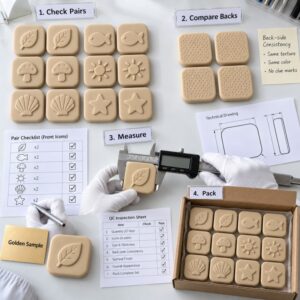
Face-Down Recognition Test
Place all tiles face down under consistent lighting.
Ask reviewers who do not know the symbol arrangement to identify any tiles that appear visually different.
Pair Comparison
Compare both copies of each symbol to verify that their design, size, orientation and appearance are consistent.
Thickness and Flatness Inspection
Check representative pieces using an agreed measurement method that limits unnecessary silicone compression.
Handling and Flip Test
Confirm that the tiles can be picked up, turned over and placed back without unacceptable distortion.
Cleaning Evaluation
Clean the samples using the intended care method and inspect the relief features and surface finish.
Packaging Test
Pack and unpack the complete set, then review shape recovery and possible marks.
Complete Set Check
Count each symbol and its matching partner before approving the retail pack.
A formal AQL inspection plan may be used for appropriate lot-sampling checks, while complete-set accuracy and safety-related requirements should receive inspection controls suited to their importance.
Silicone Memory Matching Game OEM Checklist
| 项目 | Buyer Approval Requirement |
|---|---|
| Intended user | Target age group and use scenario |
| Set configuration | Correct number of pairs |
| Tile shape | Common external geometry |
| Back design | No unintended identifying clues |
| Tile thickness | Consistent within specification |
| Corner radius | Smooth and consistent |
| Front symbols | Clearly distinct between pairs |
| Paired symbols | Identical approved design |
| 颜色 | Approved physical reference |
| 纹理 | Consistent reverse-side finish |
| Mold quality | Controlled cavities and edges |
| Cleaning | Appropriate for finished materials |
| 包装 | Avoids unwanted deformation |
| Set accuracy | All pairs present, no extras |
| Quality control | Appearance, function and completeness |
| Target market | Applicable toy requirements identified |
How LYA Silicone Supports Custom Educational Toy Development
LYA Silicone supports OEM and ODM development for customized silicone consumer products, including educational toys and sensory-play products.
Its 硅胶教育产品 range includes matching games, stacking toys, educational blocks, puzzles and fidget products.
Depending on the project, development support can include:
-
Product concept and drawing review
-
Tile structure and layout planning
-
Material and hardness discussion
-
Custom front-symbol development
-
Mold development
-
Color matching
-
Sample production
-
Dimensional and appearance inspection
-
Complete-set verification
-
Packaging customization
-
Mass-production quality control
For matching games, the buyer should confirm the intended play pattern, age classification, material requirements, test plan and final packaging before tooling.
Frequently Asked Questions
Should All Silicone Memory Game Tiles Have Identical Backs?
For conventional face-down memory matching, a uniform reverse-side appearance helps prevent players from identifying pairs before flipping the tiles.
Can Different Tile Colors Be Used?
Yes, when color is part of the intended game design. However, unintended back-side color differences can create recognizable clues.
Can Silicone Memory Tiles Have Molded Animal Symbols?
Yes. Molded symbols can be considered for customized designs, provided the details are manufacturable and appropriate for the product.
Why Do Matching Pairs Need Separate Inspection?
Two tiles with the same intended symbol can still differ in color, relief definition or shape because of manufacturing variation.
Is Checking the Total Number of Tiles Enough?
No. A set can have the correct total count while containing missing pairs and unwanted duplicates.
Can a Brand Customize the Number of Matching Pairs?
Yes. Set quantity, artwork and packaging can be defined during OEM development, subject to tooling and commercial requirements.
Does Using Silicone Automatically Make a Memory Game Safe for Babies?
No. Age grading, dimensions, material suitability, mechanical integrity and applicable toy requirements must be assessed for the complete finished product.
Build a Fair Game, Not Just Attractive Tiles
A successful silicone matching game depends on:
Uniform Tile Backs → Clear Front Symbols → Consistent Dimensions → Correct Pairs → Complete Packaging → Production Inspection
For educational toy brands, these controls help preserve the intended play experience while supporting repeatable OEM manufacturing.
If you are developing a private-label silicone memory matching game, contact us with your reference design, target age group, artwork, number of pairs, material requirements, target market, color plan, packaging concept and estimated order quantity.