 Chinese
  English
  French
  German
  Spanish
  Polish
  Japanese
  Korean
  Russian
 目录
Answer Excerpt
Product weight can be a useful process-control indicator for 定制硅胶产品, but it should not be used as the only acceptance criterion. Weight variation may come from material dosing, cavity filling, flash, trimming, wall-thickness differences, mold-cavity balance or process changes. Buyers should establish an approved weight range from qualified production samples and use weight together with dimensions, appearance and functional testing.
A buyer approves a silicone sample weighing 138 grams.
Mass production begins several weeks later.
The factory then measures different products and finds:
- 136.8 g
- 137.5 g
- 138.2 g
- 139.0 g
Does this automatically mean some products are defective?
Not necessarily.
Manufacturing always contains controlled variation.
The real question is whether the weight variation is:
- expected,
- stable,
- traceable,
- and still compatible with the approved product requirements.
For silicone OEM projects, product weight can be extremely useful—but only when buyers understand what the number actually tells them.
Why Is Product Weight Useful in Silicone Quality Control?
Weight is relatively easy to measure.
Compared with flexible dimensions, it is also less affected by:
- how an operator holds the product,
- how hard a caliper presses,
- whether an edge bends,
- or whether a soft wall changes shape during measurement.
This makes product weight useful for identifying unusual production changes.
For example, a sudden lower weight may indicate:
- incomplete filling,
- insufficient material charge,
- missing thin features,
- abnormal trimming,
- or cavity-specific filling differences.
A sudden higher weight may indicate:
- excessive flash,
- excess material,
- incomplete trimming,
- or another process change.
However, weight indicates that something may have changed.
It does not automatically tell the engineer exactly what changed.
Why Can Sample Weight Differ From Mass-Production Weight?
Engineering samples are usually produced in a smaller, more closely monitored run.
During sampling, technicians may adjust:
- material quantity,
- mold temperature,
- molding pressure,
- cure time,
- trimming method,
- demolding timing,
- and process settings.
After the buyer approves the sample, these settings need to be converted into repeatable production instructions.
Your existing silicone sample and mass production consistency content already identifies material filling, mold cavities and product weight as factors that can vary when a project moves from sampling to bulk production.
A production part should therefore not be expected to match one golden sample to the last fraction of a gram.
The correct objective is a qualified production range.
How Can Material Dosing Affect Product Weight?
The mold must receive enough silicone to form the intended product.
For LSR injection molding, the machine meters a controlled shot of material into the mold.
For compression-molded silicone products, a prepared material charge is placed into the mold before molding.
If the material quantity becomes too low, possible results include:
- lower finished weight,
- incomplete edges,
- missing textures,
- shortened features,
- or short filling.
If the material quantity is unnecessarily high, the result may include:
- more excess material,
- greater flash,
- increased trimming,
- and material waste.
SIMTEC’s LSR troubleshooting guidance specifically includes checking consistent shot size or weight when investigating molding problems such as flash.
The target should therefore be a stable molding process—not simply adding more silicone to make every part heavier.
Why Can Flash Increase Product Weight?
Flash is the thin unwanted silicone that appears where material enters small gaps around:
- parting lines,
- vents,
- shut-off areas,
- or other mold interfaces.
Before trimming, a product with more flash may weigh more than a clean product.
After trimming, the final weight may return closer to the approved range.
This creates an important quality-control lesson:
The weighing stage must be defined.
Do not compare:
- one sample weighed before trimming,
- another after trimming,
- and another after final cleaning.
The inspection specification should state whether product weight is recorded:
- after molding,
- after deflashing,
- after cleaning,
- or as finished packed product.
For most buyer-side product standards, finished-product weight is usually the more meaningful reference.
Can Excessive Trimming Reduce Product Weight?
Yes.
Trimming is another source of variation.
A silicone product may contain intentionally removable flash around the mold split.
If operators trim differently, one product may lose slightly more material than another.
More serious over-trimming can affect:
- edge geometry,
- sealing lips,
- release tabs,
- suction edges,
- thin rims,
- or cosmetic boundaries.
This means an unusually low weight may sometimes come from finishing rather than incomplete molding.
The engineer should therefore inspect the actual product before changing machine settings.
Example: Custom Silicone Baby Suction Bowl
Consider a custom silicone baby suction bowl containing:
- a round bowl body,
- a thicker bottom section,
- a wide suction base,
- a thin flexible suction lip,
- a rounded upper rim.
LYA’s current suction-bowl product offering includes the bowl, suction base and matching lid, making this a useful real-world OEM example.
Suppose the approved finished bowl weighs 138 g.
During pilot production, the factory may establish an approved production range based on actual qualified parts.
Now imagine three abnormal situations.
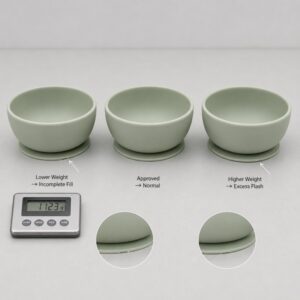
Situation 1 — Product Weight Is Too Low
Inspection finds:
- lower weight,
- incomplete suction-lip area,
- one shortened edge.
This suggests that the lower weight may be related to incomplete filling.
Situation 2 — Product Weight Is Too High
Inspection finds:
- higher weight,
- continuous thin flash around the suction-base edge.
The extra weight is real, but it does not mean the product is stronger or better.
It indicates excess material where it should not be.
Situation 3 — Weight Is Correct but the Product Is Still Defective
The bowl weighs exactly within the approved range.
However:
- one section of the suction lip is incomplete,
- while another area contains excess flash.
The missing material and excess material partially cancel each other in total weight.
The scale says “normal.”
The product is still defective.
This is why weight cannot replace visual and functional inspection.
Can Wall-Thickness Variation Change Product Weight?
Yes.
The mass of a molded silicone product is strongly related to the amount of material occupying the product geometry.
If wall thickness changes across the finished product, weight may change as well.
Possible causes include:
- mold geometry,
- cavity condition,
- dimensional variation,
- deformation,
- or product-design changes.
For flexible silicone products, wall thickness is often more meaningful than simply checking a soft outer dimension.
A bowl can have nearly the same outer diameter while still containing a slightly different wall structure.
That is why product weight should be reviewed together with dimensional tolerances and critical wall dimensions.
Why Should Different Mold Cavities Be Weighed Separately?
A multi-cavity mold produces several parts in the same production cycle.
However, each cavity has its own:
- material flow path,
- gate condition,
- venting,
- cavity surface,
- thermal condition,
- and maintenance history.
Your current multi-cavity mold consistency guide already recommends comparing product weight between cavities because filling differences may produce different weights and product conditions.
During mold qualification, samples should remain traceable as:
- Cavity 1
- Cavity 2
- Cavity 3
- Cavity 4
Then compare weight by cavity.
A useful pattern might look like:
Cavity 1 → stable
Cavity 2 → stable
Cavity 3 → repeatedly lighter
Cavity 4 → stable
That is much more useful than mixing all four cavities into one container and calculating only one average.
The repeated low result from Cavity 3 gives the engineering team a clear investigation target.

Why Should Weight Be Tracked Over Time?
One isolated weight result provides limited information.
A trend provides more information.
For example:
Pattern A — Stable Variation
The product fluctuates slightly around a consistent center during the production run.
This may represent normal controlled manufacturing variation.
Pattern B — Gradual Weight Reduction
Products become progressively lighter during a long run.
The engineering team may need to investigate:
- material supply,
- dosing,
- gates,
- vents,
- process drift,
- or mold condition.
Pattern C — Sudden Weight Increase
A sudden increase may coincide with:
- flash,
- trimming change,
- process adjustment,
- or another abnormal condition.
Pattern D — One Cavity Is Always Different
This points toward a cavity-specific issue rather than a complete material-batch problem.
For higher-volume projects, weight data can therefore help reveal production trends before defects become obvious to the customer.
Should Weight Be Included in First-Piece Approval?
For suitable products, yes.
When production starts, the first-piece or first-run inspection can record:
- appearance,
- dimensions,
- product weight,
- color,
- hardness where relevant,
- and functional performance.
The purpose is to compare actual production with the approved standard before a large quantity is completed.
However, the target weight should come from qualified product data.
It should not be invented from CAD volume alone without validation.
Final silicone density, trimming, molded geometry and process conditions can influence the real finished weight.
Use actual approved molded products to establish the working reference.
How Should Buyers Establish an Acceptable Weight Range?
Do not simply say:
Product weight must equal the golden sample exactly.
That is rarely a practical manufacturing standard.
A better method is:
Step 1 — Approve Product Geometry
Confirm the drawing and critical features.
Step 2 — Approve Molded Samples
Confirm dimensions, appearance and function.
Step 3 — Run Pilot Production
Collect products produced under the intended mass-production process.
Step 4 — Record Weight by Cavity
Do not mix cavity identities.
Step 5 — Investigate Outliers
Determine whether unusual weights correspond to:
- incomplete filling,
- flash,
- trimming,
- dimensions,
- or other defects.
Step 6 — Establish the Production Range
Define the acceptable range from validated process data and product requirements.
The appropriate range depends on the actual product.
There is no universal ±1%, ±2% or other percentage that should automatically be applied to every silicone product.
Why Is Scale Resolution Important?
The weighing equipment must match the product.
For a large silicone feeding bowl, a scale with practical gram or sub-gram resolution may be suitable depending on the required control.
For a very small silicone component, the inspection may require much finer resolution.
ARBURG, for example, publicly demonstrates micro-molded LSR parts weighing only around 0.008 g, showing why weighing requirements depend strongly on actual part size.
The inspection plan should define:
- scale resolution,
- calibration status,
- weighing surface,
- product condition,
- whether accessories are included,
- and whether packaging is removed.
Consistent measurement conditions matter.
Why Weight Cannot Replace Dimensional Inspection
Two products can have the same total weight but distribute material differently.
For example:
Product A:
- correct walls,
- correct suction lip,
- no flash.
Product B:
- thinner critical lip,
- extra flash elsewhere.
Both might weigh nearly the same.
But only Product A is acceptable.
Flexible silicone dimensions are also affected by measurement conditions, so the correct solution is not to replace dimensional inspection with weighing. Your existing dimensional-control guide recommends defining critical dimensions and repeatable measurement conditions for flexible silicone parts.
Weight and dimensions answer different questions.
Use both where they provide useful information.
Why Weight Cannot Replace Functional Testing
A suction bowl can weigh correctly but still have:
- poor suction-base flatness,
- an uneven sealing edge,
- insufficient flexibility,
- a lid-fit problem,
- or deformation after packaging.
Functional performance must still be tested.
For a suction bowl, that may include:
- suction behavior,
- base condition,
- bowl stability,
- lid fit,
- recovery after deformation.
The same principle applies across other silicone products.
A bib may have correct weight but a poorly formed pocket.
A teether may have correct weight but a damaged hole.
A collapsible cup may have correct weight but fail to stay open.
Weight is an indicator—not the final definition of quality.
What Should Buyers Check When Weight Suddenly Changes?
When production weight shifts unexpectedly, investigate systematically.
Check:
- Which cavity produced the part?
- Is the change visible on one cavity or all cavities?
- Has the material batch changed?
- Has the material charge or shot size changed?
- Is there incomplete filling?
- Is there additional flash?
- Has trimming changed?
- Are critical dimensions different?
- Have gates or vents changed?
- Has mold maintenance recently occurred?
- Did machine settings change?
- Does the product still pass its functional tests?
Do not react to one abnormal number by changing several process settings simultaneously.
The objective is to identify the cause—not merely force the weight back toward a target.
Silicone Product Weight Control Checklist
| 项目 | What Should Be Confirmed |
|---|---|
| Weighing stage | Finished-product stage clearly defined |
| Reference sample | Approved product weight recorded |
| Pilot production | Used to establish realistic production data |
| Scale | Resolution suitable for product size |
| Cavity traceability | Weight recorded by mold cavity where relevant |
| Filling | Low-weight parts checked for incomplete features |
| Flash | High-weight parts checked for excess silicone |
| Trimming | Finishing process remains consistent |
| Dimensions | Critical dimensions checked separately |
| 功能 | Weight does not replace product testing |
| Production trend | Sudden or gradual shifts investigated |
| Final range | Based on validated product and process data |
How LYA Silicone Supports Product Weight and Production Consistency
LYA Silicone provides OEM and ODM development for silicone baby, pet, outdoor and educational products. Its current OEM workflow covers mold development, sample confirmation, mass production and quality control.
For suitable projects, production validation may include:
- approved-sample comparison,
- product-weight recording,
- cavity identification,
- dimensional inspection,
- surface inspection,
- flash inspection,
- functional testing,
- pilot production,
- and mass-production monitoring.
The goal is not to make every product show one identical number on the scale.
The goal is to ensure that weight remains within a validated production condition while the actual product continues to meet drawing, appearance and functional requirements.
Frequently Asked Questions
Does a heavier silicone product always mean better quality?
No.
Higher weight may simply result from excessive flash, extra material or incomplete trimming.
Does a lighter product always mean a short shot?
No.
A lower weight is a useful warning signal, but the cause could also involve trimming, geometry or another process difference.
Can two defective and good products have the same weight?
Yes.
Material may be missing in one area and excessive in another, producing a similar total weight.
Should every silicone product have a weight tolerance?
Not necessarily.
Weight should be included where it provides useful process or product-control value.
Can product weight identify a bad mold cavity?
It can help.
If one cavity repeatedly produces different weights, the cavity should be investigated together with filling, flash, dimensions and function.
Should the golden sample define the exact production weight?
The approved sample provides a useful reference, but the production range should be established from qualified pilot or production data rather than demanding mathematical identity to one sample.
Should product weight be checked before or after trimming?
The inspection stage must be defined. Finished-product weight is generally more meaningful for buyer acceptance, while before-trimming weight may also be useful for internal process control.
Use Product Weight as a Signal, Not as the Whole Quality Standard
Product weight is one of the simplest measurements available during silicone production.
Used correctly, it can help identify:
- filling variation,
- flash,
- trimming differences,
- cavity imbalance,
- process drift,
- and abnormal production changes.
But weight cannot tell the complete story.
A reliable silicone quality plan still needs:
- approved drawings,
- dimensional inspection,
- appearance standards,
- cavity traceability,
- functional testing,
- and qualified production samples.
To review weight control and production consistency for your custom silicone project, send LYA 硅胶 your 3D drawing, approved sample requirements, critical dimensions, material requirement and estimated production quantity.