 Russian
  English
  French
  German
  Spanish
  Polish
  Chinese
  Japanese
  Korean
 Содержание
Answer Excerpt
A design change to индивидуальные силиконовые изделия can still be possible after mold tooling starts, but the cost, timing and risk depend heavily on what is being changed and how the mold was originally constructed. A logo adjustment may sometimes require only local tool modification, while changes to wall thickness, product size, holes, suction geometry or mating surfaces may affect multiple mold features or require major rework. Every approved change should receive a new drawing revision, sample validation and updated quality documentation before mass production continues.
Changing a 3D model before mold machining is relatively straightforward.
Changing the same model after steel has already been cut is very different.
At that point, the engineering team is no longer editing only a CAD file.
It may also need to change:
- Mold cavities
- Inserts
- Gates
- Vents
- Parting surfaces
- Shut-off areas
- Critical dimensions
- Inspection fixtures
- Golden samples
- Упаковка
- Production documents
This is why buyers should never assume:
“It is only a small design change.”
A visually small change can create a large tooling impact.
The correct question is:
Which product and mold features are affected by this change?
Why Does the Timing of the Design Change Matter?
The same request can have very different consequences depending on when it is made.
Before Mold Machining
This is the best time to make structural changes.
The engineering team can revise:
- 3D model
- 2D drawing
- Wall thickness
- Логотип
- Texture
- Hole position
- Suction geometry
- Parting strategy
before physical tooling is committed.
Your existing custom silicone mold development guide already recommends that buyers approve DFM changes before mold machining begins.
After Mold Machining but Before First Sampling
The change may still be possible, but it can require:
- Re-machining
- Insert replacement
- Welding and re-cutting
- New electrodes
- Additional polishing
- Revised mold components
The impact depends on the mold architecture.
After Sample Approval
Risk increases again.
Now the approved sample, drawing and quality standard already represent a confirmed product.
Changing the product means the approval package must also change.
After Mass Production Starts
This is the highest-control situation.
The factory must prevent old and new versions from becoming mixed.
Revision control becomes essential.
Which Silicone Design Changes May Be Easier to Modify?
Some changes can be relatively localized when the mold was designed with replaceable inserts.
Examples may include:
- Certain molded logos
- Small local text
- Limited texture areas
- Some removable mold inserts
- Minor local geometry corrections
However, even these changes should not automatically be described as “easy.”
For example, changing a logo may affect:
- Logo depth
- Surrounding surface finish
- Insert geometry
- Polishing
- Molded appearance
If the logo was machined directly into the main cavity instead of a replaceable insert, the modification can become more difficult.
The feasibility must be checked on the actual mold design.
Which Changes Can Require Major Mold Modification?
Changes become more serious when they affect fundamental product geometry.
Typical examples include:
- Increasing overall product diameter
- Moving a large hole
- Changing bowl depth
- Changing wall thickness substantially
- Redesigning a suction base
- Changing a sealing lip
- Moving a functional opening
- Changing a major undercut
- Changing the parting-line requirement
These changes may influence multiple areas at once.
A wall-thickness change, for example, can influence:
- Final product weight
- Flexibility
- Shrinkage
- Filling
- Demolding
- Curing behavior
- Functional feel
A suction-base redesign can affect:
- Base diameter
- Chamber geometry
- Sealing edge
- Flatness
- Release tab
- Overall bowl height
The visible change may be only a few millimeters, but the tool impact may be much larger.
Can Material Be Added to or Removed From the Mold?
Buyers sometimes think mold modification is simply:
“Make this area 2 mm bigger.”
But metal-tool modification does not work in exactly the same way as editing a CAD model.
Depending on the direction of the product change, the toolmaker may need to:
- Remove tool steel
- Add material through an appropriate repair method
- Replace an insert
- Manufacture a new insert
- Re-machine a cavity
- Re-polish or re-texture the surface
Some changes are naturally easier in one direction than the other.
The engineering team should therefore review the actual mold before promising the modification method.
What Happens If the Logo Changes?
Logo changes are common in private-label projects.
A buyer may request:
- New brand name
- Larger logo
- Smaller logo
- Embossed instead of debossed logo
- Different position
- New icon
- Revised lettering
The first question is whether the logo area uses a replaceable mold insert.
If yes, a new insert may sometimes be manufactured without rebuilding the entire mold.
If not, local cavity modification may be required.
The team must then recheck:
- Logo clarity
- Edge definition
- Surface finish
- Location
- Demolding
- Appearance across all cavities
A new logo should therefore still receive new molded-sample approval.
What Happens If a Hole or Opening Moves?
Moving a hole can be more complicated than changing a logo.
A hole may be created by:
- Core pin
- Mold insert
- Shut-off feature
- Multi-part cavity structure
Moving it can affect nearby:
- Wall thickness
- Flow path
- Venting
- Structural strength
- Demolding
The original hole position may also have been selected because it was compatible with the mold structure.
This is why a seemingly simple instruction such as:
“Move this hole 5 mm to the left.”
needs engineering review before the supplier confirms cost or timing.
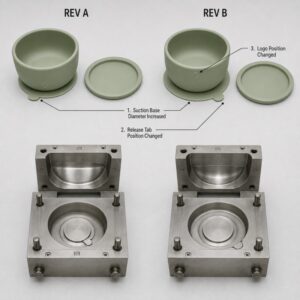
Example: Changing a Custom Silicone Baby Suction Bowl
Consider a custom silicone baby suction bowl with:
- Round bowl body
- Matching silicone lid
- Integrated suction base
- Thin sealing lip
- Release tab
- Molded logo
- Custom color
Now imagine the first sample has already been made.
The buyer requests several changes.
Change 1 — Make the Logo Larger
This may be a localized tooling change if the logo area has suitable insert construction.
Change 2 — Increase the Bowl Opening
This affects the main cavity and may also affect:
- Rim geometry
- Wall thickness
- Lid fit
- Internal capacity
Change 3 — Make the Suction Base Wider
This can affect:
- Overall mold cavity
- Base chamber
- Sealing lip
- Release tab
- Product footprint
Change 4 — Make the Lid Fit Tighter
The team should not simply reduce one diameter without checking the full interface.
Silicone lid fit depends on:
- Bowl-rim geometry
- Lid groove
- Material flexibility
- Wall thickness
- Shrinkage
- Finished dimensions
The bowl and lid need to be evaluated together.
LYA’s current suction-bowl offering already combines the bowl, suction base and matching lid, so this is a realistic example of why one design change can affect several interacting structures.
Why Should Critical Dimensions Be Rechecked After a Mold Change?
Any mold modification that affects functional geometry can change finished dimensions.
This is especially important for:
- Lid fit
- Suction-base diameter
- Sealing-lip thickness
- Hole diameter
- Product height
- Assembly interface
Flexible silicone parts also need controlled measurement conditions.
Your existing dimensional-control content already emphasizes that dimensional tolerances should focus on functional dimensions and be checked under repeatable measurement conditions.
After a tooling modification, the factory should therefore not check only the modified area.
Related functional dimensions may also need reinspection.
Why Does Every Design Change Need a Revision Number?
Revision control prevents one of the most dangerous OEM mistakes:
using the wrong version.
For example:
- Rev A — Original design
- Rev B — Larger suction base
- Rev C — New logo and lid adjustment
After Rev C is approved, production should not accidentally use:
- Rev A drawing
- Rev B inspection report
- Rev C sample
at the same time.
The current production package should point to one approved revision.
This includes:
- 3D drawing
- 2D drawing
- Mold revision
- Golden Sample
- Logo artwork
- Color reference
- Critical dimensions
- Functional test
- Packaging specification
- QC documents
Your existing sample-consistency article similarly notes that every approved document and sample should refer to the same final revision.
What Should an Engineering Change Record Include?
A practical engineering-change record does not need to be complicated.
It should clearly answer:
What Changed?
For example:
“Rev B increases suction-base outer diameter and changes release-tab position.”
Why Was It Changed?
Possible reasons:
- Better function
- Customer preference
- Assembly correction
- Branding update
- Manufacturing improvement
Which Documents Changed?
Record:
- 3D model
- 2D drawing
- Mold drawing
- Inspection drawing
- Packaging drawing
Which Mold Areas Changed?
Identify:
- Cavity
- Insert
- Core
- Gate
- Vent
- Surface
- Texture
where relevant.
What Must Be Revalidated?
Define:
- Dimensions
- Appearance
- Функция
- Fit
- Упаковка
Who Approved the New Version?
The buyer and manufacturer should both know which version is released for production.
Should the Old Mold Version Be Kept?
Sometimes yes, sometimes no.
It depends on how the tool is modified.
A replaceable insert may allow an older configuration to remain physically recoverable.
A permanent cavity modification may not.
Before changing a production tool, buyers should ask:
- Is the modification reversible?
- Will the old insert be retained?
- Can Rev A still be produced?
- Is the old version obsolete?
- Should remaining Rev A inventory be separated?
This matters when a brand sells several markets or product generations.
Do not assume a mold can always return to the previous version.
How Should Revised Tooling Be Validated?
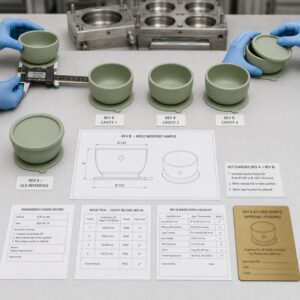
After a meaningful mold modification, the next step should be a controlled sample review.
Do not move directly into mass production simply because the modified mold closes correctly.
Step 1 — Produce New Samples
Samples should be identified with the new revision.
Step 2 — Inspect the Changed Feature
Confirm the requested modification.
Step 3 — Inspect Related Dimensions
Check adjacent or interacting features.
Step 4 — Perform Functional Testing
For the suction-bowl example, this may include:
- Suction performance
- Lid fit
- Release-tab function
- Stability
Step 5 — Check Appearance
Inspect:
- Flash
- Parting lines
- Surface
- Логотип
- Texture
Step 6 — Compare Mold Cavities
If the mold contains multiple cavities, do not approve only the best one.
Step 7 — Create the New Golden Sample
Once approved, the new revision becomes the production reference.
Why Should Packaging Be Rechecked After a Product Revision?
Product modifications may change:
- Overall size
- Height
- Flexibility
- Folding method
- Accessory fit
- Box fit
A wider suction base may no longer fit the existing insert tray.
A deeper bowl may increase box height.
A new lid tab may contact the carton.
Therefore, packaging approval should follow the current product revision.
The packaging should never remain silently based on an outdated product geometry.
Why Is Revision Control Important for Repeat Orders?
Design-change problems often appear months later.
The first modified production order may be correct.
Then a repeat order arrives.
The factory must confirm:
- Current drawing revision
- Current mold revision
- Current Golden Sample
- Current packaging
- Current inspection standard
This is where batch traceability and revision control support each other.
Traceability tells the team which production batch was made.
Revision control tells the team which product version that batch was supposed to follow.
Your current batch-traceability article likewise links production records, mold information, QC records, packaging and shipment information into one traceable production chain.
Common Engineering Change Mistakes
Making the Change Only in the 3D Drawing
The mold and QC documents may remain outdated.
Modifying the Mold Before Buyer Approval
The customer may reject a change that cannot easily be reversed.
Changing One Part Without Checking the Mating Part
Typical example:
Changing a bowl rim without rechecking the lid.
Keeping Two Different Golden Samples
Operators may not know which one is current.
Forgetting Packaging
The modified product may no longer fit correctly.
Starting Mass Production Immediately After Mold Repair
New samples should first confirm the revised product.
Calling Every Change “Minor”
The physical size of the change does not determine tooling risk.
Silicone Engineering Change Checklist
| Артикул | What Should Be Confirmed |
|---|---|
| Change request | Exact requested modification documented |
| Current revision | Existing approved version identified |
| 3D model | Updated |
| 2D drawing | Updated where applicable |
| Mold impact | Cavity, insert, core, gate, vent and parting areas reviewed |
| Reversibility | Confirm whether old version can still be produced |
| Critical dimensions | Related dimensions rechecked |
| Mating parts | Lid, accessory or assembly revalidated |
| Функция | Revised product function tested |
| Appearance | Logo, texture, flash and surface checked |
| Mold cavities | All active cavities validated |
| Golden Sample | New approved revision retained |
| QC documents | Updated to new revision |
| Упаковка | Fit and artwork reviewed |
| Repeat orders | Current revision clearly released for production |
How LYA Silicone Supports Engineering Changes
LYA Silicone supports OEM and ODM development for silicone baby, pet, outdoor, educational and other consumer silicone products.
Project support may include:
- DFM review
- 3D drawing review
- Mold development
- Mold-modification assessment
- Insert modification
- Sample production
- Dimensional inspection
- Functional testing
- Multi-cavity validation
- Golden Sample confirmation
- Revision control
- Packaging review
- Repeat mass production
The correct approach depends on the actual mold and requested modification.
A supplier should therefore review the existing tool before confirming whether a design change requires a small modification, replacement insert, major rework or new mold.
Frequently Asked Questions
Can a silicone mold always be modified?
Нет.
Many molds can be modified, but feasibility depends on the original tool construction, geometry, modification direction and available machining space.
Is changing a logo usually easy?
It can be relatively localized, especially when the tool uses a replaceable logo insert, but this should be confirmed from the actual mold.
Can I increase the product size after tooling?
Sometimes, but increasing finished-product dimensions may require significant cavity modification. The exact solution depends on the mold.
What happens if I change silicone hardness only?
A hardness change may not require physical mold modification, but it can affect flexibility, demolding, suction, fit and user feel. The new material condition should still be validated.
Do I need a new Golden Sample after every change?
A meaningful approved product revision should have a reference that represents that version. For very small administrative changes that do not affect the physical product, a new physical sample may not be necessary.
Can I change the mold after mass production?
Yes, when technically feasible, but existing inventory, old-version components, packaging and production records need to be controlled so that revisions are not mixed.
Should the new revision be tested in every mold cavity?
When the modification can influence cavity-produced features, every active cavity should be evaluated during qualification.
Does a mold modification always cost less than a new mold?
Нет.
If the modification is extensive or creates high repair risk, a new insert or new mold may be more practical.
Control the Revision Before You Change the Mold
Changing a silicone product after tooling is not automatically a problem.
Uncontrolled change is the problem.
Before modifying a production mold, buyers and manufacturers should confirm:
- What is changing
- Which mold areas are affected
- Whether the change is reversible
- Which dimensions and functions need retesting
- Which revision becomes the new production standard
Then update the drawing, mold, sample, QC standard and packaging together.
To review a design change for an existing silicone project, send LYA Silicone your current drawing, requested revision, existing sample, affected dimensions and expected production quantity.