 Russian
  English
  French
  German
  Spanish
  Polish
  Chinese
  Japanese
  Korean
 Содержание
Answer Excerpt
Silicone mold maintenance is essential for keeping индивидуальные силиконовые изделия consistent across repeat production orders. Between production runs, the mold should be cleaned, inspected, protected and documented, with special attention to vents, gates, parting lines, cavity surfaces and moving inserts. Before restarting production, buyers should expect trial samples to be compared with the approved standard so that wear, contamination or previous repairs do not create new quality differences.
A custom silicone mold may produce an excellent first production batch.
That does not mean the mold can simply be stored for several months and placed back into production without inspection.
During repeated production, the tool is exposed to:
- Heating cycles
- Mold opening and closing
- Silicone contact
- Demolding forces
- Очистка
- Trimming residue
- Surface contamination
- Operator handling
- Storage conditions
Over time, small changes can affect the finished product.
Possible symptoms include:
- More flash
- Incomplete filling
- Different surface gloss
- Poor texture definition
- Air marks
- Gate changes
- Dimensional variation
- Cavity-to-cavity differences
For repeat OEM orders, mold maintenance should therefore be treated as part of quality control.
Why Does Mold Condition Affect Repeat-Order Quality?
The finished silicone surface is largely reproduced from the mold cavity.
The mold also controls:
- Product geometry
- Parting line
- Gate position
- Venting
- Logo definition
- Surface texture
- Critical edges
- Fine molded features
If these areas change, the product can change even when the silicone material and production drawing remain the same.
This is why custom silicone mold development should not end when the first sample is approved.
The manufacturer also needs a plan for:
- Tool storage
- Очистка
- Maintenance
- Repair
- Restart inspection
- Maintenance records
A repeat order should reproduce the approved product—not create a new version of it.
Which Mold Areas Need the Most Attention?
Not every mold area has the same quality risk.
For silicone products, several areas deserve particular attention.
Vents
Vents allow displaced air to leave the cavity during filling.
If a vent becomes contaminated or partially blocked, possible results include:
- Trapped air
- Incomplete fine details
- Small burn marks
- Surface defects
- Unstable filling
Because vent features are usually very small, maintenance needs to preserve their original function without damaging the cavity.
Parting Lines
The parting line is where mold sections meet.
Residue, damage or wear in this area may increase:
- Flash
- Edge irregularity
- Visible parting-line marks
For premium consumer silicone products, even a small change may become visible on front-facing areas.
Gates
Gate condition can influence how the cavity fills.
The engineering team should check whether the gate has:
- Damage
- Contamination
- Wear
- Previous repair
- Geometry change
A gate should not be modified casually just to solve one temporary production problem.
Cavity Surface
The cavity surface determines much of the final appearance.
A matte cavity, polished cavity or textured cavity should remain consistent with the approved sample.
Why Is Vent Cleaning Important?
A silicone mold may contain extremely small venting features.
During repeated production, residue can gradually reduce their effectiveness.
This is particularly important around:
- Last-fill areas
- Thin tips
- Fine textures
- Deep grooves
- Small openings
Suppose a silicone product produced correctly during the first order but later begins showing incomplete details in the same location.
The team should not immediately change:
- Injection pressure
- Материал
- Hardness
- Gate design
First, it should check whether the mold condition has changed.
A blocked or contaminated vent may produce a problem that looks like a material or process issue.
Good troubleshooting separates mold-condition changes from true design problems.
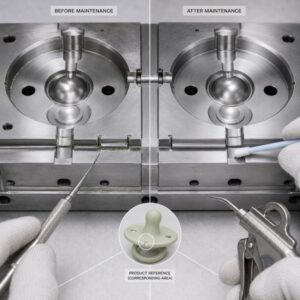
Why Should Parting Lines Be Cleaned Carefully?
Silicone can reproduce very fine gaps.
This means contamination around the mold parting surface may contribute to visible excess material.
Typical problems include:
- Thin flash
- Uneven edge lines
- Local product thickness changes
- Rough trimming areas
Maintenance should therefore remove residue without damaging the precision mating surfaces.
The solution should not be aggressive grinding or polishing every time flash appears.
That can permanently change the mold.
Instead, the team should determine whether the cause is:
- Contamination
- Mold damage
- Wear
- Clamping
- Vent condition
- Process settings
The corrective action should match the actual cause.
Why Should Surface Finish Be Protected During Maintenance?
Surface finish is part of the product specification.
A polished cavity can produce a smoother appearance.
A matte or textured cavity produces a different surface.
If one cavity is polished during repair while the others remain unchanged, products may begin to look different.
Possible differences include:
- Gloss
- Color appearance
- Texture depth
- Logo visibility
- Reflection
This is particularly important for products sold as:
- Multi-piece sets
- Color-coordinated collections
- Premium baby products
- Private-label retail products
Maintenance technicians should know which mold surfaces are cosmetic areas before performing repair work.
A surface should not be re-polished simply because it is easier to clean that way.
Example: Repeat Production of a Custom Silicone Baby Pacifier
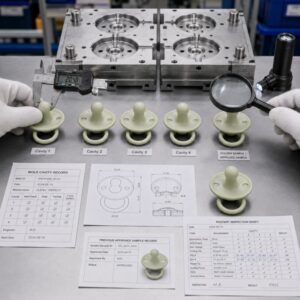
Consider a four-cavity mold producing the same custom silicone baby pacifier.
The product includes:
- Soft nipple
- Shield
- Ventilation holes
- Rounded outer edges
- Molded logo
- Fine transition areas
After the first production order, the mold is stored.
Several months later, the buyer places another order.
Before mass production restarts, the engineering team should inspect:
Nipple Cavities
Check whether fine surfaces, tips and transitions remain clean and undamaged.
Ventilation-Hole Features
Confirm that the small mold structures forming the openings are intact.
Gates
Check all cavities for consistent gate condition.
Vents
Make sure air-release areas are clean.
Parting Lines
Inspect for residue or wear that may increase flash.
Surface Finish
Compare polished or matte areas with the previous approved condition.
Cavity Identification
Keep each cavity traceable during restart sampling.
This helps determine whether a problem comes from the complete process or from one individual cavity.
Why Should Maintenance Be Recorded by Cavity?
A multi-cavity tool should not be treated as one anonymous block of metal.
Each cavity may have a different history.
For example:
- Cavity 1 may remain unchanged.
- Cavity 2 may have had a vent cleaned.
- Cavity 3 may have received a local surface repair.
- Cavity 4 may have had a gate insert replaced.
Without records, a later quality difference becomes harder to explain.
Maintenance history should therefore support multi-cavity mold consistency.
Useful records may include:
- Mold number
- Cavity number
- Date
- Problem found
- Area repaired
- Repair method
- Component replaced
- Sample result after repair
- Person or team responsible
This information improves defect tracing during future repeat orders.
How Should a Silicone Mold Be Stored Between Orders?
Storage should protect the tool rather than simply remove it from the molding machine.
The manufacturer’s storage procedure should consider:
- Cleanliness
- Moisture
- Corrosion protection
- Cavity protection
- Moving components
- Mold identification
- Storage location
- Tooling records
The exact preservation method depends on mold material and manufacturing conditions.
Any protective product used during storage should also be compatible with the production process and properly removed before the next run where required.
The important principle is that the mold should return to production in a controlled condition.
What Should Be Checked Before Restarting a Repeat Order?
Before restarting mass production, the factory should not rely only on the fact that the mold worked previously.
A restart review should confirm:
Correct Mold
Check mold identification and project number.
Correct Drawing Revision
Make sure the current production specification matches the mold revision.
Cavity Condition
Inspect for damage, residue, corrosion or unexpected marks.
Gates and Vents
Confirm that filling and air-release features remain functional.
Parting Line
Check mating surfaces and flash-sensitive areas.
Inserts and Moving Components
Confirm that inserts, cores or other controlled mold features function correctly.
Surface Finish
Inspect cosmetic areas before production.
Trial Samples
Produce restart samples before full production.
Sample Comparison
Compare restart samples with:
- Approved sample
- Drawing
- Color standard
- Appearance standard
- Critical dimensions
- Functional requirements
Only after these checks should the repeat order proceed to normal production.
Why Is the Approved Sample Important After Mold Maintenance?
A repair can make the mold mechanically functional but still change the product.
For example, a repaired cavity may produce:
- A glossier surface
- A slightly different logo
- More visible parting line
- Different texture
- Different gate mark
Therefore, mold maintenance should not be judged only by looking at the metal tool.
The real question is:
Does the repaired mold still reproduce the approved silicone product?
The final confirmation must come from molded samples.
When Does a Mold Need Repair Instead of Cleaning?
Cleaning and repair are different.
Cleaning may address:
- Residue
- Surface contamination
- Blocked vent areas
- Material deposits
Repair may be required when the tool has:
- Physical damage
- Worn parting surfaces
- Damaged cavity features
- Damaged inserts
- Gate damage
- Surface damage
- Mechanical component wear
Buyers should also understand whether a repair may affect:
- Appearance
- Dimensions
- Product function
- Mold life
A significant repair should normally be followed by new sample validation.
Should Buyers Ask About Mold Maintenance Before Paying for Tooling?
Yes.
Mold-management responsibilities are easier to clarify before the tooling order begins.
Buyers should ask:
- Who owns the mold?
- Where will it be stored?
- How long will it be stored?
- Who performs routine maintenance?
- What maintenance is included?
- Who pays for major repairs?
- How are repairs documented?
- What happens if an insert wears?
- Will samples be provided after major repair?
- Can the mold be transferred if required?
These questions become especially important for private molds intended for repeat orders over several years.
Silicone Mold Maintenance Checklist
| Maintenance Item | What Should Be Confirmed |
| Mold identification | Correct tool and current revision |
| Cavity cleaning | No silicone residue or contamination |
| Vents | Clean and functional |
| Gates | No damage or unexpected geometry change |
| Parting lines | Clean, undamaged and properly mating |
| Cavity surfaces | Approved polish or texture preserved |
| Inserts | Correct position and condition |
| Moving components | Function normally |
| Mold storage | Tool protected and traceable |
| Repair records | Changes documented by date and cavity |
| Restart samples | Compared with approved standard |
| Multi-cavity check | All active cavities evaluated |
| Production release | Full production only after validation |
How LYA Silicone Supports Repeat-Order Mold Control
LYA Silicone supports OEM and ODM development for baby, pet, outdoor and other custom silicone projects.
For tooling projects, repeat-order support may include:
- Drawing review
- Mold development
- Mold identification
- Tool storage
- Mold inspection
- Cleaning and routine maintenance
- Repair assessment
- Restart sampling
- Cavity-specific inspection
- Dimensional verification
- Appearance comparison
- Functional testing
- Repeat mass production
The goal is not only to make a mold that produces the first order.
The goal is to maintain a tooling system that can reproduce the approved product during future orders.
Frequently Asked Questions
Does a Silicone Mold Need Maintenance After Every Production Run?
The required maintenance depends on the mold, process, production quantity and condition. Routine inspection and cleaning should follow the manufacturer’s tooling procedure.
Can a Dirty Vent Cause Incomplete Filling?
Yes.
Restricted air release can contribute to trapped air and incomplete filling in sensitive areas.
Can Mold Cleaning Change the Surface Finish?
Improper cleaning or aggressive polishing can alter a precision surface. Cosmetic cavity areas should be handled according to the approved finish.
Should a Mold Be Re-Sampled After Repair?
Significant repairs that may affect dimensions, appearance, gate condition, texture or function should be validated with molded samples before full production.
Can Only One Cavity Need Maintenance?
Yes.
Multi-cavity molds can develop cavity-specific conditions, which is why cavity identification and maintenance records are useful.
Who Pays for Mold Maintenance?
That depends on the tooling agreement.
Routine maintenance, major repair, replacement inserts, damage responsibility and mold ownership should be clarified before the tooling order.
Can a Mold Be Used Again After Long-Term Storage?
Usually yes if the tool remains suitable, but it should be inspected and restart samples should be validated before mass production.
Protect the Mold to Protect Repeat-Order Quality
A custom silicone mold is not only a one-time tooling expense.
For repeat OEM projects, it is a production asset that needs controlled maintenance.
Between orders, manufacturers should pay particular attention to:
- Vents
- Gates
- Parting lines
- Cavity surfaces
- Inserts
- Хранение
- Repair records
- Restart samples
Buyers should also confirm that any significant mold repair is followed by product validation.
To discuss tooling and repeat production for your silicone project, send LYA Silicone your 3D drawing, product requirements, expected order quantity and repeat-order plan.