 Polish
  English
  French
  German
  Spanish
  Chinese
  Japanese
  Korean
  Russian
 Zawartość
Wprowadzenie
A silicone baby pacifier may appear to be a small and simple product.
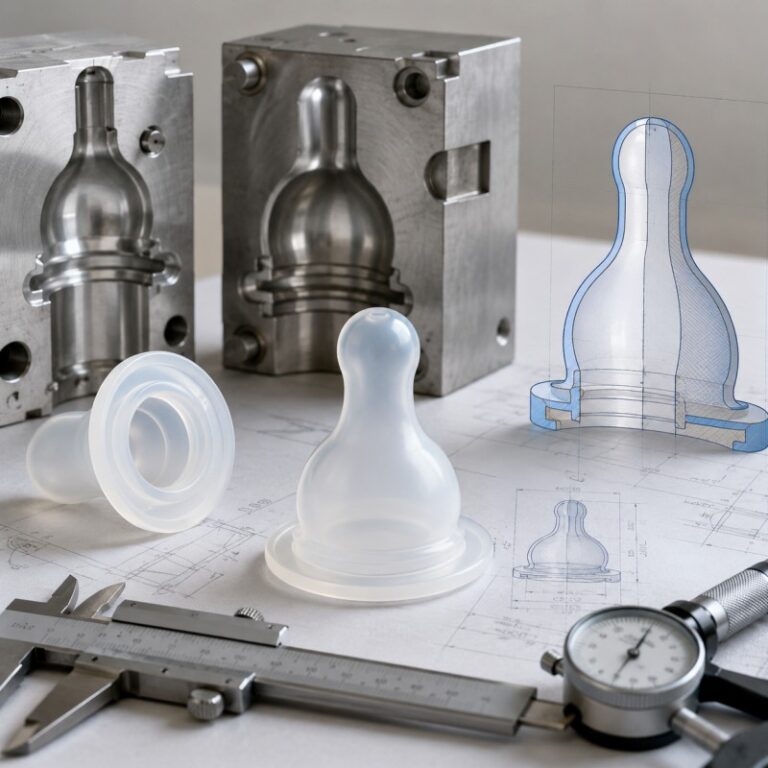
In practice, the nipple, nipple root, shield, ventilation holes, handle, surface finish, material, mold, packaging, and intended age range must work together as one complete product system.
Many pacifiers look acceptable when placed on a table but develop problems during compression, pulling, cleaning, storage, or repeated use.
Common problems include:
- The nipple collapses and recovers slowly
- The nipple remains flattened after compression
- One side becomes thinner or softer than the other
- The nipple root turns white during stretching
- Small cracks appear near the nipple base
- The nipple tears away from the shield
- The nipple feels too soft to remain stable
- The nipple feels too firm or rigid
- The shield bends excessively
- Ventilation holes contain flash or thin silicone film
- The handle or ring stretches the shield
- The pacifier becomes deformed inside the package
- Samples pass inspection but production batches feel different
These problems are not caused by silicone hardness alone.
The final performance depends on the relationship between:
- Silicone material
- Shore A hardness
- Nipple shape
- Nipple length
- Nipple wall thickness
- Internal cavity
- Nipple-root radius
- Shield thickness
- Shield size and curvature
- Ventilation-hole layout
- Handle structure
- Parting-line location
- Mold filling
- Curing
- Demolding
- Inspection
- Opakowanie
- Target-market requirements
For baby brands, importers, distributors, wholesalers, and private-label sellers, the correct question is not only:
“Is the pacifier nipple soft?”
The more useful question is:
“Can the nipple remain comfortable, structurally stable, easy to clean, and consistent after compression, pulling, repeated use, cleaning, packaging, and mass production?”
This guide explains what buyers should review before custom silicone baby pacifier tooling, sample approval, and bulk production.
Answer Excerpt
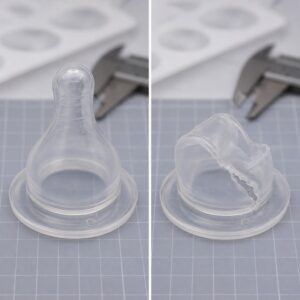
Silicone baby pacifier nipples can collapse, tear, or change shape when the material is too soft for the geometry, the nipple wall is too thin or uneven, the internal cavity is unstable, or the transition between the nipple and shield concentrates stress.
A nipple may also deform because of incomplete curing, aggressive demolding, packaging compression, excessive heat exposure, unsuitable cleaning conditions, or production variation.
Increasing silicone hardness does not automatically solve the problem. A firmer nipple may recover faster but can feel less flexible or concentrate more stress at the nipple root.
Reliable performance requires the nipple shape, wall thickness, internal cavity, root transition, shield, ventilation holes, handle, silicone material, mold, processing conditions, packaging, and test plan to be evaluated together.
1. A Pacifier Is an Integrated Product Structure
During custom silicone pacifier manufacturing, the nipple, shield, ventilation holes, handle, material and packaging should be reviewed as one complete product.
A pacifier should not be evaluated as only one silicone nipple.
Depending on the design, the product may include:
- Nipple
- Nipple root
- Guard or shield
- Ventilation holes
- Uchwyt
- Ring
- Gripping area
- Logo
- Surface texture
- Storage case
- Multi-material or one-piece structure
Each feature affects the other features.
For example:
- A soft shield may change the angle of the nipple.
- A tight handle may pull one side of the shield.
- An uneven nipple root may create asymmetric deformation.
- A poorly positioned parting line may create a weak tear path.
- Packaging pressure on the shield may distort the nipple.
A successful design must remain structurally integrated throughout manufacturing and use.
2. First Identify the Exact Nipple Failure
“Nipple deformation” can describe several different conditions.
Temporary Compression
The nipple flattens during pressure but returns to its original shape after the force is removed.
This may be normal when the recovery time and final shape meet the approved requirement.
Slow Recovery
The nipple recovers, but the process takes longer than expected.
Possible causes include:
- Material softness
- Thin wall
- Internal air behavior
- High temperature
- Packaging history
- Local deformation
Permanent Deformation
The nipple remains flattened, bent, twisted, or asymmetric after a defined recovery period.
Stress Whitening
The silicone becomes white, cloudy, or glossy around a highly stretched area.
Surface Cracking
Small visible cracks appear around the root, sidewall, tip, or parting line.
Complete Tearing
The nipple or part of the nipple separates from the shield or main body.
The corrective action depends on which failure actually occurs.
A temporary compression issue should not be investigated in the same way as root tearing or material curing failure.
3. Nipple Shape Affects Compression and Recovery
Common pacifier nipple shapes may include:
- Round nipple
- Cherry-shaped nipple
- Orthodontic nipple
- Flat nipple
- Symmetrical nipple
- Asymmetrical nipple
- Brand-specific structure
Each shape changes how the silicone deforms.
A round nipple may distribute compression differently from a flat or orthodontic structure.
An asymmetrical nipple may also require stricter control of:
- Loading direction
- Mold orientation
- Wall thickness
- Shield orientation
- Product assembly
- Packaging direction
Buyers should define whether the nipple is intended to work in one orientation or multiple orientations.
A shape selected only for visual differentiation may create unexpected molding, demolding, cleaning, or recovery problems.
Buyers can also compare different silicone pacifier structures before selecting an existing product or developing an exclusive mold.
4. A Nipple Can Be Too Soft for Its Geometry
A soft silicone material may provide a flexible touch, but softness must match the nipple dimensions.
When the complete structure is too soft, the nipple may:
- Collapse under light pressure
- Fold sideways
- Recover slowly
- Become difficult to inspect consistently
- Deform during packaging
- Stretch excessively during pull testing
- Feel unstable in the shield
Softness depends on more than Shore A hardness, so buyers should review how to choose silicone hardness according to nipple shape, wall thickness and intended function.
The actual behavior is also influenced by:
- Wall thickness
- Nipple length
- Internal cavity
- Cross-sectional shape
- Root thickness
- Material formulation
- Temperatura
- Product age
Two products using the same nominal hardness can provide different user experiences when their geometry is different.
5. A Nipple Can Also Be Too Firm
Selecting a firmer material may improve dimensional recovery, but excessive firmness can create other risks.
Possible problems include:
- Reduced flexibility
- Greater local pressure
- Increased stress around the nipple root
- More difficult demolding
- Higher pulling force
- Less forgiving deformation
- Greater sensitivity to sharp internal transitions
A firmer material cannot compensate for:
- Uneven wall thickness
- A sharp nipple root
- An incorrect internal cavity
- A poor parting-line position
- Insufficient curing
- Packaging deformation
The final hardness should be confirmed through actual molded samples rather than material plaques alone.
6. Nipple Wall Thickness Must Be Controlled
Wall thickness strongly affects how the nipple compresses and returns to shape.
If the wall is too thin, the nipple may:
- Collapse too easily
- Fold at one point
- Develop uneven deformation
- Tear during demolding
- Become sensitive to flash
- Lose dimensional stability
- Feel inconsistent between production cavities
If the wall is too thick, the nipple may:
- Feel overly firm
- Recover differently from the intended design
- Require longer curing
- Increase product weight
- Create uneven cooling
- Become difficult to deform naturally
The complete wall should not automatically use one uniform thickness.
Different areas may require controlled thickness according to:
- Nipple tip
- Main nipple body
- Neck
- Root
- Connection to the shield
Any transition between thickness zones should remain gradual.
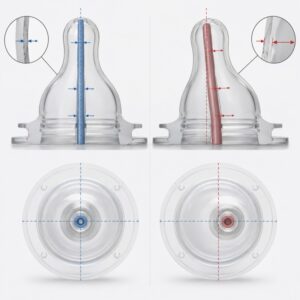
7. Uneven Wall Thickness Causes Asymmetric Collapse
A nipple may look symmetrical externally but have different wall thicknesses internally.
Possible causes include:
- Core-pin offset
- Insert movement
- Mold-cavity variation
- Tool wear
- Uneven material flow
- Core deflection
- Dimensional shrinkage
- Demolding deformation
When one side is thinner, the nipple may:
- Collapse toward that side
- Bend during compression
- Recover unevenly
- Feel softer on one side
- Show earlier whitening or cracking
- Produce inconsistent inspection results
The inspection plan should evaluate more than overall dimensions.
Depending on the structure, it may require:
- Section measurement
- Product weight
- Optical measurement
- Cut-section analysis
- Compression comparison
- Cavity identification
8. The Internal Cavity Controls Deformation
Many pacifier nipples contain an internal cavity.
The cavity influences:
- Compression force
- Recovery speed
- Wall stability
- Nipple weight
- Demolding
- Cleaning inspection
- Dimensional consistency
High-risk internal structures include:
- Sharp internal corners
- Sudden cavity changes
- Very narrow neck areas
- Off-center internal cores
- Deep blind cavities
- Areas that trap air during molding
- Areas that remain attached to the mold core
The internal cavity should provide predictable compression instead of creating one uncontrolled folding point.
The engineering team should evaluate both the external nipple shape and the hidden internal geometry.
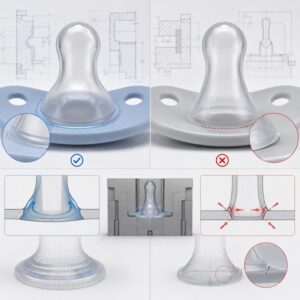
9. The Nipple Root Is a Critical Stress Area
The nipple root connects the flexible nipple to the wider shield or body.
This area experiences stress during:
- Compression
- Pulling
- Bending
- Demolding
- Handling
- Czyszczenie
- Structural-integrity testing
High-risk nipple-root conditions include:
- Sharp internal corners
- Sudden thickness changes
- Narrow connection areas
- Parting lines
- Flash
- Surface damage
- Uneven curing
- Deep logo or texture features
- Thin sections beside the shield
Possible failure signs include:
- White stress rings
- Small circumferential cracks
- Local thinning
- Root elongation
- Partial tearing
- Separation from the shield
A smoother root radius can distribute strain more evenly than a sharp 90-degree transition.
The nipple root, internal core, wall-thickness transition and demolding direction should be reviewed during custom silicone mold development before mold machining begins.
10. Longer Nipples Require More Structural Control
Increasing nipple length may change:
- Bending leverage
- Compression
- Recovery
- Mold filling
- Demolding strain
- Packaging space
- Protrusion from the shield
A longer nipple may bend more easily and transfer greater force into the nipple root.
A shorter nipple may feel more structurally stable but must still meet the product’s intended function and applicable design requirements.
The nipple should not be lengthened only to create a different appearance.
Nipple length, shield structure, target age range, root geometry, and product requirements should be reviewed together before tooling.
11. Shield Stiffness Affects Nipple Position
The shield provides more than decoration.
It affects:
- Product orientation
- Nipple position
- Handle support
- Product stability
- Ventilation
- Structural integrity
- Opakowanie
If the shield is too soft, it may:
- Fold around the nipple
- Change the nipple angle
- Distort under handle force
- Become unstable during testing
- Deform inside the package
If the shield is too rigid, it may:
- Feel bulky
- Become less comfortable
- Increase product weight
- Concentrate stress around holes or connections
- Require more difficult molding and demolding
Shield material, thickness, curvature, ribs, ventilation holes, and handle connection should be evaluated as one structure.
12. Shield Size and Shape Are Safety-Critical
A pacifier shield is intended to help prevent the product from entering too far into an infant’s mouth.
For the U.S. market, CPSC guidance identifies the guard or shield, ventilation, protrusion limits, structural integrity, attachment restrictions, and labeling among the principal pacifier requirements under 16 CFR Part 1511.
This means shield development should not be based only on:
- Fashion
- Minimalist appearance
- Small packaging
- Reduced material cost
- Competitor photographs
Brands should define:
- Target market
- Target age range
- Shield dimensions
- Shield curvature
- Ventilation layout
- Handle structure
- Test requirements
- Lab and certification plan
The final design should be reviewed and tested as a complete pacifier.
13. Ventilation Holes Must Remain Fully Open
Ventilation holes may appear simple, but small mold details can create:
- Partial blockage
- Thin silicone membranes
- Flash
- Irregular hole shape
- Sharp edges
- Core-pin marks
- Cavity-to-cavity differences
The inspection method may include:
- Optical inspection
- Pin gauges
- Vision systems
- Airflow confirmation
- Defined visual standards
Manual hole trimming should not become the primary method for correcting an unstable mold.
Ventilation-hole size, shape and arrangement should be confirmed according to the complete product design and target-market requirements.
14. Handle and Ring Design Can Distort the Shield
The handle or ring may be used during:
- Picking up the product
- Removing it
- Czyszczenie
- Carrying
- Opakowanie
- Pull testing
If the handle connection is too thin, it may:
- Stretch
- Tear
- Turn white
- Pull through the shield
- Create permanent deformation
If it is too thick or rigid, it may:
- Pull the shield out of shape
- Increase product weight
- Affect packaging
- Create difficult demolding
- Concentrate stress at the connection
The handle should not transfer uncontrolled force directly into the nipple root.
Its connection should be reviewed separately for wall thickness, radius, parting line and repeated pulling.
15. One-Piece and Multi-Part Pacifiers Have Different Risks
A one-piece silicone pacifier may reduce some separate-component and assembly risks.
However, one-piece molding can create more complex requirements for:
- Wall-thickness balance
- Internal cavity
- Shield stiffness
- Handle flexibility
- Material flow
- Venting
- Curing
- Demolding
A multi-part structure may provide different material or stiffness options, but it introduces additional considerations such as:
- Component connection
- Assembly
- Retention
- Tolerance
- Inspection
- Cleaning gaps
- Traceability
Neither structure is automatically better for every project.
The selection should depend on product design, intended use, manufacturing process, testing requirements, packaging, and target market.
16. Parting Lines and Flash Can Create Weak Points
The mold parting line may cross:
- Nipple sidewall
- Nipple root
- Shield edge
- Ventilation holes
- Uchwyt
- Ring
- Logo area
Excessive or poorly located flash may cause:
- Rough mouth-contact surfaces
- Tear initiation
- Cleaning difficulty
- Visual rejection
- Unstable hole dimensions
- Weak edges
- Manual trimming damage
Critical areas should have clearly defined standards for:
- Parting-line position
- Flash height
- Surface smoothness
- Edge condition
- Trimming
- Inspection method
The nipple root, shield edge and ventilation holes normally require closer attention than hidden non-functional surfaces.
17. Mold Filling Must Reach Every Thin Section
Pacifiers may contain a combination of:
- Thin nipple walls
- Thick shields
- Small ventilation holes
- Narrow handle connections
- Internal cavities
- Fine logos or textures
This creates an uneven material-flow path.
Possible molding defects include:
- Incomplete nipple formation
- Short shots
- Air traps
- Uneven wall thickness
- Flow marks
- Bubbles
- Weak root areas
- Missing logo details
The mold design should review:
- Gate location
- Flow direction
- Venting
- Mold temperature
- Material temperature
- Wall-thickness transitions
- Final filling area
- Cavity balance
Increasing injection pressure should not be used as the only corrective action because excessive pressure can also increase flash or dimensional variation.
18. Curing Conditions Affect Strength and Recovery
The nipple must have sufficient cured strength before demolding and testing.
Insufficient curing may cause:
- Excessive softness
- Permanent stretching
- Tacky areas
- Root tearing
- Slow recovery
- Unstable dimensions
- Surface transfer
Unstable curing can result from:
- Incorrect molding temperature
- Short curing time
- Uneven mold temperature
- Incorrect material ratio
- Mixing variation
- Thick and thin section differences
- Production-cycle instability
- Material contamination
Longer curing is not automatically the solution.
The final curing window should also consider cycle time, color, product dimensions, shield behavior, and material requirements.
19. Demolding Can Stretch the Nipple
The nipple and internal cavity may remain attached to a mold core during removal.
When the product is pulled away, the nipple may:
- Stretch
- Turn inside out
- Twist
- Develop white stress marks
- Tear at the root
- Recover slowly
- Become longer than the approved sample
Demolding risk depends on:
- Internal draft
- Nipple shape
- Core surface
- Curing condition
- Product temperature
- Material hardness
- Removal direction
- Operator or robot method
Samples should be inspected after normal demolding without manually reshaping the nipple before customer approval.
20. Surface Finish Affects Mouth Feel and Inspection
Brands can also review silicone matte, glossy and textured surface finishes before confirming the final pacifier mold surface.
Pacifier surfaces may use:
- High gloss
- Fine matte
- Mixed matte and glossy zones
- Molded texture
- Embossed logo
- Debossed logo
Surface finish affects:
- Mouth feel
- Dust visibility
- Czyszczenie
- Mold release
- Product photography
- Inspection
- Perceived softness
Deep texture should normally be avoided in areas where it:
- Traps residue
- Weakens a thin wall
- Crosses the nipple root
- Makes defects difficult to inspect
- Increases demolding friction
Surface appearance should support cleaning and function rather than being selected only for marketing photographs.
21. Cleaning and Temperature Claims Require Validation
Pacifiers may be exposed to repeated:
- Washing
- Boiling
- Steam
- Sterilizing devices
- Dishwashing
- Drying
- Hot storage
- Cold storage
These conditions can affect:
- Nipple recovery
- Shield shape
- Surface appearance
- Kolor
- Product dimensions
- Handle deformation
- Packaging fit
Brands should not automatically publish claims such as:
- Boil safe
- Steam sterilizer safe
- Można myć w zmywarce
- Microwave sterilizer safe
- Suitable for all cleaning methods
The correct claim depends on the final silicone grade, complete product structure, actual test method, test duration, repetition, packaging instructions, and target market.
22. Repeated Compression and Pulling Can Reveal Weak Areas
A nipple may pass one manual inspection but fail after repeated use simulation.
A practical durability review may include:
- Compression
- Bending
- Pulling
- Twisting
- Nipple recovery
- Root inspection
- Shield deformation
- Handle pulling
- Ventilation-hole inspection
- Surface inspection
The test should record:
- Applied method
- Number of repetitions
- Recovery time
- Deformation
- Whitening
- Cracking
- Dimensional change
- Pass/fail criteria
The required validation should match the final product and target-market requirements.
23. Packaging Can Permanently Deform the Pacifier
A correctly molded pacifier may become distorted during packaging or storage.
Common causes include:
- Nipple pressed against the box
- Handle folded over the shield
- Storage case too small
- Tight blister packaging
- Product stacked under pressure
- Mixed accessories pressing against the nipple
- Long-term storage under heat
- Incorrect product orientation
Possible results include:
- Flattened nipple
- Bent nipple
- Oval shield
- Distorted handle
- Permanent surface marks
- Slow recovery after unpacking
Packaging testing should use actual molded products and final packaging materials.
The product should be inspected:
- Before packaging
- Immediately after packaging
- After a defined storage period
- After transport simulation
- After unpacking and recovery
24. Product Sets Can Create Additional Packaging Pressure
Pacifiers may be sold with:
- Pacifier storage case
- Teether
- Clip
- Feeding accessory
- Gift box
- Multiple pacifiers
- Instruction card
Every additional item can change:
- Product position
- Packaging pressure
- Cleanliness
- Shield deformation
- Nipple protection
- Retail presentation
The pacifier should not be forced into a storage case that compresses the nipple or bends the shield.
Product-set packaging should be evaluated as part of the final sample approval.
25. Sample Testing Should Reproduce Real Product Conditions
A pacifier should not be approved only because it looks correct immediately after molding.
A practical sample evaluation may include:
- Dimensional inspection
- Nipple compression
- Nipple recovery
- Nipple pull review
- Root inspection
- Shield deformation
- Ventilation-hole inspection
- Handle or ring pulling
- Surface and flash inspection
- Cleaning simulation
- Temperature conditioning
- Packaging recovery
- Product-set fit
- Target-market testing preparation
The buyer and manufacturer should clearly define:
- Sample condition
- Test method
- Recovery time
- Inspection lighting
- Critical dimensions
- Appearance standard
- Deformation limits
- Laboratory requirements
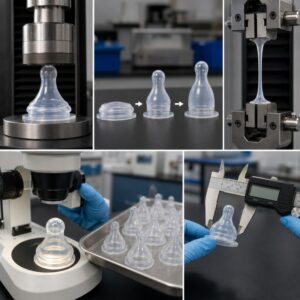
26. Why Can Samples Pass While Mass Production Fails?
Engineering samples are generally produced under close supervision.
During sampling:
- Material is prepared carefully
- Mold parameters are adjusted slowly
- Every nipple is inspected
- Products may be manually reshaped
- Packaging quantity is limited
- Only one material batch may be used
Mass production introduces:
- Multiple mold cavities
- Longer production runs
- Material-batch variation
- Color-batch variation
- Mold-temperature changes
- Core wear
- Vent contamination
- Operator variation
- Faster demolding
- Packaging pressure
- Storage time
A nipple structure with little manufacturing margin may produce several acceptable samples but become inconsistent during continuous production.
Pilot production should compare:
- Nipple dimensions
- Wall-thickness consistency
- Nipple recovery
- Root condition
- Shield dimensions
- Ventilation holes
- Handle structure
- Product weight
- Material hardness
- Every mold cavity
- Beginning and end of the production run

27. A Practical Pacifier Failure-Analysis Sequence
When a silicone pacifier nipple collapses, tears or changes shape, investigate the issue systematically.
Recommended sequence:
- Identify the exact failure mode.
- Record whether the defect is temporary or permanent.
- Define the recovery time before inspection.
- Mark the defect location.
- Identify the mold-cavity number.
- Compare passing and failing samples.
- Measure nipple length and external dimensions.
- Review nipple wall thickness.
- Inspect the internal cavity and core position.
- Check the nipple-root radius and transition.
- Confirm silicone material and hardness.
- Review curing time and mold temperature.
- Observe the complete demolding process.
- Inspect parting lines and flash.
- Check shield and handle deformation.
- Review cleaning or temperature exposure.
- Inspect packaging pressure and product orientation.
- Compare different material and production batches.
- Change one controlled variable.
- Repeat testing and document the result.
Do not change material hardness, nipple thickness, mold core, curing conditions, and packaging simultaneously.
Changing one variable at a time makes the actual root cause easier to confirm.
28. What Should Be Validated Before Mass Production?
Before approving a custom silicone baby pacifier, buyers and manufacturers should confirm:
- Intended age range
- Target market
- Pacifier structure
- One-piece or multi-part construction
- Silicone material
- Shore A hardness
- Nipple shape
- Nipple length
- Nipple wall thickness
- Internal cavity
- Nipple-root radius
- Shield size
- Shield thickness
- Shield curvature
- Ventilation-hole dimensions
- Ventilation-hole layout
- Handle or ring structure
- Parting-line location
- Flash standard
- Surface finish
- Logo position
- Mold-filling condition
- Curing process
- Demolding method
- Compression and recovery testing
- Pull and structural testing
- Cleaning and temperature conditions
- Packaging structure
- Product-set arrangement
- Target-market test plan
- Pilot-production results
- Cavity traceability
- Final reference sample
- Inspection records
Material documentation alone should not be treated as approval of the complete finished pacifier.
How LYA Silicone Supports Custom Baby Pacifier Projects
LYA Silicone supports OEM and ODM development for custom silicone baby pacifiers, pacifier cases, teethers, feeding products, bathing products, pet products, outdoor products, educational products, and related silicone product lines.
Our custom pacifier project support can include:
- Product-requirement review
- Drawing and sample evaluation
- Target-market clarification
- Nipple-shape review
- Nipple-wall and internal-cavity evaluation
- Material and hardness selection
- Nipple-root and shield review
- Ventilation-hole evaluation
- Handle or ring development
- Tworzenie form na zamówienie
- Dopasowanie kolorów Pantone
- Logo and surface-finish development
- Molded sample production
- Compression and recovery testing support
- Packaging coordination
- Pilot production
- Appearance and dimensional inspection
- OEM/ODM mass production
LYA Silicone’s current pacifier product and manufacturing pages already cover custom nipple shapes, shield structures, ventilation holes, colors, packaging, tooling and production support. This article extends that content into structural failure analysis and validation.
With 25+ years of silicone manufacturing experience, we help buyers evaluate the complete pacifier rather than treating the material, nipple, shield, handle, and packaging as separate issues.
The objective is to develop a pacifier that:
- Maintains controlled nipple flexibility
- Recovers after compression
- Avoids weak nipple-root transitions
- Maintains stable shield and ventilation structures
- Remains consistent across mold cavities
- Recovers after packaging and storage
- Supports the buyer’s target-market testing plan
What Information Should Buyers Provide?
To evaluate a custom silicone baby pacifier project, buyers should provide:
- Product reference photo
- 2D drawing
- 3D file, when available
- Physical sample, when available
- Intended age range
- Target sales market
- Nipple shape
- Nipple dimensions
- Shield dimensions
- Ventilation-hole design
- Handle or ring structure
- Silicone material requirement
- Hardness preference
- Product color
- Logo file
- Surface finish
- Cleaning requirements
- Packaging concept
- Pacifier-case requirement
- Product-set requirements
- Testing requirements
- Estimated quantity
- Expected launch schedule
When an existing pacifier has a quality problem, buyers should also provide:
- Compression and recovery videos
- Close-up photographs
- Exact failure location
- Product dimensions
- Material and hardness information
- Mold-cavity number
- Production batch
- Cleaning conditions
- Packaging method
- Storage time
- Affected quantity
Frequently Asked Questions
Why does a silicone pacifier nipple collapse?
The nipple may be too soft or thin for its geometry, the internal cavity may be unstable, or the wall thickness may be uneven. Temperature, packaging pressure and repeated use can also affect recovery.
Does harder silicone prevent nipple collapse?
Not automatically. A firmer material may improve recovery but can increase stiffness or concentrate stress at the nipple root. Hardness, wall thickness and geometry must be evaluated together.
Why does the nipple tear at the base?
Possible causes include a sharp root transition, thin wall, parting-line defect, flash, uneven curing, aggressive demolding, uneven wall thickness or excessive pulling.
Why does one side of the nipple collapse more easily?
The internal core may be offset, one wall may be thinner, the nipple may be asymmetrical, or one mold cavity may have dimensional or process variation.
Can nipple wall thickness be increased after the mold is completed?
Some mold modifications may be possible, but changing internal wall thickness usually affects the mold core, cavity, product feel and final dimensions. Feasibility depends on the completed tool.
Why does the nipple become deformed after packaging?
The nipple may be continuously pressed against a box, blister, case or another product. Long storage and elevated temperature can make recovery slower or leave permanent deformation.
Should the pacifier be tested after cleaning or sterilization?
The final sample should be evaluated under the cleaning and temperature conditions the brand intends to claim. The method and number of cycles should be defined before approval.
Is food-grade silicone documentation enough for a pacifier?
No. Material documentation is only one part of the evaluation. The finished pacifier’s structure, shield, ventilation, strength, labeling, testing, packaging and target-market requirements must also be reviewed.
Can one pacifier design be sold in every country?
Testing, labeling, documentation and product requirements can vary by market. Buyers should confirm the final compliance plan with their laboratory, importer and relevant market specialists before bulk production.
What should buyers approve before bulk production?
Buyers should approve the material, hardness, nipple shape, wall thickness, internal cavity, shield, ventilation holes, handle, surface, dimensions, recovery, structural testing, cleaning conditions, packaging and final reference sample.
Wnioski
A successful silicone baby pacifier nipple must do more than feel soft when touched by hand.
It must compress predictably, recover after pressure, remain stable at the nipple root, maintain consistent wall thickness, work with the shield and ventilation structure, survive manufacturing and packaging, and meet the project’s target-market validation requirements.
Nipple collapse, slow recovery, whitening, cracking and tearing are rarely caused by one material specification alone.
Material formulation, hardness, nipple shape, wall thickness, internal cavity, root transition, shield stiffness, mold filling, curing, demolding, testing and packaging all affect the final result.
The most reliable approach is to review the complete pacifier before tooling, produce actual molded samples, validate the nipple and shield under defined conditions, and confirm consistency through pilot production.
If you are developing a custom silicone baby pacifier or investigating nipple collapse, tearing or deformation, contact LYA Silicone and send us your drawing, sample, intended age range, target market, nipple structure, material, hardness, shield, ventilation holes, testing requirements, packaging and estimated quantity. Our team will review the project and provide an appropriate OEM or ODM manufacturing proposal.