 Japanese
  English
  French
  German
  Spanish
  Polish
  Chinese
  Korean
  Russian
 内容
Answer Excerpt
There is no single ideal wall thickness for every custom silicone product. The correct thickness depends on product size, silicone hardness, flexibility, tear resistance, molding process, demolding, functional load and user experience. Buyers should define critical thin and thick areas during DFM, avoid unnecessary abrupt transitions, and approve the final structure through molded samples and functional testing before mass production.
Wall thickness is one of the most important structural decisions in custom silicone product development.
A product can use the correct silicone material and still perform poorly when its wall structure is unsuitable.
Common problems include:
- Product feels too soft or unstable
- Thin edges tear easily
- Product becomes too heavy
- Folding areas do not recover correctly
- Suction structures deform
- Bristles collapse
- Holes tear during use
- Product takes longer to mold
- Material cost increases unnecessarily
- Thick and thin sections behave differently
The objective is not simply to make a silicone product “thicker” or “thinner.”
The goal is to create a wall structure that provides the required flexibility, strength, function and production stability.
Why Does Wall Thickness Matter in Silicone Product Design?
Silicone is flexible, so product geometry strongly influences how the finished product feels and performs.
Wall thickness can affect:
- 柔軟性
- Shape stability
- Compression
- Folding
- Recovery
- Tear resistance
- Product weight
- Material consumption
- Filling behavior
- Curing
- Demolding
- Dimensional consistency
Two products made from the same silicone hardness may feel very different if their wall thicknesses are different.
For example, a thick silicone bowl wall can feel firm even when made from relatively soft material.
A thin wall using the same material may bend easily.
This is why buyers should not select silicone hardness without also considering product geometry.
What Happens If Silicone Walls Are Too Thin?
Thin silicone structures can be useful when a product needs:
- 柔軟性
- Folding
- Soft contact
- Lightweight construction
- Controlled sealing
- Easy bending
However, excessively thin areas can create problems.
Reduced Structural Stability
A thin wall may collapse or bend when the product needs to remain upright.
Examples include:
- Silicone bowls
- Cups
- Bib pockets
- Pet feeding products
- Collapsible products
The product may look correct when sitting freely on a table but lose its shape when filled, handled or packaged.
Greater Tear Risk
Thin areas are more sensitive to:
- Small trimming cuts
- Sharp corners
- Parting lines
- Holes
- Repeated pulling
- Demolding stress
Once a small tear starts, repeated stretching may cause it to grow.
Difficult Molding
Long, thin flow paths can be more difficult to fill consistently.
This may contribute to:
- Short filling
- Flow marks
- Air traps
- Incomplete edges
- Incomplete textures
Wall thickness therefore needs to be considered together with gate location and mold venting.
What Happens If Silicone Walls Are Too Thick?
Making the entire product thicker does not automatically improve quality.
Higher Material Consumption
More silicone increases product weight and raw-material usage.
For high-volume orders, unnecessary thickness can create significant additional material consumption.
Reduced Flexibility
A product designed to fold, compress or bend may become too stiff if its wall is unnecessarily thick.
This can affect:
- Folding cups
- Baby bibs
- Flexible lids
- Pet mats
- Soft handles
Longer Curing Requirements
Thicker silicone sections may behave differently during molding and curing than thin sections.
Large thickness differences can make process control more difficult.
Different User Experience
A thick silicone product may feel:
- Heavy
- Bulky
- Too stiff
- Difficult to fold
- Less comfortable to hold
The product should therefore use material only where the structure needs it.
Should Silicone Wall Thickness Be Uniform?
Not always.
A well-designed product may intentionally use different wall thicknesses in different functional areas.
For example, a silicone suction bowl may need:
- A relatively stable bowl wall
- A flexible suction edge
- Reinforcement around the base
- A controlled transition between the bowl and suction structure
A silicone bib may need:
- Flexible neck straps
- Stronger button areas
- Stable pocket sidewalls
- Softer outer edges
The important point is not that every area must have exactly the same thickness.
The transitions between different areas should be designed carefully.
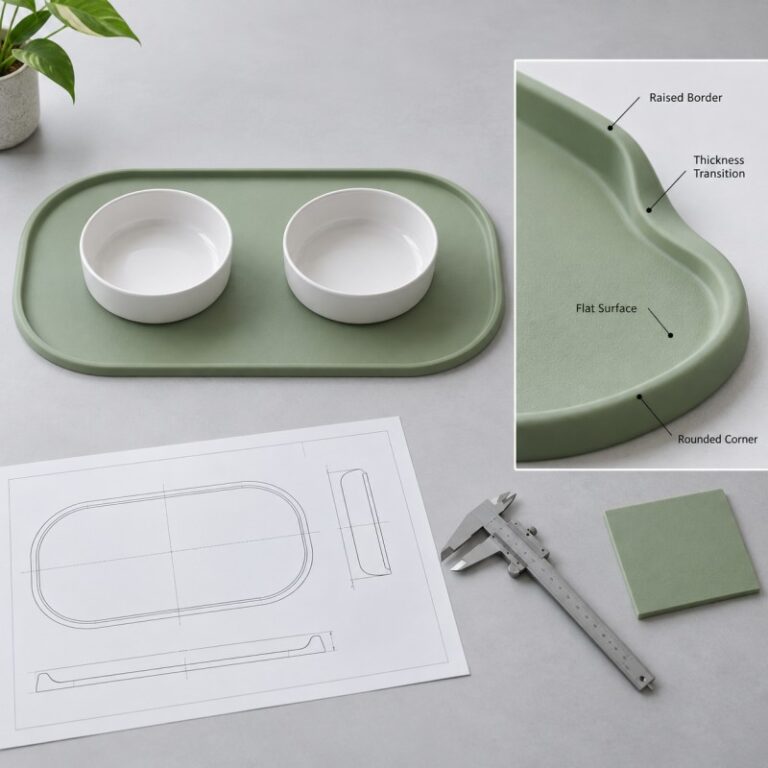
Sudden changes from very thick to very thin sections can concentrate stress and create molding or deformation problems.
Gradual transitions are generally easier to control.

Why Are Thickness Transitions Important?
Consider a structure where a thick product body connects directly to a very thin edge.
During bending, the thin section may take most of the deformation.
This can create:
- Local stress concentration
- Uneven bending
- Tear initiation
- Permanent deformation
- Dimensional variation
Rounded transitions and smooth wall changes can distribute stress more effectively.
This is particularly important around:
- Hole edges
- Handle roots
- Bristle roots
- Suction bases
- Folding areas
- Ribs
- Product corners
- Logo structures
These areas should be reviewed during DFM before the mold is manufactured.
How Does Wall Thickness Affect Different Silicone Products?
Silicone Suction Bowls and Plates
Wall thickness affects both stability and suction performance.
The bowl body needs enough structure to remain stable during feeding.
The suction base must remain flexible enough to create contact with the tabletop.
If the suction structure is too rigid, it may be difficult to press into position.
If it is too weak, the base may deform or lose contact.
The bowl body and suction structure should therefore be evaluated as separate functional zones.
Silicone Baby Bibs
A silicone bib requires different behavior in different areas.
Important areas include:
- Neck strap
- Button holes
- Buttons
- Main body
- Food-catching pocket
- Pocket transition
- Outer edge
A thick neck area may feel uncomfortable, while an excessively thin button hole may tear.
The food-catching pocket also needs enough structural support to remain open during use.
シリコーンペット製品
Different pet products create different requirements.
For example:
Pet feeding mat
Needs enough thickness to remain flat while still being flexible for storage.
Pet grooming brush
Bristles need flexibility, while the bristle root requires enough strength to resist repeated bending.
シリコーンペットボウル
The bowl body needs stability while the base may require anti-slip or suction performance.
The product should not use one wall-thickness rule for every structure.
Collapsible Silicone Products
Collapsible cups and bowls depend heavily on wall-thickness control.
The folding zones must bend repeatedly in the intended direction.
If the wall is too thick:
- Folding force increases
- The product may reopen unexpectedly
- Storage becomes difficult
If the wall is too thin:
- Folding becomes unstable
- The product may collapse during use
- Local tearing may occur
The entire folding sequence should be tested with production-intent samples.
How Does Hardness Work Together with Wall Thickness?
Silicone hardness and wall thickness should not be evaluated separately.
A buyer may request softer silicone because the product feels too rigid.
However, the real cause may be an overly thick wall.
Similarly, changing to harder silicone may not solve a product that collapses because its geometry lacks structural support.
During sampling, the engineering team should evaluate:
- Material hardness
- Wall thickness
- Product geometry
- User force
- Recovery
- Stability
- Tear resistance
This prevents unnecessary material changes when the structural design is the real issue.
How Can Buyers Reduce Material Without Making the Product Weak?
Material reduction should focus on structural efficiency rather than simply reducing every wall.
Possible approaches include:
- Removing unnecessary thick areas
- Reinforcing only high-load locations
- Using ribs where appropriate
- Improving transitions
- Adjusting product geometry
- Optimizing the base structure
- Reducing non-functional material
- Maintaining thickness around holes and pulling areas
The objective should be to maintain product function while avoiding unnecessary material.
Reducing too much material only to lower unit cost can result in:
- Higher rejection rates
- Product deformation
- Customer complaints
- Reduced durability
Cost optimization should therefore be validated through samples and functional testing.
What Should Buyers Confirm Before Opening the Mold?
Before final tooling, confirm:
- Product dimensions
- Silicone hardness
- Main wall thickness
- Thin functional areas
- Thick reinforcement areas
- Folding positions
- Hole locations
- Suction structure
- Handle roots
- Bristle roots
- Wall transitions
- Product weight target
- Packaging method
- Functional requirements
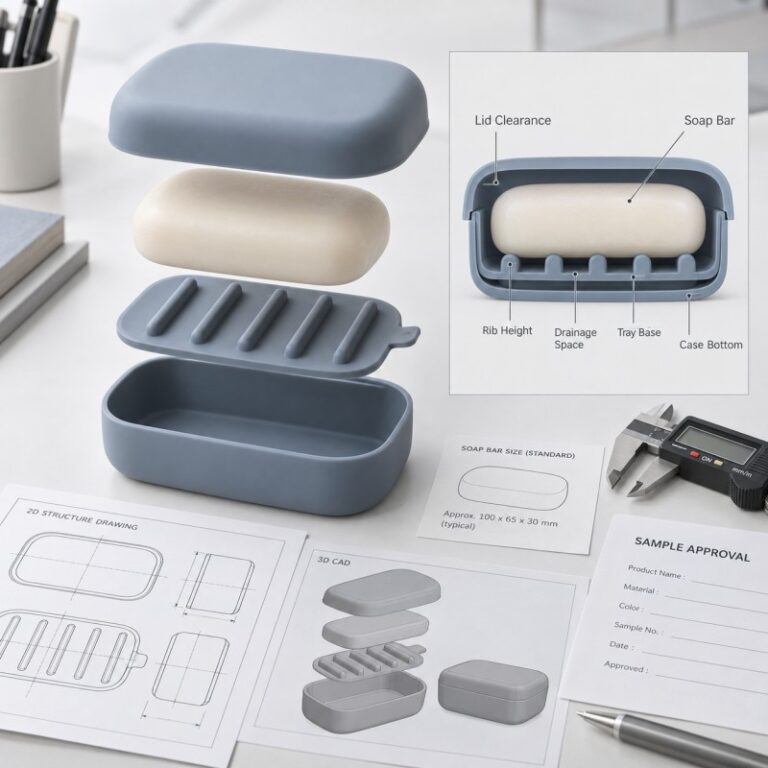
Critical areas should be marked on the drawing.
The manufacturer should understand which parts of the product must be:
- フレキシブル
- Stable
- 折りたたみ式
- Strong
- Soft
- Load-bearing
This is more useful than giving only one general thickness requirement.
What Should Be Tested During Sample Approval?
Shape Stability
Does the product maintain its intended shape during normal use?
柔軟性
Can the product bend or fold as designed?
Recovery
Does it return to its intended shape after compression?
耐引裂性
Check holes, thin edges, roots and transition areas.
Functional Performance
Test the actual function, such as:
- Suction
- Folding
- Grip
- Lid fit
- Pocket opening
- Bristle bending
Packaging Recovery
Check whether folding or carton pressure changes the product shape.
Mold-Cavity Consistency
Compare samples from every production cavity.
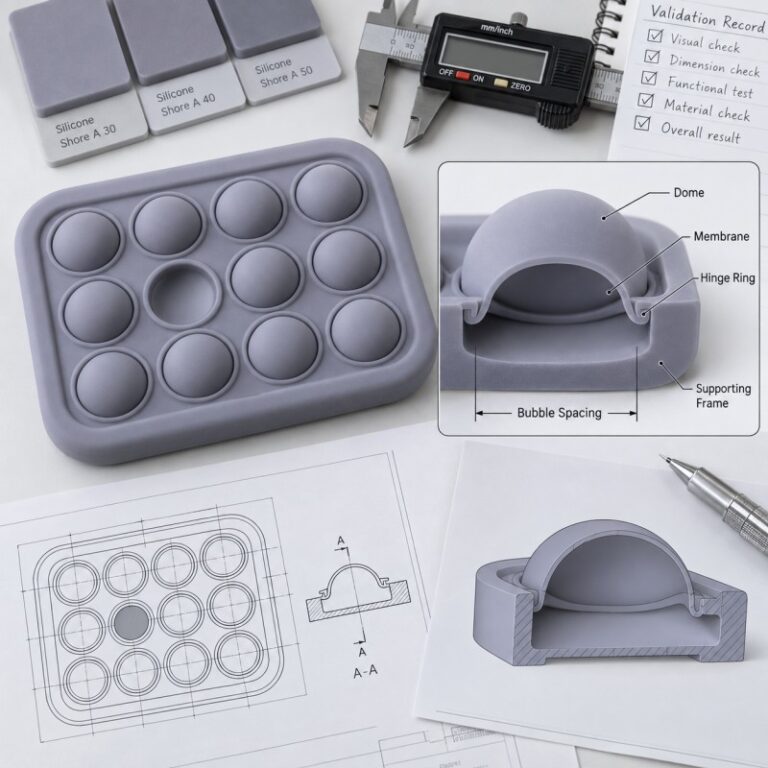
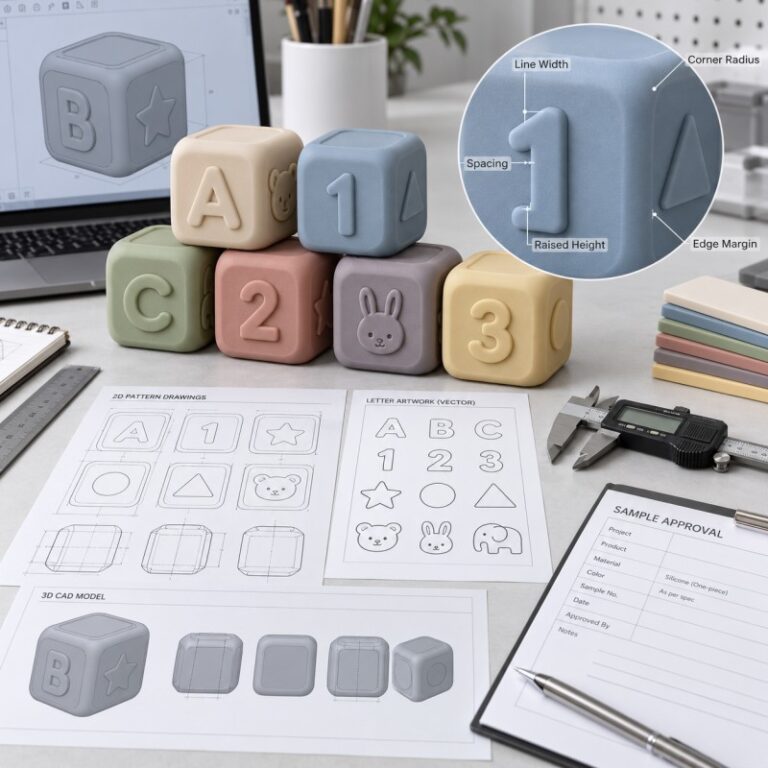
The final wall structure should be approved using real molded parts rather than only reviewing the 3D drawing.

Wall Thickness DFM Checklist
| 項目 | What Buyers Should Confirm |
|---|---|
| Main body | Does it provide enough shape stability? |
| Flexible areas | Can they bend without excessive force? |
| Thin edges | Is there enough material to resist tearing? |
| Holes | Is the surrounding wall strong enough? |
| Thick areas | Is the extra material functionally necessary? |
| Transitions | Are thick-to-thin changes gradual? |
| Folding areas | Do they bend and recover repeatedly? |
| Suction structures | Is flexibility balanced with support? |
| Bristle roots | Can they withstand repeated bending? |
| パッケージング | Will compression distort thin structures? |
| Hardness | Has it been evaluated together with thickness? |
| サンプル | Has the final structure passed functional testing? |
How LYA Silicone Supports Wall Thickness Optimization
LYA Silicone supports OEM and ODM development for silicone baby, pet, household, outdoor and educational products.
Project support may include:
- Product drawing review
- DFM analysis
- Wall-thickness evaluation
- Material and hardness discussion
- Functional-zone analysis
- カスタム金型開発
- Sample production
- Dimensional inspection
- Flexibility and recovery testing
- Tear-risk review
- Packaging validation
- Pilot production
- Mass-production quality control
For a new custom project, buyers should explain how each part of the product needs to behave rather than focusing only on a single wall-thickness number.
Frequently Asked Questions
Is There a Standard Wall Thickness for All Silicone Products?
そうだ。
The appropriate thickness depends on product size, material, hardness, geometry, function and manufacturing requirements.
Is Thicker Silicone Always More Durable?
そうだ。
Additional thickness can improve support in some areas, but excessive thickness may increase stiffness, weight and cost.
Can a Thin Silicone Product Still Be Durable?
Yes, when the material, geometry and load are suitable.
Critical edges, holes and transition areas still require careful design.
Can Wall Thickness Be Changed After the Mold Is Finished?
Some mold modifications may be possible, but changing wall thickness can affect mold cores, cavities, dimensions and product behavior.
It is better to review thickness during DFM.
Why Does the Same Hardness Feel Different on Two Products?
Wall thickness and geometry strongly affect the perceived stiffness of the finished product.
The same material hardness can feel very different in different structures.
Should Wall Thickness Be Tested Before Mass Production?
Yes.
Samples should be evaluated for flexibility, stability, tearing, function, packaging and recovery before mass production.
Balance Flexibility, Strength and Production Efficiency
Good silicone wall-thickness design is a balance.
The product must contain enough material to perform reliably without becoming unnecessarily heavy, stiff or expensive.
Before mold development, buyers should review:
- Wall thickness
- Silicone hardness
- Structural transitions
- Functional zones
- Thin edges
- Reinforcement areas
- パッケージング
- Product testing
To review the wall structure of your custom silicone product, send リヤ・シリコーン your drawing, application, hardness requirements, functional expectations, packaging concept and estimated order quantity.