 Japanese
  English
  French
  German
  Spanish
  Polish
  Chinese
  Korean
  Russian
 内容
Answer Excerpt
Cosmetic defect standards for custom silicone products should define which surfaces are critical, what types of defects are acceptable, how large or visible a defect may be, and under what lighting and viewing conditions inspection is performed. Buyers should approve molded samples, defect photos or limit samples before mass production instead of relying on vague requirements such as “no defects” or “perfect surface.”
A custom silicone product can meet its dimensions and function correctly but still be rejected because of appearance.
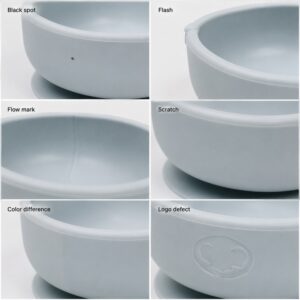
Typical complaints include:
- Small black spots
- Visible flash
- Flow marks
- Color differences
- Surface scratches
- Dust or fibers
- Gloss variation
- Parting-line marks
- Small dents
- Packaging impressions
- Logo defects
- Minor deformation
The difficulty is that terms such as “small,” “obvious” or “acceptable” mean different things to different people.
A buyer may consider a small mark unacceptable on the front of a premium baby product, while the same mark may be acceptable on a hidden bottom surface.
For this reason, appearance requirements should be converted into an agreed inspection standard before mass production begins.
Why Is “No Cosmetic Defects” Not a Practical Quality Standard?
Buyers sometimes write requirements such as:
No black spots.
No flash.
No surface marks.
No color difference.
These statements describe the desired result but do not provide enough information for repeatable inspection.
Manufacturing inspection needs answers to questions such as:
- How large is the defect?
- Where is it located?
- How many defects are allowed?
- How far apart must they be?
- From what distance is the product inspected?
- Under what lighting?
- For how many seconds?
- Is the surface functional or decorative?
- Does the defect affect cleaning or safety?
- Does the defect remain visible after normal use?
Without these definitions, the buyer and manufacturer may inspect the same product and reach different conclusions.
A useful standard should therefore describe both the defect and the inspection condition.
Which Silicone Surface Defects Should Buyers Define?
Black Spots and Foreign Particles
Small dark or colored particles may result from contamination during:
- Material preparation
- Mixing
- 成形
- Demolding
- Trimming
- クリーニング
- パッケージング
The acceptance standard should consider:
- Particle size
- Number of particles
- Location
- Product color
- Visibility
- Whether the area contacts food or the user
A black spot on the underside of a large mat may be evaluated differently from one on the front surface of a pastel baby bowl.
Flash and Parting Lines
Flash is excess material around the mold separation area.
Parting lines are the visible lines created where mold sections meet.
Buyers should define:
- Which edges are critical
- Maximum acceptable visible flash
- Whether sharp edges are allowed
- Whether trimming marks are acceptable
- Whether the parting line affects grip, cleaning or appearance
Areas around mouths, handles, sealing surfaces and product openings normally require more attention than hidden non-functional areas.
Flow Marks
Flow marks may appear as:
- Lines
- Waves
- Gloss differences
- Slight color variation
- Directional patterns
They are often more visible on:
- Large flat surfaces
- Glossy silicone
- Dark colors
- Premium front surfaces
A minor flow mark may not affect product function, but it can affect perceived quality.
The standard should specify where flow marks are not allowed and where minor marks may be commercially acceptable.
Color Variation
Silicone color appearance can be influenced by:
- Pigment ratio
- Material batch
- Product thickness
- Surface finish
- Lighting
- Curing condition
Color should not be judged only from a computer screen or Pantone card.
The buyer should approve an actual molded color sample.
For multi-component sets, all products should also be reviewed together because slightly different surface finishes and thicknesses can make the same nominal color appear different.
Surface Scratches and Pressure Marks
Silicone surfaces may show marks caused by:
- Mold contact
- Trimming
- Handling
- Product stacking
- パッケージング
- Carton pressure
- Accessories rubbing against the product
Some marks disappear after the product rests.
Others remain visible.
The standard should define whether inspection occurs:
- Immediately after unpacking
- After a recovery period
- After washing
- After the product returns to its natural shape
This is especially important for folded bibs, mats and collapsible products.
Logo and Texture Defects
A molded or printed logo may show:
- Missing detail
- Uneven depth
- Incomplete letters
- Printing misalignment
- Ink overflow
- Distortion
- Uneven texture around the logo
The logo is usually a high-visibility brand area.
Buyers should approve:
- Logo size
- Position
- Depth or height
- Print color
- Edge clarity
- Orientation
- Acceptable registration variation
Logo inspection should use the final production artwork, not an early concept drawing.
Should Every Product Surface Have the Same Standard?
そうだ。
A practical appearance standard divides the product into different inspection zones.
Zone A — High-Visibility Surface
例を挙げよう:
- Front of the product
- Main branding area
- Retail display surface
- Area directly seen by the customer
This area normally has the strictest cosmetic standard.
Zone B — Secondary Visible Surface
例を挙げよう:
- Product sides
- Back surfaces
- Handles
- Areas visible during normal use but not the main focal point
Minor defects may have a slightly wider acceptance range.
Zone C — Hidden or Non-Cosmetic Surface
例を挙げよう:
- Bottom areas
- Internal assembly surfaces
- Areas covered after assembly
Cosmetic acceptance may be more practical here, provided the defect does not affect:
- 機能
- クリーニング
- Assembly
- 安全性
- 耐久性
This zoning approach prevents the buyer from applying the most expensive appearance standard to every square millimeter of the product.
What Is a Limit Sample?
A limit sample shows the maximum acceptable cosmetic defect.
Instead of writing:
Small flash is acceptable.
A physical or photographic limit sample can show exactly what “small” means.
Limit samples can be created for:
- Black spots
- Flash
- Parting lines
- Flow marks
- Surface scratches
- Color variation
- Small dents
- Packaging impressions
- Logo defects
The buyer and manufacturer can then compare production parts against the same visual reference.
A good limit sample should include:
- 商品名
- Defect type
- Defect location
- Approval date
- Drawing or specification revision
- Accepted/rejected status
Limit samples should not replace measurable specifications where measurement is practical, but they are very useful for appearance characteristics that are difficult to describe with numbers alone.

How Should Cosmetic Inspection Be Performed?
Use Consistent Lighting
Inspection results may change dramatically under different lighting.
The buyer and manufacturer should agree on a reasonable inspection environment.
Avoid comparing one sample under bright direct sunlight and another under dim warehouse lighting.
Define Viewing Distance
A tiny surface mark visible only from a few centimeters away may not be visible during normal product use.
Inspection should define a consistent viewing distance appropriate to the product.
Premium or highly cosmetic surfaces may justify closer inspection.
Define Viewing Time
Inspectors should not spend several minutes searching every product for microscopic imperfections unless the product specification genuinely requires that level of control.
A defined inspection time helps maintain consistency between operators.
Inspect the Product in Its Normal Shape
Flexible silicone can change appearance when:
- Stretched
- Compressed
- Folded
- Flattened
The inspection method should state how the product is positioned.
For example, a silicone bib should not be aggressively stretched simply to expose a tiny surface feature that would never be visible during normal use.
How Should Defects Be Classified?
For practical project control, defects can be grouped according to their effect.
Functional or Safety-Related Defects
Examples may include:
- Sharp trimming damage
- Tears
- Missing functional material
- Defects affecting sealing
- Damaged oral-contact edges
- Incorrect assembly
These are not merely cosmetic issues and should be evaluated against the functional specification.
Major Appearance Defects
Examples may include:
- Large visible black spots
- Strong color mismatch
- Obvious flow marks on the front surface
- Damaged logos
- Severe deformation
- Clearly visible trimming defects
These may make the product unacceptable to the buyer even when function is unaffected.
Minor Appearance Defects
Examples may include:
- Very small marks on secondary surfaces
- Slight gloss variation
- Minor parting-line visibility
- Small marks within an agreed limit
The exact classification should be agreed for each product rather than copied blindly from another project.
What Should Buyers Approve Before Mass Production?
Before releasing mass production, confirm:
- Final molded sample
- Final product color
- Surface finish
- ロゴ
- Parting-line location
- Flash standard
- Black-spot standard
- Flow-mark standard
- Scratch and pressure-mark limits
- Critical cosmetic zones
- Inspection lighting
- Viewing distance
- Limit samples or defect photos
- Packaging condition
- Final drawing revision
A buyer should not approve only one perfect sample and assume every mass-production product will look mathematically identical.
The objective is to define a controlled acceptable range.
Cosmetic Inspection Checklist
| Inspection Item | What Should Be Confirmed |
|---|---|
| Inspection zones | Which surfaces are Zone A, B or C |
| Black spots | Size, quantity and allowed location |
| Flash | Maximum acceptable visibility and edge condition |
| Parting line | Location and appearance limit |
| Flow marks | Allowed location and visibility |
| カラー | Approved molded reference sample |
| Scratches | Size, depth and cosmetic zone |
| ロゴ | Position, clarity, depth and color |
| テクスチャー | Uniformity and acceptable variation |
| Deformation | Product shape after agreed recovery period |
| Packaging marks | Acceptable condition after unpacking |
| Limit samples | Approved reference for subjective defects |
How LYA Silicone Supports Appearance Quality Control
LYA Silicone supports OEM and ODM development for silicone baby, pet, household, outdoor and educational products.
Project support may include:
- Product and drawing review
- Cosmetic-surface identification
- Mold and parting-line review
- Surface-finish development
- Pantone color matching
- Logo sample approval
- Mold-cavity inspection
- Appearance inspection
- Limit-sample confirmation
- Packaging validation
- Pilot production
- Mass-production quality control
For projects with strict appearance requirements, buyers should explain which surfaces directly affect retail presentation and brand perception.
This allows inspection resources to focus on the areas that matter most.
Frequently Asked Questions
Is Any Black Spot Acceptable on a Silicone Product?
It depends on product application, defect size, location and the agreed standard.
The acceptance criteria should be defined before mass production.
Is a Visible Parting Line Always a Defect?
そうだ。
A molded silicone product normally has a designed parting-line location.
The important issue is whether the line exceeds the agreed appearance or functional limit.
Can Flow Marks Be Completely Eliminated?
Not every molded geometry and surface can be guaranteed to show absolutely no visible flow pattern.
DFM, mold design and process control can reduce the risk, while the final acceptance limit should be agreed on actual samples.
Should Color Be Approved Using a Pantone Card?
A Pantone reference is useful, but final approval should be based on the actual molded silicone product because surface finish and thickness influence appearance.
Why Do Packaging Marks Appear Only After Shipping?
Long-term compression, stacking and temperature can change flexible silicone surfaces.
Final packaging should therefore be included in product validation.
Is One Golden Sample Enough for Appearance Inspection?
A golden sample defines the desired target, but limit samples or defect standards are useful for defining the maximum acceptable variation.
Define Appearance Before the First Mass-Production Batch
Cosmetic quality should not depend on whether one inspector thinks a product “looks good.”
Before production, buyers and manufacturers should agree on:
- Critical cosmetic surfaces
- Defect types
- Defect limits
- Color reference
- Logo standard
- Inspection conditions
- Limit samples
- Packaging condition
To discuss appearance standards for your custom silicone product, send リヤ・シリコーン your drawing, reference sample, target color, surface requirements, logo, packaging concept and estimated quantity.