 Japanese
  English
  French
  German
  Spanish
  Polish
  Chinese
  Korean
  Russian
 内容
はじめに
A silicone baby suction bowl may look stable when it is first pressed onto a table or high-chair tray.
However, during actual use, the bowl may:
- Slide when the child pushes it sideways
- Lift from one edge
- Release after several minutes
- Lose suction after warm food is added
- Work on glass but fail on a textured tray
- Move when the handle is pulled
- Become unstable when filled
- Stop sticking after washing
- Perform differently between production batches
- Arrive with a warped suction base after packaging
These problems are often described simply as “weak suction.”
In practice, suction performance depends on the complete relationship between:
- Suction-base diameter
- Suction-chamber depth
- Sealing-rim geometry
- Base flatness
- Silicone hardness
- Wall thickness
- Bowl height and capacity
- Handle position
- Surface material
- Surface texture
- Moisture, oil and food residue
- Product temperature
- Mold shrinkage
- Demolding
- Cooling
- パッケージング
- Test method
A bowl may resist vertical lifting but still slide horizontally.
Another bowl may feel firmly attached immediately after pressing but gradually release because air enters through a small gap under the sealing rim.
For baby brands, importers, distributors, wholesalers and private-label sellers, the correct question is not only:
“Does the bowl have a suction base?”
The more useful question is:
“On which surfaces, under which loads, and for how long can the suction base remain stable during realistic feeding conditions?”
This guide explains what buyers should review before custom silicone baby suction bowl tooling, sample approval and mass production.
Answer Excerpt
Silicone baby suction bowls can lose grip, slide or lift when the suction base is not sufficiently flat, the sealing rim contains a gap, the suction chamber is poorly proportioned, or the material and wall thickness do not allow controlled deformation.
Performance also depends on the tray surface. Smooth, flat and non-porous surfaces normally produce a different result from textured, curved, scratched or porous surfaces.
A bowl that passes a vertical pull test may still fail a horizontal sliding test. A bowl that sticks immediately may also release gradually when air enters through flash, surface debris, a warped edge or an uneven tray.
Reliable performance requires the suction base, bowl body, handles, material, mold, cooling method, packaging and test surface to be evaluated as one complete system.
1. A Suction Bowl Works by Controlling Air Under the Base
During custom silicone baby feeding bowl manufacturing, the suction base, bowl body, spoon, lid and packaging should be reviewed as one complete feeding-product system.
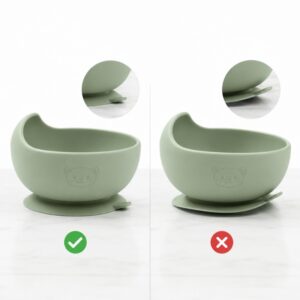
A suction base does not attach through material stickiness alone.
When the user presses the bowl downward, part of the air beneath the suction base is pushed out. The flexible sealing rim then contacts the supporting surface and restricts air from returning.
The resulting pressure difference helps hold the bowl against the surface.
For this process to work consistently, the base needs:
- A continuous sealing edge
- Sufficient flexibility to conform to the surface
- Adequate recovery after pressing
- A suitable internal chamber
- No uncontrolled air path
- A reasonably smooth supporting surface
- Sufficient structural stability under load
If air gradually enters beneath the rim, the pressure difference decreases and the bowl releases.
The base can therefore look completely normal while still containing a small leakage path.
2. First Define the Intended Supporting Surface
Suction performance cannot be evaluated without identifying the surface on which the product will be used.
Possible surfaces include:
- Plastic high-chair trays
- Glass tables
- Polished stone
- Laminated tabletops
- Painted wood
- Stainless steel
- Ceramic tiles
- Textured plastic
- Curved trays
- Scratched surfaces
- Porous wood
A bowl that performs well on glass may not provide the same result on a deeply textured plastic tray.
Before tooling, buyers should define:
- Main use surface
- Surface texture
- Surface flatness
- Surface material
- Expected cleanliness
- Whether the surface may be wet
- Whether the tray contains raised edges
- Whether the product must work on several surface types
The reference surface should be retained for sample and mass-production testing.
Buyers can also compare different silicone feeding bowl and spoon structures before selecting an existing product or developing a new suction-bowl mold.
3. Smooth and Textured Surfaces Produce Different Results
A smooth surface normally allows the silicone sealing rim to form more continuous contact.
A textured surface may contain small channels through which air can enter.
Surface features that can reduce suction include:
- Molded grain
- Raised dots
- Deep matte texture
- Scratches
- Embossed logos
- Recessed patterns
- Surface joints
- Small holes
- Curvature
The silicone rim may bridge over the high points while leaving gaps across the lower areas.
A thicker or softer rim may conform more easily to some textures, but excessive softness can create instability or edge rolling.
The product claim should therefore state the intended surface conditions rather than implying identical performance on every table and tray.
4. Suction-Base Flatness Is Critical
The sealing rim should contact the supporting surface evenly around its circumference.
If the base is warped, one section may touch first while another remains slightly raised.
Possible causes of poor flatness include:
- Uneven wall thickness
- Material shrinkage
- Mold-temperature variation
- Demolding deformation
- Unsupported cooling
- Hot-part stacking
- Packaging pressure
- Long-term storage
- Bowl-body weight
- Cavity-to-cavity variation
A small raised section can become an air-entry path.
Flatness should be checked:
- Immediately after normal conditioning
- After packaging
- After storage
- After transportation simulation
- After warm-food testing
- Across every mold cavity
The base should not be manually pressed flat before inspection.
5. The Sealing Rim Must Form Continuous Contact
The outer rim of the suction base is the primary sealing boundary.
Its performance depends on:
- Rim width
- Rim thickness
- Rim angle
- Edge radius
- Material hardness
- Surface finish
- Flatness
- Mold parting line
- Flash
- Product temperature
If the rim is too narrow, small surface defects may interrupt contact.
If the rim is too thick or rigid, it may not conform to the tray.
If the rim is too thin or soft, it may:
- Roll inward
- Fold outward
- Tear
- Become permanently distorted
- React strongly to packaging pressure
The correct rim should deform during activation and recover into a stable sealing position.
6. Suction-Chamber Depth Affects Activation and Holding
The space beneath the base forms the suction chamber.
A very shallow chamber may:
- Displace limited air
- Create weak initial attachment
- Release easily under load
- Be sensitive to surface variation
A very deep chamber may:
- Require excessive pressing force
- Increase base deformation
- Make the product feel unstable
- Create difficult demolding
- Increase packaging height
- Pull the bowl downward unevenly
Chamber depth should be coordinated with:
- Base diameter
- Rim flexibility
- Bowl weight
- Expected food load
- User pressing force
- Release-tab design
- Product height
A larger chamber is not automatically stronger.
The complete geometry determines how much usable pressure difference can be created and maintained.
7. Suction-Base Diameter Affects Stability
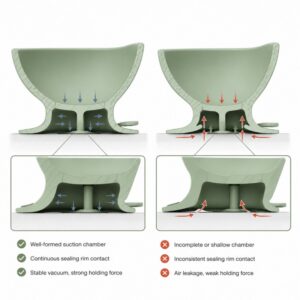
A larger base can provide a wider contact area and greater resistance to tipping.
However, increasing diameter may also:
- Increase material consumption
- Increase packaging size
- Interfere with tray edges
- Make release more difficult
- Create greater flatness risk
- Require more uniform molding
- Increase the effect of bowl-body warpage
A small base may fit more trays but provide less resistance to:
- Side loading
- Handle pulling
- Tall bowl structures
- Heavy food
- Child movement
The base diameter should be selected together with the bowl height, capacity, handles, tray dimensions and expected use.
8. Activation Force Must Be Practical
The user must normally press the bowl downward to activate the suction base.
If the required force is too low, the base may activate easily but also release or deform easily.
If the required force is too high:
- Parents may not press it correctly
- The bowl may not fully attach
- The rim may remain partially open
- The bowl body may collapse before the base activates
- The product may feel inconvenient
The pressing method should be defined during testing.
For example:
- Pressing the center of the bowl
- Pressing both handles
- Pressing the base edge
- Applying a defined force
- Holding the pressure for a defined time
A product that works only after an unusually strong laboratory press may not perform reliably in normal use.
9. Silicone Hardness Does Not Determine Suction Alone
A softer material may conform more easily to a smooth or slightly uneven surface.
However, excessive softness can cause:
- Sealing-rim rolling
- Base collapse
- Slow recovery
- Bowl-body instability
- Handle deformation
- Packaging damage
A firmer material may provide:
- Better shape support
- Faster recovery
- More stable handling
- Greater rim definition
However, excessive firmness can make the sealing rim difficult to deform against the tray.
The same hardness can perform differently when base diameter, wall thickness, rim shape or chamber depth changes.
The final hardness should therefore be confirmed using the complete molded bowl on representative surfaces.
Buyers should also review how to choose silicone hardness according to wall thickness, base geometry and intended product function.
10. Base Wall Thickness Controls Flexibility and Recovery
The suction base needs to deform enough to expel air while remaining strong enough to recover and retain its shape.
If the base wall is too thin, it may:
- Collapse unevenly
- Wrinkle
- Stretch
- Develop permanent deformation
- Tear near the bowl connection
- Lose flatness after packaging
If the base is too thick, it may:
- Require excessive activation force
- Conform poorly to the surface
- Increase product weight
- Cure unevenly
- Recover too aggressively
- Release prematurely
Wall thickness may need to vary between:
- Central chamber
- Sealing rim
- Bowl connection
- Release-tab area
- Structural support zones
Thickness transitions should remain gradual to reduce stress and warpage.
11. Vertical Pull and Horizontal Sliding Are Different Tests
A suction bowl can resist upward pulling but still move when pushed sideways.
Vertical pull testing evaluates how much force is required to lift the bowl away from the surface.
Horizontal testing evaluates resistance to sliding across the tray.
Horizontal sliding depends on:
- Suction force
- Surface friction
- Bowl load
- Silicone texture
- Moisture
- Pushing direction
- Handle position
- Tray finish
A bowl may remain sealed while sliding across a smooth wet surface.
This means the suction seal has not necessarily failed, but the user still experiences an unstable product.
Both vertical and horizontal performance should be evaluated.
12. Bowl Height and Capacity Change the Tipping Load
A tall bowl creates more leverage when the child pushes the upper wall or handles.
A short, wide bowl generally behaves differently from a tall, narrow bowl.
Important variables include:
- Overall height
- Rim diameter
- Base diameter
- 定員
- Fill level
- Food weight
- Handle height
- Center of gravity
- Bowl-wall flexibility
A base that performs well on an empty bowl may lift at one edge after the bowl is filled.
Testing should therefore include:
- Empty bowl
- Partially filled bowl
- Fully filled bowl
- Different food consistencies
- Loads applied at different heights
13. Handles Can Create Uneven Side Loads
Handles encourage the child to pull or push the bowl from a specific location.
If the handles are positioned high above the suction base, they create greater leverage.
Possible results include:
- One edge lifting first
- Bowl twisting
- Horizontal sliding
- Rim leakage
- Base distortion
- Handle-root stress
Handle variables include:
- Height
- Width
- Connection thickness
- Left-right symmetry
- Distance from the center
- Grip opening
- Bowl-wall reinforcement
The bowl should be tested by pulling each handle separately and both handles together.
A centered vertical pull does not reproduce every realistic use condition.
14. Tray Curvature Can Break the Seal
Some high-chair trays appear flat but contain:
- Shallow curvature
- Raised center areas
- Drainage slopes
- Recessed sections
- Decorative contours
- Tray seams
- Molded cup holders
A wide suction base may bridge across a curved area and contact only at several points.
A smaller base may fit inside a flat section but provide less overall stability.
Buyers should confirm the expected tray dimensions and avoid assuming that every high-chair tray provides a completely flat surface.
15. Moisture, Oil and Food Residue Affect Performance
The condition of both the tray and suction base affects sealing and friction.
Possible residues include:
- Water
- Cooking oil
- Baby food
- Milk
- Soap
- Detergent
- Dust
- Paper fibers
- Hand lotion
- Cleaning products
A small amount of water may change sliding behavior.
Oil can reduce friction and prevent stable contact.
Dried food may create a small air gap.
Testing should define whether surfaces are:
- Dry and clean
- Wet
- Lightly oily
- Recently washed
- Contaminated with food residue
The instruction for use should reflect the conditions under which the product was validated.
16. Warm Food and Temperature Can Change the Result
Warm food can change the temperature of the bowl body and suction base.
Temperature may affect:
- Silicone flexibility
- Base recovery
- Bowl-wall deformation
- Internal air pressure
- Tray temperature
- Moisture formation
- User handling
A bowl may perform differently after being filled with warm food compared with room-temperature water.
Temperature testing should use defined conditions rather than unverified statements such as “works equally at every temperature.”
The final material, bowl structure, food condition, cleaning method and target-market requirements should be reviewed together.
17. Air Leakage Can Cause Delayed Release
Some bowls attach successfully but release several minutes later.
Possible air-entry paths include:
- Warped sealing rim
- Flash
- Surface scratches
- Dust or crumbs
- Tray texture
- Mold parting line
- Damaged rim
- Release-tab interference
- Uneven activation
- Bowl deformation under load
Holding-time testing is therefore important.
The test should record:
- Surface type
- Activation method
- Bowl load
- 温度
- Test duration
- Whether one edge lifts first
- Time to complete release
- Cavity number
An immediate pull test alone cannot identify slow air leakage.
18. The Release Tab Must Be Easy to Use but Difficult to Activate Accidentally
A release tab allows an adult to lift one section of the sealing rim and introduce air beneath the base.
If the tab is too small:
- It may be difficult to grip
- Users may pull the bowl body instead
- Excessive force may deform the base
If the tab is too large or poorly positioned:
- A child may pull it
- It may contact the tray
- It may lift the sealing rim
- Packaging may bend it
- It may create an unbalanced appearance
The release tab should be positioned away from normal child grip areas where practical.
Its connection should also resist repeated pulling without tearing.
19. Parting Lines and Flash Can Create Air Paths
The mold parting line may cross:
- The sealing rim
- Release tab
- Suction chamber
- Bowl connection
- Handle roots
Flash on the sealing edge can:
- Prevent continuous tray contact
- Create a small air channel
- Fold under the rim
- Tear during cleaning
- Produce inconsistent results between cavities
Manual trimming may also damage the edge or create local irregularity.
The drawing should identify the suction rim as a critical functional surface with an agreed flash and edge standard.
The suction rim, chamber depth, parting line, release tab and demolding direction should be reviewed during custom silicone mold development before mold machining begins.
20. Mold Shrinkage and Warpage Affect Base Geometry
Silicone dimensions can change after molding, cooling and conditioning.
Shrinkage and warpage may affect:
- Base diameter
- Chamber depth
- Rim flatness
- Release-tab position
- Bowl-to-base alignment
- Left-right symmetry
The result can vary with:
- 素材グレード
- Hardness
- Wall thickness
- Mold temperature
- Curing time
- Demolding temperature
- Product geometry
- Cooling support
- Mold cavity
Mold compensation should consider the final conditioned product rather than only the hot part immediately after demolding.
21. Demolding and Cooling Can Distort the Suction Base
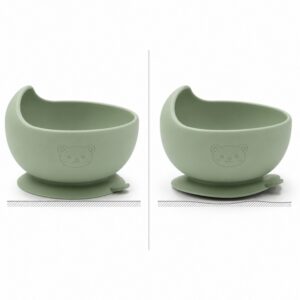
A wide flexible base may stretch or fold while being removed from the mold.
Possible demolding defects include:
- Rim rolling
- One-sided elongation
- Base inversion
- Release-tab stretching
- Permanent creasing
- Uneven chamber depth
The product may also deform after demolding if it is:
- Stacked while hot
- Placed on an uneven tray
- Compressed by another product
- Left unsupported
- Packed before recovery
Cooling trays or controlled placement may be required to maintain flatness.
The manufacturer should not manually reshape samples before customer inspection.
22. Packaging Can Permanently Deform the Base
A correctly molded suction bowl may lose performance after retail packaging.
Packaging risks include:
- Base folded upward
- Bowl pressed into a small box
- Spoon stored beneath the suction rim
- Lid pressing the bowl out of shape
- Multiple bowls tightly stacked
- Paper inserts bending the release tab
- Long-term carton pressure
- Storage under heat
Possible results include:
- Warped rim
- Permanent fold lines
- Reduced chamber depth
- One-sided lifting
- Poor recovery
- Lid-fit problems
Packaging tests should use final molded samples and actual packaging materials.
Inspection should take place:
- Before packaging
- Immediately after packaging
- After storage
- After transportation simulation
- After unpacking and recovery
- During suction-performance retesting
23. Material Documentation Does Not Prove Suction Performance
Food-contact material documentation is important, but it does not confirm that the finished bowl will remain attached to the tray.
Finished-product evaluation should also cover:
- Suction structure
- Surface compatibility
- Bowl stability
- Rim quality
- Cleaning design
- パッケージング
- Intended age group
- Target market
- Final test plan
Baby brands can review the complete silicone baby feeding set safety checklist before confirming material, structure, testing and packaging requirements.
Your existing feeding-set safety guide already makes the same broader point: buyers should not approve a finished baby feeding product based only on the words “food-grade silicone”; structure, suction performance, testing, packaging and intended use must also be evaluated.
The material and finished product should therefore be reviewed as separate but connected approval items.
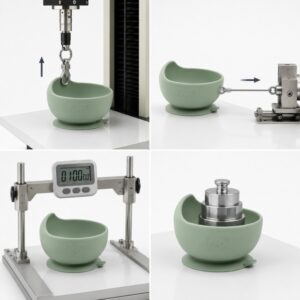
24. Sample Testing Should Reproduce Real Feeding Conditions
A suction bowl should not be approved only because it sticks to a clean glass plate once.
A practical test plan may include:
- Immediate suction test
- Holding-time test
- Vertical pull test
- Horizontal sliding test
- Edge-lifting test
- Single-handle pull
- Two-handle pull
- Empty-bowl test
- Full-bowl test
- Warm-food test
- Wet-surface test
- Textured-tray test
- Repeated attachment and release
- Cleaning and retesting
- Packaging recovery
- Cavity-to-cavity comparison
The method should define:
- Test surface
- Surface cleanliness
- Activation force
- Activation time
- Fill weight
- Pulling direction
- Pulling speed
- Holding duration
- 温度
- Acceptance criteria
Statements such as “strong suction” are too subjective without defined test conditions.
25. Why Can Samples Pass While Mass Production Fails?
Engineering samples are normally made under close supervision.
During sampling:
- Mold parameters are adjusted carefully
- Products are cooled individually
- Flat samples may be selected
- The test surface is clean
- Every base is inspected
- Packaging pressure is limited
- Production runs are short
Mass production introduces:
- Multiple mold cavities
- Longer continuous runs
- Material-batch variation
- Mold-temperature drift
- Tool wear
- Demolding-speed variation
- Hot-part stacking
- Operator changes
- Packaging pressure
- Storage time
A suction structure with little manufacturing margin may produce several good samples but become inconsistent during continuous production.
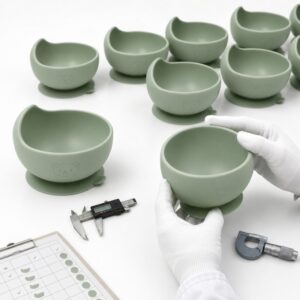
Pilot production should compare:
- Base flatness
- Rim thickness
- Chamber depth
- Product weight
- Hardness
- Release-tab shape
- Vertical pull
- Horizontal sliding
- Holding time
- Every mold cavity
- Beginning and end of the run
26. A Practical Suction-Failure Analysis
When a silicone baby bowl loses suction or slides, investigate the problem systematically.
Recommended sequence:
- Record the exact failure mode.
- Confirm the supporting surface.
- Clean and document the surface condition.
- Record the activation method.
- Test the bowl empty.
- Test the bowl with a defined load.
- Perform vertical and horizontal tests separately.
- Record the holding time before release.
- Inspect which edge lifts first.
- Measure base diameter and chamber depth.
- Check sealing-rim flatness.
- Inspect flash and parting lines.
- Confirm material and hardness.
- Identify the mold-cavity number.
- Compare passing and failing samples.
- Review demolding and cooling.
- Inspect packaging deformation.
- Test after washing and drying.
- Change one controlled variable.
- Repeat the complete test and record the result.
Do not change hardness, rim thickness, chamber depth, base diameter and packaging simultaneously.
Changing one variable at a time makes the root cause easier to confirm.
27. What Should Be Validated Before Mass Production?
Before approving a custom silicone baby suction bowl, buyers and manufacturers should confirm:
- Intended age range
- Target market
- Bowl capacity
- Bowl dimensions
- Product weight
- Silicone material
- Shore A hardness
- Bowl-wall thickness
- Suction-base diameter
- Suction-chamber depth
- Sealing-rim width
- Sealing-rim thickness
- Base flatness
- Release-tab design
- Handle position
- Center of gravity
- Intended supporting surfaces
- Surface-texture limits
- Activation method
- Vertical pull requirement
- Horizontal sliding requirement
- Holding-time requirement
- Fill weight
- Temperature conditions
- Cleaning method
- Parting-line location
- Flash standard
- Demolding method
- Cooling support
- Packaging structure
- Packaging-recovery test
- Pilot-production results
- Cavity traceability
- Final reference sample
- Inspection records
Approval should clearly state the test surfaces.
A bowl should not be described as suitable for every surface unless that claim has been validated.
How LYA Silicone Supports Custom Suction Bowl Projects
LYA Silicone supports OEM and ODM development for custom silicone baby feeding bowls, suction plates, spoons, bibs, cups, teethers, pacifiers, pet products, outdoor products and related silicone product collections.
Our custom suction bowl project support can include:
- Product-requirement review
- Drawing and sample evaluation
- Target-surface clarification
- Bowl-capacity review
- Suction-base structure review
- Sealing-rim development
- Material and hardness selection
- Wall-thickness review
- Handle and release-tab evaluation
- カスタム金型開発
- Pantone color matching
- Logo and surface-finish development
- Molded sample production
- Suction testing support
- Packaging coordination
- Pilot production
- Appearance and dimensional inspection
- OEM/ODM mass production
With 25+ years of silicone manufacturing experience, we help buyers evaluate the complete relationship between:
- Bowl body
- Suction base
- Supporting surface
- 素材
- Mold
- パッケージング
- Test method
The objective is not only to make the bowl attach once on a clean laboratory surface.
The objective is to produce stable suction performance under defined feeding, cleaning, storage and mass-production conditions.
What Information Should Buyers Provide?
To evaluate a custom silicone baby suction bowl project, buyers should provide:
- Product reference photo
- 2D drawing
- 3D file, when available
- Physical sample, when available
- Intended age range
- Target sales market
- Bowl capacity
- Bowl dimensions
- Intended tray or table surface
- Suction-performance requirement
- Silicone material requirement
- Hardness preference
- Handle design
- Lid requirement
- Product color
- Logo file
- Surface finish
- Cleaning conditions
- Packaging concept
- Testing requirements
- Estimated quantity
- Expected launch schedule
When an existing bowl has a suction problem, buyers should also provide:
- Failure videos
- Supporting-surface photos
- Surface material and texture
- Bowl load
- Time before release
- Pulling direction
- Base measurements
- Material and hardness
- Mold-cavity number
- Packaging method
- Storage time
- Affected quantity
Frequently Asked Questions
Why does a silicone suction bowl stick to glass but not to a high-chair tray?
Glass is normally smoother and more uniform. A high-chair tray may contain texture, curvature, scratches or molded patterns that allow air to enter beneath the sealing rim.
Why does the bowl release after several minutes?
A small gap, warped edge, flash, surface particle or tray texture may allow air to enter gradually beneath the base.
Does softer silicone always create stronger suction?
No. Softer silicone may conform more easily but can also roll, collapse, recover slowly or deform during packaging. Hardness must be evaluated with the rim and base geometry.
Does a larger suction base always hold better?
Not automatically. A larger base can improve stability but may be harder to keep flat, require greater activation force and fit fewer tray surfaces.
Why does the bowl resist lifting but still slide?
Vertical pull resistance and horizontal friction are different performance characteristics. A wet or smooth surface may allow the bowl to slide while the suction seal remains partly active.
Why does one edge lift first?
Possible causes include poor flatness, uneven rim thickness, asymmetric loading, handle pulling, packaging deformation or cavity variation.
Can the suction rim be made thicker?
It may be possible, but excessive thickness can reduce conformity and increase activation force. The chamber, rim and material must be resampled together.
Why does suction become weaker after packaging?
The base may remain folded, compressed or warped inside the package. Long storage and heat can make recovery slower.
Should suction be tested after washing?
Yes. Washing, drying, detergent residue, water and repeated use can change the practical surface condition and should be included in validation.
Can the bowl be described as completely non-slip?
The correct claim depends on the tray surface, cleanliness, moisture, activation, load, direction of force and test conditions. A defined “suction” or “anti-slip” claim is safer than an unqualified universal statement.
What should buyers approve before bulk production?
Buyers should approve the material, hardness, bowl dimensions, suction-base geometry, flatness, release tab, test surfaces, vertical and horizontal performance, holding time, packaging and pilot-production consistency.
結論
A reliable silicone baby suction bowl must do more than attach briefly to a clean glass surface.
The suction base should form continuous contact, maintain flatness, resist edge lifting, provide practical activation and perform on the surfaces defined for the final product.
Weak suction, delayed release, sliding and one-sided lifting are rarely caused by one material specification alone.
Base diameter, chamber depth, sealing-rim geometry, hardness, wall thickness, bowl capacity, handles, tray surface, mold accuracy, cooling, cleaning, packaging and test method all affect the result.
The most reliable approach is to define the intended surfaces before tooling, test actual molded samples under realistic loads, evaluate vertical and horizontal performance separately, and confirm consistency through pilot production.
If you are developing a custom silicone baby suction bowl or investigating suction loss, sliding or base deformation, contact LYA Silicone and send us your drawing, sample, capacity, material, hardness, base structure, target surfaces, testing requirements, packaging and estimated quantity. Our team will review the project and provide an appropriate OEM or ODM manufacturing proposal.