 Japanese
  English
  French
  German
  Spanish
  Polish
  Chinese
  Korean
  Russian
 内容
Answer Excerpt
LSR injection molding and silicone compression molding can both produce high-quality カスタムシリコーン製品, but they suit different project requirements. LSR injection molding is often considered for thin features, complex geometry, automation and repeatable high-volume production. Compression molding is commonly suitable for relatively simple solid silicone products, larger parts and projects where tooling complexity and production flexibility are important. The final process should be selected during DFM based on the actual product design.
When requesting a silicone product quotation, buyers sometimes ask:
Which process is better—LSR injection molding or compression molding?
There is no single correct answer.
A baby pacifier, silicone bib, pet feeding mat and collapsible cup do not have the same structure.
The correct manufacturing route depends on:
- Product geometry
- 素材
- Wall thickness
- Fine features
- Annual quantity
- Tooling budget
- Automation requirement
- Appearance requirement
- Dimensional control
- Production consistency
The process should follow the product—not the other way around.
What Is LSR Injection Molding?
LSR stands for Liquid Silicone Rubber.
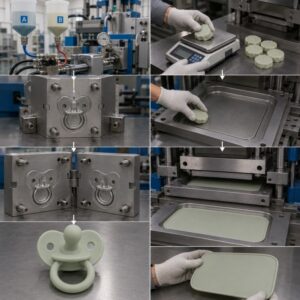
LSR is typically supplied as a two-component liquid material. During production, the components are metered and mixed before the silicone is injected into a heated mold and cured.
This production method can be highly automated.
It is often considered for products containing:
- Thin features
- Small openings
- Fine molded details
- Complex geometry
- High cavity counts
- Consistent repeated production
- Precision functional areas
Typical consumer-product examples may include:
- Silicone pacifiers
- Certain baby feeding components
- Small precision silicone parts
- Thin flexible components
- Some complex one-piece products
LSR’s ability to flow into fine mold features can be useful when a product contains small details or narrow structures.
However, the mold must also control:
- Gate position
- Venting
- Parting line
- Flash
- Demolding
- Cavity balance
LSR does not automatically eliminate engineering problems.
What Is Silicone Compression Molding?
Compression molding commonly uses solid or high-consistency silicone rubber.
A prepared quantity of silicone material is placed into an open heated mold.
The mold closes and applies pressure, causing the silicone to fill the cavity and cure into the final shape.
Compression molding is commonly considered for:
- Relatively simple molded products
- Larger silicone parts
- Mats
- Bibs
- Bowls
- Some toys
- Pads
- General consumer silicone products
It can be a practical process for many OEM projects where the structure does not require the flow characteristics or automation of LSR injection molding.
The product still requires proper control of:
- Material loading
- Mold temperature
- Cure
- Flash
- Parting lines
- Demolding
- Dimensions
- Surface quality
Compression molding should not be interpreted as a “low-quality” process.
For the right product geometry, it may be the more practical manufacturing solution.
What Is the Main Difference Between the Two Processes?
The biggest difference begins with the material form and how the silicone enters the mold.
LSR射出成形
The liquid silicone is metered and injected into a closed mold.
圧縮成形
A prepared solid silicone charge is placed into the mold before the mold closes and compresses the material.
This difference affects:
- Mold design
- 設備
- Material handling
- Automation
- Filling behavior
- Production workflow
But buyers usually care about the final result rather than the machine itself.
The more useful question is:
Which process can produce my product reliably at the required quantity, quality and total cost?
Which Process Is Better for Complex Geometry?
LSR injection molding is often considered when the product contains complicated flow paths or fine features.
Examples may include:
- Thin flexible lips
- Narrow openings
- Fine molded textures
- Small detailed structures
- Deep but fillable cavity features
- Multiple precision zones
Because the material is injected into the cavity, mold-flow strategy can be designed around the geometry.
However, complex geometry also increases the importance of:
- Gate design
- Venting
- Air evacuation
- Demolding
- Tool precision
A difficult product does not become easy simply because LSR is selected.
The structure should still go through custom silicone mold development and DFM before tooling.
Which Process Is Better for Larger or Simpler Products?
Compression molding can be very practical for larger and structurally simpler silicone products.
Examples may include:
- Silicone feeding mats
- Baby bibs
- Large flat products
- Simple bowls
- Some pet products
- Larger molded accessories
For these products, an advanced LSR injection system may not always provide enough benefit to justify additional tooling and process complexity.
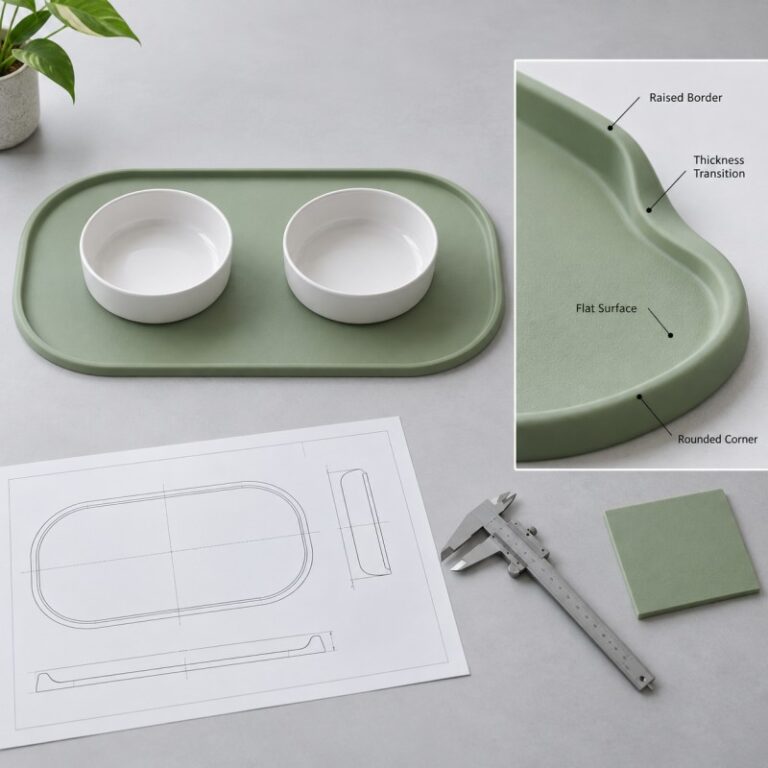
For example, a large flat silicone feeding mat with a simple raised edge may be well suited to a compression-molding approach.
The final decision still depends on:
- Product thickness
- テクスチャー
- サイズ
- Quantity
- Surface requirement
- Material specification
A large product is not automatically compression molded, just as a small product is not automatically LSR molded.
How Does Tooling Differ?
LSR Tooling
LSR injection molds may require precise control of:
- Runner system
- Gate
- Venting
- Mold sealing
- Cavity balance
- 温度
- Needle shut-off or related systems where applicable
This can increase mold complexity.
Compression Tooling
Compression molds may use a more direct cavity structure for suitable products.
However, the mold still needs accurate:
- Product geometry
- Parting line
- Cavity dimensions
- Surface finish
- Venting
- Demolding design
A simple process does not mean an imprecise mold.
Tooling should always be evaluated against the actual product.
Which Process Has Better Automation?
LSR injection molding generally offers greater potential for automated material feeding, injection and high-cavity production.
This can be advantageous when:
- Order quantities become large
- Product consistency is critical
- Labor content needs to be reduced
- Production is repeated for long periods
- Multi-cavity molds are used
Compression molding may involve more material preparation and loading depending on the production system.
However, automation alone should not determine the process.
A customer ordering a relatively simple product at a moderate quantity may not benefit from paying for a manufacturing system designed around much higher production volumes.
Does LSR Always Provide Better Dimensional Accuracy?
Not automatically.
LSR injection molding can provide strong repeatability when the material, mold and process are controlled correctly.
But final dimensional consistency is still influenced by:
- Silicone shrinkage
- Product flexibility
- Mold cavities
- Wall thickness
- 温度
- Measurement method
Compression-molded parts can also achieve controlled dimensions when the product and mold are designed appropriately.
The buyer should define which dimensions are actually critical instead of selecting a manufacturing process based only on a general claim such as:
LSR is more precise.
The correct question is:
Can this process consistently meet the critical dimensions required by this particular product?
What About Flash and Parting Lines?
Both processes require mold-separation strategy.
Flash risk depends on:
- Mold precision
- Parting-line design
- Material behavior
- Clamping
- Mold condition
- Venting
- Process parameters
LSR can enter extremely small gaps, making precise mold closing and flash control important.
Compression molding can also create excess material around the parting area that requires controlled trimming.
Buyers should approve the actual:
- Parting-line location
- Flash standard
- Trimming appearance
- Critical cosmetic zones
before mass production.
Example 1: Custom Silicone Baby Pacifier
A シリコーンベビー用品 such as a one-piece pacifier may contain:
- Thin nipple structures
- Smooth oral-contact surfaces
- Ventilation openings
- Fine transitions
- Detailed geometry
For this type of product, LSR injection molding may be evaluated because of the combination of material flow, fine structures and production repeatability.
However, final process selection still depends on the actual design and material specification.
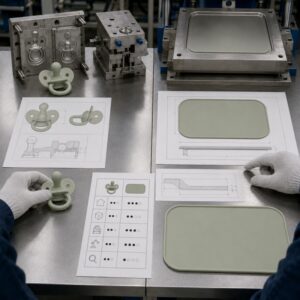
The manufacturer should review:
- Nipple geometry
- Gate position
- Venting
- Mold parting
- Demolding
- Surface quality
before tooling.
Example 2: Silicone Baby Feeding Mat
Consider a large one-piece silicone feeding mat.
The product may have:
- Large flat body
- Simple rounded corners
- Shallow raised spill edge
- Matte surface
- Anti-slip underside texture
This geometry may be a good candidate for solid silicone compression molding.
The process can be selected around:
- 製品サイズ
- Wall thickness
- Surface texture
- Material usage
- Production quantity
Trying to force the same process used for a small precision pacifier onto a large simple mat may not provide a meaningful customer benefit.
What About Silicone Pet Products?
The same rule applies to silicone pet products.
A pet product category can contain very different structures:
- Lick mats
- Feeding bowls
- Grooming brushes
- Chew toys
- Treat bags
- Travel accessories
A simple pet feeding mat and a complex small molded component should not automatically use the same process.
Product category does not determine manufacturing technology.
Geometry and production requirements do.
How Should Buyers Choose Between LSR and Compression Molding?
Before choosing the process, answer these questions:
1. How Complex Is the Product?
Does it contain thin features, fine details or difficult flow paths?
2. How Large Is the Product?
Large simple components may require a different approach from small precision parts.
3. What Quantity Is Expected?
Do not consider only the first order.
Estimate expected repeat orders or annual demand where possible.
4. Which Dimensions Are Critical?
Identify actual assembly, fit and functional requirements.
5. How Important Is Automation?
High-volume projects may benefit more from automated production.
6. What Is the Tooling Budget?
Compare total project cost instead of only unit price.
7. Which Material Is Required?
Material selection and process selection need to be reviewed together.
LSR vs Compression Molding Comparison
| 項目 | LSR射出成形 | Silicone Compression Molding |
|---|---|---|
| Typical material form | Two-component liquid silicone | High-consistency/solid silicone |
| Material enters mold | Injected into closed mold | Prepared charge compressed in mold |
| Automation potential | 高い | Depends on production setup |
| Fine structures | Often advantageous | Depends on geometry |
| Large simple parts | Possible, but process must justify it | Often practical |
| Tool complexity | Can be higher | Often simpler for suitable parts |
| Gate system | Required | Different material-loading logic |
| Flash control | Requires precise mold sealing | Requires controlled mold/trim design |
| Production quantity | Often attractive for repeated/high-volume work | Flexible for many project scales |
| Best selection method | DFM + geometry + volume + quality requirement | DFM + geometry + volume + quality requirement |
Common Buyer Mistakes
Choosing LSR Because It Sounds More Advanced
The most advanced process is not automatically the most economical or appropriate process.
Choosing Compression Molding Only Because the Mold Is Simpler
A complex product may create filling or consistency problems that justify another process.
Comparing Only Unit Price
A proper comparison should consider:
- Tooling
- Sampling
- 製造
- Labor
- Scrap
- Inspection
- Expected repeat volume
Selecting the Process Before the 3D Design Is Final
A change in:
- Wall thickness
- Hole geometry
- テクスチャー
- サイズ
- Undercut
may change the preferred molding route.
How LYA Silicone Supports Process Selection
LYA Silicone supports OEM and ODM development for baby, pet, outdoor and educational silicone products.
Project review may include:
- Product drawing review
- Application review
- Material selection
- Hardness discussion
- Process selection
- DFM analysis
- Mold development
- Sample production
- Functional validation
- Pilot production
- Mass-production quality control
The goal is not to sell a customer a particular molding process.
The goal is to select a process capable of producing the required product consistently and economically.
Frequently Asked Questions
Is LSR Injection Molding Always More Expensive?
Not necessarily.
Tooling and equipment requirements may be higher, but production volume, automation and part geometry affect the total project economics.
Is Compression Molding Only for Cheap Products?
そうだ。
Compression molding is a mature manufacturing process used for many high-quality silicone products.
Can the Same Product Be Made by Both Processes?
Sometimes yes.
The better process depends on material, geometry, quantity, appearance and quality requirements.
Is LSR Better for High-Volume Production?
It is often attractive for highly automated and repeated production, but the product must justify the tooling and process.
Is Compression Molding Better for Prototypes?
It can be practical for certain simpler structures, but prototype strategy depends on the final manufacturing process and project requirements.
Should the Process Be Confirmed Before Tooling?
Yes.
Mold design depends heavily on the selected material and molding method.
Choose the Process After Reviewing the Product
LSR injection molding and compression molding are not competing technologies where one must always win.
They are different manufacturing tools.
Before opening a mold, buyers should review:
- Product geometry
- サイズ
- Wall thickness
- 素材
- Quantity
- Automation
- Critical dimensions
- Surface quality
- Tooling investment
To determine the appropriate process for a custom silicone project, send リヤ・シリコーン your 3D drawing, product application, dimensions, material requirements, estimated quantity and critical quality requirements.