 German
  English
  French
  Spanish
  Polish
  Chinese
  Japanese
  Korean
  Russian
 Inhalt
Answer Excerpt
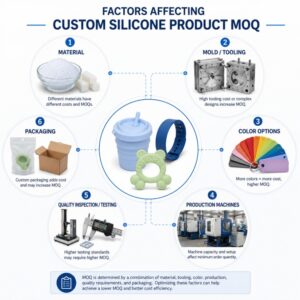
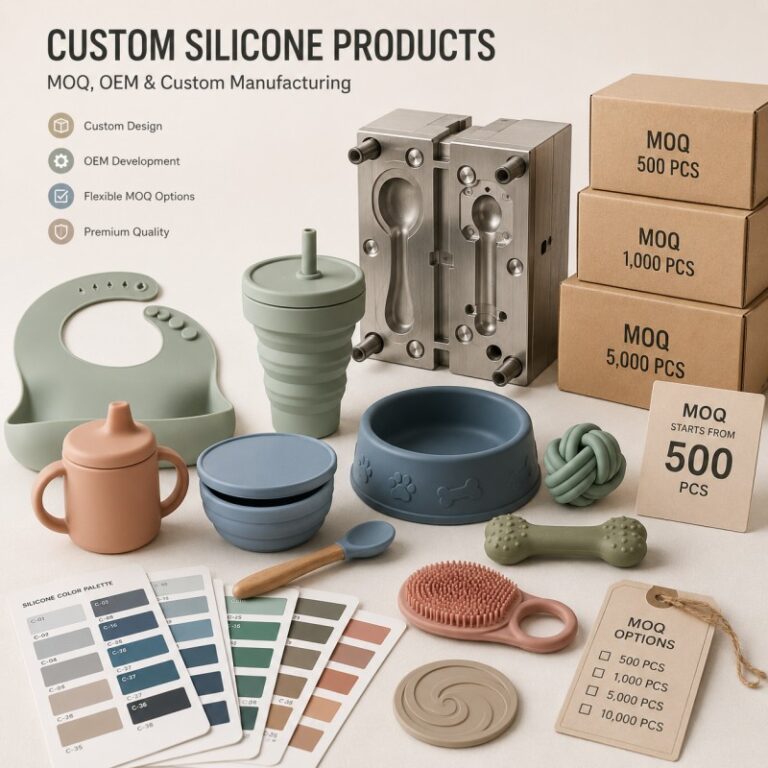
Custom silicone products usually require a minimum order quantity because production involves material preparation, color matching, mold setup, machine adjustment, quality inspection, packaging and production scheduling. The MOQ is not determined by product size alone. It also depends on whether an existing mold or private mold is used, how many colors and SKUs are required, and whether custom packaging or secondary processing is included.
When buyers first contact a silicone manufacturer, one of the most common questions is:
What is your minimum order quantity?
The answer is rarely one fixed number for every product.
A standard silicone bib made with an existing mold may have a very different MOQ from a newly developed multi-color silicone feeding set with custom packaging. Even when two products appear similar, their material, weight, molding cycle, logo process and packaging requirements may create completely different production conditions.
Understanding how MOQ is calculated helps buyers prepare more realistic project plans, compare quotations correctly and avoid unnecessary development costs.
What Does MOQ Mean in Custom Silicone Manufacturing?
MOQ stands for minimum order quantity.
It is the smallest production quantity that allows a manufacturer to complete an order under workable manufacturing and commercial conditions.
For custom silicone products, MOQ may apply to:
- Total order quantity
- Quantity per product
- Quantity per color
- Quantity per size
- Quantity per logo
- Quantity per packaging design
- Quantity per material or hardness
- Quantity per production batch
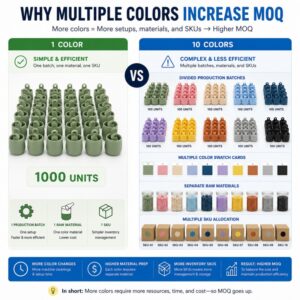
For example, a factory may accept a total order of 1,000 pieces, but if the buyer divides it into ten colors, each color has only 100 pieces.
That is not always equivalent to producing one color in a batch of 1,000 pieces. Each additional color may require separate material mixing, machine cleaning, production adjustment, color approval and inspection.
Therefore, buyers should always ask whether the MOQ applies to the total order or to each individual SKU.
Why Do Custom Silicone Products Require an MOQ?
1. Silicone Material Must Be Prepared for Each Production Batch
Silicone material is not simply taken from a warehouse and molded immediately.
Depending on the project, production preparation may include:
- Confirming the material grade
- Selecting the curing system
- Mixing color masterbatch
- Adjusting hardness
- Weighing the required material
- Preparing production records
- Testing color consistency
- Preventing material contamination
For customized colors, the production team must prepare enough material to achieve stable color and processing conditions.
When the quantity is too small, material loss during mixing, testing and machine preparation can represent a large percentage of the total order.
This is one reason why dividing a small order into many Pantone colors can increase the MOQ or unit price.
2. Mold and Machine Setup Require Time
Before mass production begins, the manufacturer may need to:
- Install the mold
- Clean the mold
- Set mold temperature
- Adjust pressure and curing time
- Confirm venting
- Test product release
- Inspect the first molded pieces
- Adjust flash and parting-line conditions
- Confirm dimensions and appearance
These steps are required whether the order contains 500 pieces or 50,000 pieces.
For a very small production quantity, setup time may be longer than the actual molding time. This makes the order inefficient unless the setup cost is included in the price.
MOQ allows setup and production time to be distributed across a reasonable number of products.
3. Production Creates Unavoidable Material and Process Loss
Manufacturing rarely converts 100% of prepared raw material into saleable finished products.
Possible production loss includes:
- Initial machine adjustment pieces
- Color-testing samples
- Products used for dimensional inspection
- Products used for functional testing
- Flash and trimming loss
- Products rejected during quality inspection
- Material remaining after production
- Packaging and assembly loss
The expected loss depends on product structure, mold design, process stability and inspection standards.
For products with complex geometry, thin walls, multiple cavities or strict appearance requirements, the manufacturer may need to prepare additional material and production allowance.
A very small order can therefore create a disproportionately high loss rate.
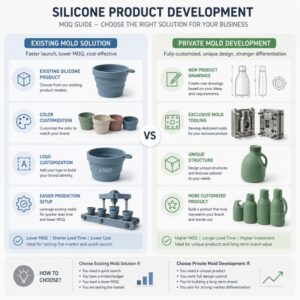
How Does an Existing Mold Affect MOQ?
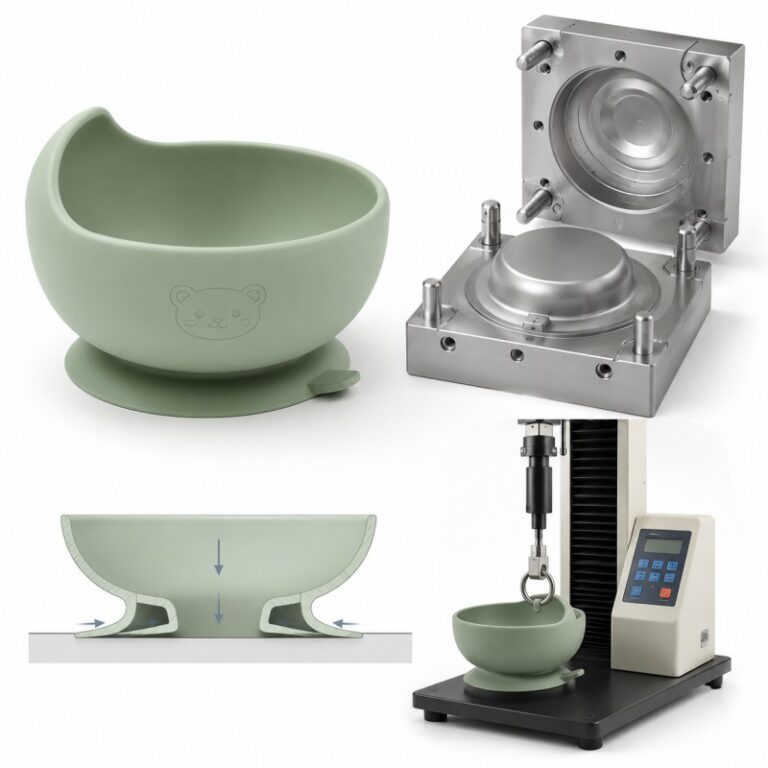
Using an existing mold generally reduces the development work required before production.
Buyers may be able to customize:
- Product color
- Logo
- Verpackung
- Product combination
- Zubehör
- Labeling
- Quantity per set
Because the basic mold already exists, the buyer normally does not need to pay for complete new mold development.
An existing mold can be suitable for:
- Testing a new market
- Launching a first private-label product
- Building a small product collection
- Validating packaging and sales channels
- Reducing initial investment
However, buyers should confirm:
- Whether the mold can accept a custom logo
- Whether the shape is available to other customers
- Which dimensions can be changed
- Whether a new logo insert is required
- Available material and hardness options
- Minimum quantity per color
- Mold condition and product consistency
An existing mold reduces tooling investment, but it does not automatically eliminate all production MOQ requirements.
The factory still needs to prepare material, set up production, inspect the product and complete packaging.
How Does a New Private Mold Affect MOQ?
A new private mold is normally required when the buyer needs:
- Exclusive product geometry
- Benutzerdefinierte Abmessungen
- Unique functional structure
- Proprietary surface texture
- Special wall thickness
- Different suction or folding performance
- Exclusive brand design
- A product that cannot be made with an existing mold
The first production order should be large enough to justify the mold-development and production setup process.
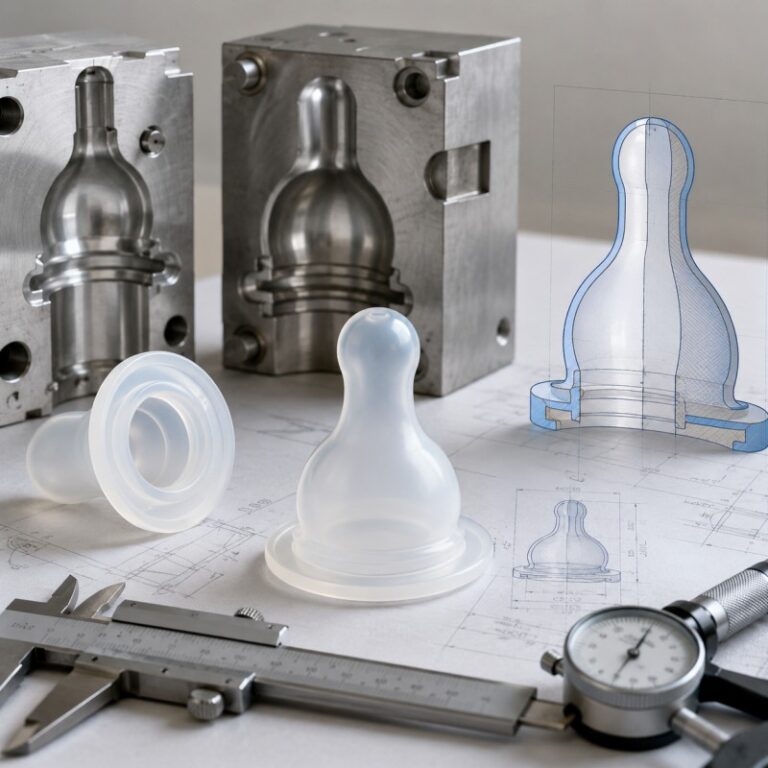
A private-mold project may involve:
- Product requirement review
- 2D or 3D drawing confirmation
- DFM review
- Mold design
- Mold manufacturing
- First sampling
- Product modification
- Sample approval
- Pilot production
- Massenproduktion
MOQ is only one part of this project.
Buyers should separately evaluate:
- Mold cost
- Sample cost
- Product unit cost
- Packaging cost
- Testing cost
- Shipping cost
- Expected annual demand
- Product lifecycle
A lower first-order MOQ may be possible, but the buyer must still consider whether the total development investment is commercially reasonable.
Why Do Multiple Colors Increase MOQ?
Every color can become a separate production batch.
For each additional color, the manufacturer may need to:
- Match a new Pantone color
- Prepare a separate material batch
- Clean color-mixing equipment
- Adjust the production process
- Produce first-piece samples
- Confirm color under standard lighting
- Separate inspection records
- Separate packaging and labels
Consider the following two order structures:
Order A
- One product
- One size
- One logo
- One color
- 1,000 pieces
Order B
- One product
- One size
- One logo
- Ten colors
- 100 pieces per color
Both orders contain 1,000 pieces, but Order B may require significantly more preparation and production management.
For a first order, it is usually more efficient to launch fewer colors and increase the number of pieces per color.
After the product achieves stable sales, additional colors can be introduced in later orders.
How Do Product Variations Affect MOQ?
A variation may include:
- Farbe
- Größe
- Hardness
- Qualität des Materials
- Logo
- Surface texture
- Verpackung
- Product set
- Accessory
- Language version
Each variation may create a new SKU.
Too many SKUs in a small first order can cause:
- Higher material preparation cost
- More frequent machine changes
- More complicated quality inspection
- Higher packaging cost
- More inventory management
- Increased labeling errors
- Greater risk of slow-moving stock
For new product launches, buyers should identify the strongest initial SKU rather than trying to release every possible variation at once.
A focused first order is generally easier to manufacture, inspect, ship and sell.
How Does Packaging Affect Minimum Order Quantity?
Custom packaging can have a separate MOQ from the silicone product itself.
Examples include:
- Printed color boxes
- Gift boxes
- Kraft boxes
- Paper sleeves
- Hanging cards
- Instruction manuals
- Barcode labels
- Custom polybags
- Packaging inserts
- Shipping cartons
A silicone factory may be able to produce 500 silicone products, while the packaging supplier may require a larger quantity of printed boxes.
This creates several possible solutions:
Use Standard Packaging
A plain bag, standard box or neutral packaging solution can reduce the first-order packaging requirement.
Add a Custom Label
A standard package with a custom sticker or barcode label may be suitable for market testing.
Produce Extra Packaging
The buyer may order more packaging than products and keep the remaining packaging for the next production batch.
Simplify the Artwork
Using one packaging design for several colors can reduce the number of packaging SKUs.
Packaging requirements should be discussed at the beginning of the project, not after the silicone products have already been produced.
Does a Smaller Silicone Product Always Have a Lower MOQ?
No.
Product size is only one factor.
A small silicone teether may require:
- Strict appearance control
- Oral-contact material
- Small functional details
- Precise logo molding
- Multiple colors
- Additional product testing
- Individual retail packaging
A larger but simple silicone mat may have:
- One color
- Simple geometry
- Standard hardness
- Basic packaging
- Less complicated inspection
The smaller product may therefore require more production preparation than the larger product.
MOQ should be evaluated according to the complete manufacturing process rather than product dimensions alone.
What Is the Difference Between Sampling Quantity and Production MOQ?
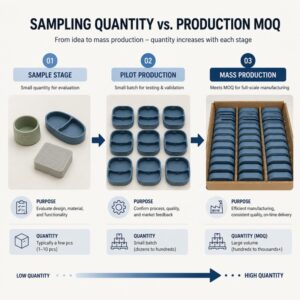
Sample quantity and mass-production MOQ are different concepts.
Prototype or Mold Sample
Used to evaluate:
- Product geometry
- Dimensions
- Hardness
- Farbe
- Surface finish
- Logo
- Assembly
- Funktion
The sample quantity is normally small because the goal is validation, not commercial sale.
Pilot Production
Used to evaluate:
- Process stability
- Mold consistency
- Production cycle
- Packaging workflow
- Inspection standards
- Batch color consistency
- Assembly efficiency
Pilot production may involve more pieces than initial sampling but fewer than full mass production.
Mass Production
Used for commercial orders after the product specification has been approved.
The mass-production MOQ is based on the final material, color, mold, inspection and packaging conditions.
Buyers should not expect the sample price per piece to be the same as the mass-production unit price.
Sample production includes engineering, setup and validation work that is distributed across only a small number of products.
What Is a Reasonable MOQ for a New Silicone Product?
There is no universal MOQ that applies to all silicone products.
The appropriate quantity depends on:
- Existing mold or private mold
- Product weight
- Number of cavities
- Material
- Hardness
- Number of colors
- Number of sizes
- Logo process
- Surface requirements
- Verpackung
- Testing
- Production schedule
For many LYA Silicone projects, production MOQ may start at approximately 500 pieces, subject to product structure, material, color, packaging and manufacturing process.
Sampling can be completed before mass production so that buyers can evaluate the product before placing a production order.
The final MOQ should always be confirmed after reviewing the actual project requirements.
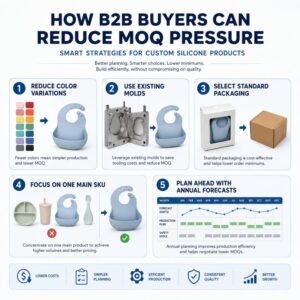
How Can Buyers Reduce MOQ Pressure?
Start with Fewer Colors
Choose one to three core colors instead of launching a large color collection.
Use an Existing Mold for Market Validation
An existing mold can reduce tooling investment and shorten development time.
Use Standard Packaging
Standard packaging with a custom label can be more practical for an initial order.
Launch One Main Product First
Validate the strongest product before expanding into a complete collection.
Keep One Hardness and Material Specification
Avoid creating separate material batches unless different hardness levels are functionally necessary.
Provide an Annual Forecast
A realistic annual forecast helps the manufacturer understand the long-term potential of the project.
Confirm the Design Before Opening the Mold
Repeated design changes increase development time, sample cost and production risk.
Combine Orders Carefully
Different colors or products may sometimes be scheduled together, but buyers should not assume that completely different products can automatically share one MOQ.
Separate Product Development from Retail Expansion
First confirm that the product works. Add more colors, sizes and packaging options after the core SKU has been validated.
When Can an Extremely Low MOQ Create Problems?
A very low MOQ may appear attractive, but buyers should evaluate what has been removed or compromised to achieve it.
Possible risks include:
- Unstable color matching
- Use of leftover material
- Limited material choices
- Shared or non-exclusive molds
- Reduced inspection
- Inconsistent packaging
- High unit cost
- Unclear traceability
- Difficulty repeating the same specification
- Limited support for product modification
The lowest MOQ is not always the best commercial option.
For a brand product, consistency between the first order and future repeat orders is usually more important than obtaining the smallest possible initial quantity.
A professional supplier should explain what is included in the MOQ rather than only presenting a number.
Questions Buyers Should Ask About MOQ
Before confirming an order, ask the manufacturer:
- Is the MOQ calculated per product or per color?
- Does each size have a separate MOQ?
- Is custom packaging included in the MOQ?
- Can an existing mold be used?
- Is a custom logo insert required?
- Can samples be produced before the mass order?
- Is the quoted unit price based on the confirmed quantity?
- What happens if the quantity changes?
- Can remaining packaging be stored for repeat orders?
- Does the MOQ include inspection and assembly?
- Are there additional setup or color-matching charges?
- Can the first order be structured as a pilot production batch?
These questions help buyers compare suppliers using the same project scope.
How LYA Silicone Supports New Product Launches
LYA Silicone supports customized silicone product development for baby, Haustier, household, outdoor and educational product brands.
Project support may include:
- Existing product customization
- Private mold development
- DFM review
- Material and hardness selection
- Pantone-Farbabstimmung
- Logo-Prägung oder -Entprägung
- Prototype and sample production
- Product testing support
- Packaging coordination
- Pilot production
- Massenproduktion
- Quality inspection
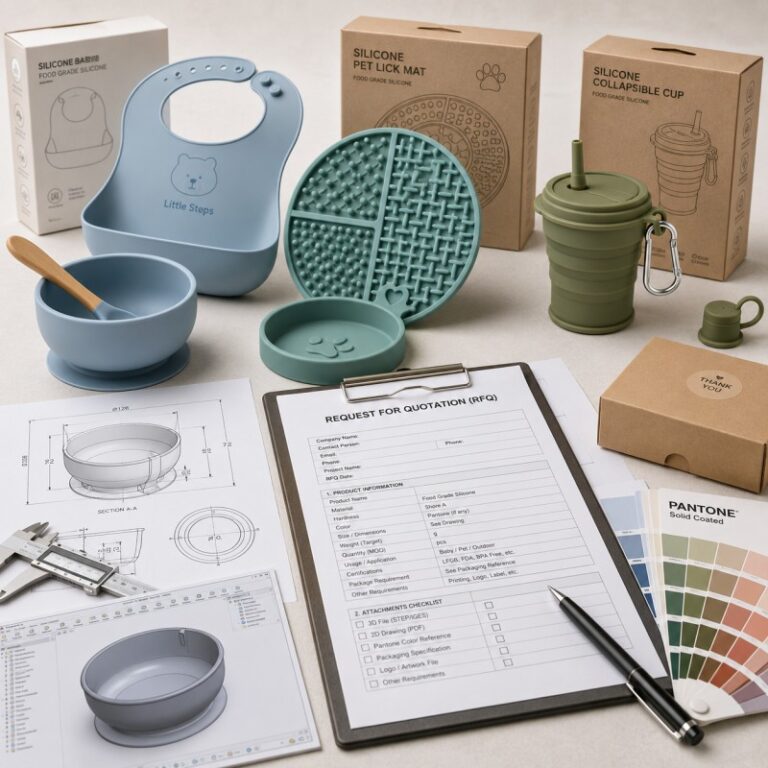
Buyers can begin with a drawing, physical sample, product concept or reference image.
The project team can then evaluate the suitable mold route, sample process, MOQ and production plan.
MOQ Planning Checklist
| Project Item | Questions to Confirm |
|---|---|
| Produkt | Which product will be launched first? |
| Mold | Existing mold or new private mold? |
| Quantity | Total quantity and quantity per SKU? |
| Farben | How many Pantone colors? |
| Sizes | Does each size require a separate batch? |
| Material | One material or multiple formulations? |
| Hardness | Is one hardness suitable for all functions? |
| Logo | Molded, printed or laser-marked? |
| Verpackung | Standard or fully customized packaging? |
| Market | Which country or region will receive the product? |
| Testing | Which product and material tests are required? |
| Forecast | What is the expected repeat-order volume? |
| Schedule | When are samples and mass production required? |
Frequently Asked Questions
Can I Order Fewer Than 500 Pieces?
Possibly, depending on whether an existing mold is available and whether the project requires custom colors, materials, logos or packaging.
The manufacturer must review the complete project before confirming a lower quantity.
Does Every Color Require a Separate MOQ?
Often, yes.
Each color normally requires separate material preparation and production control. The exact requirement depends on product weight, material and production schedule.
Can Different Products Be Combined to Reach the MOQ?
Sometimes products from an existing collection can be combined commercially, but different molds and materials still require separate production setup.
The manufacturer must confirm whether combination is practical.
Is the Mold Fee Included in the MOQ?
Normally, the mold fee and product quantity are quoted separately.
The mold fee covers tooling development, while the production MOQ applies to the finished product order.
Can I Start with Samples Before Placing the MOQ?
Yes.
Samples should be reviewed for dimensions, hardness, color, logo, function and appearance before mass production.
Does Custom Packaging Have Its Own MOQ?
Frequently, yes.
Printed boxes, sleeves and instruction manuals may be supplied by packaging manufacturers with their own minimum quantities.
Will the Unit Price Decrease If the Order Quantity Increases?
It may decrease because setup, material preparation, inspection and packaging costs can be distributed across more units.
However, the exact price also depends on product weight, cycle time and packaging.
Is the Lowest MOQ Supplier Always the Best Choice?
No.
Buyers should also evaluate material control, mold quality, repeat-order consistency, inspection, traceability and communication.
Plan a Practical First Order
A successful first order should balance market risk with manufacturing reality.
Instead of launching many colors, sizes and packaging versions at once, buyers can begin with:
- One core product
- A limited number of colors
- One confirmed material
- One packaging structure
- Clear quality standards
- A realistic production quantity
After the first product is validated, the collection can expand based on real market demand.
To discuss the appropriate MOQ for your custom silicone product, send LYA-Silikon your product drawing or reference image, dimensions, colors, logo, packaging requirements, target market and estimated quantity.