 Polish
  English
  French
  German
  Spanish
  Chinese
  Japanese
  Korean
  Russian
 Zawartość
Wprowadzenie
Many baby brands ask whether silicone pacifiers can be safely customized with unique shapes, colors, logos, and packaging. This question matters because pacifiers are used directly in infants’ mouths and require careful material, structure, and quality control. This guide explains how custom silicone pacifier manufacturing works for B2B buyers.
Answer Excerpt
Custom silicone pacifier manufacturing is the OEM/ODM process of producing food-grade silicone pacifiers for baby brands, including product design, mold development, silicone molding, custom colors, logo, packaging, inspection, and bulk delivery. Buyers should choose a manufacturer that understands baby-safe materials, pacifier structure, quality control, and target-market requirements.
Transition Paragraph
Below are the key questions baby brands, importers, wholesalers, and private label sellers usually ask before starting a custom silicone pacifier project.
People Also Ask: Can silicone pacifiers be custom manufactured?
Yes. Silicone pacifiers can be custom manufactured for baby brands through OEM/ODM production, including custom nipple shape, shield design, handle style, color, logo, packaging, and product set development.
For baby product brands, custom manufacturing is useful when standard market designs are not enough. A brand may want a minimalist one-piece silicone pacifier, an animal-shaped pacifier, a pacifier and case set, a pacifier clip set, or a full baby gift bundle. Custom manufacturing allows the brand to control both function and appearance.
A complete silicone pacifier project usually starts with a product idea, reference sample, drawing, or 3D file. Then the manufacturer evaluates the structure, material, mold feasibility, color options, logo position, packaging requirements, and production timeline.
LYA Silicone provides custom silicone pacifier OEM solutions for baby product brands, importers, wholesalers, Amazon sellers, Shopify brands, private label sellers, and global buyers looking for custom food-grade silicone products. Your website already has a Silicone Pacifier category covering custom BPA-free silicone baby pacifiers, food-grade soft silicone soothers, and OEM baby feeding products.
People Also Ask: Are silicone pacifiers safe for babies?
Silicone pacifiers can be suitable for baby products when they are made with appropriate food-grade silicone, designed correctly, tested for the target market, and produced under controlled manufacturing conditions.
Safety is the first concern for pacifiers because the product is placed directly in a baby’s mouth. Buyers should not only ask whether the pacifier is “food grade” or “BPA-free.” They should also check product structure, nipple strength, shield design, ventilation holes, material documentation, and market compliance requirements.
For the U.S. market, pacifiers are regulated under 16 CFR Part 1511, which covers requirements such as guard or shield design, protrusions, structural integrity tests, cords or attachments, and labeling. CPSC business guidance also states that pacifiers must meet requirements under 16 CFR Part 1511 and applicable ASTM F963 requirements, including requirements related to rubber nipples and heavy elements.
For brands, this means a pacifier project should not be treated like an ordinary silicone promotional product. A good supplier should support product review before tooling, controlled production during molding, and careful inspection before delivery.
People Also Ask: What material is used to make silicone pacifiers?
Most custom silicone pacifiers use food-grade silicone or baby-safe silicone materials. Many precision pacifier projects use liquid silicone rubber because it supports soft touch, stable molding, fine details, and consistent production quality.
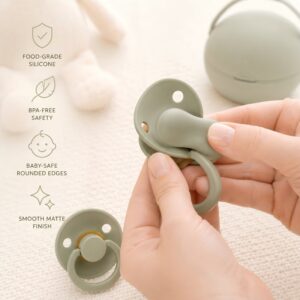
Silicone is widely used in maternity and baby products because it is soft, flexible, heat resistant, durable, and easy to clean. For pacifiers, buyers usually care about softness, odor control, bite resistance, surface smoothness, color stability, and safe contact with the baby’s mouth.
Food-grade silicone is commonly requested for baby product projects. In the U.S., FDA 21 CFR 177.2600 covers rubber articles intended for repeated food-contact use and describes permitted rubber articles and related conditions. Although pacifiers have their own child product safety requirements, many buyers still use food-contact silicone expectations when selecting materials for baby products.
For custom pacifier projects, material decisions may include silicone hardness, transparency, matte or glossy finish, color masterbatch, and molding method. Softer pacifier nipples, thicker shields, and matching silicone cases may require different molding and tooling considerations.
People Also Ask: How are silicone pacifiers manufactured?
Silicone pacifier manufacturing normally includes product design review, mold development, silicone molding, trimming, inspection, cleaning, packaging, and bulk shipment. For custom projects, samples should be approved before mass production.
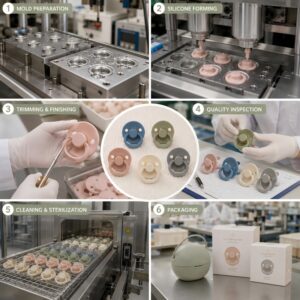
The first step is design confirmation. The buyer confirms the pacifier style, target age range, nipple shape, shield design, air holes, handle, logo, color, and packaging.
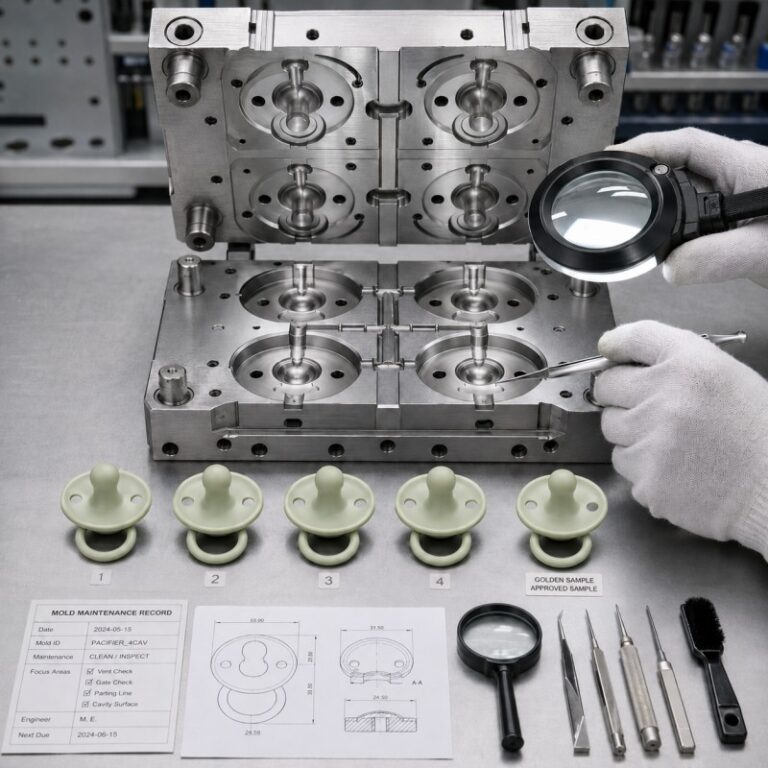
The second step is mold development. Pacifiers require accurate tooling because small structural details affect safety, comfort, surface finish, and consistency. A poor mold can cause flash, deformation, uneven thickness, poor logo detail, or unstable dimensions.
The third step is silicone molding. Depending on the design, a pacifier may be made by silicone compression molding or liquid silicone rubber molding. Production parameters such as temperature, pressure, curing time, and demolding method must be controlled carefully.
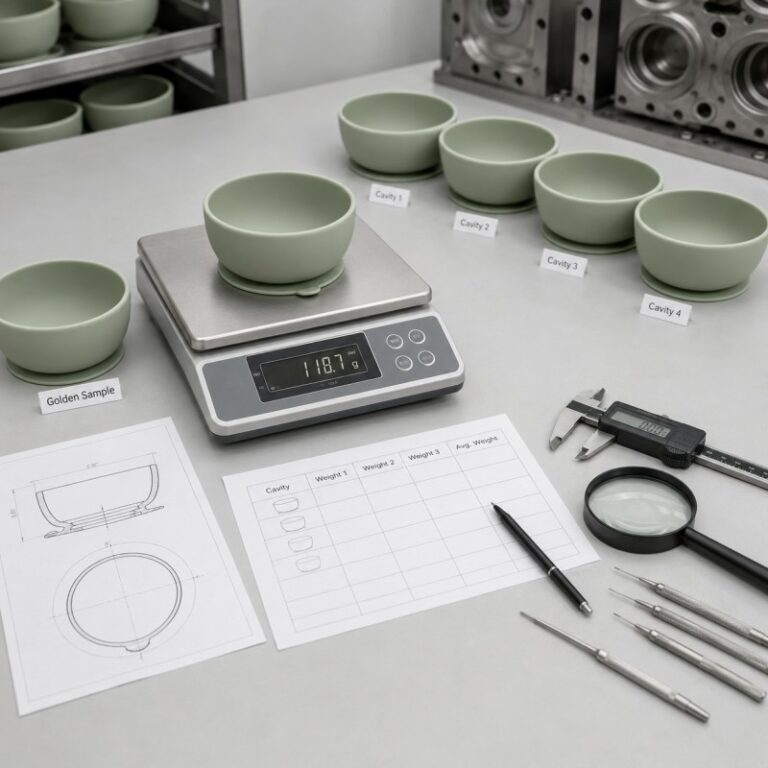
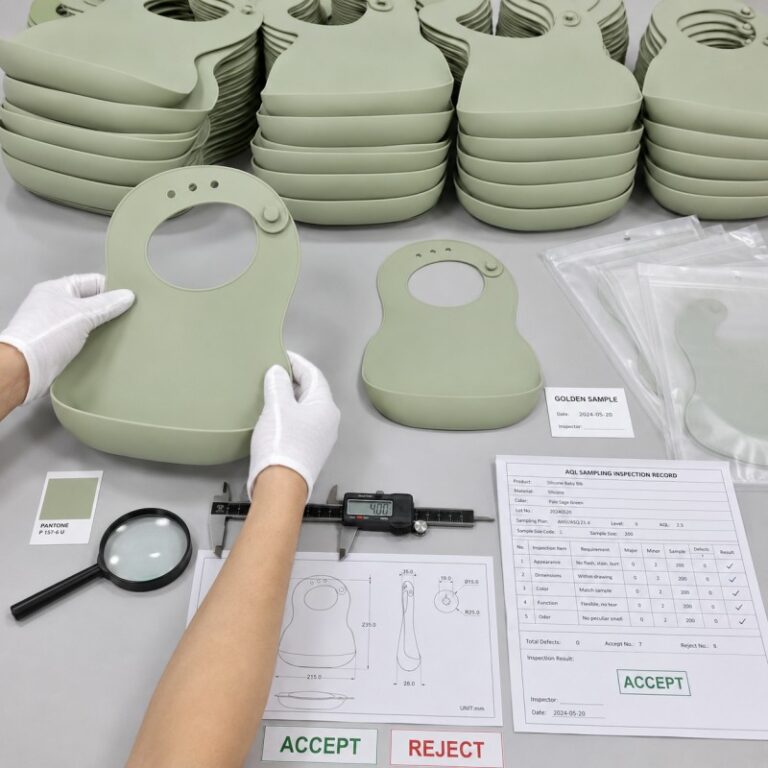
The fourth step is post-processing. This may include flash trimming, visual inspection, dimensional checking, color comparison, surface cleaning, and packaging inspection. For baby products, inspection should focus on burrs, sharp edges, contamination, odor, deformation, surface defects, and consistency between batches.
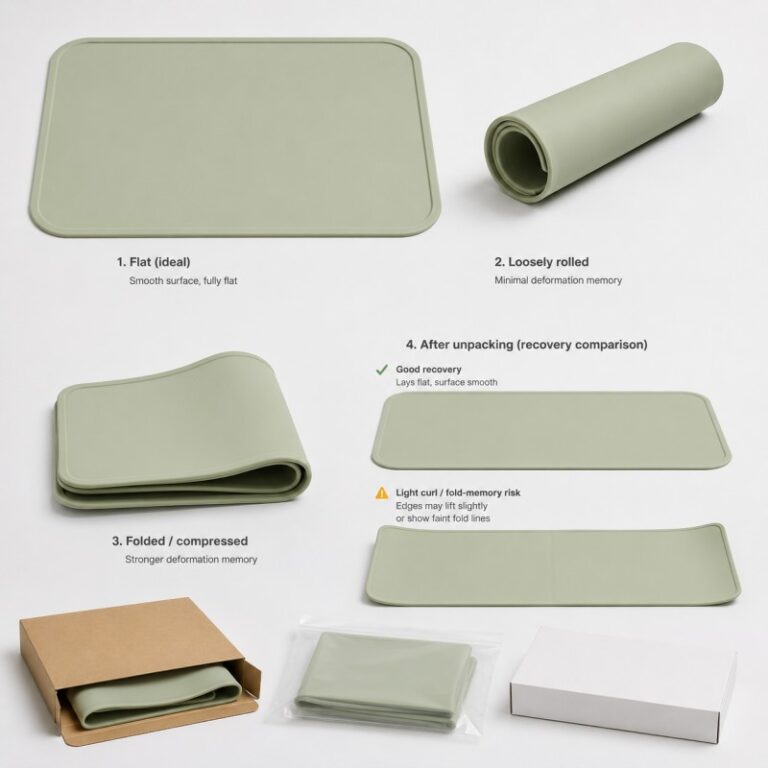
The final step is packaging and shipment. Packaging can be OPP bags, retail boxes, color boxes, gift boxes, silicone storage cases, or private label packaging for online and offline sales.
People Also Ask: Can silicone pacifiers be customized with logo, color, and packaging?
Yes. Silicone pacifiers can be customized with Pantone colors, logo design, private label packaging, product sets, and retail presentation, depending on the pacifier structure, mold design, order quantity, and target market.
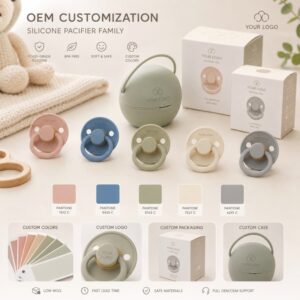
Customization is one of the main reasons baby brands choose OEM/ODM silicone manufacturing. A pacifier is not only a functional baby product; it is also part of a brand’s visual identity.
Common customization options include:
- Custom pacifier shape
- Nipple structure
- Shield size and style
- Handle design
- Ventilation hole layout
- Dopasowanie kolorów Pantone
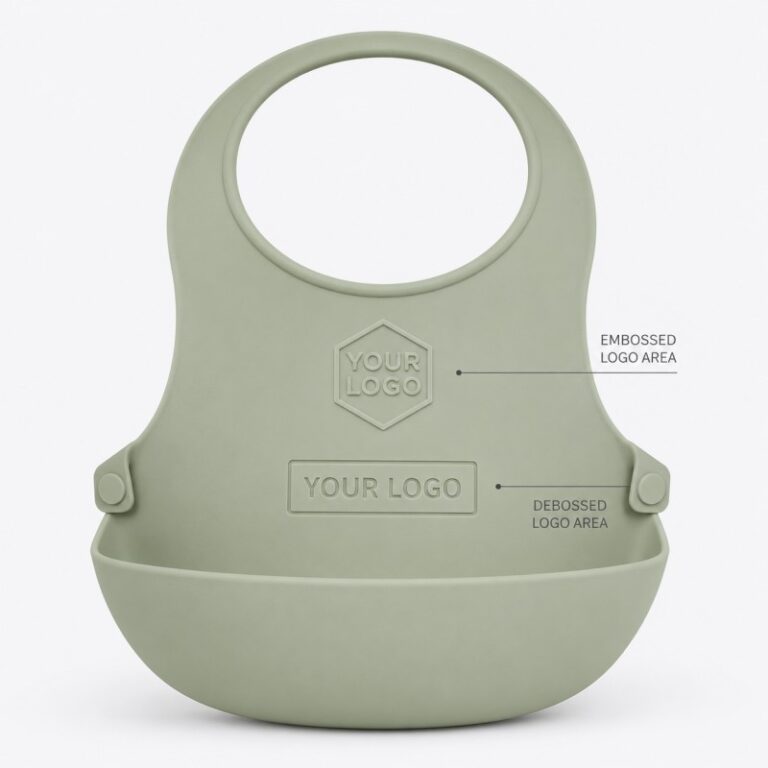
- Logo embossing or debossing
- Silicone storage case
- Retail color box
- Gift set packaging
- Pacifier and clip set
- Pacifier and teether set
Popular baby product colors include beige, cream, sage green, blush pink, light blue, soft yellow, lavender, and other neutral pastel colors. These colors are common for modern baby brands, Amazon listings, Shopify stores, boutique baby products, and gift sets.
Explore more niestandardowe silikonowe produkty dla niemowląt from LYA Silicone.
People Also Ask: What regulations apply to silicone pacifiers?
Pacifier regulations depend on the target market, but buyers should pay attention to product structure, material safety, testing, labeling, and documentation before selling in regulated markets.
For the United States, pacifiers are covered by 16 CFR Part 1511, which includes requirements for shield design, protrusions, structural integrity, cords or attachments, and labeling. CPSC also notes that pacifiers must meet applicable ASTM F963 requirements.
For buyers selling in North America, Europe, Japan, South Korea, Australia, Southeast Asia, or other global markets, compliance should be confirmed before mass production. The same design may require different testing or labeling depending on the country, age group, product set, packaging claims, and sales channel.
A silicone manufacturer can help with production and basic technical preparation, but final market compliance should be confirmed with qualified testing laboratories or compliance consultants. This is especially important for importers, Amazon sellers, and private label brands because marketplace platforms may request documentation before listing or after inspection.
People Also Ask: What should buyers check before choosing a silicone pacifier manufacturer?
Buyers should choose a silicone pacifier manufacturer with real factory capability, baby product experience, custom mold support, material control, quality inspection, packaging service, and stable B2B delivery experience.
Price is important, but it should not be the only decision factor. Pacifiers are sensitive baby products, so buyers should evaluate the supplier from several angles.
| Project Item | What Buyers Should Confirm | Why It Matters |
|---|---|---|
| Materiał | Food-grade silicone, BPA-free option, hardness, color masterbatch | Affects baby safety, softness, appearance, and market acceptance |
| Structure | Nipple shape, shield size, ventilation holes, handle design | Affects comfort, usability, tooling, and compliance review |
| Personalizacja | Pantone colors, logo position, surface finish, product set combination | Helps baby brands build private label identity |
| Opakowanie | OPP bag, color box, gift box, storage case, barcode, instructions | Affects retail sales, Amazon listings, and customer experience |
| Quality Control | Surface defects, flash, odor, deformation, dimensions, packaging accuracy | Reduces complaints, returns, and bulk production risk |
| Rynek docelowy | U.S., Europe, Japan, South Korea, Australia, Southeast Asia | Different markets may require different testing and documents |
First, check manufacturing capability. Does the supplier own a silicone processing plant? Can it support mold development, sampling, silicone molding, trimming, inspection, packaging, and bulk delivery? Shenzhen LYA Silicone Rubber Products Co., Ltd. was established in 2001, and your contact page positions the company as a silicone products manufacturer with custom product categories and inquiry support.
Second, check baby product experience. A pacifier is different from a general household silicone item. The factory should understand soft silicone performance, small product precision, smooth surface requirements, safe design details, and parent-focused product expectations.
Third, check customization ability. A brand may need custom colors, logo, packaging, barcodes, instruction cards, retail boxes, and mixed baby product sets. The supplier should be able to support both manufacturing and brand presentation.
Fourth, check quality control. Buyers should ask how the factory controls color difference, size tolerance, surface defects, flash, odor, deformation, contamination, and packaging accuracy before shipment.
Finally, check communication and sampling speed. Fast sampling is useful for product launches, trade shows, seasonal promotions, Amazon testing, and private label collection development.
People Also Ask: How do I start a custom silicone pacifier project?
To start a custom silicone pacifier project, prepare your product idea, reference photos, target age range, size, color plan, logo file, packaging style, estimated order quantity, and target market. Then ask the manufacturer to review feasibility, tooling, sampling, cost, and timeline.
A clear project brief helps reduce mistakes. For example, a baby brand may say: “We need a soft food-grade silicone pacifier for 6–18 months, two neutral colors, logo on the storage case, retail color box, and shipment to the U.S. market.” This gives the factory enough information to evaluate product structure, material, mold requirements, packaging, cost, and testing needs.
A typical custom project may include:
- Product idea review
- Structure evaluation
- 3D drawing or sample confirmation
- Mold quotation
- Mold making
- Sample production
- Sample approval
- Packaging confirmation
- Produkcja masowa
- Final inspection
- Shipment
At LYA Silicone, buyers can start with a drawing, sample, product photo, or rough product idea. The team can help review the design and provide a suitable custom silicone pacifier manufacturing solution.
FAQ About Custom Silicone Pacifier Manufacturing
What information should I provide for a custom silicone pacifier quote?
For a faster quote, buyers should provide product photos, drawings, size requirements, target age range, material requirements, color options, logo file, packaging style, estimated order quantity, and target market. If you already have a sample, it can also help the factory evaluate tooling and production details more accurately.
Can LYA Silicone make pacifiers in custom shapes and colors?
Yes. LYA Silicone can support custom pacifier shapes, nipple designs, shield styles, handle structures, Pantone colors, logo options, and packaging solutions. Custom designs usually require mold development before sample production and mass production.
Can you produce silicone pacifiers for private label brands?
Yes. LYA Silicone supports private label silicone pacifier manufacturing for baby brands, importers, wholesalers, Amazon sellers, Shopify brands, and distributors. Custom logo, retail packaging, gift boxes, storage cases, and product set combinations can be discussed based on the project requirements.
How long does sampling usually take?
Sampling time depends on the product structure and mold complexity. If a new custom mold is required, the process usually includes design review, mold making, trial production, sample adjustment, and final sample approval. Buyers should confirm the timeline with the factory before placing bulk orders.
What quality points should be checked before bulk production?
Before bulk production, buyers should confirm material, color, softness, size, surface finish, logo effect, packaging layout, and structural details. For pacifiers, special attention should be given to smooth edges, ventilation holes, nipple strength, odor, deformation, surface defects, and packaging accuracy.
Can silicone pacifiers be packed together with other baby products?
Yes. Silicone pacifiers can be packed with pacifier cases, pacifier clips, baby teethers, feeding spoons, bowls, bibs, or gift box sets. This is useful for baby product brands that want to develop a complete silicone baby product collection.
Wnioski
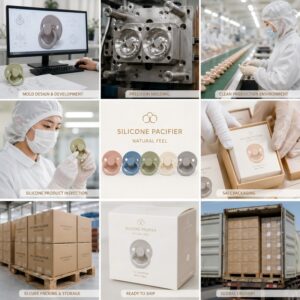
Custom manufacturing of silicone pacifiers is a strong opportunity for baby product brands that want safe, soft, durable, easy-clean, and brandable baby care products. However, pacifiers are not simple silicone items. They require careful material selection, structural design, mold development, quality control, packaging planning, and market compliance review.
For B2B buyers, the best partner is not only the lowest-price supplier. It is a silicone factory that understands baby product requirements, supports OEM/ODM customization, offers stable bulk production, and helps brands move from idea to finished product efficiently.
Shenzhen LYA Silicone Rubber Products Co., Ltd. provides custom food-grade silicone product manufacturing for baby, pet, outdoor, toy, and household product brands. With factory-direct pricing, custom logo and packaging support, fast sampling, stable production, and reliable delivery, LYA Silicone can support custom silicone pacifier projects for global markets.
Have questions about pacifier design, material, color, packaging, or OEM production? Share your project requirements with LYA Silicone, or leave a comment and discuss what type of custom silicone baby product you want to develop next.
Kontakt LYA Silicone to discuss your custom silicone pacifier project.