 Japanese
  English
  French
  German
  Spanish
  Polish
  Chinese
  Korean
  Russian
 内容
Answer Excerpt
Good silicone stacking cups design requires more than making several cups in different sizes. Diameter progression, wall taper, rim geometry, nesting clearance, silicone hardness, wall thickness and dimensional tolerances all affect whether the cups stack securely, nest smoothly and separate easily. If these features are not coordinated during DFM, the finished set may wobble, stick together, jam during nesting or feel inconsistent between production batches.
A stacking cup set looks simple.
Usually, the product contains several soft cups arranged from large to small.
But when an OEM brand starts developing its own set, several practical problems can appear:
- Cups do not sit straight when stacked
- One cup falls too deeply into another
- Two nested cups become difficult to separate
- A tower leans or wobbles
- Soft rims collapse under the next cup
- One production cavity fits differently from another
- Packaging pressure changes the cup shape
These problems are rarely caused by one dimension alone.
Stacking performance comes from the relationship between all parts in the set.
What Makes a Silicone Stacking Cup Different From a Normal Cup?
A normal drinking cup mainly needs to:
- Hold liquid
- Stand properly
- Feel comfortable in the hand
A stacking or nesting cup has additional geometric relationships.
Each cup must interact with:
- The cup above it
- The cup below it
- The next larger cup during nesting
- The next smaller cup during nesting
This means each part belongs to a complete dimensional system.
For カスタムシリコーン製品, modifying only one cup without checking the rest of the set can create unexpected fit problems.
The design should therefore be reviewed as a complete stack rather than as six unrelated products.
Why Is Diameter Progression Important?
Consider a six-piece stacking cup set.
Cup 1 is the smallest.
Cup 6 is the largest.
If the diameter difference between each cup is too small, the next cup may not have enough stable contact area.
If the difference is too large, the set may look disconnected and stacking may become unstable.
The engineering team needs to control:
- Top diameter
- Bottom diameter
- Overall height
- Rim diameter
- Contact diameter
- Size progression between adjacent cups
A visually smooth progression in CAD does not automatically create a stable physical stack.
Soft silicone can deform slightly under load.
The product therefore needs to be validated with real molded samples.
Why Do Silicone Stacking Cups Sometimes Stick Together?
One of the most common problems appears when cups are nested for storage.
A smaller cup slides into a larger one.
But when the user tries to separate them, the cups feel stuck.
Several factors can cause this.
Insufficient Nesting Clearance
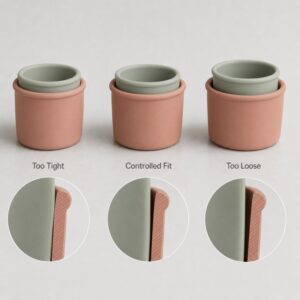
If the gap between two nested surfaces is too small, the silicone surfaces may contact over a large area.
This increases friction.
Nearly Parallel Walls
If the outer wall of the smaller cup and the inner wall of the larger cup have very similar angles, they may create extensive surface contact.
A controlled difference in geometry can make separation easier.
Soft Silicone Deformation
Soft walls can compress slightly during nesting.
The smaller cup may enter farther than expected and become mechanically wedged.
Surface Condition
A very smooth or slightly tacky silicone surface can behave differently from a controlled matte surface.
Surface finish should therefore be evaluated together with nesting geometry.
Trapped Air
Some cup structures can temporarily trap air between nested surfaces.
Depending on the product geometry, an appropriate air-release path or controlled gap may help prevent suction-like resistance.
The solution should come from the actual product structure rather than adding random holes.
Why Does Wall Taper Matter?
A tapered cup is narrower at one end and wider at the other.
For nesting products, taper can help guide one cup into another.
But the taper needs to be coordinated.
If the walls are too parallel:
- Nesting may become tight
- Contact area may become excessive
- Separation may become harder
If the taper difference is too aggressive:
- Cups may sit too loosely
- Nesting depth becomes inconsistent
- The product may rattle in the package
The correct geometry depends on:
- Cup height
- Wall thickness
- Material hardness
- Surface finish
- Target nesting depth
This is why the geometry should be reviewed during custom silicone mold development rather than adjusted only after tooling is complete.
Why Do Stacking Cups Wobble?
A tower can wobble even when every cup looks correct individually.
Typical causes include:
Uneven Rim Plane
If a cup rim is not sufficiently flat, the next cup may sit at an angle.
Inconsistent Contact Surface
The upper cup should meet the lower cup in a predictable area.
If contact happens only at one side, the stack can lean.
Excessively Soft Structure
A very soft cup may deform under the weight of several cups above it.
Base Warpage
If the cup base is not flat, the entire tower starts from an unstable foundation.
Dimensional Variation
Small differences in diameter can accumulate across several parts.
This is especially important when a six- or eight-piece set is stacked together.
One slightly different part may affect everything above it.
How Does Silicone Hardness Affect Stacking Performance?
Hardness changes how the same geometry behaves.
A softer silicone cup may:
- Feel more comfortable
- Compress more easily
- Bend more during stacking
- Grip adjacent cups more strongly during nesting
A harder silicone cup may:
- Hold its geometry more firmly
- Feel more structured
- Reduce some deformation
But harder is not automatically better.
The correct silicone hardness should balance:
- User feel
- Product function
- Stacking stability
- Nesting behavior
- 耐久性
The actual geometry and hardness should be tested together.
Changing hardness after the mold is finished can change the perceived fit even though all mold dimensions remain unchanged.
Why Is Rim Geometry Important?
The rim is one of the most important contact areas.
A good rim should provide:
- Rounded touch
- Adequate stiffness
- Predictable stacking contact
- Consistent molded shape
If the rim is extremely thin, it may:
- Curl
- Collapse
- Deform after packaging
- Create inconsistent stacking height
If it is excessively thick, the cup may:
- Feel bulky
- Become unnecessarily stiff
- Require more material
- Change the visual proportion
A rounded rim with sufficient structural support usually gives the engineering team better control than an unsupported thin edge.
Example: A Six-Piece Silicone Nesting Cup Set
Consider a six-piece silicone stacking toy.
Each cup has:
- A truncated-cone body
- Open top
- Rounded rim
- Flat lower surface
- Slightly different diameter
- Coordinated height
- Soft matte silicone surface
The design should allow two different functions.
Function 1 — Stack Upward
Cup 6 sits at the bottom.
Cup 5 sits on Cup 6.
The process continues until Cup 1 is at the top.
The tower should:
- Remain centered
- Avoid excessive lean
- Resist easy sliding
- Maintain consistent visual spacing
Function 2 — Nest Together
Cup 1 fits inside Cup 2.
Cup 2 fits inside Cup 3.
Eventually the complete set fits inside Cup 6.
The nested set should:
- Store compactly
- Avoid excessive friction
- Avoid mechanical jamming
- Separate without excessive pulling
A geometry that works perfectly for stacking may not automatically work perfectly for nesting.
Both functions need validation.
Why Are Dimensional Tolerances More Complicated in a Multi-Part Set?
A single cup may be within tolerance.
The next cup may also be within tolerance.
But the interaction between the two may still be poor if both parts are produced at opposite ends of their permitted ranges.
This is called tolerance accumulation.
For example:
Cup A may be slightly larger within specification.
Cup B may be slightly smaller within specification.
Individually, both pass inspection.
Together, the nesting clearance becomes too small.
For this reason, dimensional tolerances for stacking sets should focus on functional relationships, not only isolated dimensions.
Important paired dimensions may include:
- Outer diameter of smaller cup
- Inner diameter of larger cup
- Rim contact diameter
- Nesting depth
- Stack contact height
Why Should Mold Cavities Be Checked as a Complete Set?
If each cup size is produced in multiple cavities, the number of possible combinations increases.
For example:
Cup 3 from Cavity 1 may fit correctly with Cup 4 from Cavity 1.
But does:
Cup 3 from Cavity 2
fit correctly with:
Cup 4 from Cavity 3?
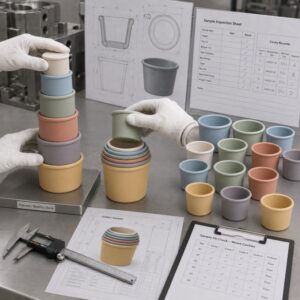
Production inspection should therefore avoid validating only one perfect matched set.
The factory should sample different cavity combinations and check:
- Stacking
- Nesting
- Separation
- Appearance
- Critical dimensions
This helps ensure real bulk products can be mixed during packing without causing fit complaints.
How Can Surface Finish Affect Nesting?
Silicone surface finish changes more than appearance.
A highly polished surface and a fine matte surface can produce different contact behavior.
For nesting cups, the engineering team should evaluate whether the chosen finish creates:
- Excessive friction
- Too little grip
- Difficult separation
- Unwanted visible rubbing marks
Texture should also be used carefully.
Large decorative textures on the outer wall can create visual identity.
But texture inside the nesting contact zone may interfere with predictable clearance.
Functional contact areas should remain controlled.
Why Does Packaging Matter?
A nesting cup set is often packaged in its nested state.
That saves space.
However, packaging pressure can affect soft silicone.
If the cups are forced too tightly together and stored for a long period, they may:
- Become harder to separate
- Develop temporary deformation
- Show rim distortion
Packaging inserts and carton dimensions should therefore avoid forcing the cups beyond their intended nesting depth.
The final packaging test should use actual mass-production samples.
What Should Buyers Check During Sample Approval?
Do not approve a stacking cup set only because the colors and shapes look attractive.
Test the actual product system.
Stacking Test
Build the complete tower several times.
Check:
- Centering
- Wobble
- Lean
- Rim deformation
Nesting Test
Insert all cups into the largest cup.
Check:
- Nesting depth
- Friction
- Separation force
- Whether cups jam
Mixed-Part Test
Use parts from different mold cavities.
Recovery Test
Compress or nest the cups, then allow them to recover.
Check whether:
- Rims return to shape
- Bases remain flat
- Walls remain symmetrical
Packaging Test
Pack the product using the intended retail package.
After storage, repeat stacking and nesting tests.
Silicone Stacking Cup DFM Checklist
| 項目 | What Buyers Should Confirm |
|---|---|
| Size progression | Logical diameter sequence between cups |
| Wall taper | Supports nesting without excessive surface contact |
| Nesting clearance | Cups insert and separate consistently |
| Rim geometry | Stable, rounded and sufficiently supported |
| Wall thickness | Balanced with softness and shape retention |
| Hardness | Supports user feel and stacking stability |
| Base | Remains flat and stable |
| Surface finish | Does not create excessive friction |
| Tolerances | Functional paired dimensions controlled |
| Mold cavities | Different cavity combinations tested |
| Recovery | Cup returns to intended geometry |
| パッケージング | Does not force cups into an over-tight nested state |
How LYA Silicone Supports Custom Stacking Cup Development
LYA Silicone supports OEM and ODM development for silicone educational and baby products, including custom stacking and developmental toy concepts.
Project review may include:
- Product concept review
- Cup-size progression
- 3D structure design
- Silicone hardness selection
- Wall-thickness review
- Nesting clearance
- Mold development
- Sample production
- Dimensional inspection
- Stacking testing
- Nesting testing
- Color customization
- Packaging review
- Mass-production quality control
The objective is not simply to make several cups that fit inside each other.
The objective is to create a complete product system that stacks, nests, separates and packs consistently.
Frequently Asked Questions
Why do silicone stacking cups stick together?
Common reasons include insufficient nesting clearance, excessive surface contact, very soft walls, surface friction or trapped air between nested parts.
Should stacking cups use the same wall angle?
Not necessarily.
The inner and outer geometry of adjacent cups should be designed to create controlled nesting rather than uncontrolled full-surface contact.
Does softer silicone make cups easier to stack?
Not always.
Softer silicone may increase grip but can also increase deformation and nesting friction.
Why does a stacking tower lean?
Possible causes include uneven rims, base warpage, inconsistent contact diameter or tolerance accumulation across multiple parts.
Should every cup be tested separately?
Yes, but the complete set also needs functional testing because the interaction between parts is what determines stacking and nesting performance.
Can the cup dimensions be changed after tooling?
Some mold modifications may be possible, but changing the diameter or taper can affect the entire stacking system. It is better to optimize these relationships during DFM.
Should stacking cups be tested after packaging?
Yes.
Nested storage and packaging pressure can change temporary fit and shape, so final packaging validation is useful before mass production.
Design the Set as One System, Not Six Separate Cups
A successful silicone stacking cup set depends on the relationship between every piece.
Buyers should review:
- Diameter progression
- Wall taper
- Nesting clearance
- Rim geometry
- Hardness
- Wall thickness
- Tolerances
- パッケージング
before tooling is finalized.
The goal is simple:
The cups should stack securely, nest compactly and separate easily.
To review a custom stacking cup or silicone educational toy project, send リヤ・シリコーン your reference design, target dimensions, number of pieces, material requirements, target hardness, packaging concept and estimated order quantity.