 Japanese
  English
  French
  German
  Spanish
  Polish
  Chinese
  Korean
  Russian
 内容
Answer Excerpt
A Y-shaped silicone teether sample should not be approved for mass production based on appearance, softness or color alone. Baby brands should verify the approved drawing, material identification, molded geometry, surface texture, edge quality, structural integrity, cleaning instructions, target-market testing requirements and retail packaging.
For OEM buyers, sample approval is a controlled decision about the complete finished product. A visually attractive prototype is not sufficient evidence that every feature meets the required specification or that future production batches will remain consistent.
The most reliable approach is to establish measurable acceptance criteria, evaluate representative molded samples and record the approved product revision before releasing the project for production.
Why Is Sample Approval Critical for a Y-Shaped Silicone Teether?
A Y-shaped teether contains several functional areas within a relatively small molded product.
These may include two upper branches, a lower gripping stem, rounded chewing ends and multiple surface-texture zones.
Each area can behave differently when the teether is bent, held, washed or compressed.
For example, a sample may have a visually correct Y-shaped outline but still contain:
-
Uneven branch thickness
-
Poorly formed texture details
-
Excessive flash around an edge
-
A weak transition near the central junction
-
Unacceptable color variation
-
An incorrect material formulation
-
Dimensions that differ from the approved drawing
Approving only the overall appearance creates unnecessary uncertainty.
Baby product brands should treat the molded teether as a finished consumer product requiring clearly documented acceptance criteria.
What Should Be Defined Before the First Sample Is Made?
The buyer should provide a product specification before asking the manufacturer to produce an approval sample.
At minimum, the specification should identify:
-
Intended use and target user
-
Product drawing and revision
-
Overall dimensions
-
Material requirements
-
Target flexibility
-
Surface-texture arrangement
-
Critical structural features
-
Color reference
-
Branding requirements
-
Intended cleaning method
-
Target sales market
-
Required product testing
-
Packaging concept
The target user and age classification should be determined through an appropriate product assessment, not selected simply because another teether has a similar appearance.
A reference photograph may help communicate the concept, but it does not replace a controlled technical specification.
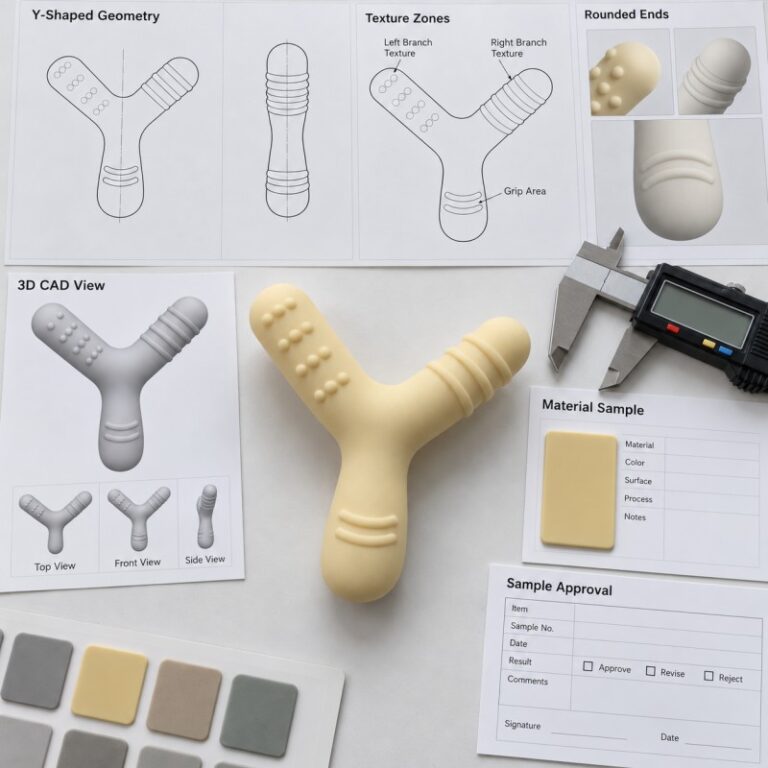
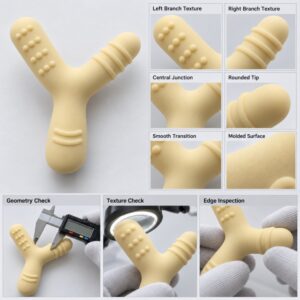
How Should the Y-Shaped Geometry Be Checked?
The Y-shaped structure is a defining characteristic of this product.
The inspection should verify more than the maximum length and width.
Branch Symmetry
If the approved design is symmetrical, the upper branches should be checked for their intended relative angles, lengths and cross-sectional geometry.
Unintended variation may affect appearance and handling.
Central Junction
The transition where the branches meet the main body deserves particular attention.
Sudden changes in cross-section may create localized deformation or stress concentration.
Rounded Ends
Every intended contact surface should match the approved geometry.
The inspection should identify unwanted sharp edges, incomplete filling or irregular material projections.
Overall Dimensions
Dimensions should be measured according to an agreed procedure that does not unnecessarily compress or distort the silicone.
For a flexible product, the measurement condition matters.
The buyer should identify which dimensions are critical to the product’s intended use and applicable requirements.
Why Must Surface-Texture Zones Be Approved Separately?
A Y-shaped sensory teether may use several molded textures across different regions.
Common design concepts include rounded dots, shallow ribs and smooth contact areas.
Each texture must be evaluated for its intended geometry.
Important inspection points include:
-
Feature height
-
Feature width
-
Spacing
-
Root shape
-
Edge smoothness
-
Surface consistency
-
Incomplete or distorted details
-
Cleaning accessibility
For example, a very small raised dot may appear acceptable in a CAD rendering but be less consistent after molding.
Similarly, an unnecessarily deep groove may complicate routine cleaning.
The objective is not to maximize texture complexity. It is to reproduce the approved design reliably and maintain suitable finished-product geometry.
A buyer should approve actual molded texture samples rather than relying only on photographs.
[Insert Image 2 here: Y-shaped teether geometry and texture inspection.]
Does a Correct Silicone Hardness Number Guarantee a Good Teether?
そうだ。
The specified silicone hardness helps describe the material’s resistance to indentation, but it does not determine the complete teether’s functional behavior.
Actual bending and recovery also depend on:
-
Cross-sectional dimensions
-
Branch geometry
-
Material formulation
-
Feature thickness
-
Local transitions
-
Processing conditions
A sample with the correct nominal hardness may still feel excessively flexible if the molded structure is too thin.
Conversely, a thick section of relatively soft silicone may feel firmer than expected.
The buyer should therefore review hardness records alongside the actual molded part and applicable functional tests.
No universal hardness value should be presented as suitable for every infant teether.
What Material Documentation Should Buyers Request?
Because a teether is intended for oral contact, material identification and target-market requirements are especially important.
A project should have an agreed material specification identifying the relevant silicone compound and any applicable colorant or additive system.
Depending on the buyer’s requirements, supporting documentation may include:
-
Material identification
-
Supplier documentation
-
Material lot information
-
Relevant test reports
-
Color formulation reference
-
Agreed processing or production records
However, a raw-material test report does not automatically prove that the final molded teether satisfies every finished-product requirement.
Different markets may require different assessments of the finished product and its packaging.
A statement such as “food grade” should not be used as a substitute for determining applicable compliance obligations.
Brands should also verify whether reports cover the actual material, color, product design and intended application.
Why Should the Mold Parting Line Be Inspected?
A mold parting line may be visible where two mold surfaces meet.
Its location and resulting finish can affect both product appearance and the quality of exposed surfaces.
For a teether, the buyer should pay attention to:
-
Chewing-contact areas
-
Rounded branch ends
-
Curved outer edges
-
The central junction
-
Raised texture features
Excessive flash or poorly finished edges may be unacceptable even when the main body is correctly molded.
The factory and buyer should agree on appearance and edge-quality criteria before sample approval.
A finished teether should not rely on aggressive manual trimming that creates inconsistent edges from one piece to another.
How Should Flexibility and Recovery Be Evaluated?
A flexible teether may undergo bending and compression during intended use.
The buyer should establish a representative evaluation method for the approved design.
This may involve controlled deformation of relevant areas, followed by inspection of their recovery.
The evaluation should look for:
-
Unexpected cracking
-
Local tearing
-
Persistent deformation
-
Unacceptable surface damage
-
Changes in critical geometry
The test method, deformation conditions and acceptance criteria should be specified in advance.
A manually bent sample returning to its shape once is not proof of lifetime durability.
Similarly, an arbitrary demonstration of extreme stretching does not establish suitability for infant use.
Testing should be appropriate to the actual product and its foreseeable use conditions.
How Should Cleaning Instructions Be Validated?
Cleaning instructions are part of the product specification.
The finished teether may contain multiple grooves, raised dots and curved intersections.
These surfaces should remain accessible through the intended cleaning procedure.
The buyer should confirm:
-
Proposed cleaning method
-
Material compatibility
-
Texture accessibility
-
Relevant exposure conditions
-
Post-cleaning appearance
-
Changes in flexibility or geometry
Do not automatically assume that every silicone teether can withstand all dishwasher programs, boiling conditions or sterilization methods.
The instructions should reflect the actual compound, finished design and validated use conditions.
The final retail packaging should communicate the approved care method clearly.
When Should Target-Market Testing Be Planned?
Testing requirements should be considered before tooling rather than after the first production order is completed.
Different markets and product classifications may introduce requirements relating to:
-
Material composition
-
Mechanical and physical safety
-
Relevant small-part or breakage hazards
-
Chemical safety
-
Age classification
-
Labels and warnings
-
Traceability documentation
The appropriate requirements depend on the final product and where it will be sold.
The buyer should agree on the applicable standards and evaluation plan with qualified testing or compliance specialists.
A supplier’s general company certifications should not be treated as evidence that a newly developed teether has passed every required test.
If a design fails a necessary finished-product assessment, changes may be required before it can proceed to sale.
Why Is One Attractive Sample Not Enough?
Development samples are often produced under carefully monitored conditions.
Mass production introduces more variation.
Potential sources include:
-
Different mold cavities
-
Raw-material batches
-
Pigment batches
-
Process settings
-
Demolding practices
-
Inspection methods
-
Packaging pressure
A single ideal sample cannot demonstrate that the production process consistently reproduces all important characteristics.
Where relevant, buyers should review samples from every intended mold cavity and compare them against the same approved specifications.
A pre-production trial can also help identify variation before the factory proceeds with a larger order.
What Must Be Frozen Before Tooling Approval?
Before custom silicone mold development is finalized, the buyer should establish a controlled drawing revision and identify the approved product requirements.
These should include:
-
Geometry and critical dimensions
-
Target material specification
-
Relevant color formulation
-
Surface-texture layout
-
Logo and marking locations
-
Parting-line considerations
-
Functional acceptance criteria
-
Applicable testing requirements
-
Packaging requirements
Any material change, tooling modification or significant revision to critical geometry should trigger an appropriate review of the existing approval.
Otherwise, the bulk product may no longer match the sample that the brand originally accepted.
A documented revision process is particularly important when several parties are involved in engineering, purchasing, packaging and quality control.
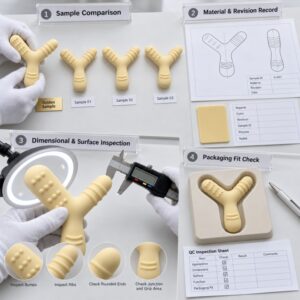
How Should Pilot Production Be Inspected?
Before a full production release, a buyer may approve a representative pilot lot or other production-intent samples.
The inspection should distinguish between critical functional requirements and ordinary cosmetic characteristics.
An AQL inspection plan can support statistical acceptance sampling for appropriately classified defects, but it does not replace product safety testing or controls required for critical hazards.
A practical approval process may include:
-
Verify the material and approved product revision.
-
Sample products from relevant production cavities.
-
Check critical dimensions and surface features.
-
Evaluate structural and functional requirements.
-
Review molded edge and flash quality.
-
Compare color and finish with approved references.
-
Review packaging and product identification.
-
Record nonconformities and necessary corrective actions.
Results should be documented rather than summarized simply as “the samples look good.”
Why Should the Retail Package Be Approved With the Teether?
A molded product and its retail package are part of the same commercial deliverable.
Packaging may affect:
-
Product positioning
-
Compression during storage
-
Surface marks
-
Traceability information
-
Cleaning instructions
-
Product identification
-
Age and safety warnings
-
Customer expectations
For example, a tight retail insert may hold a flexible branch in a bent position during storage.
The brand should confirm whether the product recovers acceptably after unpacking.
The artwork should also be reviewed against the exact target-market requirements.
Do not print claims such as “FDA approved,” “100% safe” or “certified for every age” unless their meaning and supporting evidence have been properly established.
Practical Example: Approving a Y-Shaped Silicone Teether
Consider a private-label brand developing a one-piece Y-shaped silicone teether in a muted color.
The design contains two rounded upper branches, one lower gripping stem and three distinct surface-texture areas.
Sample A — Correct Appearance, Incorrect Texture
The outline matches the drawing, but one textured area is poorly defined.
The sample should not be approved without considering whether the feature meets the specified requirements.
Sample B — Correct Color, Unverified Material
The product looks correct, but the submitted documentation does not identify the final material formulation.
The buyer should resolve the material traceability gap before approval.
Sample C — Acceptable Molded Part, Unapproved Packaging
The teether meets the defined product specification, but the package bends one branch during storage.
The packaging must be reviewed before the complete retail configuration is approved.
Production-Ready Approval
The buyer releases the product only after confirming the applicable design, material, testing, inspection and packaging requirements.
Approval should be recorded against the actual product and document revisions.
Y-Shaped Silicone Teether Sample Approval Checklist
| Approval Item | What the Buyer Should Verify |
|---|---|
| Drawing revision | Matches the intended product design |
| Material identification | Agreed silicone formulation documented |
| カラー | Matches the approved reference |
| Overall dimensions | Meet the specified requirements |
| Branch geometry | Correct angles, shape and transitions |
| Rounded edges | No unacceptable sharp or rough features |
| Texture zones | Consistent with the approved design |
| Molded finish | Acceptable parting line, flash and appearance |
| Hardness | Within agreed material specification |
| 柔軟性 | Evaluated under defined conditions |
| Recovery | No unacceptable permanent deformation |
| クリーニング | Proposed method validated |
| Safety testing | Applicable finished-product requirements addressed |
| Pilot samples | Relevant production variation reviewed |
| パッケージング | Approved for product fit and labeling |
| Traceability | Lot and revision identification defined |
| Approval record | Results and authorizations documented |
How LYA Silicone Supports Teether OEM Sample Approval
LYA Silicone supports OEM and ODM development for custom consumer silicone products, including baby teethers, feeding accessories and related baby-care products.
Brands developing a custom silicone baby teether can discuss:
-
Product concept and drawing review
-
Material and hardness selection
-
カスタム金型開発
-
Color and surface-texture customization
-
Sample production
-
Dimensional and appearance inspection
-
Production consistency
-
Packaging coordination
-
Bulk manufacturing
For Y-shaped teether projects, the customer should define the intended geometry, material specification, target market, required testing and approval process.
Sample preparation and manufacturing support should be distinguished from independent finished-product certification or regulatory approval.
The aim is to establish a clear and repeatable product specification that both the buyer and manufacturer can follow.
Frequently Asked Questions
Is a Y-Shaped Silicone Teether Different From a Regular Teether?
A Y-shaped teether uses a distinctive multi-branch geometry. Its suitability depends on the actual dimensions, structure, material and finished-product assessment rather than the shape name alone.
Can Baby Brands Customize the Texture on Each Branch?
Yes, surface-texture arrangements may be customized when the proposed features are appropriate for molding, cleaning and the finished product’s intended use.
Is Food-Grade Silicone Documentation Enough for Sample Approval?
No. Material documentation is only one part of the assessment. The finished design and applicable product requirements must also be considered.
Can One Approved Prototype Be Used as the Mass-Production Standard?
An approved reference sample is useful, but production controls should also include drawings, material requirements, inspection criteria and any necessary testing or pilot-production evidence.
Should Buyers Approve the Product Before or After Packaging Design?
The molded product may be reviewed first, but the complete retail configuration should be approved before the product is released for sale.
Can a Brand Change Color After Sample Approval?
Yes, subject to review. A formulation or colorant change may require new evaluation and approval, particularly where material and finished-product requirements are affected.
Is Hardness Testing the Same as Mechanical Safety Testing?
No. Hardness describes a material characteristic. Mechanical safety assessment may involve separate methods and criteria applicable to the product.
What Documents Should Be Included in the Approval Record?
The record may include approved drawings, material identification, sample inspection results, relevant test reports, packaging files, product revision details and authorized approval decisions.
Approve the Complete Product, Not Just the Prototype
Successful silicone teether production depends on a controlled sequence:
Product Specification → Molded Sample → Material Verification → Functional Evaluation → Applicable Testing → Packaging Approval → Production Control
Each step contributes to the final product’s consistency and suitability.
A soft, attractive sample may be a promising starting point, but it should not be the sole basis for releasing an infant product into mass production.
If you are developing a new Y-shaped silicone teether or an exclusive private-label baby teether collection, contact us with your product drawing, reference sample, target dimensions, material requirements, intended market, packaging concept and estimated quantity.