 Japanese
  English
  French
  German
  Spanish
  Polish
  Chinese
  Korean
  Russian
 内容
Answer Excerpt
A silicone pacifier holder case may develop strap tearing, loose button engagement or unwanted detachment when the hanging loop is too thin, the connection root contains sharp transitions, or the fastening geometry is unsuitable for repeated use.
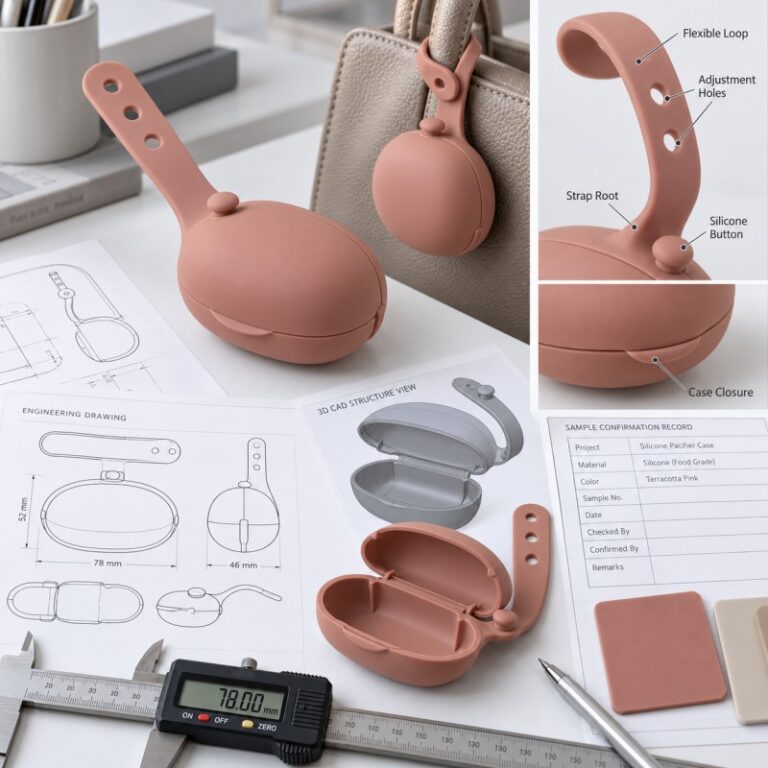
Reliable silicone pacifier case strap design requires the strap width, thickness, root radius, closure engagement, material flexibility, intended attachment point and repeated-use conditions to be evaluated together.
For OEM baby accessory brands, the hanging strap should be treated as a functional component rather than a decorative feature. Sample approval should include carrying, fastening, removal, cleaning and packaging evaluations under defined conditions.
Why Is the Hanging Strap Important on a Pacifier Case?
A silicone pacifier case is commonly used to store a pacifier while it is not in use.
For parents and caregivers, the product may be carried inside a diaper bag or attached to a suitable external bag handle or stroller storage point.
The hanging strap makes the case more accessible, but it also introduces mechanical requirements.
The strap may experience:
-
Repeated bending
-
Stretching during attachment
-
Tension while carrying
-
Twisting during movement
-
Local pressure around the fastener
-
Repeated opening and closing
-
Deformation during packaging
A case body may remain in good condition while the hanging loop becomes the first feature to fail.
For manufacturers, this means that the carrying structure needs its own design and inspection requirements.
What Causes Silicone Pacifier Case Straps to Tear?
Silicone is flexible, but not every flexible structure has the same tear resistance.
A strap can fail for several reasons.
Narrow Connection Root
When a relatively wide strap connects to the case through a very narrow section, force becomes concentrated around the connection.
Repeated pulling may create local stretching and eventually initiate a tear.
Sharp Internal Corners
Sharp transitions at the strap root or adjustment holes can concentrate stress.
A smoother, rounded transition can distribute deformation more gradually.
Excessive Local Stretch
A strap that must stretch too far to engage its fastening button may experience repeated high strain.
Molding Defects
Incomplete filling, flash damage or a defect near the strap root can reduce the integrity of a finished part.
Unsuitable Product Geometry
Even when the material is appropriate, the strap may remain vulnerable if its length, thickness and connection geometry are poorly balanced.
These failures should be investigated through structural review and sample testing rather than addressed only by increasing silicone hardness.
How Should the Strap Root Be Reinforced?
The strap root is the transition between the flexible hanging loop and the main storage case.
This area often carries a significant portion of the load when the product is suspended from a bag.
A good design should avoid an abrupt transition from a thin strap into a thick case wall.
Instead, the geometry should be reviewed for:
-
Sufficient connection width
-
Gradual thickness transitions
-
Rounded internal corners
-
Appropriate root curvature
-
Continuous molded material
-
Suitable clearance from nearby openings
These principles also apply to thin silicone edges in other custom molded products.
A thicker root may improve structural support, but excessive thickness can create an unnecessarily rigid region.
The objective is controlled deformation without concentrating excessive strain at one small connection point.
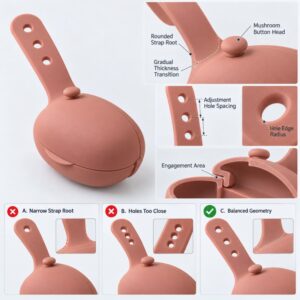
Why Do Button Closures Come Loose?
Many silicone hanging straps use a flexible button-and-hole closure.
The user wraps the strap around an attachment point and secures it onto an integrated button.
The fastening system must balance two requirements:
Easy to Fasten → Secure During Intended Use
A button that is too small relative to the opening may disengage too easily.
A button that is too large may require excessive stretching during installation.
Relevant design variables include:
-
Button-head diameter
-
Button-neck geometry
-
Adjustment-hole dimensions
-
Strap thickness around the hole
-
Button-root support
-
Hole-edge radius
-
Engagement depth
-
Direction of applied force
The closure must be evaluated as a complete system.
A fastening button should not be considered reliable simply because it feels difficult to close.
Excessive engagement force may increase local strain around the adjustment holes.
How Should Adjustment Holes Be Designed?
Multiple adjustment holes allow one strap to fit selected attachment-point sizes.
However, every hole removes material from the strap.
If the holes are too close together, the remaining silicone between them may become vulnerable to stretching and tearing.
If a hole is too close to the edge, there may be insufficient surrounding material to resist repeated loading.
The design team should review:
-
Hole diameter
-
Hole spacing
-
Edge distance
-
Remaining material width
-
Hole shape
-
Local thickness
-
Fastening direction
Rounded openings are often preferable to openings containing sharp internal corners.
However, no universal hole spacing can be recommended without knowing the strap dimensions, material properties and intended application.
Testing should include the adjustment positions that generate the greatest expected deformation.
Does a Longer Hanging Strap Work Better?
Not automatically.
A longer strap may provide greater flexibility when attaching the case to different bag handles.
However, extra length can also create more movement during carrying.
A very short strap may hold the case close to the attachment point but become difficult to fasten.
The brand should define the intended attachment locations before selecting strap length.
Useful reference points may include:
-
Diaper bag handles
-
Suitable stroller storage handles
-
Adult handbags
-
Travel bag handles
-
Other designated external carrying points
These locations may have different cross-sectional dimensions.
A strap intended for several attachment types should be tested on representative reference handles rather than described as universally compatible.
How Does Silicone Hardness Affect Strap Performance?
The selected silicone hardness influences how easily the strap bends and stretches.
A softer material may make the strap easier to fasten around certain attachment points.
However, excessive flexibility can allow greater deformation around the button holes.
A firmer material may provide a different fastening feel but can also require more force to stretch over the button.
Material hardness does not independently describe:
-
Tear strength
-
Elongation at break
-
Fatigue behavior
-
Permanent deformation
-
Button retention
-
Recovery after repeated stretching
Two silicone compounds with similar hardness values may have different mechanical properties.
For OEM development, material selection should therefore consider the actual compound specification and complete molded strap structure.
Why Does Wall Thickness Matter?
Local wall thickness influences the stiffness and flexibility of the case body, hanging strap and closure features.
Different functional areas may need different structural behavior.
For example:
| Functional Area | Main Design Requirement |
|---|---|
| Storage case body | Maintain intended shape and storage capacity |
| Flexible hanging strap | Bend sufficiently for attachment |
| Strap connection root | Distribute repeated loading |
| Adjustment-hole region | Resist unwanted tearing and enlargement |
| Fastening button | Maintain engagement geometry |
| Case closure lip | Open and close under controlled force |
Making every section equally thick may not provide the desired functionality.
The strap needs sufficient flexibility, while the connection root requires appropriate structural support.
Smooth transitions between these areas are usually more important than simply increasing thickness everywhere.
Can the Case Opening Affect Strap Durability?
Yes.
The case opening and hanging strap are different functional features, but their positions can influence each other.
For example, if the hanging strap connects very close to a flexible case opening, pulling on the strap may distort the closure.
This can create several problems:
-
The case opening becomes misaligned.
-
The closure lip lifts unintentionally.
-
The fastening force changes.
-
The case body twists during carrying.
-
The strap root experiences additional deformation.
The designer should evaluate the hanging location relative to the closure, hinge and main case geometry.
Where possible, the carrying load should not repeatedly force the storage closure open.
Why Should the Stored Pacifier Be Part of the Test?
A case may behave differently when empty and when holding a pacifier.
The stored item adds weight and occupies space inside the flexible container.
For a case designed around a silicone baby pacifier, buyers should confirm that the selected reference pacifier fits without excessive compression.
The case should also allow the pacifier to be inserted and removed through the intended opening.
Relevant checks include:
-
Internal storage dimensions
-
Pacifier orientation
-
Available clearance
-
Case closure fit
-
Strap position
-
Weight of the filled case
-
Accessibility during normal use
A case intended to hold two pacifiers may require a different structure from a compact single-pacifier holder.
The actual storage configuration should be defined before the mold is finalized.
How Should Repeated Fastening Be Tested?
A new strap may feel secure during the first installation.
However, its behavior can change after repeated opening and closing.
A practical test should use a defined sequence:
-
Attach the strap to the approved reference handle.
-
Fasten the selected adjustment hole onto the button.
-
Check whether the closure is fully seated.
-
Apply the agreed handling or carrying load.
-
Release the closure using the intended method.
-
Repeat the sequence according to the agreed test plan.
-
Inspect the strap, holes, button and connection root.
The test should check for:
-
Enlarged adjustment holes
-
Local tearing
-
Persistent elongation
-
Button deformation
-
Reduced engagement stability
-
Unexpected detachment
-
Unacceptable changes in fastening force
The buyer and manufacturer should agree on cycle counts, loading conditions and acceptance criteria.
A single successful fastening demonstration does not establish long-term reliability.
How Should Pull Direction Be Considered?
The same strap can experience different strain depending on how force is applied.
For example:
-
A downward load may mainly tension the strap.
-
A sideways load may twist the connection root.
-
An angled load may pull against one side of an adjustment hole.
-
Repeated bag movement may alternate between several directions.
Testing should reflect the intended use rather than applying force in only one convenient direction.
The fastening system should also be checked for unintended disengagement when the load is applied at an angle.
This is particularly relevant when the case is suspended from an attachment point that allows movement.
How Can Brands Reduce Damage During Cleaning?
A silicone pacifier case may be opened, rinsed and dried repeatedly.
Cleaning creates additional handling of the strap and storage opening.
Very deep grooves around the button or strap connection may collect residue and become difficult to inspect.
Brands should consider:
-
Accessible strap roots
-
Smooth adjustment-hole edges
-
Practical button geometry
-
Easy-to-rinse internal surfaces
-
Suitable cleaning instructions
-
Full drying before storage when appropriate
The final cleaning method should be confirmed for the actual silicone formulation and finished product.
A case should not automatically be described as dishwasher-safe, boil-safe or sterilizable under every condition without relevant validation.
Should the Hanging Loop Be Attached Directly to the Baby?
No. A pacifier storage case hanging loop should not automatically be treated as a baby-worn accessory or a pacifier retention clip.
Its intended purpose is external storage and carrying at designated adult-managed attachment locations.
The product’s safety instructions should address foreseeable hazards associated with loops, straps, detachable components and placement near infants.
Brands should avoid encouraging attachment to a baby’s neck, clothing during sleep, or sleeping area.
Pacifier holders, pacifier clips and storage cases may be subject to different requirements depending on the product structure and target market.
The manufacturer and buyer should confirm the final use instructions, warnings, age-related considerations and applicable product requirements before production.
Practical Example: A One-Piece Silicone Pacifier Storage Case
Consider a rounded oval silicone pacifier case with:
-
Flexible storage body
-
Integral hinge
-
Overlapping closure lip
-
Integrated hanging strap
-
Three adjustment holes
-
One rounded fastening button
The case is intended to hold one pacifier and attach to a suitable diaper bag handle.
Version A — Strap Root Too Narrow
The strap connects to the case through a thin, abrupt transition.
Repeated side loading concentrates deformation near the connection.
Version B — Adjustment Holes Too Close Together
The remaining silicone between adjacent holes becomes excessively narrow.
This may create weak regions under repeated stretching.
Version C — Button Engagement Too Loose
The strap fastens easily, but the button may disengage during normal movement.
Improved Version
The revised concept uses:
-
A wider, rounded strap root
-
Gradual thickness transitions
-
Appropriately spaced adjustment holes
-
Controlled button engagement
-
Suitable strap length
-
A storage closure positioned away from major carrying loads
This is an illustrative engineering concept, not a claim that a particular design has already passed testing.
The final structure must still be evaluated through molded samples.
What Should Brands Test Before Mass Production?
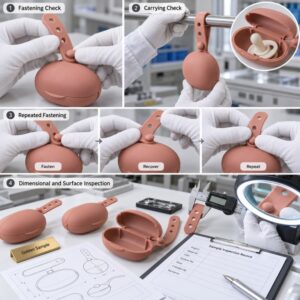
Strap Root Inspection
Check the connection between the strap and case body for incomplete molding, visible defects and unfavorable transitions.
Button Engagement
Fasten and release the strap using all intended adjustment positions.
Repeated-Use Evaluation
Perform the agreed fastening cycles and inspect changes in geometry and function.
Carrying Evaluation
Load the case with the intended pacifier and attach it to representative approved handles.
Angled Pull Evaluation
Check the strap under different relevant loading directions.
Case Closure Evaluation
Confirm that carrying loads do not unintentionally open or distort the storage case.
Shape-Recovery Evaluation
Inspect whether the strap returns sufficiently toward its approved geometry after repeated stretching.
Packaging Evaluation
Review whether the retail packaging keeps the strap folded or stretched in a way that causes unwanted deformation.
Multi-Sample Comparison
Evaluate samples from relevant mold cavities and production conditions rather than approving only one ideal piece.
Silicone Pacifier Case Strap Design Checklist
| Evaluation Item | What the Brand Should Confirm |
|---|---|
| Intended attachment | Defined adult-managed carrying locations |
| Strap length | Suitable for reference handles |
| Strap width | Provides required flexibility and support |
| Strap thickness | Appropriate for intended loads |
| Connection root | Rounded, continuous and structurally supported |
| Adjustment holes | Controlled size, spacing and edge distance |
| Fastening button | Suitable geometry and engagement |
| Material hardness | Evaluated with the complete molded structure |
| Case capacity | Fits approved reference pacifier |
| Case closure | Remains functional during carrying |
| Repeated fastening | Evaluated under an agreed cycle test |
| Angled loading | Relevant pulling directions considered |
| クリーニング | Strap and closure areas accessible |
| パッケージング | Avoids prolonged unwanted deformation |
| Mold quality | Critical areas consistently formed |
| Final inspection | Appearance and function both controlled |
| Product instructions | Appropriate warnings and intended use |
How LYA Silicone Supports Pacifier Case OEM Development
LYA Silicone supports OEM and ODM development for custom silicone baby accessories, including pacifier storage cases, feeding accessories and related consumer silicone products.
Project support can include:
-
Product drawing review
-
Storage-capacity planning
-
Hanging strap and closure discussion
-
Strap-root structure evaluation
-
Material and hardness selection
-
Mold development
-
Color matching
-
Molded-logo customization
-
Sample production
-
Functional inspection
-
Packaging coordination
-
Bulk manufacturing
For hanging-strap projects, buyers should define the intended attachment method, reference handle geometry, expected loading conditions and product testing requirements before tooling.
The final material, dimensions, testing and packaging should be confirmed against the actual project specification.
Frequently Asked Questions
Why Do Silicone Pacifier Case Straps Tear Near the Body?
Possible causes include narrow strap roots, sharp transitions, local molding defects, excessive stretching or loading beyond the intended design conditions.
Does Thicker Silicone Always Make a Stronger Strap?
Not necessarily. Thickness affects flexibility and geometry, but tear strength, material formulation and stress distribution also matter.
Can a Silicone Pacifier Case Have an Adjustable Hanging Loop?
Yes. A strap can use multiple adjustment holes or another suitable fastening design, subject to structural and functional validation.
Why Does the Button Become Loose After Repeated Use?
Possible causes include local deformation, changes in hole geometry or unsuitable button-to-hole engagement.
Can One Strap Fit Every Stroller or Bag Handle?
No universal compatibility should be assumed. Attachment-point size and geometry vary, so brands should define and test the intended range.
Should the Strap Be Tested With a Pacifier Inside the Case?
Yes. A filled case better represents the intended carrying condition than an empty case alone.
Can Strap and Case Be Molded as One Piece?
A one-piece silicone design with an integrated strap can be considered, subject to tooling feasibility, wall geometry and the required finished-product performance.
What Should Buyers Send for an OEM Quotation?
Provide the case drawing or sample, intended pacifier size, strap structure, attachment locations, fastening requirements, material preferences, color, logo, packaging, target market and estimated quantity.
Design the Strap as Part of the Complete Storage System
A reliable silicone pacifier case depends on more than a soft storage body.
The functional chain includes:
Case Body → Strap Root → Flexible Loop → Adjustment Hole → Fastening Button → Carrying Load → Repeated Use
Every area affects overall performance.
Increasing silicone hardness or making the strap thicker cannot automatically resolve unsuitable connection geometry or unstable fastening.
For baby accessory brands, the better approach is to define the intended use, review the complete structure, evaluate molded samples and establish repeatable inspection requirements.
If you are developing a custom silicone pacifier holder case or a private-label baby accessory collection, contact us with your product drawing, pacifier reference, strap structure, target market, color, logo, packaging requirements and estimated order quantity.