 Japanese
  English
  French
  German
  Spanish
  Polish
  Chinese
  Korean
  Russian
 内容
Answer Excerpt
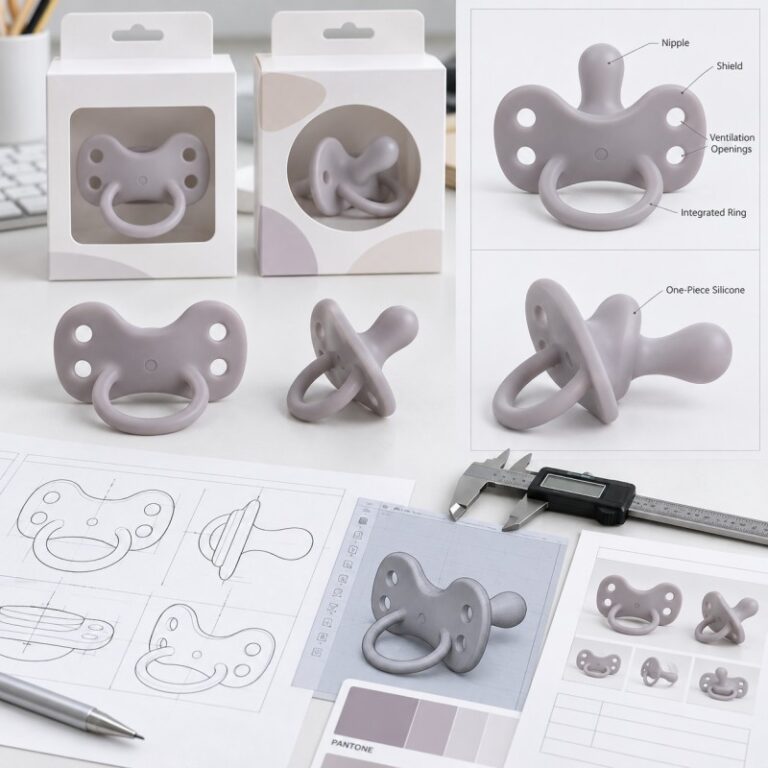
A silicone dummy, silicone pacifier and silicone soother generally describe the same type of baby soothing product, although the preferred term varies by market. For OEM buyers, the important differences are not the words themselves but the final product structure, nipple geometry, shield design, ventilation openings, material specification, packaging and target-market requirements.
A silicone baby pacifier project should therefore be developed around the intended market and final product specification rather than simply copying a reference product sold under a different regional name.
Is a Silicone Dummy Different From a Silicone Pacifier?
In most commercial contexts, “dummy,” “pacifier” and “soother” refer to the same general product category.
The terminology varies by country and sales channel.
A brand selling in one market may use “pacifier” throughout its product listing, while another market may respond more naturally to “dummy” or “soother.”
For manufacturers, however, changing the product name does not automatically change the engineering requirements.
The factory still needs a clear specification covering:
- Product structure
- Nipple shape
- Shield geometry
- Ventilation openings
- Handle or ring
- Silicone hardness
- Surface finish
- カラー
- ロゴ
- パッケージング
- Target market
This is why brands should separate marketing terminology from manufacturing specifications.
Why Does Terminology Matter for Baby Brands?
Terminology matters because it affects how the product is presented to customers.
A product developed for several markets may need different:
- Product titles
- Packaging wording
- Online listing copy
- Search keywords
- Instruction wording
However, the underlying molded product may remain the same.
For example, the same approved design may be marketed as:
“Silicone Pacifier”
in one market and:
“Silicone Dummy”
in another.
Brands should decide this early because packaging artwork, private-label content and product-page SEO may all depend on the chosen terminology.
It is better to resolve naming before packaging goes into production.
What Should Buyers Define Before Requesting a Pacifier Quote?
A useful OEM inquiry should contain more than a product photo.
Before asking for tooling or production pricing, the buyer should define:
Target Market
The manufacturer needs to know where the final product will be sold.
This matters because product testing, packaging information and compliance planning may differ between markets.
The buyer should confirm the applicable requirements for the final design with the appropriate testing or compliance specialists.
Product Structure
Confirm whether the concept is:
- One-piece silicone construction
- Multi-component construction
- Integrated ring
- Separate handle
- Custom shield shape
- Existing design or exclusive mold
Target Dimensions
Provide the available drawing, sample dimensions or 3D model.
Critical dimensions should be identified before tooling rather than estimated from photos.
Color and Branding
Confirm:
- Target color
- Pantone reference where applicable
- Molded logo
- Printed packaging
- Private-label requirements
A detailed RFQ gives the manufacturer a better basis for DFM review.
One-Piece or Multi-Part Pacifier: Which Structure Should a Brand Choose?
The correct structure depends on the product concept.
A one-piece silicone design may integrate:
- Nipple
- Shield
- Handle or ring
into one continuous molded product.
This can reduce the number of assembly interfaces.
A multi-part design may use separate components when the product concept requires a particular appearance or function.
However, additional components also create more areas that need to be controlled, such as:
- Assembly fit
- Component retention
- Dimensional compatibility
- Production inspection
The choice should therefore be made during product development, not after the mold is already built.
Why Is Nipple Geometry More Important Than Appearance Alone?
The nipple is the main flexible portion of the product.
Its behavior depends on several variables working together:
- Overall shape
- Length
- Cross-section
- Local thickness
- Base transition
- Material flexibility
A visually attractive nipple can still perform poorly if the transition between the nipple and shield is not suitable for repeated deformation.
Brands should avoid selecting a design only because it resembles a popular market product.
The geometry should be reviewed as part of the complete product.
How Does Silicone Hardness Affect the Nipple and Shield?
The selected silicone hardness affects how the product feels and deforms.
A softer specification may create greater flexibility in the nipple, but it can also make other areas of the product more flexible.
A firmer specification may provide more support to the shield or ring, but it may change the intended feel of the nipple.
This creates an important engineering issue:
The nipple and shield do not necessarily need the same mechanical behavior even when they are molded from one material.
The design therefore needs to balance:
Material Hardness + Local Thickness + Product Geometry
Hardness should always be evaluated on actual molded samples rather than approved only as a number on a material specification.
Why Does Shield Geometry Need Careful Review?
The shield is a large visible and functional part of a pacifier.
Its design may include:
- Round profiles
- Butterfly profiles
- Curved edges
- Integrated rings
- Ventilation openings
- Molded branding
The shield should not be treated as a decorative plate.
Changing the shape can affect:
- Overall product dimensions
- Rigidity
- 重量
- パッケージング
- Mold layout
- Ventilation-hole position
Smooth edge transitions and controlled geometry are particularly important because the shield is a major external contact surface.
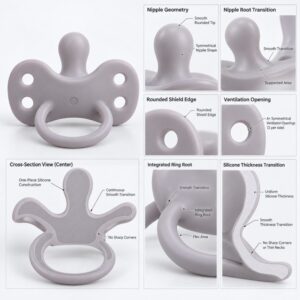
What Is the Role of Ventilation Openings?
Many pacifier concepts include openings in the shield.
From an OEM design perspective, these openings need to be treated as real structural features.
Their position can affect:
- Shield stiffness
- Local wall structure
- Mold filling
- Demolding
- Cleaning access
- Product appearance
A designer should not simply move or resize openings for visual reasons without checking the effect on the surrounding structure.
The appropriate number, geometry and location must also comply with the requirements applicable to the final product and market.
Avoid copying dimensions from another product without knowing its complete design specification.
How Should the Handle or Ring Be Designed?
The handle or ring may be used for:
- Handling
- Attaching compatible accessories
- Product storage
- Visual styling
If the ring is integrated into a one-piece silicone product, its root areas need enough support for repeated flexing.
Important points include:
- Ring opening
- Local thickness
- Root transition
- Radius
- Relationship to the shield
- Demolding direction
A very thin connection can create a weak local area.
An unnecessarily thick ring may make the product bulky.
The handle should therefore be treated as a functional flexible structure.
Why Does Easy Cleaning Need to Be Considered During Design?
Pacifier geometry can create small transitions around:
- Nipple base
- Shield
- Ventilation openings
- Ring
- Molded logos
Deep narrow grooves or unnecessary pockets can make cleaning more difficult.
For an OEM project, the designer should review whether normal cleaning can reach all intended exposed surfaces.
A more complicated visual design is not automatically a better product.
Simple, rounded geometry can often make:
- Inspection easier
- Cleaning easier
- Mold finishing easier
- Production consistency easier to control
How Should Materials and Compliance Be Planned?
Baby products should not be developed by making broad assumptions such as:
“silicone means the product automatically meets every market requirement.”
The final material, pigment, product structure, packaging and finished article should be evaluated against the requirements applicable to the target market.
Before tooling, buyers should define:
- Target country or region
- 製品カテゴリー
- Intended age group
- Material requirements
- Required laboratory tests
- Packaging statements
- Warning or instruction requirements
The manufacturer can support material selection and sample preparation, but the compliance plan should be defined for the actual final product.
Why Should Compliance Planning Start Before Tooling?
Some testing requirements can affect product geometry.
For example, the final design may need review around:
- Openings
- Small features
- Structural integrity
- Edges
- Components
- Product dimensions
Waiting until mass production to think about testing can create unnecessary redesign risk.
Compliance planning should therefore be part of the project specification before custom silicone mold development begins.
This does not mean every product needs the same tests.
The test plan depends on the final market, design and product claims.
How Does Mold Design Affect Pacifier Quality?
The mold determines how important product features are reproduced.
The tooling team should review:
- Parting-line location
- Venting
- Product filling
- Nipple geometry
- Shield edges
- Ventilation holes
- Ring structure
- Logo details
- Demolding
For oral-contact or highly visible areas, surface quality and flash control deserve particular attention.
The buyer should understand where the parting line will appear before tooling approval.
Discovering an undesirable mold split only after receiving the first sample can lead to avoidable modification.
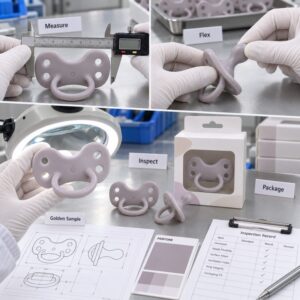
What Should Brands Test on Pacifier Samples?
The sample should be evaluated as a finished product, not only as a molded shape.
Appearance
Check:
- Surface finish
- カラー
- Flash
- Edge quality
- Logo clarity
- Deformation
Dimensions
Confirm critical product dimensions using the approved drawing.
Nipple Flexibility
Evaluate whether the nipple behaves according to the agreed product concept.
Shape Recovery
After controlled deformation, check whether the product returns toward its approved geometry.
Structural Integrity
Any pull, deformation or durability evaluation should follow the agreed test method and applicable product requirements rather than arbitrary factory numbers.
Cleaning Review
Check whether openings, transitions and molded details remain accessible using the intended cleaning method.
Packaging Fit
Place the real product into the proposed retail package and make sure the nipple, shield or ring is not stored under harmful deformation.
Why Should Packaging Terminology Be Confirmed Early?
A factory can manufacture a correct product and still create a packaging problem if terminology is changed late.
For example, packaging may have already been prepared with “pacifier” when a distributor wants “dummy.”
Changing terminology can affect:
- Front-panel copy
- Product instructions
- Barcode descriptions
- Carton labels
- Online product listings
When the same physical product will be sold in several regions, brands should create a market-specific packaging matrix before printing begins.
This can reduce artwork mistakes and unnecessary packaging rework.
Practical Example: One Pacifier Design for Two Markets
Consider a baby brand developing one muted-color one-piece silicone pacifier.
The product uses:
- Flexible nipple
- Rounded butterfly-style shield
- Four ventilation openings
- Integrated ring
- Molded brand mark
The physical design remains the same.
For the first market, the packaging uses “Silicone Pacifier.”
For another market, the brand decides to use “Silicone Dummy.”
The manufacturer does not need to create a new mold simply because the commercial name changes.
However, the buyer should still confirm:
- Packaging artwork
- Local product terminology
- Labeling
- Target-market testing
- Retail requirements
This illustrates the key difference:
Product terminology can change while the manufacturing specification remains controlled.
OEM Silicone Pacifier Development Checklist
| 項目 | What the Buyer Should Confirm |
|---|---|
| Market terminology | Dummy, pacifier or soother |
| Target market | Defined before testing and packaging |
| Product structure | One-piece or multi-part |
| Nipple geometry | Final shape and structural requirements |
| Shield design | Shape, edges and overall size |
| Ventilation openings | Position and geometry reviewed |
| Ring / handle | Structure and repeated-use requirements |
| Silicone hardness | Tested with final geometry |
| カラー | Final color reference approved |
| ロゴ | Molded or packaging-based branding |
| Mold | DFM review before tooling |
| Sample approval | Appearance, dimensions and function |
| Testing | Based on final market requirements |
| パッケージング | Terminology and product fit confirmed |
| 大量生産 | Approved sample and inspection standard established |
How LYA Silicone Supports Pacifier OEM Development
LYA Silicone supports OEM and ODM development for custom baby silicone products, including pacifiers and other シリコーンベビー用品.
A pacifier development project can include:
- Product drawing review
- Nipple-structure discussion
- Shield design review
- Ventilation-hole review
- Silicone hardness discussion
- Color customization
- Molded-logo planning
- Mold development
- Sample production
- Dimensional inspection
- Appearance inspection
- Packaging coordination
- Production quality control
The final design, material and testing requirements should always be confirmed according to the buyer’s actual product and target market.
Frequently Asked Questions
Is a Silicone Dummy the Same as a Pacifier?
In common commercial usage, the terms usually refer to the same general baby product category. The preferred term varies by market.
Is a Soother Different From a Dummy?
“Soother” is another common market term for the same general type of product. Brands should use the terminology appropriate to their target customers and packaging.
Can One Pacifier Design Be Sold Under Different Product Names?
Yes, the commercial terminology can differ by market while the physical product remains the same, provided the relevant packaging, labeling and market requirements are properly managed.
Should the Nipple and Shield Use the Same Silicone Hardness?
A one-piece product normally uses one material system, so geometry and local thickness are used together with material hardness to create the required behavior. The final design should be validated on molded samples.
Can a Brand Copy the Ventilation Holes From Another Pacifier?
The safer development approach is to design the complete product around its own target market and applicable requirements rather than copying isolated dimensions from another product.
When Should Pacifier Testing Requirements Be Confirmed?
They should be discussed before tooling whenever possible because compliance requirements can influence the final structure and product specification.
Should Packaging Be Approved With the Actual Molded Pacifier?
Yes. Production-intent samples help confirm product orientation, compression, terminology, label placement and presentation before packaging is mass produced.
Use the Right Name, but Engineer the Right Product
Whether the market calls it a silicone dummy, pacifier or soother, the manufacturing project still depends on:
Nipple → Shield → Ventilation → Ring → Material → Mold → Testing → Packaging
The terminology is part of marketing.
The product specification is what controls manufacturing.
If you are developing a custom silicone pacifier for a baby brand, distributor or private-label project, contact us with your reference design, drawing, target market, product structure, dimensions, color, logo, packaging requirements and estimated quantity.