 Spanish
 English
 French
 German
 Polish
 Chinese
 Japanese
 Korean
 Russian
Contenido
Answer Excerpt
A silicone cat litter mat may retain fine litter inside its recessed surface cells when the cell depth, spacing, ridge geometry, and perimeter design do not match the litter type and intended cleaning method. A pattern that collects loose granules effectively during use may also make those granules harder to release during cleaning. For OEM buyers, the goal is to balance litter collection with cleanability by testing the actual surface pattern against representative litter, checking how easily particles can be removed, and approving the design using a repeatable sample-evaluation process.
Why Can Fine Litter Remain Inside a Silicone Cat Litter Mat?
A cat litter mat needs to perform two related but different functions. During everyday use, its surface should help collect loose granules around the litter box. During cleaning, those same particles should be removable without excessive effort.
These functions can conflict. A pattern with deep recesses may provide space for litter to settle, but narrow spaces or difficult-to-reach corners may make the particles harder to release. A shallow pattern may be easier to wipe, yet allow some granules to move across the surface instead of remaining within the collection area.
For product developers, the key question is not simply whether a mat has a textured surface. It is whether the surface geometry suits the target litter, floor arrangement, and cleaning routine.
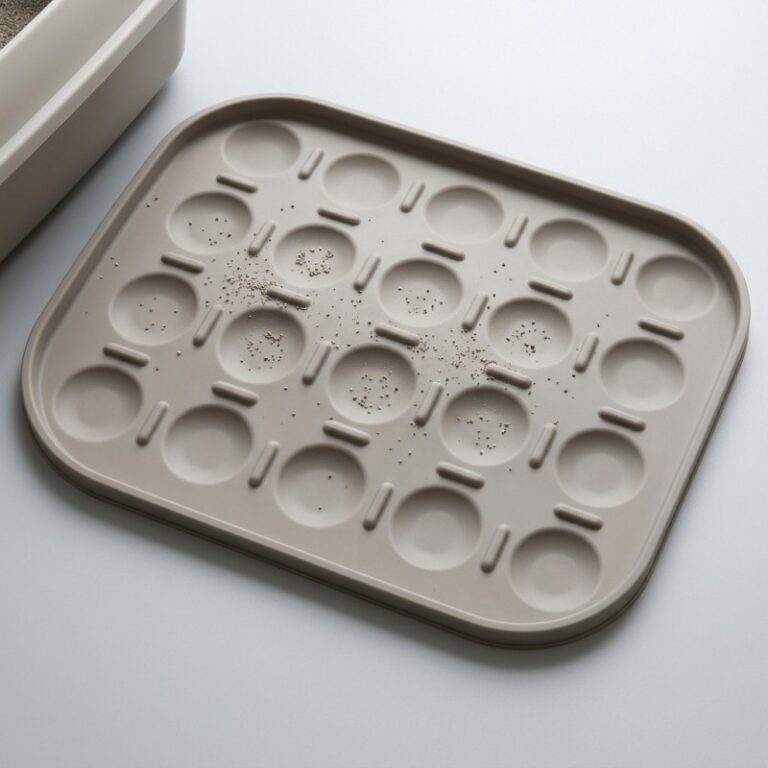
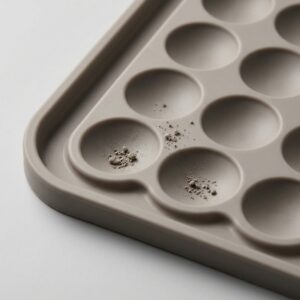
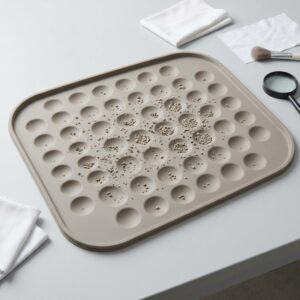
LYA Silicone’s custom silicone cat litter mat provides a relevant product reference: a proposed one-piece molded mat with shallow recessed collection cells, low-profile dividing ridges, rounded corners, and a continuous perimeter rim. Actual litter-retention and cleaning performance still needs to be evaluated using samples.
1. The recessed cells are too deep for the intended cleaning method
Recessed cells provide space for loose granules to settle. However, if particles sit deep within the cells, lifting or gently flexing the mat may not release them as easily as expected.
This does not mean every cell should be as shallow as possible. The appropriate depth depends on the intended litter type, particle dimensions, desired collection behavior, and how the user will empty the mat.
A design review should consider the complete cleaning sequence. Will the user lift and shake the mat, flex it over a waste container, wipe the surface, or rinse it? The pattern should be evaluated against the intended method rather than selected by appearance alone.
2. Narrow spaces make particles harder to remove
The spaces between dividing ridges can influence how litter moves across the surface. If the gaps are too narrow for the target particles to move freely, granules may remain between the ridges or collect at transitions.
Sharp internal corners can also create locations that are more difficult to wipe or inspect than broad, rounded transitions.
During design development, compare the width of the recessed cells, ridge spacing, corner radii, and expected particle sizes. A pattern should not be judged only by how many cells fit within the available mat area.
3. The perimeter rim makes emptying less convenient
A continuous perimeter rim can help define the collection area, but its geometry also affects how particles leave the mat.
If the edge is too low for the intended application, granules may travel beyond the mat during use. If the rim is unnecessarily tall or has difficult transitions, particles may collect near the border and become harder to remove.
The rim should therefore be designed together with the collection cells. Review its height, thickness, corner transitions, and relationship to the main surface. The goal is a practical balance between keeping litter within the mat area and allowing straightforward emptying.
4. Different litter types behave differently
Cat litter is not a single, uniform material. Depending on the product, particles may be fine or coarse, rounded or irregular, lightweight or relatively heavy. Some litters also form clumps when wet.
These differences can change how particles settle into a recessed pattern and how easily they move out during cleaning.
For example, a surface pattern that is easy to empty with one coarse particle type may retain smaller granules in its recesses. A wet residue or broken clump may also require a different cleaning method from dry loose litter.
OEM buyers should identify the intended litter types before approving the surface design. If a product is intended for several litter categories, evaluate those categories separately rather than assuming that one sample result applies to every material.
How Should the Surface Pattern Be Designed for Better Cleanability?
The best design is not necessarily the one with the deepest cells or the most pronounced texture. It is the one that balances the required collection function, cleanability, manufacturability, and target retail positioning.
Match cell depth and spacing to the target litter
Start with the expected particle sizes and the intended cleaning routine. Review cell depth, opening width, ridge height, and spacing as a connected system.
Avoid choosing the pattern solely from a rendered image. A pattern may look distinctive on screen but behave differently when actual granules settle into its recesses.
Where possible, develop sample patterns that allow the team to compare collection and release behavior before committing to the final tooling design.
Prefer practical, inspectable transitions
Rounded internal transitions can make a surface easier to inspect and may reduce the number of narrow corners where residue collects. Their final geometry should still be compatible with the product’s functional requirements and molding process.
The design should also account for the ridge-to-cell transition and the connection between the main collection surface and the perimeter rim. These details can matter as much as the overall pattern.
Keep the mat easy to handle during cleaning
The overall footprint, thickness, flexibility, and edge profile influence how a user lifts and empties the mat. A large mat may provide more collection area, but it may also be more cumbersome to handle if its structure is too flexible for the intended use.
The underside should also be considered. Floor contact, handling, and the finished silicone formulation can affect how the mat behaves in its intended setting. Any slip-resistance requirement should be defined and tested on the target floor materials rather than assumed from the word “silicone.”
For broader guidance on product surfaces and cleaning access, see the silicone product drainage and easy-clean design guide.
Review dimensions and edge consistency
The mat’s length, width, perimeter profile, cell spacing, and thickness all contribute to its final appearance and handling. If the geometry varies between samples, the collection pattern may also vary.
Identify which dimensions are critical to the intended function and define how they will be checked. A dimensional tolerance guide can help buyers distinguish functional dimensions from features that are primarily visual.
How Should OEM Buyers Test Litter Collection and Release?
A sample test should evaluate both what happens during use and what happens when the mat is cleaned. A surface that collects granules well but is difficult to empty may not deliver the overall experience the brand expects.
The following process can be adapted to the project.
Step 1: Define the target litter
Record the litter types the product is intended to accommodate. If more than one type matters, include representative samples with different particle sizes or shapes.
Do not use one litter type as a substitute for all possible materials.
Step 2: Standardize the sample setup
Use the same mat configuration, test surface, litter quantity, and application method when comparing different patterns. Record the conditions so that the results can be repeated.
The test should reflect the intended use scenario without presenting a simulated test as a verified real-world performance claim.
Step 3: Evaluate collection behavior
Apply the selected litter using the agreed method and observe how particles distribute across the mat. Note whether they remain in the intended collection area, move over the perimeter, or accumulate in particular cells.
Photographs can help document differences between pattern options.
Step 4: Follow the intended cleaning method
Use the cleaning sequence intended for the final product. This may involve lifting, gently flexing, shaking, wiping, or rinsing, depending on the product instructions and material requirements.
Observe whether particles leave the recessed cells and perimeter area. Record any remaining granules, visible residue, or areas that require additional cleaning.
Step 5: Compare more than one sample
A single successful sample does not establish consistency. Evaluate multiple samples produced under the agreed development conditions, and compare the pattern, dimensions, edge profile, and cleaning behavior.
If the mat will be packaged in a folded or compressed state, inspect it after the agreed packaging and recovery process as well.
Step 6: Document the acceptance criteria
Before approval, agree on what constitutes an acceptable result. This could include visual appearance, dimensional requirements, the agreed cleaning procedure, and defined observations of litter remaining after cleaning.
Do not invent a universal pass rate or promise that all particles will always be collected. The appropriate criteria depend on the final design, target litter, and buyer requirements.
What Should Buyers Include in a Custom Cat Litter Mat Brief?
A clear project brief helps the manufacturer evaluate the design before tooling and sampling. Buyers should provide the following information:
- Target use: The intended litter-box arrangement, floor location, and available floor space.
- Litter types: The main litter products or representative samples the mat is expected to accommodate.
- Mat dimensions: Target length, width, thickness, and overall outline.
- Surface pattern: Reference images or drawings showing the recessed cells, ridge spacing, cell depth, and perimeter design.
- Cleaning method: Whether the product is intended to be lifted, flexed, wiped, rinsed, or cleaned using another defined method.
- Material and flexibility: Material requirements and handling preferences, subject to technical review and sample evaluation.
- Branding: Color, molded logo location, surface finish, and retail presentation.
- Embalaje: Folded or flat presentation, package dimensions, labels, and storage requirements.
- Quality criteria: Critical dimensions, appearance standards, sample-test method, and approval requirements.
- Commercial details: Target market, estimated order quantity, desired launch timing, and packaging concept.
Before tooling begins, buyers can use the custom silicone mold development checklist to organize the drawings, functional requirements, and sample-approval criteria.
Frequently Asked Questions
Do deeper cells always collect more cat litter?
Not necessarily. Deeper cells provide more space for particles to settle, but they may also make some particles harder to remove. The appropriate depth depends on the target litter and intended cleaning method.
Should a silicone cat litter mat have holes through the surface?
Not every design requires through-holes. The current product concept uses recessed collection cells rather than openings passing through the mat. The appropriate structure depends on the collection function, cleaning routine, and product requirements.
Can one surface pattern work for every type of cat litter?
That should not be assumed. Particle size, shape, and the presence of wet residue can affect collection and cleaning. Buyers should test representative litter types before approving a pattern for a broad market claim.
Can a manufacturer guarantee that no litter will remain on the mat?
A universal guarantee would not be appropriate without a defined test method and scope. Buyers should specify the litter types, cleaning procedure, and acceptance criteria, then evaluate the finished samples against those requirements.
What should be approved before mass production?
Approve the final dimensions, surface pattern, perimeter profile, material requirements, color, logo, packaging, inspection method, and sample-evaluation criteria. Keep an approved reference sample for comparison during production.
Develop a Cat Litter Mat That Balances Collection and Cleaning
A silicone cat litter mat needs a practical balance between capturing loose granules during use and releasing them during cleaning. Cell depth, ridge spacing, rounded transitions, perimeter geometry, mat flexibility, and the intended litter type all deserve review.
For OEM and ODM projects, the most useful approach is to define the target use conditions, compare molded surface patterns, test the actual litter, and document the cleaning method before approving the final design.
LYA Silicone supports custom product development for pet brands and buyers. Explore our silicone pet products to review the broader product range, or discuss your requirements through our OEM/ODM silicone manufacturing service.
To start a project, contact LYA Silicone with your product reference, target dimensions, preferred surface pattern, litter type, cleaning requirements, color, logo, packaging concept, and estimated order quantity. The final design and performance criteria can then be reviewed for the specific project.