 Spanish
 English
 French
 German
 Polish
 Chinese
 Japanese
 Korean
 Russian
Contenido
Answer Excerpt
A silicone bath toy organizer may retain water when drainage openings are poorly positioned, the basket base has insufficient drainage paths, or stored toys block the outlet area. For OEM development, buyers should evaluate drainage-hole placement, opening geometry, base slope, wall transitions, mounting orientation and cleaning access together. The final design should be tested with representative molded samples in the intended installation position rather than judged only from a flat product drawing.
Introducción
A bathroom toy organizer is exposed to water almost every day. After bathing, wet toys are placed inside the basket, and residual water needs a practical path to leave the storage area.
For baby product brands, a wall-mounted silicone bath toy organizer must do more than hold toys. Its structure should support convenient access, practical storage, drainage and routine cleaning.
A product may look well-designed in a product photograph but still retain water after installation. The cause may be an outlet positioned too high, a flat base that creates low points, a drainage opening blocked by stored toys, or a mounting angle that changes the direction of water flow.
These issues should be considered before tooling.
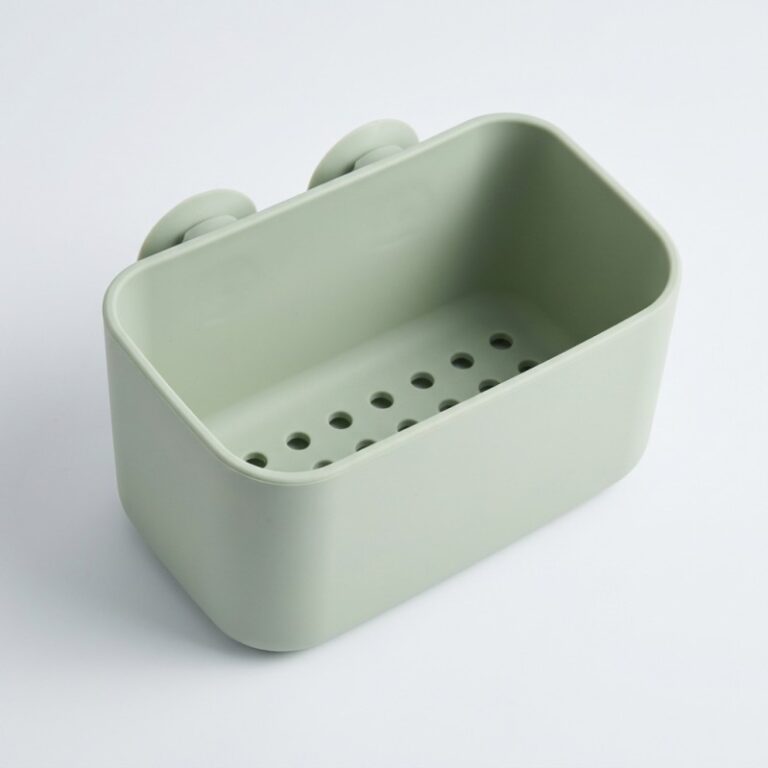
LYA Silicone’s product range includes silicone baby bath toys, and its bathroom storage product concept includes an open-top silicone basket with suction-cup mounting and a customized drainage layout. This guide explains how OEM buyers can evaluate the drainage structure of a custom silicone bath toy organizer.
1. Why Does a Silicone Bath Toy Organizer Hold Water?
Water retention is usually related to the relationship between the basket base, drainage openings, stored items and installed orientation.
Several conditions may contribute to the problem.
Drainage openings are positioned too high
If the lowest effective drainage opening is higher than the lowest point of the basket interior, a layer of water may remain below the opening.
The design team should review the relationship between the internal base surface and the outlet location.
The base contains low points
A basket base may appear flat in a 2D drawing but develop local depressions after molding or installation.
These low points can collect water and prevent it from reaching the outlet.
Stored toys block the openings
Bath toys are not always placed in a consistent arrangement. A large toy may cover a drainage opening, while several smaller toys may accumulate near the base.
The organizer should therefore be evaluated with representative stored items rather than only when empty.
The installed angle changes water flow
A wall-mounted basket may not remain perfectly level. If the mounting position or suction-cup arrangement causes the basket to tilt, water may collect away from the intended outlet.
Narrow openings are difficult to clean
A drainage hole that is too small or located in a difficult-to-access area may collect soap residue, dirt or other bathroom deposits.
Drainage performance and cleaning access should be considered together.
2. How Should OEM Buyers Position Drainage Holes?
Drainage-hole placement should be determined by the internal shape of the basket and its intended installation position.
The objective is to create a practical path for water to move out of the organizer without weakening the product or making it difficult to clean.
Place openings near effective collection areas
The lowest internal areas are important because water naturally collects there.
Before finalizing the hole positions, review:
- The internal base profile
- The intended installation angle
- The location of local depressions
- The position of suction-cup mounting features
- The areas likely to be covered by stored toys
A drainage opening should be located where water can realistically reach it.
Avoid placing every hole along one arbitrary line
A row of openings may look visually balanced, but it does not automatically provide effective drainage.
If the basket base has several low points, a single row may leave some areas without a suitable drainage path.
The designer should study the internal geometry and determine whether one outlet area or multiple drainage zones are more appropriate.
Keep the openings accessible
Drainage openings should be visible and accessible for routine rinsing.
Avoid placing them directly beside deep recesses, tight corners or decorative features that make cleaning difficult.
The final layout should be reviewed from both the inside and outside of the basket.
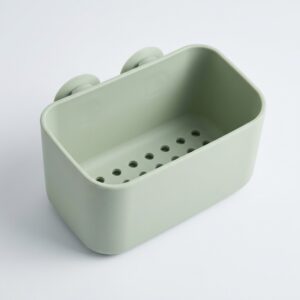
3. How Do Drainage-Hole Shape and Size Affect the Product?
The opening shape influences water passage, cleaning access and the remaining material around each hole.
There is no single drainage-hole dimension that suits every basket. The appropriate geometry depends on the product size, wall thickness, silicone material, base shape and intended use.
Round openings
Round holes are relatively straightforward to inspect and can be integrated into different base profiles.
The designer should check the edge radius and surrounding material to avoid unnecessarily sharp transitions.
Elongated slots
Slots may provide a longer drainage path within a limited area.
However, a long opening also removes more material from the base. Its length, width, end radius and distance from nearby edges should be reviewed together.
Multiple small openings
Several smaller openings may distribute drainage locations across the base.
However, closely spaced openings can leave narrow material bridges between them. These areas need structural review, especially when the basket is squeezed or flexed during installation and cleaning.
Design comparison
| Opening type | Potential advantage | Design concern |
|---|---|---|
| Round hole | Simple geometry and visual inspection | May leave water in distant low points |
| Elongated slot | Can cover a longer drainage area | Requires review of remaining material |
| Multiple openings | Offers several drainage paths | Small openings may be harder to clean |
| Perimeter opening | Can support drainage near an edge | Must not interfere with mounting or wall structure |
The final choice should be based on the basket’s actual geometry and sample evaluation.
4. Why Does the Basket Base Need a Drainage-Friendly Profile?
Drainage holes alone cannot solve every water-retention problem.
If the basket base has an unsuitable profile, water may remain in areas that do not lead to the openings.
Base slope
A gently directed internal profile may help water move toward a drainage area.
The required slope should be defined in the product drawing and reviewed with the actual installed position.
A visual slope in a rendering is not sufficient. The molded sample should be placed in its intended mounting position to check the real water path.
Internal corners
A sharp internal corner may create a local collection area that is difficult to rinse.
A smoother transition between the base and sidewall can make the interior easier to access.
Wall-to-base transition
The base and sidewalls should be reviewed as one structure.
A sudden change in thickness or geometry may create a local depression or distortion. The manufacturer should evaluate whether the molded basket maintains its intended internal profile after demolding and cooling.
Basket deformation
Silicone is flexible. If the basket deforms under the weight of stored toys or mounting forces, its drainage direction may change.
The design should be evaluated under a representative loading condition, not only when the basket is empty.
5. How Do Suction-Cup Mounting and Installation Affect Drainage?
A wall-mounted organizer needs a stable installation position.
Even if the basket has a suitable drainage layout, poor mounting orientation may change the effective base slope.
OEM buyers should review the relationship between:
- Suction-cup locations
- Basket center of gravity
- Basket wall geometry
- Mounting surface
- Installed angle
- Expected stored-item load
Suction-cup position
The suction cups should be positioned so that the organizer can be installed in the intended orientation.
If the mounting points are uneven, the basket may tilt and change the drainage direction.
Mounting-surface compatibility
Different bathroom surfaces may have different textures and flatness.
The product should be evaluated on the surface types specified by the buyer. A result on one smooth reference surface should not be treated as proof of performance on every tile, glass or textured wall.
Loading condition
An empty basket may sit differently from one containing several wet bath toys.
The sample test should include a representative loading condition agreed by the buyer and manufacturer.
The organizer should not be described as supporting a particular load unless that load has been specified and validated.
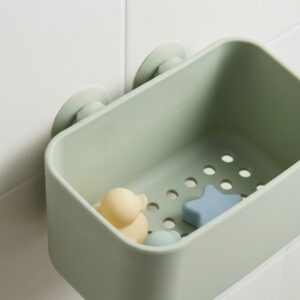
6. How Can Buyers Validate Drainage Before Mass Production?
A drainage test should reproduce the product’s intended installation and use conditions.
A simple water-pouring demonstration may help identify obvious issues, but a repeatable sample-validation procedure provides more useful engineering information.
Step 1: Confirm the installation position
Mount the sample using the intended suction-cup arrangement on an agreed reference surface.
Record the installation orientation and check whether the basket is visibly tilted.
Step 2: Inspect the empty basket
Check the internal base profile, drainage openings, wall transitions and visible molding defects.
Look for local depressions or areas that could retain water.
Step 3: Apply a defined amount of water
The buyer and manufacturer should agree on a consistent water quantity and application method.
Pour the water into the basket in a repeatable manner and observe whether it moves toward the drainage openings.
Do not assume that a single pour represents every real-use condition.
Step 4: Repeat with representative toys
Place representative bath toys inside the basket.
Check whether the stored items block the drainage openings or create additional water-retention areas.
The product should be evaluated in the storage condition for which it is being developed.
Step 5: Inspect residual water
After the agreed observation period, inspect the base and corners.
Record where water remains, whether the openings are blocked and whether the basket has changed shape.
Step 6: Repeat after installation and handling cycles
If the organizer is intended for repeated mounting and removal, include those actions in the sample-validation plan.
Check whether the suction-cup arrangement, basket shape or drainage direction changes after repeated handling.
Step 7: Document acceptance criteria
A useful sample report should include:
- Sample identification
- Basket dimensions
- Drainage-hole layout
- Installation surface
- Installation orientation
- Water application method
- Stored-toy arrangement
- Observation period
- Residual-water locations
- Visible deformation
- Agreed pass/fail criteria
The buyer and manufacturer should establish project-specific acceptance limits. There is no universal drainage time or residual-water threshold that can be applied to every organizer.
7. What Manufacturing Issues Should Be Checked Around Drainage Openings?
Drainage features also affect mold design and finished-product inspection.
The openings should be reviewed as functional features rather than decorative details.
Flash around openings
Excessive flash or incomplete trimming can partially obstruct a drainage opening.
Inspect the edge of each opening after molding and finishing.
Incomplete formation
Small or narrow features may require specific attention during mold design and sample inspection.
Check whether the finished openings match the approved drawing.
Edge quality
Rough edges or irregular trimming may affect cleaning and appearance.
The opening should have a consistent, manufacturable edge profile.
Material bridges
When multiple openings are placed close together, the remaining material between them should be reviewed for deformation and handling concerns.
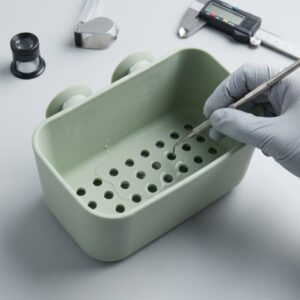
Dimensional consistency
Compare samples from relevant mold cavities and production runs.
A drainage design should be evaluated on actual molded parts, not only on the CAD model.
8. What Should Buyers Include in an OEM RFQ?
A clear RFQ helps the manufacturer understand the product’s storage function, mounting method and drainage requirements.
| RFQ item | Information to provide |
|---|---|
| Product type | Wall-mounted silicone bath toy organizer |
| Basket shape | Reference drawing, sample or product photo |
| Overall dimensions | Target width, height and depth |
| Storage requirement | Types and approximate arrangement of bath toys |
| Drainage layout | Hole positions, shapes and functional expectations |
| Base profile | Flat, sloped or custom internal geometry |
| Mounting method | Suction-cup arrangement or other specified structure |
| Installation surface | Intended wall or bathroom surface |
| Material | Required silicone material specification |
| Hardness | Target requirement, if already defined |
| Color | Pantone reference or approved sample |
| Logotipo | Molded or other agreed branding method |
| Embalaje | Individual packaging or retail set |
| Target market | Destination country and applicable product requirements |
| Order quantity | Estimated order quantity and forecast |
Buyers can also review the custom silicone mold development checklist before submitting drawings for tooling evaluation.
9. Frequently Asked Questions
Why does a silicone bath toy organizer retain water?
Possible causes include drainage openings positioned above the lowest internal area, an unsuitable base profile, blocked openings, local deformation or an incorrect installed angle. The actual cause should be identified through sample inspection.
Should a silicone bath toy organizer have one large drainage hole or several small holes?
Neither layout is universally better. A large opening may provide a direct drainage path but remove more material. Multiple smaller openings may distribute drainage locations but can be harder to clean and may leave narrow material bridges. The design should be evaluated with the complete basket geometry.
Does a sloped basket base always improve drainage?
A suitable slope may help guide water toward an outlet, but the result depends on the installed orientation, base shape, outlet location and basket deformation. It must be verified on a mounted sample.
Can suction cups affect drainage performance?
Yes. If the mounting arrangement causes the basket to tilt, water may collect away from the intended drainage openings. The basket should be tested in its actual mounting position.
Can drainage holes become blocked by bath toys?
Yes. Stored toys may cover openings or obstruct the water path. This is why the basket should be evaluated both empty and with representative stored items.
Can the drainage layout be customized for different basket shapes?
The drainage layout can be considered during custom product development. Final feasibility depends on the basket geometry, wall structure, mold design, material and buyer’s functional requirements.
What should be checked before approving mass production?
Buyers should confirm the approved basket dimensions, drainage-hole layout, base profile, mounting orientation, material specification, surface quality, installation stability, sample-validation results and packaging condition.
Conclusion: Design Drainage as Part of the Complete Organizer Structure
A silicone bath toy organizer should not be designed by adding drainage holes at the end of product development.
The drainage path depends on:
Basket Geometry → Base Profile → Drainage Opening → Mounting Orientation → Stored Toys → Sample Validation → Production Inspection
Each element affects the final result.
For baby product brands, wholesalers, importers and private-label buyers, the most reliable approach is to define the intended storage and installation conditions, review the drainage structure before tooling and validate the finished molded samples.
LYA Silicone supports custom silicone product development and OEM/ODM manufacturing. Buyers can explore the Silicone Baby Products collection and the Silicone Baby Bath Toys collection for related product categories.
If you are developing a wall-mounted silicone bath toy organizer, send your drawing, reference sample, target basket dimensions, drainage layout, mounting requirements, material preferences, color, packaging concept and estimated order quantity through our OEM/ODM silicone manufacturing serviceo contact LYA Silicone to discuss your project.