 Spanish
  English
  French
  German
  Polish
  Chinese
  Japanese
  Korean
  Russian
 Contenido
Answer Excerpt
Packaging for productos de silicona personalizados should be designed according to the product’s shape, wall thickness, elasticity, storage duration, transport condition and recovery requirement. A package that is too tight, too small or poorly supported can create curl, flattening, folding marks or shape distortion after storage and shipment. Buyers should define not only the product geometry, but also the packaging condition and recovery standard before mass production.
Silicone is flexible, soft and resilient.
That is exactly why many brands choose it for:
- Baby feeding products
- Pet products
- Travel accessories
- Outdoor products
- Educational products
However, the same flexibility that makes silicone attractive can also create packaging challenges.
A product may look perfect when it is demolded.
But after being:
- folded,
- rolled,
- compressed,
- stacked,
- bagged,
- boxed,
- warehoused,
- and shipped,
it may no longer return to its intended shape quickly enough.
For B2B buyers, the issue is not only:
Can the product be packed?
A better question is:
Can it still recover its intended geometry after real packaging, storage and shipping conditions?
Why Is Packaging an Engineering Issue Instead of Just a Final Step?
Many sourcing teams still treat packaging as something that happens after product approval.
That approach is risky.
For flexible silicone items, packaging can directly influence:
- shape retention
- sealing performance
- edge flatness
- assembly fit
- visual appearance
- user experience
For example, a silicone product may pass dimensional inspection in the factory, yet still reach the customer with:
- curled edges
- a collapsed opening
- a flattened zone
- pocket deformation
- permanent folding tendency
- poor lay-flat performance
This means packaging should be considered part of product development, not only part of final shipping.
Which Silicone Products Are Most Sensitive to Packaging Deformation?
Some silicone products are far more sensitive than others.
Typical examples include:
- silicone baby placemats
- baberos de silicona
- collapsible silicone cups
- soft silicone pouches
- suction bowls
- lids with sealing lips
- thin silicone trays
- pet feeding mats
- soft bottle bodies
These products are more likely to deform because they often have one or more of the following characteristics:
- large surface area
- thin wall sections
- soft hardness
- wide flat geometry
- foldable structures
- unsupported edges
- open-pocket features
- sealing features that require flatness
A simple O-ring and a large flat feeding mat do not react to packaging pressure in the same way.
So the package design should match the actual product structure.
What Usually Causes Deformation During Packaging and Shipment?
Deformation is rarely caused by only one factor.
In most real projects, it comes from several conditions acting together.
1. Excessive Compression
If the package squeezes the silicone product too tightly, the product may remain under stress for a long period.
This can contribute to temporary or even persistent shape distortion.
2. Uncontrolled Folding or Rolling
Some products can be folded or rolled safely.
Others cannot.
If the folding line is too sharp, or if the rolling diameter is too small, the product may develop visible bend memory.
3. Unsupported Wide Surfaces
Large flat silicone parts may sag, wave or curl when stored without support.
4. High Stacking Pressure
Multiple inner boxes or shipping cartons stacked for long periods can increase deformation risk.
5. Time and Temperature
Storage time matters.
So does heat.
A shape that recovers well after one hour may recover poorly after weeks of compression in a hot warehouse.
6. Incomplete Recovery Standard
Sometimes the supplier and buyer never clearly define what “recovered” actually means.
Is slight waviness acceptable?
How long may recovery take?
Does the product need to recover naturally, or after manual flattening?
If these questions are not defined early, quality disputes become more likely.
Why Should Recovery Be Evaluated Together With Compression Set?
When a flexible silicone product is held in a compressed or bent state, the key practical issue is whether it can recover after the stress is removed.
This behavior is often related to material elasticity, structure and compression set tendencies.
But buyers should not evaluate only the raw material.
They should also evaluate the finished product geometry.
A soft, thin, wide product may behave very differently from a thicker or more compact part made from the same silicone grade.
So packaging validation should be based on the actual finished product—not only the material data sheet.
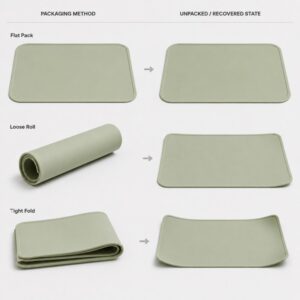
Should the Product Be Folded, Rolled or Stored Flat?
There is no universal answer.
The best packaging method depends on the product.
Flat Packing
Flat packing is often preferred for products that require excellent lay-flat performance, such as placemats or thin mats.
Advantages:
- lower deformation risk
- faster unpacking recovery
- better protection of flat geometry
Possible limitation:
- larger package size
Rolled Packing
Rolled packing can work well for some thin flexible mats, provided the rolling diameter is large enough and the product can recover well.
Advantages:
- better space efficiency than flat packing
- more controlled than random folding
Possible limitation:
- rolled-edge memory if the diameter is too small
Folded Packing
Folding may reduce package size significantly, but it should be validated carefully.
Advantages:
- compact packaging
- lower logistics volume
Possible limitations:
- visible fold lines
- delayed recovery
- localized flattening or curl
- pocket or flange distortion
For many soft consumer products, the packaging method should be confirmed through actual recovery testing rather than by assumption.
How Should Packaging Be Tested Before Mass Production?
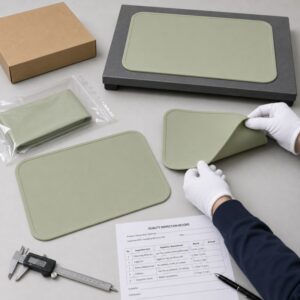
A package should not be approved only because it looks acceptable in a mockup.
It should be verified under realistic conditions.
Storage and Recovery Test
Store the product in the intended packaging condition for an agreed period.
Then unpack it and evaluate:
- immediate appearance
- shape recovery after a defined time
- edge flatness
- sealing or fitting function
- visual acceptability
Stacking Test
Simulate actual stacking load from master cartons or palletized goods.
This helps show whether long-term pressure changes the product shape.
Temperature Exposure Test
If the goods may be stored or transported in warm environments, heat exposure should be considered.
Soft silicone products may behave differently after prolonged storage at elevated temperature.
Transit Simulation
Depending on the product, basic transport validation may include vibration, handling or drop review to ensure packaging still protects the geometry.
Packaging Comparison Test
In many projects, the best way is to compare several methods side by side, such as:
- flat pack
- loose roll
- tight roll
- single fold
- double fold
Then check which method gives the best result after the same storage condition.
What Should Be Defined in the Recovery Standard?
Without a written standard, two parties may judge recovery differently.
A practical recovery standard may define:
- package condition
- storage duration
- storage temperature
- unpacking method
- waiting time after unpacking
- whether manual flattening is allowed
- acceptable curl level
- acceptable visual marks
- acceptable functional deformation
For example, a buyer may require that a baby placemat:
- be unpacked naturally,
- rest on a flat table,
- recover within a defined time,
- and show no unacceptable edge curl or permanent crease.
This standard should be agreed before production.
Why Should Packaging Be Reviewed During Product and Tooling Development?
If packaging is discussed only after tooling is finished, improvement options may be limited.
In many cases, packaging performance is influenced by:
- wall thickness
- edge thickness
- product symmetry
- structural ribs
- pocket depth
- flange width
- material hardness
- overall size
That is why packaging should be reviewed during custom silicone mold development.
Sometimes a small structural adjustment can improve both manufacturability and packaging stability.
For example:
- a slightly more stable edge profile
- a more balanced wall transition
- a less deformation-sensitive pocket angle
- a more supportive packaging insert size
This is also connected to dimensional tolerances, because a product that is already near its structural limit may become more sensitive to packaging stress.
Example: A One-Piece Silicone Baby Placemat
Consider a one-piece silicone baby placemat with:
- a wide rounded rectangular shape
- a shallow raised spill edge
- a large flat center area
- soft flexible silicone
- rollable structure
At the factory, the placemat may lie flat and pass inspection.
However, if it is tightly folded into a box that is too small, the customer may open it and find:
- curved long edges
- a slight center wave
- uplifted corners
- delayed lay-flat recovery
If the same placemat is instead packed:
- flat in a larger box, or
- loosely rolled with a larger diameter,
the recovery result may be better.
This example shows that deformation control is not only a material issue.
It is also a product-plus-packaging system issue.
Why Should Appearance Standards Also Cover Post-Unpacking Condition?
A product may look acceptable inside the factory but fail from the customer’s perspective after unboxing.
That is why silicone product cosmetic defect standards should include post-unpacking appearance where relevant.
The inspection should not consider only:
- black spots
- flash
- scratches
- contamination
It may also need to consider:
- edge curl
- visible crease memory
- opening deformation
- storage-induced flattening
- pocket distortion
For some products, approved limit samples are useful here as well.
They help define what level of post-packaging deformation is still acceptable.
How LYA Silicone Supports Packaging Deformation Control
LYA Silicone provides OEM and ODM development for baby, pet, outdoor and educational silicone products.
For packaging-sensitive projects, development support may include:
- product structure review
- material and hardness discussion
- packaging concept review
- sample packaging comparison
- storage and recovery validation
- visual appearance check after unpacking
- shipment packaging review
- mass-production quality control
The goal is not simply to reduce carton size.
The goal is to help the final product arrive in a condition that still matches the customer’s functional and visual expectations.
Packaging Deformation Prevention Checklist
| Artículo | What Should Be Confirmed |
|---|---|
| Product geometry | Wide, thin, foldable or deformation-sensitive areas identified |
| Material | Hardness and elasticity suitable for intended packaging condition |
| Packaging method | Flat, rolled or folded validated on actual product |
| Compression level | Product not stored under excessive stress |
| Inner pack size | Not too small for the product geometry |
| Stacking | Shipping load simulated if needed |
| Temperatura | Storage and transport heat considered |
| Recovery rule | Time and acceptance standard defined |
| Appearance | Post-unpacking visual requirements defined |
| Función | Product still performs after recovery |
| Sample approval | Final packaging confirmed before mass production |
Frequently Asked Questions
Can all silicone products be folded to save space?
No.
Some silicone products tolerate folding well, while others may show unacceptable distortion after storage.
Is rolling always better than folding?
Not always.
Rolling may reduce sharp crease risk, but if the rolling diameter is too small, the product may still develop curl memory.
Should recovery be checked immediately after unpacking?
Immediate inspection is useful, but many projects should also define a waiting period after unpacking because some silicone products recover gradually.
Can packaging alone solve deformation problems?
Not always.
Sometimes the product structure, wall thickness or hardness also needs adjustment.
Should post-packaging appearance be part of final quality control?
Yes.
For flexible silicone products, post-unpacking appearance may be just as important as appearance at the factory.
Does a larger box always mean better protection?
Not necessarily.
The package should provide appropriate support without over-compressing the product. Oversized packaging may also create movement problems during shipment.
Define the Packaging Standard Before Mass Production
For flexible silicone products, packaging is not only a shipping task.
It is part of the product-development decision.
A reliable packaging solution should consider:
- product geometry
- packaging method
- storage time
- stacking pressure
- temperature
- recovery performance
- post-unpacking appearance
Before mass production, buyers and manufacturers should confirm the product, the package and the recovery standard together.
If you are developing a packaging-sensitive silicone product, send Silicona LYA your drawing, target packaging format, product dimensions, storage expectation and estimated order quantity for project review.