 Spanish
  English
  French
  German
  Polish
  Chinese
  Japanese
  Korean
  Russian
 Contenido
Answer Excerpt
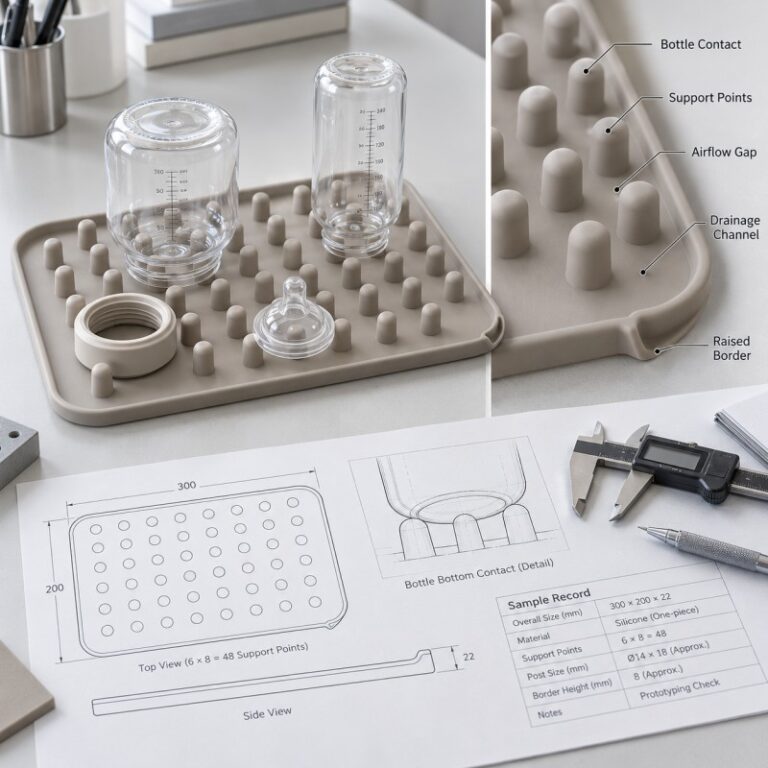
A well-designed silicone baby bottle drying mat should support washed bottles and feeding accessories without allowing them to tip easily or sit directly in pooled water. Its performance depends on support-point height, spacing, drainage channels, airflow access, bottle contact geometry, perimeter design and overall mat stability.
For OEM baby product brands, the key is to validate the complete drying arrangement using actual bottles, nipples, caps and feeding accessories rather than judging the empty mat by appearance alone.
Why Do Some Baby Bottle Drying Mats Perform Poorly?
A baby bottle drying mat may look like a simple flexible silicone surface. However, supporting several washed items creates different engineering requirements.
The mat must accommodate objects with different:
-
Heights and weights
-
Base diameters
-
Opening shapes
-
Contact surfaces
-
Center-of-gravity positions
-
Water-drainage needs
A tall baby bottle may become unstable on soft or uneven supports. A bottle collar may sit flat and block the space underneath it. Small accessories may fall between widely spaced raised features.
Meanwhile, a mat with a raised edge may collect rinse water but fail to provide an accessible way to empty it.
These are functional design problems, not necessarily material defects.
For OEM brands, the objective should be to balance three factors:
Bottle Stability → Airflow Access → Water Management
Improving one factor should not create a serious problem in another.
How Does Support-Point Geometry Affect Bottle Stability?
Raised support points are one of the defining features of many silicone bottle drying mats.
They lift the bottom or rim of a washed item above the main mat surface, leaving open space for water movement and air circulation.
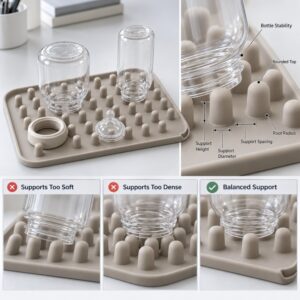
However, support points can behave differently depending on their geometry.
Support-Point Height
If the supports are too low, bottle openings or accessories may remain close to collected water.
If they are excessively tall and flexible, a heavy bottle may sway or tilt.
The correct height should be evaluated using representative bottle dimensions and loads.
Support-Point Diameter
Very narrow supports may bend more easily under load.
Very broad supports may reduce the available open area beneath the bottle.
The support diameter should provide enough contact stability without unnecessarily blocking drainage and airflow.
Support-Point Spacing
Closely spaced supports can distribute weight across more contact locations, but very dense layouts may create narrow cleaning gaps.
Widely spaced supports provide open space, but small accessories or narrow bottle rims may not be supported evenly.
The appropriate spacing therefore depends on the complete range of items the mat is expected to hold.
Why Is Contact Geometry More Important Than the Number of Supports?
Adding more support points does not automatically make a drying mat better.
Consider a washed baby bottle positioned upside down.
Depending on its design, the bottle may contact the mat through its mouth, collar or another structural edge.
If the contact surface sits unevenly across several flexible supports, the bottle may lean.
If a wide contact surface completely covers a densely packed support area, the open space underneath may be restricted.
The designer should examine:
-
Actual contact diameter
-
Number of supports carrying the load
-
Height consistency
-
Local support deformation
-
Bottle center of gravity
-
Access for water and air
A stable contact arrangement is more important than simply maximizing the number of raised features.
How Should Airflow Channels Be Designed?
A drying mat should not be expected to dry a bottle merely because the material is silicone.
The actual drying process depends on water removal, accessible surface area, room conditions and how the washed item is positioned.
Open channels between support points can help prevent large contact areas from trapping moisture against the base.
A useful drainage and easy-clean design should evaluate:
-
Channel continuity
-
Spacing between raised supports
-
Areas where water accumulates
-
Cleaning access between structures
-
The direction in which water can be emptied
However, the mat should not be marketed as guaranteeing a specific drying time without comparative testing under defined conditions.
Airflow can assist drying, but an inverted bottle with a restricted opening may still retain moisture internally. A passive drying mat does not replace appropriate washing, draining and drying procedures.
Why Can a Very Dense Support Layout Create Problems?
Dense support arrays often look attractive in product photographs.
They can also provide multiple contact points for small accessories.
But excessive density may create:
-
Narrow gaps that are difficult to rinse
-
More contact surfaces
-
Limited space for wiping between supports
-
Greater complexity during mold production
-
Small pockets that retain residue
The correct density depends on the intended items.
A mat designed mainly for large baby bottles may need a different layout from one intended for bottle nipples, collars, pump parts and pacifier accessories.
For a mixed-accessory product, the design team may consider more than one functional area.
Should the Mat Have Separate Zones for Bottles and Small Accessories?
Separate functional zones can be useful when the product is expected to support both tall bottles and small components.
For example, one area may use relatively broad, low-profile support points suitable for bottle rims.
Another area may use smaller rounded supports with spacing better suited to caps and collars.
The objective is not to create as many different textures as possible.
Every functional zone should solve a clear user problem.
Potential zone requirements include:
Bottle Zone
Support taller objects while controlling local bending and tipping.
Accessory Zone
Hold smaller components above the base surface without allowing them to fall into deep gaps.
Open Drainage Area
Provide accessible space for water collection and removal without creating difficult-to-clean corners.
A simple and consistent layout may still be preferable when the product is intended for a narrow range of accessories.
How Does the Outer Border Affect Water Management?
A shallow raised border can help prevent small amounts of residual water from spreading immediately across the countertop.
However, the border also changes how water is removed from the mat.
If the perimeter is completely continuous, users may need to lift and tilt the mat to empty collected water.
If a drainage outlet is added, its position should match the intended use and countertop arrangement.
Important considerations include:
-
Border height
-
Border thickness
-
Corner geometry
-
Available water-collection space
-
Emptying method
-
Cleaning access
A higher border does not automatically improve daily usability.
The perimeter should retain manageable amounts of water while remaining convenient to wipe, rinse and empty.
Why Does Silicone Hardness Affect Support Stability?
The same support-point design can behave differently when the silicone material changes.
A softer material may make raised supports more flexible.
A firmer material may help retain their shape under load.
However, excessive firmness can change the overall handling experience of the mat.
The correct balance depends on:
-
Support-point geometry
-
Bottle weight
-
Mat size
-
Base thickness
-
Intended flexibility
-
Packaging method
Material selection should therefore be validated on molded samples rather than based only on a nominal hardness specification.
How Should the Mat Base Be Designed?
The mat base provides the foundation for the entire support array.
If the base is too flexible, the product may curl or distort when users move several wet bottles at once.
If the base is unnecessarily thick, the product becomes heavier and may be less convenient to roll or store.
Design teams should review whether the mat:
-
Lies flat on the intended countertop
-
Supports representative bottle loads
-
Can be lifted for cleaning
-
Recovers after bending
-
Remains stable when wet
-
Avoids excessive edge curling
The underside also matters.
A complex underside texture may collect dust or water against the countertop.
A clean, stable contact surface can be more useful than a decorative pattern that does not improve the product’s function.
What About Hygiene and Bacteria on Drying Mats?
For baby feeding accessories, hygiene is an important consideration.
A common consumer question is: does silicone harbor bacteria?
The practical concern is not simply the silicone material. Water, milk residue and other contamination can remain on surfaces or in narrow spaces if the product is not cleaned properly.
A silicone drying mat should therefore be designed so users can easily inspect and rinse:
-
Support-point roots
-
Water-collection channels
-
Outer corners
-
Border transitions
-
The underside of the mat
The product should not be described as antibacterial or self-sanitizing without evidence supporting that specific claim.
Brands should provide realistic cleaning instructions based on the finished product and the requirements of the target market.
Why Should Real Bottle Sizes Be Used During Development?
CAD models can help establish the drying mat’s basic dimensions, but actual bottle samples are useful during validation.
Different brands may use:
-
Wide-neck bottles
-
Narrow-neck bottles
-
Tall bottles
-
Short feeding cups
-
Separate collars and caps
-
Breast pump accessories
These products have different balance and contact characteristics.
A drying mat designed around only one reference bottle may not support another common format equally well.
Before tooling, buyers should define a representative item list and the intended number of items used simultaneously.
This provides a more meaningful basis for support-point layout and testing.
How Should the Product Be Reviewed Before Mold Development?
Before custom silicone mold development, the buyer and manufacturer should finalize the main functional geometry.
Important items include:
-
Overall mat length and width
-
Support-point pattern
-
Support-point height and diameter
-
Support spacing
-
Border design
-
Base thickness
-
Surface finish
-
Logo position
-
Material requirements
-
Packaging structure
-
Critical quality characteristics
Support-point roots should be manufacturable and easy to inspect.
Very narrow, tall or densely packed features can increase mold filling, demolding and inspection complexity.
The final structure should support consistent production without requiring unnecessary manual reshaping after molding.
Practical Example: A Drying Mat for Baby Bottles and Accessories
Consider a rounded rectangular silicone drying mat designed for two bottles and several small feeding accessories.
The product has a shallow outer border and a grid of rounded raised supports.
Version A — Supports Too Soft
The individual support points bend excessively beneath taller bottles.
The bottles become less stable when placed off-center.
Version B — Supports Too Dense
The bottles are supported, but the small channels between the raised features become difficult to rinse and wipe.
Version C — Poor Water-Collection Layout
The support geometry works, but the collected water is inconvenient to empty from the perimeter.
Improved Design
A better design balances:
-
Support-point stability
-
Practical spacing
-
Open channels
-
Manageable border height
-
Easy access for cleaning
-
Overall mat flatness
The final decision should come from sample testing with real bottles and accessories.
What Should Brands Test During Sample Approval?
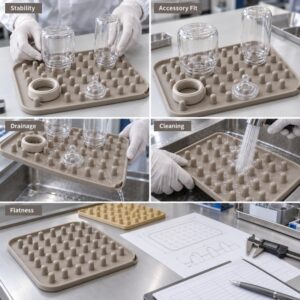
Bottle Stability Test
Place representative clean bottles upside down in the intended positions.
Check whether they remain stable without excessive leaning.
Accessory Placement Test
Arrange collars, nipples and other washable accessories.
Confirm that smaller items are supported without becoming trapped between raised structures.
Drainage Observation
Add a controlled amount of clean water and observe where it accumulates.
Check how conveniently it can be removed.
Airflow Accessibility Review
Inspect whether the support structure leaves open paths beneath the intended contact surfaces.
Do not infer a guaranteed drying-time improvement without separate testing.
Cleaning Test
Rinse and wipe the mat after simulated use.
Inspect whether all support-point roots and channels remain accessible.
Flatness and Recovery
Lift and gently bend the mat, then return it to the countertop.
Check whether it recovers its intended shape.
Multi-Sample Comparison
Evaluate more than one molded sample to confirm consistent support geometry and overall appearance.
Silicone Baby Bottle Drying Mat Design Checklist
| Artículo | What the Buyer Should Confirm |
|---|---|
| Target bottles | Actual bottle shapes, sizes and weights |
| Accessory range | Caps, collars, nipples and other parts |
| Support-point height | Enough clearance without instability |
| Support-point spacing | Suitable for large and small items |
| Support geometry | Rounded, stable and moldable |
| Airflow paths | Open space beneath contact areas |
| Drainage layout | Water can be managed and removed |
| Outer border | Practical containment and emptying |
| Base thickness | Stable but flexible enough for handling |
| Silicone hardness | Evaluated with loaded samples |
| Cleaning access | Support roots and channels can be reached |
| Mat flatness | Stable on representative countertops |
| Mold review | Repeated features can be formed consistently |
| Sample approval | Real-use stability and cleaning verified |
| Embalaje | Avoids permanent curling or support distortion |
How LYA Silicone Supports Custom Drying Mat Development
LYA Silicone provides OEM and ODM development support for custom consumer silicone products, including baby feeding and cleaning accessories.
Its existing range of Productos de silicona para bebés includes feeding bowls, bibs, cups, pacifiers, bottle brushes and other related products.
For a custom drying mat project, development can include:
-
Product concept and drawing review
-
Target bottle and accessory evaluation
-
Support-point layout
-
Drainage structure planning
-
Silicone material and hardness discussion
-
Mold development
-
Color and logo customization
-
Sample production
-
Functional inspection
-
Packaging review
-
Mass-production quality control
The goal is to manufacture a mat that supports actual feeding accessories reliably, not merely one that looks attractive in product photographs.
Frequently Asked Questions
Do Taller Silicone Support Points Always Improve Bottle Drying?
No. Taller supports may create more clearance, but excessive flexibility can reduce bottle stability. Actual airflow and drying performance also depend on the bottle’s position and surrounding conditions.
Why Do Bottles Tip on Some Silicone Drying Mats?
Possible causes include flexible supports, uneven contact geometry, unsuitable spacing, insufficient base stability or the bottle’s center of gravity.
Does a Silicone Drying Mat Prevent Bacterial Growth?
A silicone drying mat should not be assumed to prevent bacterial growth. Cleaning, removal of residue and appropriate drying remain important.
Are More Support Points Always Better?
Not necessarily. Dense support arrangements can improve contact distribution but may restrict cleaning access or reduce the openness of drainage channels.
Should a Drying Mat Have a Raised Edge?
A shallow edge can help contain residual water, but its height and drainage arrangement should also make the mat convenient to empty and clean.
Can a Brand Customize the Support Layout?
Yes. Depending on the manufacturing project, the support arrangement, dimensions, edge structure, material and packaging can be developed around the intended use.
Should Actual Baby Bottles Be Used During Sample Approval?
Yes. Representative bottles and accessories provide more reliable functional feedback than evaluating an empty mat alone.
Design for Real Bottles, Not Just an Empty Mat
A successful silicone bottle drying mat should balance:
Bottle Contact → Support Stability → Airflow Access → Water Management → Cleaning → Manufacturing Consistency
The design should be validated as a functional system.
A dense array of attractive raised structures does not automatically create a better drying surface, and an extremely soft mat does not automatically provide better usability.
If you are developing a custom silicone baby bottle drying mat or a private-label baby feeding accessory collection, contact us with your target dimensions, bottle types, support-layout requirements, material preferences, colors, logo, packaging concept and estimated order quantity.