 Spanish
  English
  French
  German
  Polish
  Chinese
  Japanese
  Korean
  Russian
 Contenido
Answer Excerpt
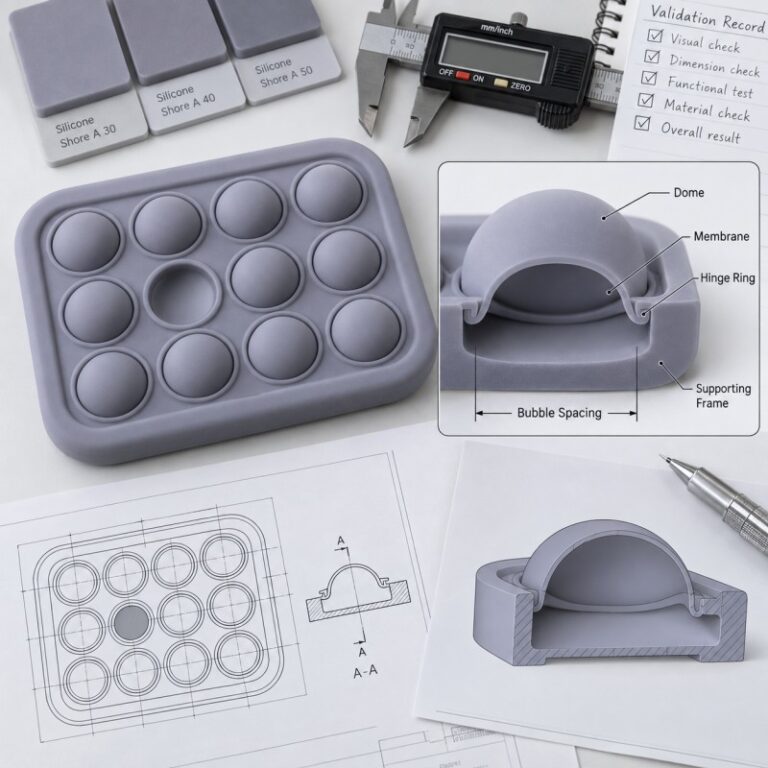
Good silicone pop bubble design depends on the complete relationship between dome diameter, dome height, membrane thickness, hinge geometry, silicone hardness, bubble spacing and the stiffness of the surrounding frame.
A bubble that is too stiff may require excessive pressing force or fail to invert completely. A bubble that is too soft may collapse without clear tactile feedback, recover inconsistently or interact with neighboring bubbles. For OEM fidget and sensory products, the bubble should therefore be validated as a functional flexible structure before mass production.
Why Does a Simple Silicone Bubble Need Engineering Review?
A pop bubble looks simple from the outside.
It is usually a circular flexible dome integrated into a silicone panel or toy body.
But during use, that small dome must repeatedly move through several stages:
- Initial finger contact
- Elastic deformation
- Inversion through the surrounding membrane
- Temporary inverted position
- Reverse pressing
- Recovery toward the original geometry
That means the bubble is not merely decorative surface geometry.
It is a repeatedly deforming mechanism.
Its performance depends on:
Dome Geometry → Membrane → Hinge Zone → Material → Supporting Frame
Changing only one of these variables can noticeably change the pressing experience.
What Determines Whether a Silicone Bubble Can Invert Properly?
A successful pop bubble usually needs enough flexibility to move through its neutral position without becoming unstable.
Several variables are involved.
Dome Diameter
A larger dome generally creates a larger deforming area.
That can change:
- Pressing distance
- Finger contact
- Structural flexibility
- Space required between bubbles
A very small bubble may feel locally stiff if the membrane and dome height are not adjusted accordingly.
Dome Height
The height of the dome affects how far the bubble needs to move during inversion.
If the dome is too shallow, the tactile transition may become weak.
If it is unnecessarily tall, it may require greater deformation and can become unstable near the edge.
Membrane Thickness
The thin flexible section forming the bubble is one of the most important variables.
Too thick:
- Pressing resistance may become high
- Small users may find the bubble difficult to invert
- The complete toy may flex instead of the individual bubble
Too thin:
- The bubble may collapse too easily
- Shape control may decrease
- Local deformation can become inconsistent
- Long-term recovery may become less stable
There is therefore no single universal wall thickness for every pop bubble.
The actual geometry and material need to be evaluated together.
Why Is the Hinge Ring Around the Bubble Important?
The flexible transition around the outside of the dome acts like a hinge zone.
This region allows the dome to rotate and invert relative to the surrounding panel.
If this transition is too rigid, the entire dome may resist pressing.
If it is too weak, the bubble may feel uncontrolled.
A useful design review should examine:
- Hinge-ring width
- Local thickness
- Transition radius
- Connection to the frame
- Distance to neighboring bubbles
The transition should be smooth rather than creating an abrupt thickness change.
This is especially important because repeated pressing concentrates deformation around this area.
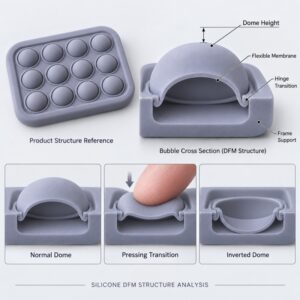
Why Can’t the Bubble Be Designed Independently From the Frame?
The surrounding frame provides structural support.
If the frame is very flexible, pressing one bubble may bend the entire toy.
Instead of the dome inverting cleanly, the user may see the whole panel deform downward.
If the frame is excessively rigid relative to the bubble, the contrast between the two regions can become too strong.
A balanced design should allow:
- The frame to support the hand
- The individual bubble to deform locally
- Neighboring bubbles to remain relatively stable
- The toy to recover after pressing
This is why bubble geometry and frame geometry should be developed together.
How Does Silicone Hardness Affect the Pressing Experience?
The same bubble design can behave very differently when molded in different silicone hardness levels.
A softer silicone may provide:
- Lower initial pressing resistance
- Softer finger contact
- Greater overall flexibility
But it can also make:
- The frame flex more
- The bubbles feel less defined
- Neighboring areas deform together
A firmer silicone can improve structural definition but may require greater pressing force.
Hardness should therefore not be selected with a rule such as:
Softer silicone always creates a better sensory toy.
That is too simplistic.
The correct material should be tested together with the actual dome, hinge and frame structure.
Why Does Bubble Spacing Matter?
Individual bubbles need enough surrounding structure to operate independently.
When bubbles are placed too close together, pressing one dome may deform the membrane of the neighboring dome.
Possible effects include:
- Neighboring bubble movement
- Uneven pressing feel
- Weak frame support
- Difficult mold venting
- Local shape distortion
Very wide spacing, on the other hand, increases overall product size and may reduce the desired bubble density.
The designer should consider:
- Bubble diameter
- Hinge width
- Space between hinge zones
- Outer-frame width
- Desired product dimensions
Spacing is therefore a functional parameter, not only a visual-layout choice.
Should Every Bubble on the Product Have the Same Geometry?
Usually, maintaining consistent bubble geometry is helpful when the brand wants a repeatable pressing experience.
However, some sensory products intentionally use:
- Large bubbles
- Small bubbles
- Different shapes
- Different tactile zones
That can be a valid design direction.
But each different bubble geometry should be treated as a separate functional structure.
If one toy contains three dome sizes, the team should not assume that one membrane thickness automatically works for all three.
Each version may require separate validation.
How Does Bubble Shape Affect Performance?
Circular bubbles are common because their geometry distributes deformation relatively evenly.
However, OEM designs may use:
- Circular domes
- Rounded squares
- Hearts
- Animal-inspired shapes
- Geometric forms
The more the bubble moves away from a symmetrical circular shape, the more carefully the bending pattern should be reviewed.
For example, a heart-shaped bubble contains areas with different curvature.
If the geometry is not balanced, one section may begin to invert earlier than another.
Decorative design is possible, but it should not override the mechanical function.
Why Are Sharp Corners a Poor Choice for Flexible Bubble Geometry?
Sharp internal corners concentrate deformation into smaller regions.
During repeated pressing, these areas may experience more localized bending than smooth curves.
Rounded transitions can generally provide:
- More gradual deformation
- Cleaner molded geometry
- Better tactile comfort
- More predictable recovery
This does not mean every bubble must be circular.
It means decorative shapes should be softened enough to remain compatible with repeated flexible movement.
How Does Dome Height Change Tactile Feedback?
Imagine two bubbles with the same outer diameter.
Bubble A is shallow.
Bubble B has a noticeably higher dome.
They can feel very different.
A Shallow Dome
May provide:
- Shorter pressing travel
- Subtle inversion
- Lower profile
But if it is too shallow, the transition between the two positions may not feel distinct enough.
A Higher Dome
May provide:
- More finger travel
- Stronger geometric change
- More noticeable inversion
But excessive height can also create:
- Greater local strain
- More difficult recovery
- More interaction with packaging
- More obvious product thickness
The correct height should match the intended sensory experience rather than simply maximizing the visible dome.
Why Should Pressing Force Be Evaluated Across the Whole Board?
A common quality problem is not necessarily that every bubble is bad.
The problem may be that:
- Bubble 1 feels soft
- Bubble 2 feels firm
- Bubble 3 requires much more force
- Bubble 4 does not invert completely
Users notice inconsistency very quickly on a repetitive sensory product.
Possible causes can include differences in:
- Local membrane thickness
- Dome geometry
- Mold filling
- Frame support
- Cavity condition
- Product deformation
Sample inspection should therefore compare bubbles across the whole product, not only test one representative dome.
What Does a Good Pop Bubble Recovery Look Like?
After reverse pressing, the bubble should return toward the approved geometry without unacceptable permanent distortion.
Potential problems include:
- Dome remains partially inverted
- Dome returns slowly
- Bubble becomes tilted
- Hinge area wrinkles
- Dome height changes after repeated use
Recovery should be evaluated after realistic repeated pressing.
A single successful pop does not prove that the structure is ready for production.
Why Can Adjacent Bubbles Feel Different?
Even when the CAD geometry is identical, their position within the product may change the surrounding structural support.
For example:
A corner bubble may have a rigid outer frame close to two sides.
A center bubble may be surrounded by other flexible bubbles.
This can change how the local panel responds during pressing.
For this reason, the sample plan should compare:
- Corner bubbles
- Edge bubbles
- Center bubbles
rather than testing only the easiest location.
Should the Bubble Surface Have Texture?
It can.
A bubble may include:
- Small raised dots
- Simple embossed symbols
- Letters
- Numbers
- Fine tactile textures
But surface decoration adds local material and changes the dome geometry.
A large raised feature at the center can make the dome locally thicker.
Deep recessed details can create thinner areas.
If tactile decoration is used, it should therefore be reviewed together with the bubble membrane.
The learning or sensory graphic should not unintentionally change the pressing behavior.
How Should Bubble Geometry Be Reviewed Before Tooling?
Pop bubbles should be included in the early custom silicone mold development review.
Important points include:
- Dome geometry
- Bubble spacing
- Membrane thickness
- Hinge transition
- Frame stiffness
- Mold split
- Filling direction
- Venting
- Demolding
- Surface finish
Very thin flexible membranes and repeated dome structures can create different molding requirements from a simple solid silicone part.
The design should therefore be frozen only after the manufacturing team has reviewed the functional geometry.
Why Does Mold Filling Matter for Pop Bubbles?
A fidget board may contain many identical flexible domes.
Each bubble needs to form completely.
Incomplete or inconsistent molding can affect:
- Dome shape
- Edge definition
- Membrane continuity
- Surface appearance
- Pressing performance
The tooling team should consider how silicone reaches the repeated thin sections and how trapped air is released.
A visually small defect can become a functional defect if it changes the flexible area.
How Does Demolding Affect Bubble Shape?
After molding, the product must be removed from the tool.
During removal, flexible bubbles may temporarily invert or stretch.
That is not automatically a defect.
The important question is whether the product returns to its approved geometry after appropriate recovery.
The team should evaluate:
- Bubble orientation after release
- Dome symmetry
- Frame flatness
- Hinge condition
- Permanent deformation
The sample should be judged after a defined conditioning period rather than only at the exact moment it leaves the mold.
Practical Example: 12-Bubble Silicone Fidget Board
Consider a one-piece Juguete de silicona with a rounded rectangular frame and twelve circular press bubbles arranged in three rows of four.
The brand wants:
- Comfortable finger pressing
- Clear inversion
- Consistent feel across all twelve bubbles
- Reliable return after reverse pressing
- Compact overall size
Version A — Membrane Too Thick
Individual bubbles look correct, but pressing force is high.
When the user presses a dome, the surrounding board begins to bend.
Version B — Membrane Too Thin
The bubbles press easily, but several collapse with little tactile transition and do not maintain consistent geometry.
Version C — Frame Too Flexible
Bubble geometry is reasonable, but pressing the middle bubbles bends the complete panel.
Optimized Version
The final structure balances:
- Dome diameter
- Dome height
- Flexible membrane
- Hinge-ring transition
- Bubble spacing
- Supporting frame
- Silicone hardness
The important point is that good tactile performance comes from the complete system.
What Should Brands Test During Sample Approval?
Initial Pressing
Press every bubble individually.
Compare:
- Pressing resistance
- Viajar
- Inversion
- Finger comfort
Bubble-to-Bubble Consistency
Compare corner, edge and center bubbles.
The product should meet the agreed tactile standard across the complete board.
Reverse Pressing
Invert the bubbles and press them back from the opposite side.
Check whether both directions behave as intended.
Recovery
Allow the product to rest after pressing and confirm that the bubbles return to the approved geometry.
Repeated Pressing
Operate representative bubbles repeatedly.
Inspect:
- Hinge ring
- Dome surface
- Local whitening
- Permanent wrinkles
- Cracks
- Loss of recovery
Frame Flatness
Place the complete product on an appropriate flat reference surface and check whether repeated pressing has caused unacceptable twisting or warping.
Multi-Sample Comparison
Do not approve only one ideal sample.
Compare several molded pieces and, where applicable, samples from different mold cavities.
Packaging Review
Confirm that the packaging does not keep individual domes permanently inverted or apply uneven compression during storage and shipping.
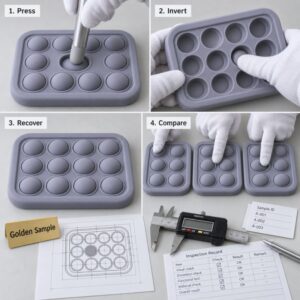
Silicone Pop Bubble Design Checklist
| Artículo | What the Brand Should Confirm |
|---|---|
| Bubble function | Intended tactile interaction |
| Dome diameter | Suitable for finger contact and product layout |
| Dome height | Balanced pressing travel and recovery |
| Membrane | Flexible without uncontrolled collapse |
| Hinge ring | Smooth transition around the dome |
| Bubble spacing | Enough structural separation |
| Frame | Supports local pressing |
| Hardness | Tested with actual geometry |
| Bubble shape | Symmetrical or intentionally engineered |
| Surface detail | Does not disrupt membrane function |
| Mold filling | Every dome forms completely |
| Demolding | Bubble recovers after mold release |
| Pressing feel | Compared across all bubble locations |
| Reverse pressing | Validated from intended directions |
| Recovery | No unacceptable permanent distortion |
| Repeated use | Hinge and dome remain stable |
| Embalaje | Domes are not stored under harmful compression |
How LYA Silicone Supports Custom Fidget Toy Development
For OEM and ODM development, a silicone fidget toy should be reviewed as both a visual product and a flexible mechanical system.
Project development can include:
- Product concept review
- Bubble layout
- Dome geometry
- Membrane design
- Hinge transition
- Bubble spacing
- Silicone hardness
- Frame structure
- Mold-development review
- Color customization
- Molded graphics
- Sample production
- Pressing comparison
- Recovery evaluation
- Repeated-use testing
- Packaging review
- Mass-production inspection
The objective is not simply to make bubbles softer.
The objective is to create repeatable tactile behavior across the complete product.
Frequently Asked Questions
Why are silicone pop bubbles sometimes difficult to press?
Possible causes include excessive membrane thickness, unsuitable dome geometry, firm silicone, a rigid hinge transition or an unbalanced relationship between the bubble and surrounding frame.
Why does the whole fidget toy bend when one bubble is pressed?
The supporting frame may be too flexible relative to the bubble, so pressing force deforms the complete panel instead of remaining localized around the dome.
Why do some bubbles feel different even when they look identical?
Position, membrane variation, surrounding support, molding consistency and local geometry can all affect tactile behavior.
Should all bubbles use the same membrane thickness?
For identical bubbles, consistent geometry is normally desirable. If a product intentionally uses several bubble sizes or shapes, each type should be validated independently.
Does softer silicone always make a better pop bubble?
No. Softer silicone can reduce pressing resistance, but it may also reduce structural definition and frame support. Material hardness and geometry need to be balanced.
Can letters or textures be molded onto a pop bubble?
Yes, but the added geometry can change local thickness and deformation. Raised or recessed details should be evaluated as part of the flexible dome.
Should pop bubbles be tested before mass production?
Yes. Pressing consistency, inversion, reverse pressing, recovery, repeated use and packaging effects should all be checked on actual molded samples.
Engineer the Tactile Response, Not Just the Bubble Shape
A successful silicone pop bubble depends on:
Dome Diameter → Dome Height → Membrane → Hinge → Spacing → Frame → Hardness → Pressing → Recovery
These variables interact with each other.
Changing only the silicone hardness or making the membrane thinner does not guarantee better tactile performance.
If you are developing a custom silicone fidget or sensory product, contact us with your product drawing, bubble layout, target dimensions, intended tactile experience, color requirements, packaging concept and estimated order quantity.