 Spanish
  English
  French
  German
  Polish
  Chinese
  Japanese
  Korean
  Russian
 Contenido
Answer Excerpt
A silicone first article inspection should verify that the first production-ready parts match the latest approved drawing, material, hardness, color, dimensions, appearance, function, mold-cavity requirements and packaging specification before full mass production continues. For custom silicone products, first article inspection is not simply a visual check of one attractive sample. It should act as a production-release checkpoint that confirms the factory is manufacturing the correct revision under the intended production conditions.
A silicone sample may already have been approved weeks before mass production.
So why inspect the first production parts again?
Because several things may have changed between prototype approval and the production run:
- The mold may have been adjusted
- Production cavities may now be fully active
- Material or color batches may be different
- Machine settings may have changed
- Packaging may now be finalized
- The latest drawing revision may contain updates
- Production staff may be using a different setup from the sample stage
The purpose of first article inspection is to catch these differences before thousands of parts are produced.
What Is First Article Inspection for Custom Silicone Products?
In consumer silicone manufacturing, terms such as:
- First Article Inspection
- FAI
- First Piece Inspection
- First-Off Inspection
- Production Release Sample
may be used differently by different buyers and factories.
For a typical OEM silicone project, the practical objective is similar:
Confirm that the first parts made under intended production conditions meet the currently approved product requirements before releasing the order into full production.
It should not be confused with final shipment inspection.
First article inspection happens near the beginning of a production run.
Final inspection happens after the production lot has largely been completed.
The two controls solve different problems.
When Is First Article Inspection Especially Useful?
Not every repeat order requires the same level of review.
A stronger first article inspection is particularly useful when:
- A new mold enters production
- A new product is launched
- A mold has been modified
- A mold insert has been replaced
- New mold cavities are activated
- Silicone hardness changes
- Color formulation changes
- Product dimensions are revised
- Logo position or size changes
- A long production interruption has occurred
- A recurring quality issue was recently corrected
The buyer and manufacturer should decide which characteristics need reconfirmation according to the actual change.
Changing only a packaging label does not require the same engineering review as changing a cup wall thickness or mold cavity.
1. Confirm the Correct Drawing Revision First
Before measuring any product, check the document revision.
The inspection team should know exactly which drawing controls production.
For example:
- Rev A — original sample
- Rev B — logo modified
- Rev C — wall thickness and base geometry revised
If production is supposed to follow Rev C but the inspection team is measuring against Rev B, even accurate measurements can lead to the wrong conclusion.
The active production package should clearly identify:
- 3D model
- 2D drawing
- Revision number
- Approval date
- Critical dimensions
- Material specification
- Color reference
- Functional requirements
- Packaging specification
Revision control becomes particularly important after a silicone product design change after tooling.
Old drawings should not remain mixed with current production documents.
2. Check Material and Hardness
The first article should use the intended production material.
Buyers should confirm where applicable:
- Silicone material specification
- Material batch identification
- Hardness requirement
- Color formulation
- Relevant project documentation
A product can have the correct geometry but behave differently if the hardness changes.
For example, a collapsible silicone cup with softer material may:
- Collapse more easily
- Recover differently
- Feel less stable when expanded
- Change the way fold lines behave
A harder version may maintain shape better but require greater force to collapse.
Therefore, silicone hardness should be treated as a functional product parameter rather than only a material number.
3. Inspect the Overall Product Appearance
First article inspection should establish whether the production process is generating the expected surface quality.
Typical silicone appearance items may include:
- Black spots
- Surface contamination
- Flash
- Flow marks
- Parting-line condition
- Scratches
- Color variation
- Uneven gloss
- Texture condition
- Logo quality
- Local deformation
Not every visible molding line is automatically a defect.
The acceptance requirement should come from the approved cosmetic standard, drawing, reference sample or limit sample.
For subjective appearance requirements, relying only on a written sentence such as:
Surface must look good.
is not sufficient.
Approved visual references are much more useful.
4. Measure Critical Dimensions, Not Every Dimension Equally
A drawing may contain dozens of dimensions.
Not all of them have the same functional importance.
First article inspection should prioritize critical characteristics.
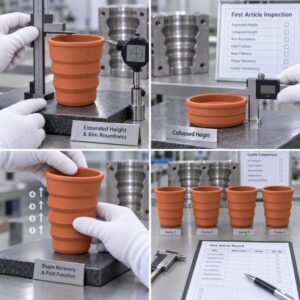
For a collapsible silicone cup, these might include:
- Overall expanded height
- Collapsed height
- Top opening diameter
- Base diameter
- Wall thickness
- Fold-ring position
- Fold-ring height
- Rim thickness
Other silicone products may have different functional dimensions.
For example:
A lid needs controlled fit dimensions.
A suction bowl requires base geometry.
A straw cup needs coordinated straw-hole and lid dimensions.
The buyer and manufacturer should identify dimensional tolerances that directly affect function before production begins.
5. Do Not Average Away a Mold-Cavity Problem
A multi-cavity mold may produce several products during each molding cycle.
Suppose four cavities produce the following results:
- Cavity 1 — correct
- Cavity 2 — correct
- Cavity 3 — correct
- Cavity 4 — repeated dimensional deviation
If the factory measures only randomly mixed products, a cavity-specific issue may be hidden.
During first article inspection, it can be useful to identify samples by cavity where the mold structure allows practical cavity traceability.
Then compare:
- Dimensions
- Weight where relevant
- Flash
- Surface condition
- Functional performance
The objective is not simply to prove that one good part exists.
It is to determine whether the production tooling can repeatedly produce acceptable parts.
6. Inspect Function, Not Just Dimensions
A dimensionally acceptable product can still fail in use.
Consider the collapsible cup example.
A first article should not pass only because:
- Diameter is correct
- Height is correct
- Color looks correct
The cup should also be tested for its intended function.
Relevant checks could include:
Expansion Test
Expand the cup completely.
Confirm that each fold ring reaches its intended position.
Collapse Test
Collapse the product repeatedly.
Check whether the fold sequence works naturally.
Shape-Recovery Test
After compression, allow the silicone to recover.
Check whether:
- Rim remains round
- Base remains stable
- Walls remain symmetrical
Standing Test
Place the expanded cup on a flat surface.
It should remain stable under the agreed test condition.
Functional tests should always reflect the actual product rather than applying the same generic checklist to every silicone part.
7. Compare the First Article With the Approved Golden Sample
A golden sample is useful because some product characteristics are difficult to express entirely through numbers.
Side-by-side comparison can help check:
- Color
- Softness perception
- Texture
- Logo appearance
- Parting line
- Overall shape
- Surface finish
However, a golden sample should not replace drawings and specifications.
One sample cannot reliably define every:
- Dimension
- Tolerancia
- Material requirement
- Functional limit
The strongest production standard normally combines:
Approved drawing + specification + golden sample + functional criteria
Your existing sample and mass production consistency control should ultimately connect all of these references to the same approved revision.
8. Check Color Under Controlled Conditions
Silicone color can appear different depending on:
- Product thickness
- Surface texture
- Lighting
- Transparency
- Viewing background
For that reason, first article color evaluation should ideally use the agreed comparison method.
Do not approve color on a phone photo and then expect the physical product to look identical under every lighting condition.
For OEM products, the molded color sample should remain the practical final visual reference where color appearance is important.
9. Inspect Logos and Molded Details
A logo may be:
- Embossed
- Debossed
- Molded into the part
- Added through another approved decoration process
For molded logos, first article inspection should check:
- Position
- Orientation
- Completeness
- Edge definition
- Surface appearance
- Interaction with surrounding geometry
Very small decorative features can also be affected by:
- Mold venting
- Part geometry
- Surface finish
- Demolding
If branding is commercially important, do not wait until final shipment inspection to discover that the mass-production logo looks different from the approved sample.
10. Check Parting Lines and Flash Before Full Production
Flash and parting-line condition are common silicone quality concerns.
First articles provide an early opportunity to review whether the production setup is producing acceptable edges.
Inspect areas such as:
- Product rim
- Fold lines
- Holes
- Thin edges
- Logo region
- Functional mating surfaces
For a collapsible cup, flash around the rim or folding structures may influence both appearance and use.
If a defect repeatedly appears at the same mold location, the root cause should be investigated before the entire batch is completed.
11. Verify Product Weight Where It Is a Useful Process Signal
Weight is not a universal acceptance criterion for every silicone product.
However, for certain stable molded products, unexpected weight differences may help indicate changes such as:
- Incomplete filling
- Excessive flash
- Material variation
- Cavity variation
- Process instability
Weight should not replace dimensional or functional inspection.
Instead, it can be used as an additional process-control indicator where the product and manufacturing process make it meaningful.
12. Confirm Packaging With Real Production Parts
Packaging is often finalized late in development.
That creates another risk.
A perfect first article can still become deformed if the final packaging:
- Compresses the product
- Forces it into the wrong shape
- Bends thin edges
- Presses one silicone surface against another
- Holds a collapsible structure under excessive load
For the collapsible cup example, confirm:
- Whether it is packed expanded or collapsed
- Whether fold rings are compressed correctly
- Whether the rim is distorted
- Whether the product recovers after unpacking
- Whether retail packaging has adequate space
Packaging should therefore be part of production release when it can affect the finished product.
Example: First Article Inspection for a Custom Silicone Collapsible Cup
Consider a muted terracotta-colored silicone collapsible cup designed for an outdoor lifestyle brand.
The one-piece silicone product contains:
- Reinforced rounded top rim
- Four collapsible accordion sections
- Stable circular base
- Matte exterior surface
- Molded custom logo
Before mass production continues, the inspection team receives samples from the active production mold.
Step 1 — Verify Documents
Confirm:
- Latest drawing
- Revision
- Material
- Hardness
- Color
- Packaging specification
Step 2 — Check Appearance
Inspect:
- Color
- Black spots
- Flash
- Fold surfaces
- Logotipo
- Rim
- Base
Step 3 — Measure Critical Dimensions
Measure:
- Expanded height
- Collapsed height
- Top diameter
- Base diameter
- Critical fold dimensions
Step 4 — Test Function
Perform:
- Full expansion
- Full collapse
- Repeated folding
- Recovery
- Flat standing
Step 5 — Compare Cavities
Where applicable, compare production pieces from different active mold cavities.
Step 6 — Approve Production Release
If the agreed requirements are met, retain the approved production reference and release the run according to the factory’s quality procedure.
If something fails, correct the issue before producing the entire quantity.
What Should Be Recorded in a First Article Inspection Report?
A practical report may include:
| Inspection Item | What Should Be Recorded |
|---|---|
| Producto | Product name / SKU |
| Revision | Current approved drawing revision |
| Production date | When first articles were molded |
| Mold | Active production mold identification |
| Cavity | Cavity identification where applicable |
| Material | Approved silicone specification / batch reference |
| Hardness | Agreed requirement and result where tested |
| Color | Approved color reference |
| Dimensions | Critical measured dimensions |
| Appearance | Cosmetic inspection results |
| Función | Product-specific test results |
| Logo / texture | Approved appearance comparison |
| Embalaje | Fit and deformation review |
| Resultado | Approved / correction required |
| Reference | Approved first article or production sample retained |
The exact format can remain simple.
The important point is that the report clearly connects the inspected product with the correct production revision.
First Article Inspection vs AQL Inspection
These two controls should not be treated as interchangeable.
First Article Inspection
Purpose:
Can production continue using this setup?
It normally focuses on the first production-ready pieces.
AQL Inspection
Purpose:
Does the completed production lot meet the agreed statistical acceptance plan?
It normally evaluates samples from a defined production lot.
Your existing AQL inspection process can therefore complement first article approval rather than replace it.
A useful quality flow may look like:
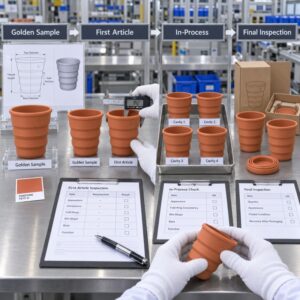
Approved Sample → First Article Inspection → In-Process Control → Final/AQL Inspection → Shipment
First Article Inspection vs Golden Sample Approval
These are also different.
Golden Sample
Defines the approved target product.
First Article
Checks whether the current production setup is reproducing that approved target.
The golden sample answers:
What should we make?
The first article answers:
Is the production process making it correctly now?
That distinction is especially useful for repeat orders, mold repairs and engineering changes.
How Does Batch Traceability Help?
Suppose the first article passes.
Later, a defect appears during production.
If the factory maintains useful batch traceability, the team can investigate:
- Material lot
- Color batch
- Tiempo de producción
- Mold
- Cavity
- QC record
- Packaging batch
This helps distinguish an isolated production change from a product-design problem.
First article inspection and traceability therefore support different stages of the same quality-control system.
Common First Article Inspection Mistakes
Approving Only One Attractive Part
One visually perfect product does not prove all active mold cavities are stable.
Checking Appearance but Not Function
The product can look correct and still fail its intended use.
Using an Old Drawing
A precise inspection against the wrong revision is still wrong.
Ignoring Packaging
Flexible silicone may change under compression during storage.
Measuring Everything but Identifying No Critical Dimensions
Inspection effort should focus on characteristics that influence fit, function and customer requirements.
Treating FAI as Final Shipment Inspection
Passing first article inspection does not prove that the entire production lot will remain acceptable.
In-process and final controls are still required according to the project quality plan.
Silicone First Article Inspection Checklist
Before production release, buyers and manufacturers should confirm:
- Correct drawing revision
- Correct material
- Correct hardness
- Correct color
- Critical dimensions
- Surface condition
- Flash
- Parting lines
- Logotipo
- Molded details
- Mold-cavity consistency
- Functional performance
- Shape recovery
- Embalaje
- Inspection records
- Approval status
The checklist should be adjusted according to the product.
A silicone bib, pet lick mat, collapsible cup and educational toy do not require exactly the same functional tests.
How LYA Silicone Supports Production Quality Control
LYA Silicone supports OEM and ODM development for custom silicone baby, pet, outdoor and educational products.
Quality planning for a project may include:
- Drawing and DFM review
- Material selection
- Mold development
- Sample production
- Golden-sample confirmation
- Critical-dimension inspection
- Mold-cavity review
- Functional testing
- First production-piece review
- In-process inspection
- Packaging validation
- Final inspection
- Production records
The objective is not to add paperwork for its own sake.
The objective is to identify a production problem while it can still be corrected efficiently.
Frequently Asked Questions
Is first article inspection required for every silicone order?
Not necessarily in the same form. The level of inspection should depend on the project, customer requirements, tooling condition, product changes and quality risk.
Is first article inspection only required for a new mold?
No. It can also be useful after mold modification, long production interruptions, material changes, important engineering revisions or correction of a recurring problem.
Is one first article sample enough?
It depends on the product and mold. For multi-cavity production, samples from different active cavities may need to be reviewed.
Should every drawing dimension be measured?
Not always. Critical and function-related dimensions should receive priority according to the agreed inspection plan.
Does passing first article inspection guarantee mass-production quality?
No. It confirms the initial production setup against the agreed requirements. In-process and final quality controls are still needed.
Is a golden sample the same as a first article?
No. A golden sample represents the approved target, while a first article verifies whether the current production process is reproducing that target.
Should packaging be included in first article approval?
When packaging can affect shape, surface, fit or function, it should be validated using real production samples before shipment.
Release Mass Production Only After the Production Standard Is Clear
A successful custom silicone project should not jump directly from sample approval to uncontrolled mass production.
Before full production continues, confirm:
Revision → Material → Dimensions → Appearance → Function → Cavities → Packaging → Approval
First article inspection creates an early production checkpoint.
It gives both buyer and manufacturer an opportunity to confirm that the factory is not merely making a silicone product—it is making the correct approved product.
To review a custom silicone product project, send Silicona LYA your current drawing, reference sample, material requirements, target hardness, critical dimensions, functional requirements, packaging specification and estimated order quantity.