 Spanish
  English
  French
  German
  Polish
  Chinese
  Japanese
  Korean
  Russian
 Contenido
Answer Excerpt
Undercuts can be used in productos de silicona personalizados because cured silicone is flexible, but the product still needs a controlled demolding path. Deep undercuts, narrow openings, sharp textures, thin sections and locking structures can increase stretching during mold release. Buyers should review demolding direction, material flexibility, tear-sensitive areas and mold structure during DFM before tooling and validate the final design with production-intent samples.
Silicone allows product designers to create structures that would be difficult to remove from a rigid mold if the product were made from a much less flexible material.
However, flexibility does not mean that every undercut can be removed safely.
A silicone product may technically come out of the mold but still create production problems such as:
- Product tearing
- White stress marks
- Thin-edge damage
- Permanent deformation
- Distorted holes
- Damaged texture
- Slow manual demolding
- Different results between operators
- High scrap rates
- Longer production cycles
Your existing mold-development checklist already identifies deep undercuts, narrow openings, internal locking structures and sharp textures as areas that need demolding review before tooling.
For OEM buyers, the question should therefore not only be:
Can this shape be molded?
A better question is:
Can this product be removed from the mold repeatedly without damaging the part or making mass production unstable?
What Is an Undercut in a Silicone Product?
An undercut is a feature that prevents a molded product from moving directly out of the mold along a simple straight release direction.
Common examples include:
- Internal lips
- Reverse hooks
- Deep grooves
- Narrow necks
- Closed openings
- Ring structures
- Deep recessed textures
- Side-facing details
- Locking ribs
- Structures wider behind a narrow opening
A simple flat silicone mat may have very little undercut.
A ring-shaped teether with internal openings, raised chewing textures and narrow connecting sections can contain several features that stretch significantly during demolding.
Silicone flexibility may allow some of these features to release without complex mechanical mold actions, but the amount of deformation still needs to remain within a practical range for the selected material and structure.
Which Product Features Create Demolding Risk?
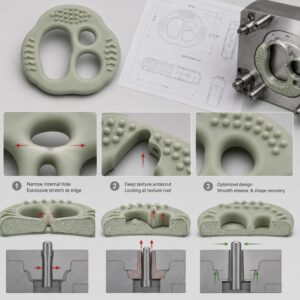
1. Narrow Openings
A product may contain a large internal feature behind a smaller opening.
During demolding, the larger feature must pass through the narrow opening.
This causes the surrounding silicone to stretch.
Examples include:
- Ring handles
- Finger holes
- Teether openings
- Flexible covers
- Internal retention lips
If the remaining silicone around the opening is too thin, repeated stretching during demolding may create tears or permanent distortion.
2. Deep Raised Textures
Raised textures are common on:
- Baby teethers
- Pet chew products
- Sensory toys
- Grooming products
- Grip surfaces
The deeper and more complex the texture becomes, the more the product may need to stretch or peel away from the corresponding mold feature.
Textures with sharp roots or narrow spaces can also increase local stress.
For a silicone baby teether, raised dots, waves and ridges may provide the intended surface structure, but their root geometry and demolding direction should be reviewed before the mold is cut. LYA’s current teether product range supports custom shapes, textures and mold development, making this a practical DFM issue for private-label projects.
3. Internal Locking Structures
Some silicone products use flexible internal lips or snap-fit structures to:
- Hold a lid
- Retain another component
- Create an assembly connection
- Prevent a component from sliding out
These features may work well during final use but create difficult mold release.
The designer needs to consider two different movements:
- How the finished product will assemble with its matching component
- How the silicone part itself will leave the manufacturing mold
A structure that works perfectly during assembly may still be unsuitable for efficient production if the demolding path requires excessive stretching.
4. Thin Sections Beside an Undercut
Undercuts become more risky when the surrounding material is thin.
High-risk combinations include:
- A narrow hole beside a thin outer edge
- A deep texture on a thin wall
- A locking lip connected by a narrow neck
- A handle opening with very little surrounding material
The product may stretch successfully several times during sampling but develop inconsistent damage when repeated across thousands of production cycles.
DFM should therefore evaluate undercut depth together with wall thickness and tear-sensitive geometry.
Why Is Demolding Direction Important?
Demolding direction determines how the finished product moves away from the mold surfaces.
A good release direction minimizes unnecessary:
- Stretching
- Twisting
- Peeling
- Pulling
- Local deformation
Consider a textured silicone ring.
If the product can release mostly along the natural direction of the texture, the required deformation may be relatively controlled.
If the same texture locks sideways behind a mold feature, the product may need to stretch significantly before release.
The manufacturer should identify the main release direction during custom silicone mold development, not after the first tool has already been machined. Your current mold checklist similarly recommends confirming the primary demolding direction, undercut depth, product stretching and whether inserts are needed before tooling.
Does Silicone Hardness Affect Demolding?
Yes, but hardness should not be evaluated alone.
A softer silicone may deform more easily during removal, while a firmer structure may resist distortion but require greater force to pass over an undercut.
Demolding behavior also depends on:
- Elongation
- Tear resistance
- Wall thickness
- Product geometry
- Texture
- Undercut depth
- Mold surface
- Release path
For this reason, Shore A hardness should be reviewed together with the complete molded structure.
Changing hardness after tooling can also change product flexibility, dimensions, suction, folding and demolding behavior, which is why material and hardness should ideally be confirmed before final mold approval.
Can Draft Help Silicone Demolding?
Draft is a slight taper applied to a wall or feature to help the product separate from the mold.
Silicone may tolerate less conventional geometry than many rigid products because it can flex during release, but this does not mean draft can always be ignored.
Draft can be particularly useful around:
- Deep walls
- Textures
- Ribs
- Logo features
- Internal cavities
- Tall protrusions
The required geometry depends on the actual material, surface finish, feature depth and mold design.
Avoid using one universal draft value for every silicone product.
The correct approach is to evaluate whether the selected feature can release consistently without damaging either the product or the intended surface finish.
When Is a More Complex Mold Structure Needed?
Not every undercut should be solved by stretching the silicone.
Depending on the product, the mold may require:
- Removable inserts
- Multi-part mold construction
- Split cores
- Special core geometry
- Manual inserts
- Other controlled mold-release solutions
A more complex mold can increase:
- Tooling cost
- Mold-maintenance requirements
- Production steps
- Operator involvement
- Cycle time
Therefore, the engineering team should compare two options:
Option A: Simplify the product geometry.
Option B: Keep the product design and accept a more complex mold.
The better choice depends on how important the feature is to product function and brand differentiation.
Why Can a Sample Demold Well but Mass Production Still Have Problems?
Engineering samples are usually produced in small quantities.
A technician may carefully remove each part by hand.
Mass production is different.
Operators need a repeatable method across:
- Hundreds or thousands of parts
- Multiple mold cavities
- Different shifts
- Longer production runs
A structure that requires one specific technician to carefully twist and pull every product may not be a stable production design.
Possible mass-production problems include:
- Different pulling force between operators
- Torn thin areas
- Distorted holes
- Slow output
- Inconsistent product shape
- Higher rejection rate
Demolding should therefore be evaluated during pilot production, not only on one successful first sample. LYA’s current mold-development process also recommends pilot production to validate mold-cavity differences, handling and production stability before full production.
What Should Buyers Check During Sample Approval?
Check the Product Immediately After Demolding
Inspect:
- Holes
- Thin edges
- Texture roots
- Internal lips
- Narrow necks
- Handles
- Logos
- Parting lines
Look for:
- Small tears
- White stress marks
- Distortion
- Surface damage
- Permanent stretching
Check Shape Recovery
Allow the product to rest under the agreed conditions.
Confirm whether stretched areas return to the approved shape.
Compare Mold Cavities
Identify samples by cavity number.
One cavity may release differently because of small differences in:
- Surface finish
- Venting
- Geometry
- Filling
- Mold condition
Repeat Demolding
One successful part is not enough.
Repeated production should confirm that the product can be removed consistently.
Repeat Functional Testing
After demolding, confirm that the product still performs its intended function.
For a teether, check:
- Ring shape
- Hole geometry
- Texture integrity
- Thin connections
- Overall deformation
The product should not pass simply because it can physically be removed from the mold.
Undercut and Demolding DFM Checklist
| Artículo | What Buyers Should Confirm |
| Main release direction | Product can leave the mold in a controlled direction |
| Undercuts | Depth and geometry are practical |
| Narrow openings | Enough surrounding material remains |
| Thin areas | Not overstretched during release |
| Textures | Roots and direction allow stable demolding |
| Internal lips | Mold release is considered before assembly function |
| Material | Flexibility and tear behavior suit the structure |
| Hardness | Evaluated together with geometry |
| Mold structure | Inserts or split construction identified early |
| Surface finish | Demolding does not damage cosmetic areas |
| Mold cavities | Each cavity releases consistently |
| Pilot production | Demolding remains repeatable at production volume |
How LYA Silicone Supports Demolding DFM Review
LYA Silicone’s current website positions the company around OEM and ODM development for silicone baby, pet, outdoor, educational and other consumer silicone products, with project support covering drawings, mold development, sampling and mass production.
For products with complex undercuts or flexible structures, project review may include:
- Product drawing review
- Undercut analysis
- Demolding-direction evaluation
- Wall-thickness review
- Material and hardness discussion
- Texture review
- Mold-structure planning
- Sample production
- Demolding inspection
- Shape-recovery validation
- Pilot production
- Mass-production quality control
The best time to solve a difficult demolding problem is before mold machining begins.
Frequently Asked Questions
Can Silicone Products Have Undercuts?
Yes.
Silicone flexibility allows many undercut structures, but depth, wall thickness, material behavior and release direction still need engineering review.
Does Softer Silicone Always Make Demolding Easier?
No.
A softer product may stretch more easily, but the final result also depends on tear resistance, geometry, thickness and the undercut structure.
Can a Deep Undercut Tear the Product?
It can increase tear risk when excessive stretching is concentrated around thin or sharp areas.
Do Silicone Products Always Need Draft Angles?
Not every feature requires the same draft strategy.
The required geometry depends on feature depth, material, surface finish and mold-release method.
Can the Mold Be Changed After Demolding Problems Appear?
Sometimes mold modification is possible, but it can add tooling cost, sample revisions and project delay.
Undercut and release risks are better reviewed during DFM.
Should Demolding Be Checked During Pilot Production?
Yes.
Pilot production helps confirm whether the release method is repeatable across cavities, operators and a longer production run.
Design the Product for Both Use and Manufacturing
A successful silicone product must work in two different situations:
- During customer use
- During manufacturing and demolding
An attractive undercut, texture or locking structure should not create unnecessary tearing, deformation or slow manual production.
Before tooling, review:
- Undercuts
- Demolding direction
- Wall thickness
- Material
- Hardness
- Texture
- Mold structure
- Shape recovery
- Pilot-production behavior
To review the mold-release risk of your custom silicone product, send Silicona LYA your drawing, product application, material requirement, target hardness, critical textures, expected quantity and product-use requirements.