 Spanish
  English
  French
  German
  Polish
  Chinese
  Japanese
  Korean
  Russian
 Contenido
Answer Excerpt
Thin silicone edges often tear because stress is concentrated around sharp corners, sudden wall-thickness changes, holes, parting lines, trimming areas or poorly supported flexible structures. Material tear strength and hardness are important, but product geometry, mold design, curing, demolding, packaging and actual use conditions must also be evaluated before mass production.
A silicone product can feel soft and flexible but still tear during demolding, assembly, cleaning or repeated use.
Common failure locations include:
- Thin edges around silicone bibs
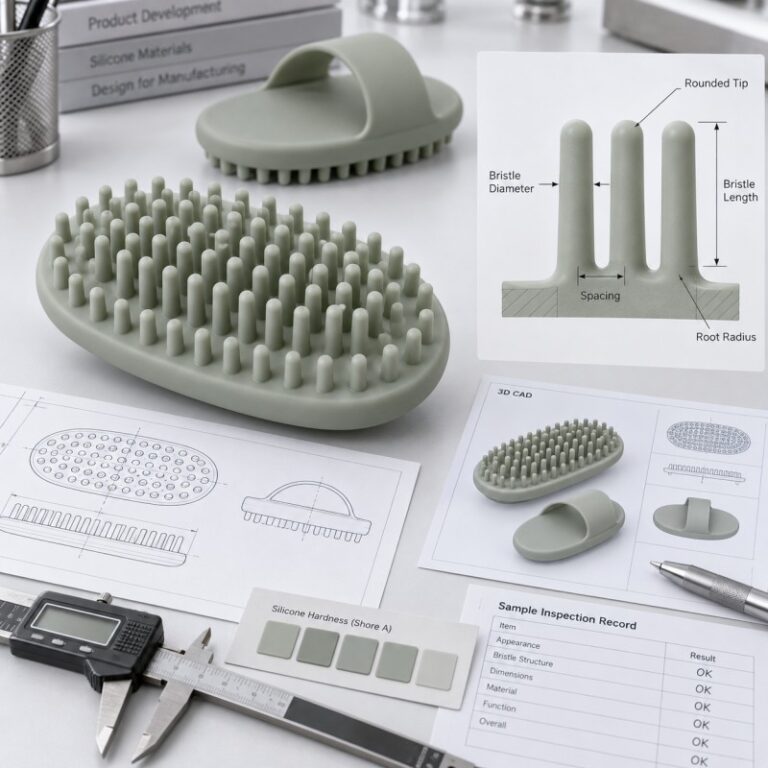
- Bristle roots on silicone brushes
- Hanging holes
- Button holes
- Folding rings
- Suction-base edges
- Product openings
- Logo corners
- Trimmed parting lines
- Thin areas around inserts
These failures are not always caused by using “bad silicone.”
In many projects, the real problem is a combination of material selection, wall thickness, corner geometry, mold structure and the way the product is removed, trimmed, packed and used.
Where Do Silicone Products Commonly Tear?
Thin Outer Edges
Thin edges may be used to create:
- Soft touch
- Easy folding
- Flexible sealing
- Lightweight products
- Comfortable contact
- Reduced material weight
However, an edge that is too thin may stretch much more than the surrounding structure.
Once a small cut, flash mark or sharp corner appears, the tear can continue through the product.
Holes and Openings
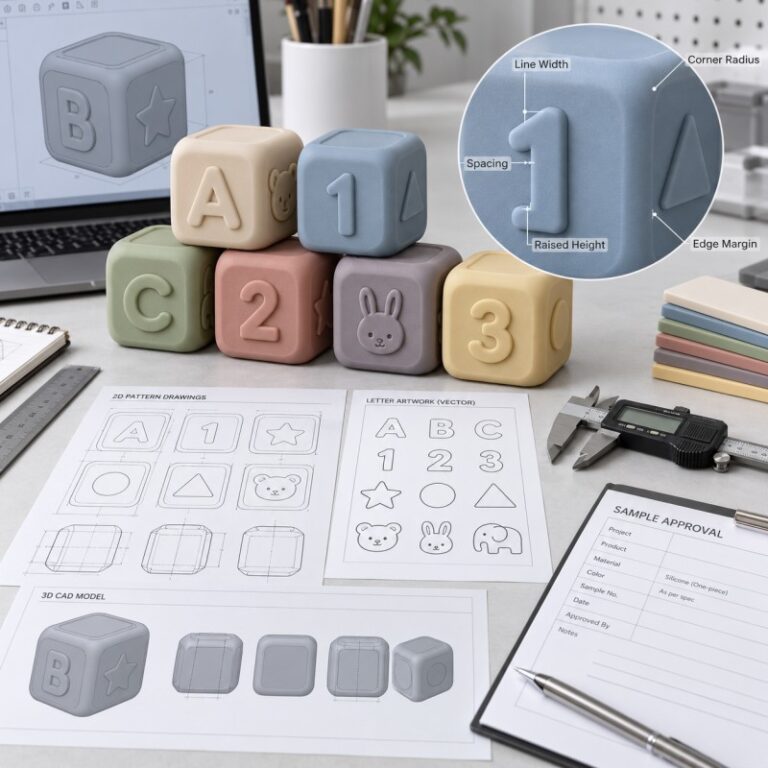
Hanging holes, button holes and product openings create local stress concentration.
The risk increases when:
- The hole is too close to the edge
- The surrounding silicone is too thin
- The hole has sharp internal corners
- The hole is stretched repeatedly
- Flash remains inside the opening
- Trimming creates a small cut
Bristle and Texture Roots
Silicone brushes and textured mats often contain many raised features.
The root of each bristle or texture must transfer bending force into the product body.
If the transition is too sharp or too thin, repeated bending can produce cracks at the root.
Folding Structures
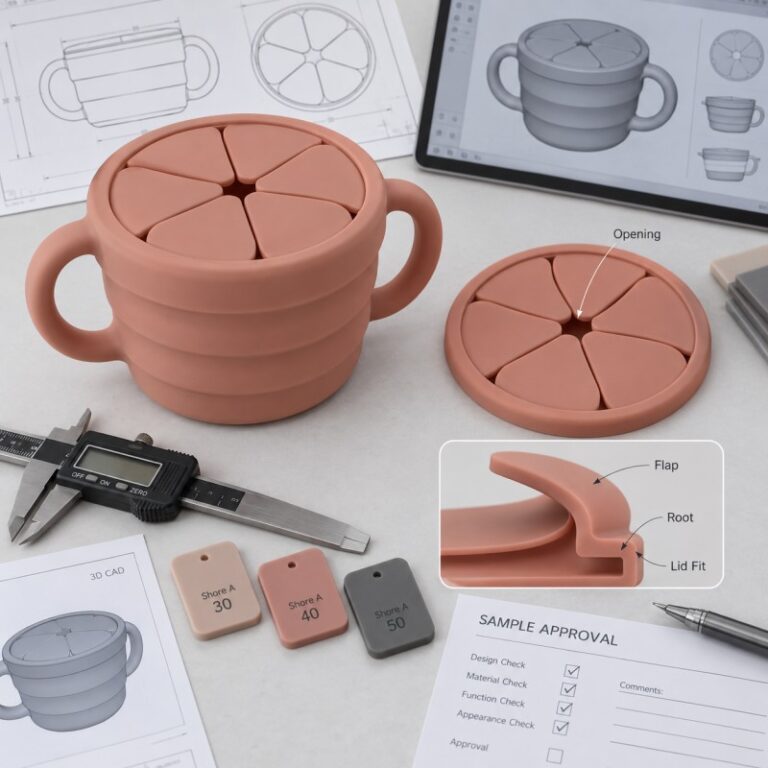
Collapsible cups, foldable bowls and flexible hinges depend on controlled deformation.
If the folding line is too thin, too sharp or uneven, stress may repeatedly concentrate in one narrow area.
Why Do Thin Silicone Areas Tear?
1. Sharp Corners Concentrate Stress
Silicone stretches well, but sharp internal corners can concentrate force into a very small area.
This commonly occurs around:
- Square holes
- Narrow slots
- Logo corners
- Bristle roots
- Rib intersections
- Sudden wall transitions
A rounded transition normally distributes stress more evenly than a sharp corner.
The correct radius depends on product size, wall thickness, hardness and function.
The design should therefore be reviewed before the mold is manufactured.
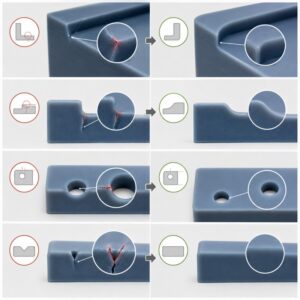
2. Wall Thickness Changes Too Suddenly
A thick section connected directly to a very thin section can create an unstable transition.
During bending or pulling, the thin area deforms more than the thick area.
Possible results include:
- Local stretching
- Stress whitening
- Surface cracking
- Tear initiation
- Uneven shrinkage
- Difficult demolding
Wall thickness does not need to be identical across the whole product, but the transition should be gradual where possible.
3. The Hole Is Too Close to the Product Edge
A button hole or hanging hole needs enough silicone around it to carry the expected force.
If the remaining material between the hole and outer edge is too narrow, the product may tear when:
- The button is repeatedly opened
- The product is hung by the hole
- The user pulls the product
- The product is stretched during packaging
- The part is removed from the mold
The actual use force should be considered before defining the hole position.
4. The Parting Line or Flash Creates a Tear Starting Point
Parting lines are created where mold sections meet.
When the parting line is located on a highly stretched thin edge, it may become a weak area.
The risk increases when:
- Flash is thick
- Trimming leaves a notch
- Manual cutting damages the edge
- Mold mismatch creates a step
- The edge is stretched after trimming
The parting line should be positioned away from critical bending or pulling areas whenever the product structure allows.
5. Material Hardness Alone Does Not Determine Tear Resistance
Buyers sometimes assume that harder silicone will always be stronger.
This is not always correct.
A harder material may improve structural stability, but it can also:
- Reduce flexibility
- Increase bending force
- Change user comfort
- Affect folding
- Change suction performance
- Transfer stress to another thin area
A softer material may stretch more easily but provide less structural support.
Material selection should therefore consider:
- Tear strength
- Elongation
- Hardness
- Product thickness
- Repeated use
- Cleaning conditions
- Expected pulling force
The final choice should be validated with production-intent samples.
6. Demolding Can Damage Thin Structures
A product may already be damaged before it reaches the customer.
Thin edges, deep undercuts, small holes and long bristles can be stretched during demolding.
Possible signs include:
- Small edge cuts
- Bristle-root cracks
- Torn holes
- Distorted folding areas
- Local whitening
- Uneven product shape
The mold should allow the product to release without excessive pulling.
Demolding direction, draft, mold surface and operator method all affect the result.
7. Trimming Can Turn Flash into a Crack
Flash removal must be controlled carefully.
If scissors, blades or manual pulling cut into the product body, even a very small notch can become the starting point of a larger tear.
Important trimming controls include:
- Approved trimming tool
- Cutting direction
- Operator training
- Inspection lighting
- Maximum remaining flash
- Minimum acceptable edge thickness
- Limit samples
The product should be inspected after trimming, not only immediately after molding.
How Can Thin-Edge Tearing Be Prevented?
Add Rounded Transitions
Use appropriate radii around:
- Holes
- Bristle roots
- Ribs
- Folding lines
- Logo corners
- Thin-to-thick transitions
Increase Local Thickness
The entire product may not need to become thicker.
A local reinforcement can sometimes be added around:
- Hanging holes
- Button holes
- Handle openings
- Bristle bases
- Folding joints
- High-pull areas
Move Critical Features
A hole, logo, parting line or texture may need to be moved away from the weakest edge.
Review the Mold Release Direction
The product should not require excessive stretching to leave the mold.
Control Flash and Trimming
Critical thin edges should have a clear inspection and trimming standard.
Test the Final Packaged Product
Folding and compression during packaging may place continuous stress on thin structures.
Packaging should not keep a critical edge stretched for long periods.
What Tests Should Be Completed Before Mass Production?
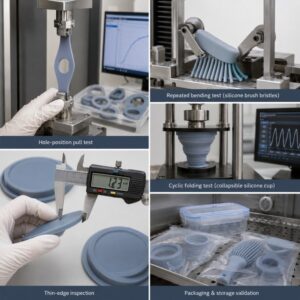
Pull Test
Apply a controlled pulling force to holes, handles or thin edges.
Repeated Flexing Test
Bend or fold the critical area for an agreed number of cycles.
Tear Initiation Check
Inspect edges, holes and trimmed areas for small cuts or notches.
Demolding Review
Check whether the product is damaged during normal production removal.
Packaging Storage Test
Pack the product in its final position and inspect it after storage.
Functional Use Test
Test the product under its intended use conditions.
Examples include:
- Opening and closing a bib button
- Bending brush bristles
- Folding a silicone cup
- Pulling a hanging hole
- Stretching a lid over its matching container
- Cleaning a textured mat
A sample should not be approved only because it looks good when placed on a table.
Product-Specific Risk Checklist
| Producto | Common Tear Location | Design Focus |
|---|---|---|
| Babero de silicona | Button holes and thin outer edges | Hole spacing, edge thickness and repeated opening |
| Pet bath brush | Bristle roots | Root radius, bristle length and bending force |
| Collapsible cup | Folding rings | Thickness transition and repeated folding |
| Lick mat | Thin corners and hanging holes | Local reinforcement and edge distance |
| Silicone lid | Stretching edge | Wall thickness, opening size and fit |
| Suction bowl | Thin suction lip | Parting line, trimming and packaging |
| Teether | Small openings and textures | Rounded corners and repeated pulling |
How LYA Silicone Supports Tear-Risk Review
LYA Silicone supports OEM and ODM development for silicone baby, pet, household, outdoor and educational products.
Project review may include:
- Product-structure review
- Wall-thickness evaluation
- Material and hardness discussion
- Hole and edge design
- Parting-line review
- Mold-release analysis
- Sample production
- Pull and flex testing
- Trimming inspection
- Packaging validation
- Pilot production
- Mass-production quality control
Before mold development, buyers should provide the product drawing, application, critical pulling or folding areas, expected use conditions and packaging method.
This helps identify weak structures before they become mass-production defects.
Frequently Asked Questions
Does Thicker Silicone Always Prevent Tearing?
No.
Greater thickness may improve local strength, but it can also change flexibility, product weight, curing, folding and user comfort.
Only the critical structure should be reinforced where necessary.
Is Softer Silicone Easier to Tear?
Not always.
Softness, tear strength, elongation and product geometry must be evaluated together.
Two materials with similar hardness may still have different tear performance.
Why Does Tearing Start at a Small Cut?
A small cut concentrates stress at its tip.
When the product is pulled, the crack may continue through the silicone even if the rest of the material is strong.
Can a Damaged Mold Cause Edge Tearing?
Yes.
Mold wear, mismatch, damaged edges or poor venting can create flash, steps or surface defects that increase tear risk.
Should Holes Be Tested Before Mass Production?
Yes.
Hanging holes, button holes and other openings should be tested using the expected pulling direction and repeated-use condition.
Can Packaging Cause Thin Edges to Tear?
Yes.
A product that is folded, compressed or stretched in the package may develop stress around thin edges and holes.
Prevent Thin Structures from Becoming Weak Points
A thin silicone structure can be flexible and functional, but it must be designed around the actual forces applied during molding, trimming, packaging and use.
Before approving the mold, confirm:
- Wall thickness
- Corner radius
- Hole position
- Parting line
- Demolding method
- Material
- Hardness
- Trimming standard
- Functional test
- Packaging position
To review tear risks for your custom silicone product, send Silicona LYA your drawing, product application, material requirement, hardness, expected use conditions and estimated order quantity.