 Polish
  English
  French
  German
  Spanish
  Chinese
  Japanese
  Korean
  Russian
 Zawartość
Answer Excerpt
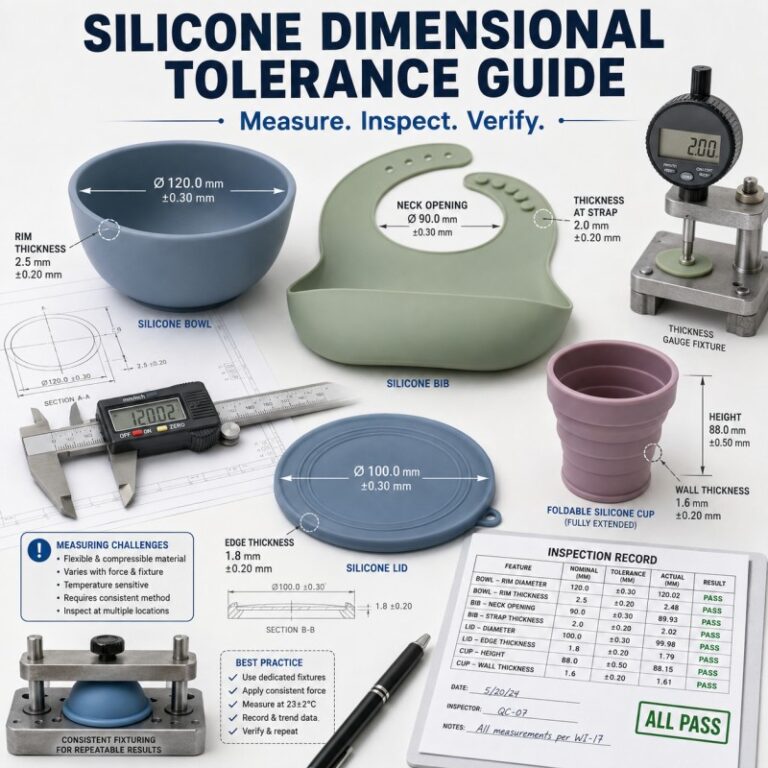
Dimensional tolerances for custom produkty silikonowe should be based on product function, material flexibility, wall thickness, mold structure, shrinkage and the actual measurement method. Buyers should not apply one tight tolerance to every dimension. Critical sealing, assembly, capacity and fit dimensions require controlled inspection, while flexible non-functional areas may need more practical limits and clearly defined measuring conditions.
Silicone products are soft, flexible and easy to deform under hand pressure.
This creates a common problem during sample approval:
The buyer measures one dimension and obtains one result, while the manufacturer measures the same product and obtains another.
The difference may not mean that either measurement is incorrect.
Results can change depending on:
- How the product is positioned
- Whether it is stretched
- Measuring-tool pressure
- Product temperature
- Resting time after molding
- Packaging deformation
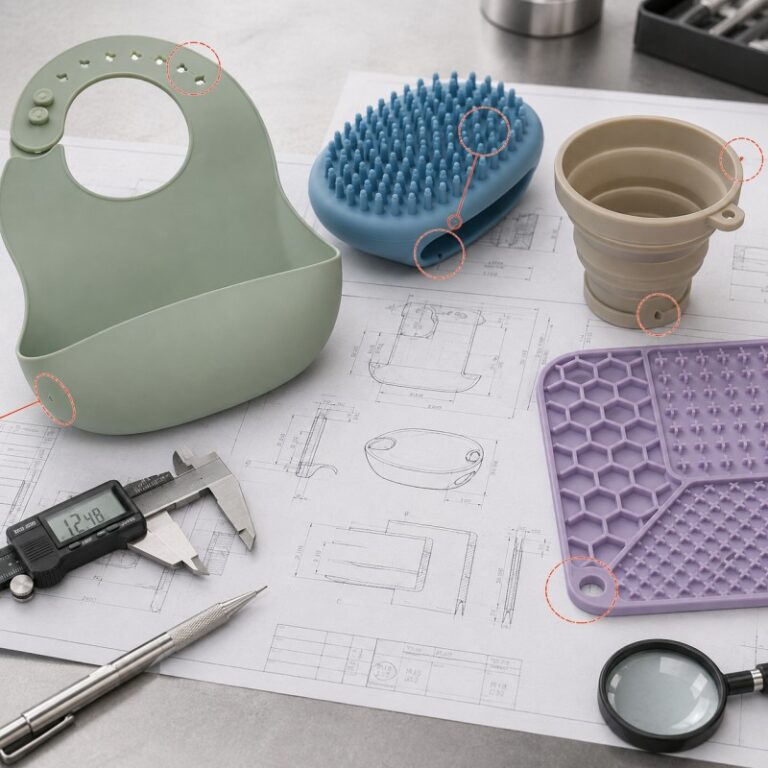
- Measurement location
- Mold cavity
- Product wall thickness
- The selected datum
For this reason, a drawing should define not only the required dimension, but also which dimensions are critical and how flexible areas should be inspected.
Why Are Silicone Products Difficult to Measure?
A rigid plastic or metal part normally maintains its shape while being measured.
A soft silicone product may change shape when it is:
- Held by hand
- Placed on an uneven table
- Pressed by a caliper
- Stretched across a fixture
- Removed from packaging
- Measured immediately after molding
- Supported in a different orientation
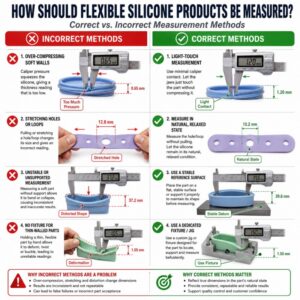
For example, measuring the opening of a flexible silicone lid with a caliper may enlarge or compress the opening.
Measuring the height of a soft suction bowl may produce different results if the base is pressed flat or allowed to rest naturally.
Therefore, flexible silicone dimensions should be evaluated under defined and repeatable conditions.
Which Dimensions Should Be Treated as Critical?
Not every dimension requires the same level of control.
Critical dimensions normally affect the product’s function, assembly or customer use.
They may include:
- Lid and container fit
- Suction-base diameter
- Sealing-lip thickness
- Hole diameter
- Button and button-hole fit
- Product capacity
- Overall assembled height
- Handle opening
- Folding-ring position
- Insert or accessory fit
- Packaging fit
- Logo position
- Component alignment
Non-critical dimensions may include flexible decorative areas that do not influence product function.
The drawing should distinguish:
- Critical dimensions
- Functional dimensions
- Appearance dimensions
- Reference dimensions
Applying an unnecessarily tight tolerance to every flexible edge can increase mold-development time, inspection cost and rejection rate without improving product performance.
Why Can Silicone Dimensions Change After Molding?
1. Silicone Shrinkage Must Be Considered
Silicone changes dimension during curing, cooling and stabilization.
The final result can be influenced by:
- Material formulation
- Product thickness
- Mold temperature
- Curing time
- Product geometry
- Mold-cavity position
- Post-curing conditions
- Cooling and storage method
The mold cannot simply be machined to exactly the same size as the required finished product.
Shrinkage compensation must be considered during mold design and confirmed through sample measurement.
Different areas of one product may not shrink in exactly the same way, especially when the product contains both thick and thin sections.
2. Wall Thickness Influences Shape Stability
A thick silicone structure normally maintains its geometry more easily than a very thin flexible edge.
Thin sections may:
- Bend during measurement
- Curl after demolding
- Change shape during packaging
- Stretch under caliper pressure
- Recover slowly after compression
A product can meet the material-hardness requirement but still be difficult to measure because its wall structure is too flexible.
Hardness and wall thickness should therefore be evaluated together.
3. Mold Cavities May Produce Slightly Different Results
A multi-cavity mold produces several products during one molding cycle.
Each cavity should be evaluated for:
- Overall dimensions
- Critical hole sizes
- Product weight
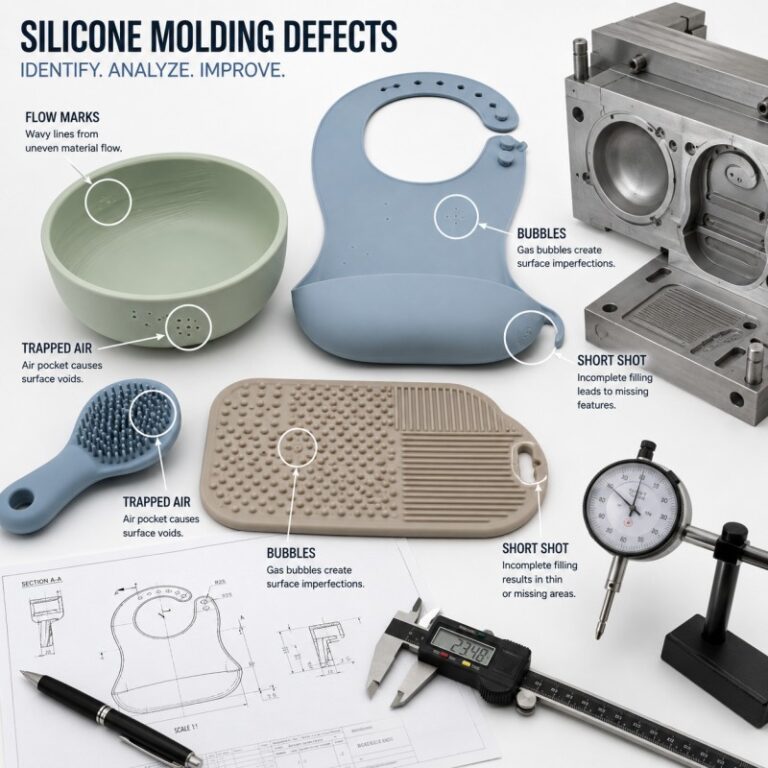
- Flash
- Filling
- Surface quality
- Functional fit
Differences in gate, venting, cavity machining or temperature may create variation between cavities.
Samples should be marked by cavity number during mold qualification and pilot production.
Approving only the best sample does not confirm that every cavity meets the same requirements.
4. Packaging Can Change the Measured Shape
A product may meet its dimensional requirements before packaging but change after being:
- Folded
- Rolled
- Compressed
- Stacked
- Stored in a small retail box
- Transported under pressure
This is especially important for:
- Śliniaki silikonowe
- Misy ssące
- Collapsible cups
- Pet lick mats
- Flexible lids
- Silicone brushes
- Flat mats
The final product should be measured and functionally tested after the agreed packaging-recovery period.
Why Should Buyers Avoid Overly Tight Tolerances?
A drawing may specify a very tight tolerance because the product designer wants high quality.
However, a tighter number does not automatically produce a better product.
Overly tight tolerances may lead to:
- More mold modifications
- Longer sample approval
- Higher inspection costs
- Higher rejection rates
- Unnecessary production sorting
- Disagreement between buyer and manufacturer
- Increased unit price
The tolerance should reflect what the product actually needs to perform correctly.
For example, the fit between a silicone lid and its matching container may require close control.
By contrast, a flexible decorative outer edge may not need the same tolerance because it does not affect sealing, assembly or use.
A practical tolerance system focuses the strictest control on critical functional areas.
How Should Flexible Silicone Products Be Measured?
Define the Product Condition
Before measuring, confirm:
- Product temperature
- Time after molding
- Time after unpacking
- Whether post-curing is complete
- Whether the product must rest naturally
- Whether the product is measured assembled or unassembled
The same condition should be used for sample approval and mass-production inspection.
Define the Measurement Datum
A datum is the reference point, surface or centerline used to position the product.
Without a defined datum, different inspectors may position the same flexible product differently.
Possible datums include:
- Flat product base
- Molded centerline
- Rigid insert
- Defined rim
- Fixture location
- Assembly interface
The datum should be stable enough to support repeatable inspection.
Control Measuring Force
A caliper can compress soft silicone.
Excessive force may produce a smaller thickness or diameter reading.
Inspectors should use consistent contact and avoid:
- Squeezing the product
- Stretching an opening
- Flattening a curved structure
- Pulling a flexible edge
- Measuring across unsupported areas
For highly flexible dimensions, a dedicated fixture or optical measurement method may be more reliable than direct hand measurement.
Use Functional Fixtures Where Appropriate
Some silicone dimensions are better evaluated through function rather than a single caliper reading.
Examples include:
- A lid installed on the matching container
- A button inserted into the approved hole
- A suction bowl placed on the test surface
- A collapsible cup opened in a positioning fixture
- A product installed into its packaging
- A silicone component assembled with its matching accessory
Go/no-go fixtures or approved mating parts can provide a more repeatable fit assessment.
What Should Be Included in a Dimensional Inspection Plan?
| Inspection Item | What Should Be Defined |
|---|---|
| Drawing revision | The final approved drawing used for production |
| Critical dimensions | Dimensions affecting fit, sealing, capacity or assembly |
| Measurement condition | Temperature, rest time and product condition |
| Datum | How the product is positioned |
| Sprzęt | Caliper, gauge, fixture, optical equipment or mating part |
| Measuring force | How compression or stretching is prevented |
| Mold cavity | Cavity number recorded for traceability |
| Sampling quantity | Number of pieces inspected from each batch |
| Acceptance criteria | Approved tolerance or functional limit |
| Packaging recovery | When the product is checked after unpacking |
| Records | Inspection result, batch and approval status |
What Should Buyers Check During Sample Approval?
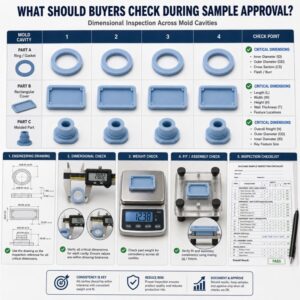
Before approving the mold sample, buyers should confirm:
Critical Dimensions
Measure the dimensions that affect actual product use.
Functional Fit
Test the silicone product with its matching container, accessory or assembly.
Mold-Cavity Consistency
Review samples from every active mold cavity.
Product Weight
Weight variation can help identify inconsistent filling, although it does not replace dimensional inspection.
Packaging Recovery
Measure and test the product after final packaging and storage simulation.
Repeated Measurement
Measure several samples rather than relying on one product.
Measurement Agreement
Confirm that the buyer and manufacturer use the same datum, equipment and product condition.
The approved sample, drawing and inspection method should all refer to the same revision.
Product-Specific Measurement Examples
Silicone Suction Bowls and Plates
Important dimensions may include:
- Suction-base diameter
- Base flatness
- Bowl capacity
- Wall thickness
- Overall height
- Lid or accessory fit
The final suction function should be tested in addition to dimensional inspection.
Silicone Baby Bibs
Important dimensions may include:
- Neck opening
- Button diameter
- Button-hole size
- Pocket width
- Pocket opening
- Overall length
- Edge thickness
The bib should be measured without stretching the neck strap or flattening the food-catching pocket.
Silikonowe produkty dla zwierząt domowych
Important areas may include:
- Bowl dimensions
- Lick-mat thickness
- Hanging-hole diameter
- Brush-bristle height
- Handle opening
- Suction-cup geometry
Brush bristles and thin textures may require visual or optical inspection rather than strong caliper contact.
Collapsible Silicone Products
Important dimensions may include:
- Expanded height
- Folded height
- Folding-ring position
- Base diameter
- Rim diameter
- Lid fit
- Wall thickness
The product should be checked in both the expanded and folded conditions.
How LYA Silicone Supports Dimensional Control
LYA Silicone supports OEM and ODM development for silicone baby, pet, household, outdoor and educational products.
Project support may include:
- Drawing and sample review
- Critical-dimension identification
- DFM analysis
- Wall-thickness evaluation
- Mold-development review
- Material and hardness discussion
- Sample production
- Mold-cavity inspection
- Dimensional measurement
- Functional fit testing
- Packaging validation
- Pilot production
- Mass-production quality control
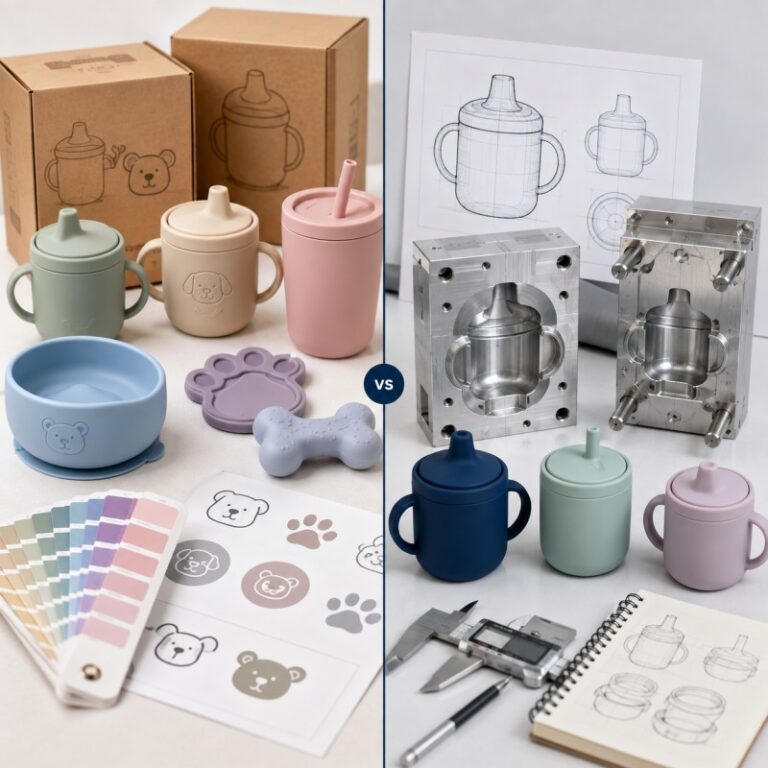
Before mold development, buyers should explain which dimensions affect assembly, sealing, suction, capacity, folding or customer use.
This allows the engineering and quality teams to focus inspection on the dimensions that directly determine product performance.
Frequently Asked Questions
Can the Same Tolerance Be Applied to Every Silicone Dimension?
Nie.
Critical functional dimensions and flexible non-functional dimensions should normally have different control requirements.
Why Do Buyer and Factory Measurements Differ?
Possible causes include product positioning, caliper pressure, temperature, recovery time, datum selection and measurement location.
Both parties should use the same documented measurement method.
Can Silicone Be Measured Immediately After Molding?
The approved inspection procedure should define when the product is stable enough to measure.
Immediate measurement may not represent the final product condition.
Is a Caliper Suitable for Every Silicone Dimension?
Nie.
A caliper may compress or stretch very soft structures. Fixtures, gauges, optical inspection or functional fit tests may be more suitable.
Should Every Mold Cavity Be Measured?
Yes, critical dimensions should be checked across every mold cavity during mold qualification or pilot production.
Can Packaging Cause a Product to Fail Dimensional Inspection?
Tak.
Folding and compression can temporarily or permanently change flexible product geometry.
Does Higher Silicone Hardness Improve Dimensional Accuracy?
Higher hardness may improve shape stability, but it can also change folding, suction, sealing and user comfort.
Hardness should not be changed without evaluating the complete product function.
Define the Measurement Method Before Mass Production
A dimensional tolerance is useful only when the product condition, datum, equipment and measurement method are clearly defined.
Before approving a custom silicone product, confirm:
- Critical functional dimensions
- Practical tolerance limits
- Measurement datum
- Measuring force
- Product-resting condition
- Mold-cavity consistency
- Functional fit
- Packaging recovery
- Inspection records
To review dimensional requirements for your custom silicone product, send Silikon LYA the drawing, matching components, product application, critical dimensions, packaging method and estimated order quantity.