 Polish
  English
  French
  German
  Spanish
  Chinese
  Japanese
  Korean
  Russian
 Zawartość
Answer Excerpt
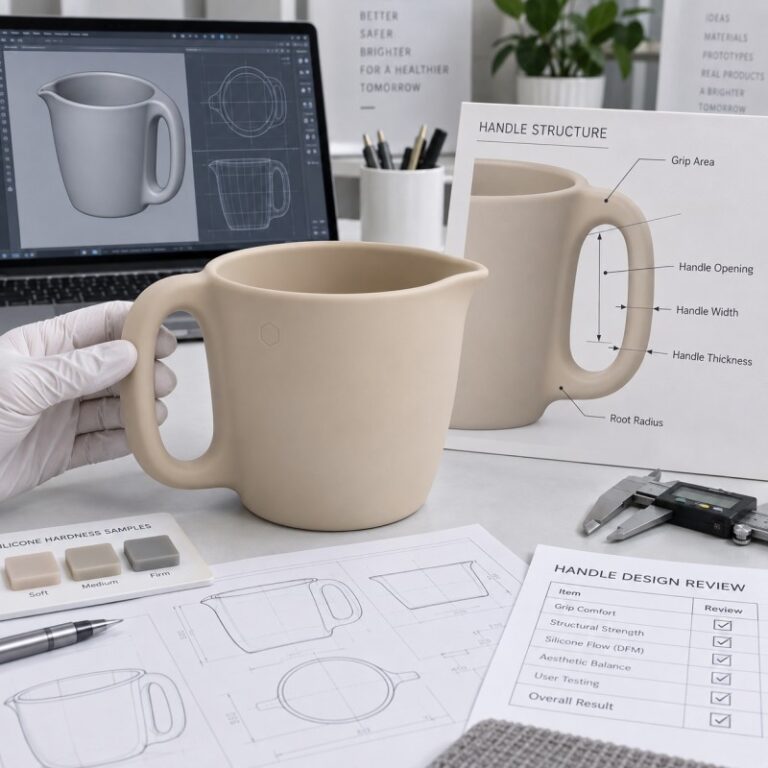
Good silicone handle design requires more than adding an opening to the side of a product. Handle width, thickness, internal opening, connection-root radius, silicone hardness, surface texture, load direction and the relationship between the handle and product body all affect comfort, durability and manufacturability.
For OEM silicone products that are carried, pulled, poured, hung or repeatedly gripped, the handle should be validated as a functional structure before tooling and mass production.
Why Do Silicone Handles Need Separate Engineering Review?
A handle often looks like a simple feature.
But in real use, it may experience:
- Pulling
- Twisting
- Bending
- Repeated flexing
- Product weight
- Wet hands
- Sudden loading
- Hanging or carrying
Because silicone is flexible, a handle does not behave like a rigid plastic handle.
Its performance depends on the complete relationship between:
Handle geometry + wall thickness + silicone hardness + root connection + product load
A handle that looks comfortable in a CAD rendering may feel too soft, stretch excessively or become difficult to grip after molding.
That is why the handle should be reviewed as a functional part of the product rather than a decorative feature.
Which Silicone Products Commonly Need Handle or Grip Design?
Handle and grip features can appear across several product categories on a custom silicone product website.
Examples include:
- Baby bath rinse cups
- Silicone snack cups
- Feeding products
- Collapsible cups
- Travel cups
- Pet care tools
- Pet hair removers
- Silicone brushes
- Carrying cases
- Educational toys
- Storage products
Each application creates different requirements.
A bath cup handle needs comfortable wet-hand grip.
A pet cleaning tool may require controlled pulling force.
A collapsible cup may need a compact grip without interfering with folding.
The design therefore needs to follow the real use scenario.
How Large Should the Handle Opening Be?
The internal handle opening determines whether the user can comfortably insert fingers or hold the product.
If the opening is too small:
- Fingers may not fit comfortably
- Grip position becomes limited
- Users may hold the outer edge instead
- Filled products can feel harder to control
If the opening is too large:
- The product becomes wider
- Packaging volume increases
- The handle may flex more
- Overall proportions can look unbalanced
The correct opening size depends on:
- Target user
- Number of fingers used
- Rozmiar produktu
- Product weight
- Carrying direction
- Whether the product is used wet or dry
For baby products, the adult user should usually be considered when the handle is intended for filling, washing or pouring.
How Should Handle Width and Thickness Be Balanced?
A silicone handle should be thick enough to resist excessive stretching but not so bulky that it becomes uncomfortable.
If the Handle Is Too Thin
Possible problems include:
- Excessive stretching
- Local tearing
- Edge curling
- Unstable grip
- Deformation under load
If the Handle Is Too Thick
Possible problems include:
- Excessive stiffness
- Bulky appearance
- Higher material use
- Difficult bending where flexibility is expected
- Larger tooling volume
The correct section should be evaluated together with the selected material.
The same cross-section may behave differently when the silicone hardness changes.
For that reason, hardness and handle geometry should be tested together rather than selected independently.
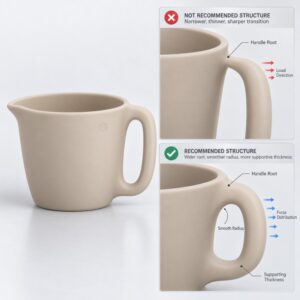
Why Is the Handle Root One of the Highest-Risk Areas?
The connection between the handle and the main product body is often more critical than the middle of the handle.
When a user pulls or carries the product, force travels from the handle into the body through this connection area.
A sharp or narrow transition can concentrate stress.
Over repeated use, this may contribute to:
- Local stretching
- Surface whitening
- Crack initiation
- Tearing
- Permanent deformation
A better transition usually uses a smoother connection with an appropriate radius and enough supporting material.
The objective is to distribute the load gradually rather than forcing the stress through one very thin location.
This is especially important for products where thin edges or narrow flexible sections are close to the handle root.
Should a Silicone Handle Be Integrated or Separate?
For many silicone products, an integrated handle can simplify the product structure.
An integrated design may provide:
- Fewer separate components
- No additional mechanical fastener
- Easier cleaning
- Unified color and material
- Cleaner appearance
However, an integrated handle still needs proper engineering review.
The designer should check:
- Root thickness
- Mold filling
- Parting line
- Demolding
- Overall product width
- Packaging impact
A separate handle may make sense in some product concepts, but it introduces an additional assembly relationship and should only be chosen when the application requires it.
For many simple consumer silicone products, a one-piece structure can be practical when the geometry is suitable.
How Does Product Weight Affect Handle Design?
The handle should not be reviewed only with an empty product.
Consider a silicone bath rinse cup.
The empty cup may be very light.
Once filled with water, the load on the handle increases significantly.
The user may also:
- Lift quickly
- Tilt the cup
- Pour from one side
- Hold it with wet hands
The handle therefore needs to perform under the actual filled-use condition.
Testing only an empty molded sample can hide problems that appear during real use.
The same logic applies to:
- Food containers
- Travel cups
- Treat bags
- Carrying accessories
OEM teams should define the expected working load before sample approval.
How Does Grip Texture Affect Usability?
A completely smooth silicone surface can still provide useful friction, but some products benefit from additional grip features.
Possible grip structures include:
- Fine ribs
- Shallow texture
- Finger grooves
- Raised dots
- Local matte texture
These features should remain subtle enough to avoid creating unnecessary cleaning difficulty.
Very deep patterns can:
- Hold residue
- Increase mold complexity
- Create harder-to-clean corners
- Affect appearance
The texture should serve the grip function rather than being added only for decoration.
Should Grip Texture Cover the Entire Handle?
Not necessarily.
A local grip zone can often provide enough tactile feedback.
For example, the inner or lower portion of a handle may receive fine ribs while the remaining surface stays smooth or matte.
This approach can help:
- Keep the visual design clean
- Limit mold complexity
- Make cleaning easier
- Clearly define the intended grip area
The texture location should match where the hand naturally contacts the product.
How Should a Handle Be Reviewed During Mold Development?
Handle geometry can influence tooling significantly.
Before custom silicone mold development, engineers should review:
- Handle opening
- Undercut condition
- Demolding direction
- Root geometry
- Parting line
- Venting
- Texture
- Wall transitions
- Areas likely to stretch during demolding
A deep closed-loop handle may create different demolding requirements from a shallow open tab.
For very flexible silicone products, the part may be removable through controlled deformation, but that should be validated rather than assumed.
Excessive stretching during demolding can affect shape and long-term consistency.
Why Does the Parting Line Matter on a Handle?
A visible parting line in the wrong location may affect:
- Hand feel
- Appearance
- Flash control
- Trimming
- Grip comfort
If a parting line sits directly on the main finger-contact edge, even a small amount of flash can become noticeable.
During DFM, the tooling team should consider where users actually touch the product.
The best mold split is not always determined only by machining convenience.
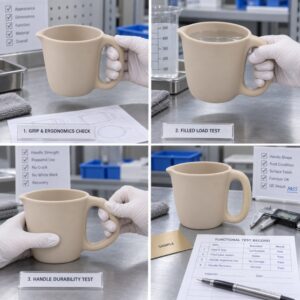
How Should Handle Samples Be Tested?
A sample should be evaluated under realistic use.
Grip Test
Have users hold the product in the intended direction.
Check:
- Finger clearance
- Comfort
- Grip position
- Edge pressure
Load Test
Fill or load the product according to its expected use.
Check whether:
- The handle stretches excessively
- The root changes shape
- The product tilts unexpectedly
Repeated Flex Test
Bend, lift or pull the handle repeatedly.
Observe:
- Recovery
- Local whitening
- Cracking
- Permanent elongation
Wet-Grip Test
For bath, feeding or washing products, test the product when the handle and user’s hand are wet.
Visual Recovery Check
After loading, allow the product to rest and confirm whether the handle returns to its intended geometry.
The final test plan should be product-specific rather than using arbitrary universal cycle numbers.
Should Multiple Mold Cavities Be Compared?
Yes, when the production mold contains several cavities.
If one cavity creates a slightly different root thickness or handle shape, users may feel the difference even when overall dimensions appear similar.
During sample and pilot production, compare:
- Handle opening
- Root geometry
- Overall shape
- Flexibility
- Surface finish
- Functional load behavior
This helps identify cavity-specific variation before full production.
Practical Example: Silicone Baby Bath Rinse Cup
Consider a one-piece baby bath rinse cup with a large integrated oval-loop handle.
The product is designed for an adult to:
- Fill the cup with water
- Lift it with one hand
- Pour water while bathing a baby
- Rinse and hang or store the product afterward
The handle should be reviewed together with the complete cup.
Handle Opening
The opening must allow comfortable finger access.
Handle Section
Width and thickness should provide enough support while retaining the soft feel expected from silicone.
Root Connection
The handle-to-cup transition should be smooth and reinforced rather than narrow and abrupt.
Filled Weight
The design should be tested with the intended water volume, not only as an empty sample.
Wet Use
Grip comfort should be checked with wet hands.
Pouring Balance
The relationship between the handle position and filled-product center of gravity should allow controlled pouring.
Czyszczenie
The handle-body transition should remain easy to rinse and dry.
This is why a silicone handle should be designed as part of the complete product system.
Silicone Handle Design Checklist
| Pozycja | What the Brand Should Confirm |
|---|---|
| Target user | Adult, child or general consumer |
| Grip style | One finger, multiple fingers, full hand |
| Opening size | Comfortable access without excessive product width |
| Handle width | Enough support for intended load |
| Thickness | Balanced flexibility and strength |
| Root radius | Smooth load transfer into product body |
| Hardness | Tested together with geometry |
| Product load | Empty and filled conditions |
| Texture | Grip support without unnecessary cleaning difficulty |
| Parting line | Avoid critical hand-contact areas where practical |
| Demolding | Handle can be removed consistently without damage |
| Sample test | Grip, load, flex and recovery |
| Cavities | Functional consistency checked |
| Opakowanie | Handle not permanently compressed or distorted |
How LYA Silicone Supports Custom Handle and Grip Development
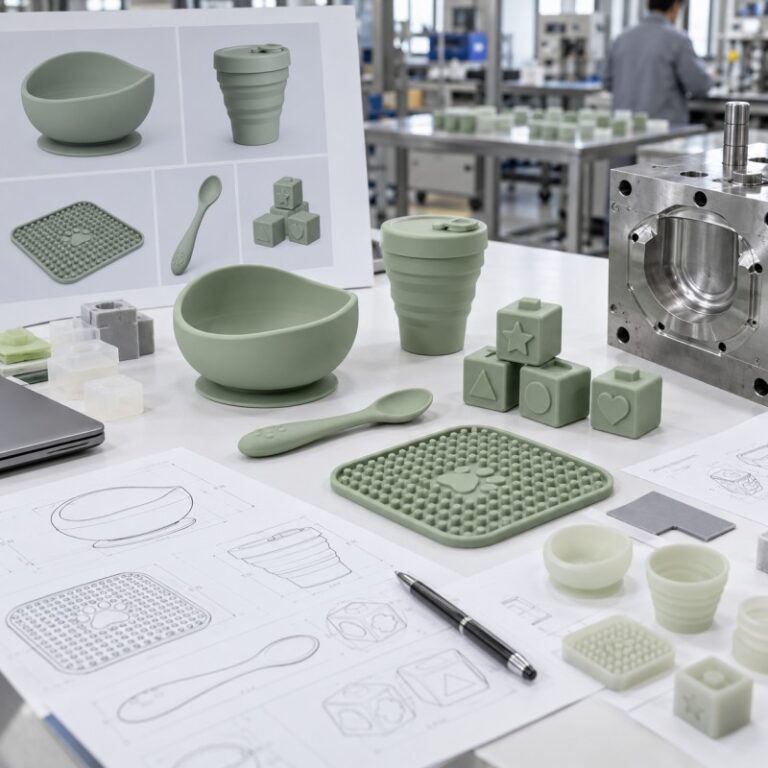
For OEM and ODM development, handle design can be reviewed together with the complete silicone product rather than treated as a late cosmetic addition.
Project evaluation may include:
- 2D and 3D drawing review
- Handle opening review
- Material and hardness discussion
- Root transition optimization
- Wall-thickness assessment
- Grip texture evaluation
- Mold-development review
- Sample production
- Functional load testing
- Repeated-use review
- Production inspection
- Packaging evaluation
The goal is to create a handle that looks integrated with the product while remaining comfortable, durable and suitable for stable manufacturing.
Frequently Asked Questions
How thick should a silicone handle be?
There is no universal thickness that works for every product. The correct section depends on silicone hardness, handle length, load, root geometry and intended flexibility.
Should a silicone handle be soft or firm?
It should match the intended function. Excessively soft handles may stretch too much, while excessively firm handles may feel uncomfortable or bulky.
Why do silicone handles tear near the product body?
The root connection can become a high-stress area, especially when it is narrow, sharp or too thin. Smooth transitions and appropriate supporting thickness can reduce stress concentration.
Can an integrated silicone handle be molded in one piece?
Yes, when the product geometry and tooling allow it. Demolding, parting lines, undercuts and handle opening should be reviewed before tooling.
Should silicone handles have anti-slip texture?
Some applications benefit from fine ribs or local texture, especially where the product is used wet. The texture should also remain practical to clean.
Do handles need repeated-use testing?
For products that are frequently lifted, pulled or flexed, repeated-use testing is useful for evaluating recovery, deformation and potential weak areas.
Design the Handle for Real Use, Not Only for CAD
A silicone handle is a functional load-bearing feature.
Its performance depends on:
Opening → Width → Thickness → Root Geometry → Hardness → Grip → Load → Moldability → Repeated Use
When these factors are reviewed early, brands can reduce tearing risk, improve user comfort and avoid late-stage tooling modifications.
If you are developing a custom silicone product with an integrated handle, grip or pull feature, contact us with your drawing, target product size, expected load, silicone requirements, color, packaging concept and estimated quantity.